Showing posts sorted by relevance for query noir. Sort by date Show all posts

Thursday, December 18, 2008

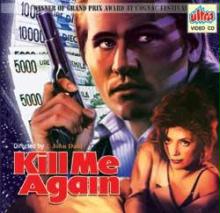
Kill Me Again (1989)


Academically, film noir's dark, tangled roots as an art form sprout from the crushing insularly realized despair of the soul. Durable and perhaps everlasting as a kind of thorough examination of the fallen, its psychology expressively at one with the poeticism with which its ambivalently lurid tales of spiritual corruption and moral decay are rendered. It was in no small measure born out of the alienation and paranoia of a time period singed by the indignities of greater urbanism and anonymity—the suppression of the individual in the squalid sea of prodigiously peopled centers of drudgery. And yet the timbre of film noir did not die out; numerous directors have endeavored to take up the mantle of noir, to pay homage to the filmic works of the past while attempting to contribute modifications—often in the name of updating—to the classic template. It is with great hope when allowing “neo-noir” a chance to radiate in its own right that the substantial viscosity of this most trenchantly oneiric cinematic expression is not lost through epochal transfiguration.

Perhaps best distilled, particularly for the purposes of exploring John Dahl's 1989 entry, Kill Me Again, the perfect definition of film noir is that it resonantly reminds of real life: men go after money for women, while women go after men for money. Dahl's picture begins with a voluptuous seductress named Fay Forrester (Joanne Whalley-Kilmer, who was married to costar Val Kilmer at the time) who manipulates one man—a psychotic killer named Vince Miller (Michael Madsen in the kind of brutish and violent role for which he became well-known)—so she can find a new host to parasitically exhaust. What helps to distinguish this rewarming of noir staples is the subtext Dahl and his fellow screenwriter David W. Warfield do not merely whip up empty-vessel figurations in lieu of characters but rather deliver articles of welcome depth. The pacing of these character beat offerings allows the ninety-five minute film to find an intriguingly uncommon rhythm.

As the tale of crime, lust and betrayal commences, Fay and Vince are in Winnemucca, Nevada. They have been eyeing some easy money, and are now ripping off an outlet of the Nevada mob, rubbing out at least one gangster in the process. The amount stolen is nearly nine hundred thousand dollars. Vince realizes that the two should stay away from population centers. After a brief verbal and physical tussle over the woman's desire to go to Las Vegas, Vince finds himself prey to Fay's burning desire to live glamorously. After telling her that they can hide out together in Idaho at a rest stop off the freeway, he suffers a terrible blow to the back of the head. Fay has picked up a rock used as a restroom doorstop as her weapon, and in a bit of Freudian literalism has left her boyfriend holding his sexual organ in his hand as he is disabled by the immoral woman.

Val Kilmer plays Reno private investigator Jack Andrews. His wife having died months before the story begins in a freak car accident for which he blames himself (he swerved off the road when a deer appears on it out of nowhere), Jack is a broken shell of a man. He has recently become the quarry of an organization of loan sharks after having failed to pay them back. In deep for ten thousand dollars, Jack suffers a series of punishments. Two ruffians have pierced the single mirage-like sanctuary of Jack's seedy, darkly lit office. After refusing to feign loyalty, Jack is pressed against his desk and his right pinkie finger is snapped in half by one of the men.

Later, as every viewer has doubtless guessed, Fay and Jack's paths cross. Dahl literally encircles and highlights the unjust randomness associated with the vicissitudes of noir, as Fay picks Jack out of a group of options under the term “Investigator” in the Reno phone book. When she enters his office, he is immediately taken with Fay's almost blindingly radiant beauty. She asks for him to “kill [her],” so that her boyfriend, who she states is “not right in the head,” will not continually search for her. She is willing to pay ten thousand dollars for this operation to be undertaken (making it appear to everyone that she has been killed), half now, half when the job is finished. What makes the propositional scene sizzle, however, is the intensely sympathetic portal through which Dahl frames this would-be damsel in distress. After meeting reluctance with Jack, she tears up. Like the best femme fatales, she exhibits her most vulnerably feminine attributes, and entices the man's sense of chivalrous protectiveness. Thus having wily waxed weakly for his consumption, she is made all the more irresistible. Kilmer underplays the scene rather charmingly. His Jack knows he should not trust her, especially as he vocally notes that carrying five thousand dollars on her person is “a lot...” Nevertheless, he cannot fight off the temptation of saving a woman. Jack almost altogether succumbs to Fay at this exact moment, all the while half-convincing himself that he is accepting the task solely for the money.

In a perpetually gloaming dry Nevada desert as well as the streets of “The World's Biggest Little City,” Reno, all atmospherically shot by Dahl and his cinematographer Jacques Steyn, the plot unfolds with a relaxedly confident integrity in the surfeit of noir touchstones. The score by William Olvis is vaguely reminiscent of suspenseful noirs and detective movies, signposting the winding road of the tale. The scene in which Jack “kills” Fay is one laced with steamy eroticism. The very act of the “murder” is sensually played with as a kind of sexual act. Fay taunts and teases Jack on a motel room bed, a shadow of Venetian blinds slicing through her gorgeous face as she giggly leads the private investigator along.

Connatural to the genre, events do not go entirely according to plan. Before he can piece together just who the betrayer and who is the betrayed, Jack finds himself interrogated by an imposing policeman. Recounting the downward spiral from which Jack is suffering in the wake of his wife's death—several petty crimes and a week-long stint in jail for protecting a client—summarized in a provocatively written monologue. “You used to be a normal, upstanding citizen,” the policeman notes. It is this key description of the incremental transformation—the procession of the “normal, upstanding citizen,” the dupe of the noir, the dupe of life itself, falling into the unforgiving pit of what would in a perfect world truly be considered the abnormal, compelled to cross one line after another. The web of illegality finally proves too strongly weaved for most noir protagonists.

Unfortunately, however, Kill Me Again fails on the rather fundamental score of following through with its premise to the conclusion. The denouement is a withered, dissipated puddle of problematically prosaic cinematic choices, and finally something of a betrayal of the film's dark promise. The ending is tepid and limp, and though there are short, closing bursts of poisonous energy, the closing portion of the picture succumbs to tired predictability lacking the inherently tragic reckoning that must be the bitter resolution to such a tale of blisteringly perfidious emotions and motivations. The empirical summation of the film's traditional noir vestiges cannot be discounted, though the destination of Kill Me Again proves less a consummation of the twisted path on which Jack is doomed to travel. Some of Dahl's interests in noir—continued in Red Rock West (1992) and The Last Seduction (1994)—may be dismissed by some as merely superficial, not having resolutely followed the implications of the stories he tells. That criticism notwithstanding, Dahl's Kill Me Again is largely an overlooked gem with roundly probed psychological subtexts. Dahl's late '80s color creation stands as a film molded by a palpable love for the old dark movies, those shot in crisply stark black-and-white, which still relentlessly haunt.

Friday, May 9, 2008

Vertigo (1958)

For a long time "purists" of film noir argued that the genre effectively died with the release of the great, long-underrated Orson Welles 1958 effort, Touch of Evil. Cultural, socioeconomic and political reasons--as well as budgetary ones (most studios began to find more expensive films in the late 1950s more affordable than beforehand, gradually resulting in the hubris of Cleopatra in 1963, given the imprecating reputation of singlehandedly representing Tinsel Town wastefulness, helping to compel Hollywood to change its ways later in the decade)--all arguably colluded to stifle the genre. The average film historian refers to Touch of Evil as the last great gasp of American noir.

Nathaniel Rich, writer for The Los Angeles Times, The Nation, The New Republic and Slate, presents an alternative reading, though: "Touch of Evil (April 23, 1958) is widely considered to be the last classic film noir by critics who cite Orson Welles' hyperbolic manipulation of standard noir conventions; it was the brawniest, most self-conscious noir yet. After this film, noir entered a period of hibernation or ended altogether. I would argue that it entered a fallow period that lasted nearly three whole weeks, until May 9, 1958, when Alfred Hitchcock's Vertigo was released, marking the beginning of the neo-noir era."

Fifty years ago today, Hitchcock's Vertigo arrived, receiving mainly mixed notices. A significant number of reviews were outright pans. Time infamously referred to the film as "another Hitchcock and bull story." Today it is correctly seen as Hitchcock's most thematically personal and probing film. At a certain point with the prolific masters of cinema, deciding on which film represents their greatest work almost becomes a fool's errand. The term "masterpiece" by its definition describes the peak of an artist's work, but some artists have proven that you can possess more than one masterpiece. Hitchcock may have the most masterworks of any director, and Vertigo is indeed one of them.

Vertigo was unavailable to the public for decades because along with four other films, Hitchcock left it as a legacy to his daughter. While many American critics grappled with the nearly traumatizing subject matter of Vertigo, the film received a more intellectually enthused reaction in France. Vertigo may have been kept out of the hands of the public for a long time but for Hitchcock's peers and later aspiring filmmakers it was a directorial clinic, a kind of cinematic textbook from which one could grasp many tools. The famous forward-zoom/dolly-out shot Hitchcock utilized to create the "Vertigo" effect has found itself blissfully reused by New Wave filmmakers, Steven Spielberg with Jaws, Martin Scorsese with Goodfellas and others. Meanwhile, vehement Hitchcock mimic, Brian DePalma, virtually remade Vertigo in 1976 with Obsession, co-written by perennial Vertigo booster Paul Schrader. In 1984, the film was re-released to much critical acclaim. Today it is considered by Sight and Sound to be the second greatest film ever made, behind the sacrosanct Citizen Kane.

Vertigo has arguably been, since its release, as Rich has written, the very template by which all neo-noirs base their respective worlds: a psychologically unsound, socially disregarded outcast, beset by vast, incomprehensible conspiratorial powers beyond his meager abilities to fight them off, cynically lured into the world of cloaked but indigenous criminality by the great desired object, a beautiful and two-faced woman. Within the film's first protracted shot is James Stewart's Scottie Ferguson reaching out, grasping the railing of a fire escape ladder. A moment later Ferguson finds himself hanging from the side of a building, horrified, as a policeman attempting to save him falls to his own death.

This scene focuses firstly on Hitchcock's obsession with the image of a man falling (almost always to their death), a show-stopping Hitchcock specialty to be found in Blackmail, Saboteur, The Man Who Knew Too Much, North by Northwest and Psycho, among others. Where Hitchcock takes the scene, however, is important both for the visual conceptualization of Ferguson's affliction of, as he later calls it, acrophobia, and for the gloomy subtext of the entire film. As Ferguson desperately holds on for dear life and looks down, the forward-zoom/dolly-out depicts his vertigo. Yet on a deeper, more metaphysical plane, Ferguson becomes, in essence, what Saul Bellow would call "The Dangling Man." One can look at Vertigo and one can legitimately sense that in at least a metaphorical way, Ferguson never leaves that ledge: throughout the whole film he is dangling about, trying to save himself from oblivion. At the very least, Hitchcock is instructing the viewer with spectacular precision that an essential piece of Ferguson's psychological make-up, identity and sanity have been lost alongside the doomed cop.

The iconic representation of women in Hitchcock's films has never found greater depth and distilled taintlessness than in Vertigo. The master's depiction of sexual power and desire, as thoroughly symbolized by his iconographic treatment of Kim Novak's non-dual dual performance as Madeleine Elster and Judy Barton, is at its boldest and most fetishistically twisted. Vertigo has often been assailed for the way it depicts Ferguson's sickly developed obsession with the woman he believes to be dead (Madeleine), trying with limitless arrogance and chauvinism to remake the second woman (who is, in actuality, the same as the lady he believes has died) into the first because of his completely plausible belief that Judy looks just a little bit like Madeleine. It's a case where the brightness of a vision, of the perfect, idealized woman insidiously blinds the man both practically, in terms of not seeing what perhaps should be an obvious truth, disguised solely by a change in hair color, and spiritually as well, poisoning him on multiple levels of existence. The epistemological foray into the psychosis of Ferguson reverberates as a kind of universal warning to all men not to recreate a woman into an object, even of adoration. This important lesson has probably been most successfully retold in the 2001 Japanese horror film Audition.

To depict is not to endorse or praise. While Hitchcock's attitude towards women may have frightened more compassionately understanding artists like Ingmar Bergman (whose films, while frank and clear-eyed in their appraisal, generally celebrate femininity as much as Hitchcock's continually bump up against and wrestle with it), who believed Hitchcock must have truly despised women, they are more nuanced than that. Just as Hitchcock belittled the bloodthirstiness of many a viewer in Saboteur by scathingly depicting a murder in a movie theatre just as an audience is laughing hysterically at the carnage of a movie-bound death, and slyly admonished eager beavers like Stewart's Rear Window character from becoming too certain that evil lurked behind every drawn curtain, it would be an error to reduce Hitchcock's apprehension and possible mistrust of women to simplistic loathing. As Ferguson's endeavor becomes personal and morbidly sexualized (just because Madeleine isn't in actuality dead does not negate the fact that he is dementedly obsessed with a woman he truly thinks is deceased), Hitchcock subtly reinforces sympathy for the woman the audience should probably detest, not pity, as the camera distances itself from the menacing Ferguson, identifying itself more freely with Judy. As Ferguson's fixation only worsens, more medium two-shots are taken from over Judy's shoulder, allowing the viewer to more gracefully see Ferguson through her eyes. The greatest formal break in a film where Ferguson is almost omnipotent, to be found in practically every single scene, is a short but crucial bit in which Judy writes her deepest, most truthful thoughts out, accompanied by a forlorn, almost endearing voice-over by Novak. For a film not in the least bit discursive, this is an important scene to recognize Hitchcock's ambivalence and even guilt (influenced by his Catholicism, perhaps).

How else can one read Vertigo when placed, as it ought to be, in the overall context of Hitchcock's art? Notorious depicts a cold-hearted American government agent using the feminine counterpart, a woman he simultaneously loves and resents. What begins as a calculated relationship becomes a love affair in which, as the woman notes, the man does not love her. His failure to respond, and his willingness to both idealize and bitingly pity a woman he believes to be untrustworthy in the shadow of her notorious repute; his desirous impulses placed against the mendacity he is called upon by his superiors to employ, and self-hatred based around forcing the woman to become the very thing he detests, a whorish and unchaste woman. After Guy Haines blows his top and screeches that he wants a troubling woman killed, Strangers on a Train places both Bruno Anthony and Haines against the backdrop of steel bars, implicating and briefly imprisoning them both for the crime Anthony deliriously commits.

No, Hitchcock's world did not permit his "heroes" to be left off the hook. After one reads about the man behind the camera, in all of his fascinating dualities, one senses that his was a confessional, tinged-with-guilt cinema, allowing himself to fully embrace and use the medium to search his own soul and find his own answers. In The Wrong Man, Henry Fonda's Christopher Emmanuel Balestrero prays for guidance and solace at an especially dark time, and his prayers are answered with poignant swiftness. One can only hope that Hitchcock's art, serving its creator, helped to answer his.

Wednesday, July 30, 2008

The Dog Days of Summer Go Black

http://www.moviezeal.com/2008/07/29/august-is-film-noir-month-at-moviezeal/

August is Film Noir Month at Movie Zeal. I will be writing an article about noir as well as three film reviews for Evan Derrick's wonderful website, which is a place you should be checking out on a regular basis just because it's a great blog, and with this marathon of noir it's about to become even better.

I would like to commend Evan for choosing to highlight the dour, sleepy-eyed countenance of Robert Mitchum with the alluring but deadly Jane Greer from my personal favorite noir of all, Jacques Tourneur's magnificent Out of the Past. (Beyond noir, it's one my absolute favorite films.) Evan knows how to make one all the more excited, obviously.

Monday, January 26, 2009

Dispatches from Noir City 7


Friday night at the San Francisco Castro Theatre was a great deal of fun, as it opened up the ten-day schedule of festivities. After entering the building, I conversed with the "czar of noir," Eddie Muller, and pointed out that he commented on my August 24, 2008 review of The Big Heat when it was posted at http://www.moviezeal.com/. (The review can also be found here, for those who wish to brave eye strain.)
Dark City Dame, I promise I'll tell "EM" you said hello sometime tonight or in the very near future; I'll be sure to run into him some more over the course of the next seven evenings.

Moments later, my dad and I found terrific seats--the center of the front row of the balcony--though those balcony seats are not as comfortable as the downstairs seats. The seats in the balcony seem to have remained the same seats for a long time. Eddie Muller came out on-stage and introduced the evening's two films, Deadline--USA and Scandal Sheet, both "newspaper noirs" from 1952. (Though the former is not, strictly speaking, a noir. It is fun, however.) Broderick Crawford is excellent in the latter film, as an amoral managing editor of a newspaper-turned-scandal sheet. The film is based on Samuel Fuller's novel, The Dark Page, and is very well-directed by Phil Karlson, whose visual keenness is quite exciting. (I recently reviewed his 1959 The Scarface Mob, which kicked off television's crime series, The Untouchables.) One I may review in the near future.

Saturday was a marathon day, as the matinee double feature was comprised of Blind Spot (1947), a fairly "light" mystery about a drunken writer (Chester Morris), mulling a plot for a mystery novel, the details of which seem crucial in a real murder investigation--of which he's the prime suspect. The Castro program notes, "Martin (Detour) Goldsmith’s script is particularly amusing for its backhanded take on crime writing." After that, the Alan Ladd-starring 1949 newspaper noir, Chicago Deadline, was up. I'm strongly considering reviewing this whenever I have an opportunity--underneath the surface of the plot, Chicago Deadline has many thematic similarities to Laura (1944).

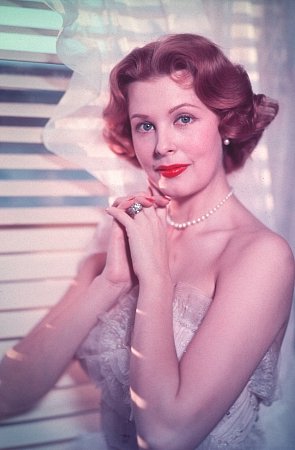
Saturday evening, after having dinner at Orphan Andy's restaurant, my father and I returned to the Castro. I met Arlene Dahl upstairs at the mezzanine. I was in line to sit down with her on a comfortable red couch and have a picture I printed out from the Internet autographed. Just as I handed her the picture, some crazy person lost control of their alcoholic drink and splattered poor Arlene Dahl and yours truly--and my picture--with liquor. Unfazed by the occurrence, Arlene Dahl happily signed the picture--which is the one at the top of this post.

Wicked as They Come (1956), starring Dahl as a social-climbing gold-digger, was screened. Sitting in what I consider the best row of the theatre, I was pleasantly surprised to learn that Ms. Dahl and five others--including her son, Loranzo Lamas, the offspring of her four-year marriage with actor and two-time costar, Fernando Lamas--sitting to my left, taking up the far-left three seats of my row and the one ahead of it. As the Castro program notes, "Arlene Dahl is a sizzling sensation as Kathleen Allen, a woman who learns early that sex is how she’ll get ahead in the world. Her high heels leave puncture wounds in a trail of saps stretching from America to England. British writer-director Ken Hughes adapts Bill Ballinger’s novel Portrait in Smoke, and the result lives up to its re-titling."

After this film was screened, a tribute reel of some of Ms. Dahl's career highlights, and moments of great passion--often violently kissing men or violently throwing objects at them--and Ms. Dahl took the stage with Mr. Muller. The interview was quite good, and moved along at a brisk pace. Ms. Dahl opened up about how she reached Hollywood, and it sounds like something out of a movie. She had joined a theatre's musical production in New York City and on opening night found herself visited backstage by Jack Warner himself, who asked her to come out to Hollywood for a screen testing. Ms. Dahl said that she believed this was all an enormous practical joke, committed by friends she knew who enjoyed pulling off stunts (though this would have been an awfully elaborate practical joke, she rightly figured). After her screen test, which she believed to be "terrible," she was signed to a seven-year contract with Warner Brothers. She recounted her stories, such as replacing Ann Sheridan in My Wild Irish Rose opposite Dennis Morgan, whose compassion and helpfulness were, she believed, indispensable in aiding her before the camera. As she and Mr. Muller downed glasses of champagne, Ms. Dahl discussed seeing Gary Cooper, her relationship with John F. Kennedy and many other interesting stories. She said she had seen Slightly Scarlet screened in France, where it is revered, and Mr. Muller gave the French credit for "getting" film noir.

After the interview, there was another break and I was amused by the terribly long line at the concession stand for popcorn and candy; as a "passport" holder, I moved my way up to the mezzenine again, and found an assortment of goodies to munch on. My favorite was easily the red potato wedges with the sour cream-horseradish sauce for dipping.

Slightly Scarlet (also 1956) followed. To be reviewed soon here at Coleman's Corner.

Sunday it was a return to the matinee, with the obscure "swamp noir," as it was billed, Cry of the Hunted (1953), shown. Formed by a strange screenplay from Jack Leonard, and helmed by Joseph H. Lewis, director of Gun Crazy and The Big Combo, this film, not surprisingly, also features some strong sexual undercurrents. I may return to this film as well, if I ever have an opportunity! It's a wild, fascinating picture, with a memorable dream sequence by the protagonist, played by William Conrad.

After an intermission, Billy Wilder's Ace in the Hole (1951) was screened. Possibly Wilder's most viciously cynical film, starring Kirk Douglas as a manipulative reporter who uses a cave-in to put him back to the top of his profession. As the Castro program boldly states, "On its release, critics called this the most bitter, cynical, mean-spirited movie ever made. It still might hold the honor."

Thus far, it has been a fine festival of film noir. Stay tuned here for more developments, reviews and whatever else strikes my fancy.

Friday, August 29, 2008

The Big Combo (1955)

(This is a review for www.moviezeal.com/ and its month-long look at classic film noir.)

From the abrupt opening note of David Raksin's instantly, perceptibly moony, jazzy score, the viewer becomes aware of The Big Combo's exquisitely composed cinematic mien as the titles play out over shots of an anonymous American city. The year is 1955 and film noir had fully matured into a self-conscious art form. Noir as an artistic style had become salient. Joseph H. Lewis, director of noirs such as My Name is Julia Ross (1945), So Dark the Night (1946), Gun Crazy (1949), The Undercover Man (1949) and A Lady Without Passport (1950), made The Big Combo as primarily a sexual contest. Lewis's work, often marked by a distinct departure from the ordinary, "healthy" sensual impulses of people, with characters pursuing sexual satisfaction from means far from the typical, consuetudinary lifestyles of the more innocent people who occasionally ran into them. Non-noirs by Lewis such as Secrets of a Co-Ed, Duel of Honor, A Young Man's Fancy and his two most famous noirs, Gun Crazy and The Big Combo, explore this theme with strenuously gelid intelligence. The Big Combo, however, Lewis's last noir, most definitively and comprehensively inquires the coria of such examinations.

The Big Combo stars Cornel Wilde as Lieutenant Leonard Diamond, a dogged, honest cop with a quixotic, senseless sexual obsession. That sexual obsession centers on his unrequited love for Susan Lowell (Jean Wallace), disillusioned girlfriend to the charismatically peccant gangster, known as Mr. Brown (Richard Conte), another twisted object of Diamond's neurotic fixations, the man Diamond is determined to bring down at any cost. (Wilde and Wallace married each other four years before the release of the film.) The triangular thematic paradigm links Diamond's professional and carnal conatus, drawing an uncompromisingly sharp mosaic from the chiaroscuro visual schema by master cinematographer John Alton, veteran of noirish black and white, light and shadow painting, in such films as Anthony Mann's T-Men (1947), Raw Deal (1948), He Walked by Night (1948) [nominally an Alfred L. Werker feature], Reign of Terror (1949) and Border Incident (1949).

Alton's lighting is probably the most overwhelming factor that points to the film's self-conscious inhabiting of noir. As with his films for Mann, Alton's cinematography, in a rudimentary, literal way, cloaks the cheapness of the production. On a deeper plane, the lighting excellently conveys the hazardous battle of wills, enlivened by Wilde's cop and Conte's hood, and casts that contest in a preternaturally numinous black-and-white netherworld. That cinematographic virtuosity recalls the dreamlike lighting of the noir-horror tale of Raw Deal. That film was accompanied by Paul Sawtell's unsettlingly eerie score; this film's score by Raksin creates a hypnotic repetitiousness that underscores the ceaseless, seemingly winless war waged by Diamond. The almost wailing jazz tune becomes increasingly familiar, and aids the visual cues in communicating the dire situation of the film's narrative.

One of the most succinct and truest moments of playfulness within the genre noted for its perfidy and danger is the first post-titles scene, which finds Wallace's Lowell running down a dark arena corridor, the sounds of a live boxing bout and raucous crowd wafting through the echoing hall. Chased by two thugs named Fante and Mingo (Lee Van Cleef and Earl Holliman), the audience is allowed to consider the worst--that the apparently scared Lowell may be running for her life. Instead, she is merely attempting to escape the boxing match, and Fante and Mingo only want to keep her in sight and close to Mr. Brown. Symbolically, however, the sequence succeeds terrifically as an expression of Lowell's desires to leave the clutches of her "first love," as she calls Brown later in the film.

The first scene with Brown takes place in the the locker room of the losing boxer, Benny, a little later in the evening. Brown and the man who was next in line to run the rackets, Joe McClure, confront the boxer, who has a contract with Brown. Screenwriter Philip Yordan provides the gangster with some of the finest, juiciest lines any Hollywood villain has ever had the opportunity to relish delivering, and Conte makes every single one of them count for all they are worth. His talkatively rat-a-tat way of controlling the people to whom he speaks, hypnotically demanding their unmitigated attention with his acidic words and almost manic delivery, is an overpoweringly logical way to intellectually disarm and defeat those around him, and the speech to Benny introduces the viewer to the characteristic.

"So you lost. Next time you'll win. I'll show you how. Take a look at Joe McClure here. He used to be my boss, now I'm his. What's the difference between me and him? We breathe the same air, sleep in the same hotel. He used to own it! Now it belongs to me. We eat the same steak, drink the same bourbon... Look--same manicure, cufflinks. But we don't get the same girls. Why? Because women know the difference. They got instinct." He offers his paramount thought about life: "First is first and second is nobody," saying the line for the first time in the film but not nearly the last. "What makes the difference? Hate. Hate is the word, Benny. Hate the man who tries to kill you. Hate him until you see red and you come out winning the big money. The girls will come tumbling after. You'll have to shut off the phone and lock the door to get a night's sleep." After Brown slaps Benny, he is crushed by the boxer's inaction. "You should have hit back," Brown snarls. "You haven't got the hate. Tear up Benny's contract," Brown orders McClure. "He's no good to me anymore."

Mr. Brown, as written by Yordan, directed by Lewis and performed by Conte, is sangfroid, philosophizing to his henchmen, coolly manipulating everyone. He has a temper, but he keeps it in check and tries to look at things always from the objective perspective of business. Conte's performance is one of the best in the long, celebrated line of the gangster character. His Mr. Brown upholds the double facade, firstly the obvious shielding of his actual criminal activities from the authorities, but the greater and more interesting emphasis he places on having, in the words of the gangsters who came before him in American cinema, "class," with the cufflinks and manicure, nevertheless possessing his celebrated "hate" that always keeps him razor sharp.

In one palpably tense scene with respective tonal components that act as equivalent weights, balancing out the horror and humor (reminiscent of Raoul Walsh's White Heat), Brown mercifully bestows upon an imminent victim the gift of being unable to hear the sound of the bullets that will destroy him. The film replaces the sound of gunfire with silence. Conte seems to interpret his character's act as genuine charity˜the question of the necessity of the person's death is not a question at all. In a full theatre today the scene evokes muted laughter and hushed comments of shock, creating an appreciative rippling response from the audience.

Wilde, of Czech-Hungarian descent, Hungarian-born, with his bulbous, intense dark eyes and imposingly burly frame, was perfectly cast as the obsessive lieutenant. His perpetual glare, the quiet moments with his girlfriend, a burlesque dancer named Rita, played to sweet, sincere perfection by Helene Stanton. They all add up a cop on the edge of burning out, driven by his twin and connected fixations, wondering why everything in his life seems to be backwards. "What is it about a hoodlum that attracts a certain kind of woman?" Diamond asks himself as much as Rita when they are alone, she knowing his mind is controlled by a certain other woman whose very existence grievously hurts him.

Rita's mien and heart is altruistic, accepting her position as Diamond's sexy, accessible avenue of relieving his stress while he bitterly complains about his unrequited love for a gangster's woman. Rita's answer is to the point: "A woman doesn't care how a guy makes a living, only how he makes love." Though her role is small, Stanton leaves an indelible impression, mixing earthy desirability with compassion and empathy for her beau, cursed with listening to his pathetic dissatisfaction with her--and himself. Only too late does Diamond realize he has been a selfish user, describing his relationship with the lady of burlesque as similar to a man with cold hands putting on gloves. In many ways, it is Rita who is the true hero of the picture. Diamond's exaltation of Lowell as something of a golden-haired goddess obscures the truth, which is that the physically darker Rita is the more purely an gelic figure in the cop's life.

And the lovemaking of Lewis's film brought him under considerable scrutiny with the production code. In one scene, Brown attempts to silence Lowell as she speaks of her wonderment that she fell for him by physically imposing himself on her, unilaterally initiating foreplay, kissing and licking Lowell's neck and shoulder, gradually moving himself downward. For 1955 especially, this scene seems to take forever, and concludes with a strong implication of oral sexual preliminaries. In the 1995 PBS "American Cinema" special about film noir, Lewis recalls the story of being interrogated by the censors and studio, demanding that the scene be removed. When inquiring why it must go, Lewis was given the answer, "You can't see where Richard Conte goes to. Where does he go?" Lewis smartly tried to play dumb. "I have no idea," Lewis said. "Maybe he went out for lunch," since he becomes obscured for the rest of the scene after descending behind Jean Wallace. Lewis made the point that he had not shown anything, and it was up to the audience to decide where Conte had gone to, allowing the scene to remain uncut.

Other subtle sexual touches include the characters of Fante and Mingo, the homosexual couple who are at Mr. Brown's beck and call. They stay in very close quarters with one another, exhibiting great loyalty and worry. Mingo is on the simple side, but Fante looks out for him in their treacherous dealings. Late in the film, when they are hiding out from the consequent heat created by the plying of their murderous trade, Mingo complains, saying, "I can't swallow no more salami." "It's all we've got," Fante reminds him. Mingo worries about where Brown is located. Fante places his hand on Mingo's neck and shoulder, comforting him about their safeness. A moment later, after being sufficiently cajoled by the more assertive of the pair, Mingo tenderly puts his hand on Fante's arm, talking about a future where the two have managed to escape this world, leaving it behind them and "never com[ing] back," Mingo worries aloud about the police: "The cops will be looking for us in every closet," he bemoans.

Perhaps most psychologically representative of the sexual theme, the act of humiliation and statement of power when Diamond is captured by Brown and his lieutenants. Brown tortures the cop by loudly playing radio music into a hearing aid device lodged in his ear. Yet that is hardly the entirety of Brown's plan. He takes a bottle of hair tonic, 40% alcohol, hoping to create drunkenness, and forces Diamond's mouth open, pouring the liquid down the lieutenant's throat. The torturous oral rape-as-frame job encapsulates the one character's sexual prowess, carnal satisfaction and corporeal superiority at the expense of the other, the dramatic essence of the triangular relationship between the cop, crook and moll.

A pivotal setting that deeply recalls the coda to Casablanca, a foggy airstrip, plays host to the moral choices that make the final act of the film mightily thrilling. The setting allows for Alton to joyously play with the monochromatic palette, and makes the presence of certain lights metaphorically convey the piercing power of the law and truth, penetratingly fighting through the ambiguity of the underworld. In the film's riveting climax, a light indeed cinematically portrays the essential instrument in the cause of good against the seemingly enveloping darkness of masked criminality and corruption.

The Big Combo most clearly represents the confluence of the gangster picture, the noir and the cop movie all in one. American cinema had found the war between the indefatigable policeman and the ruthless crime boss to be of interest to many movie-goers before even The Racket (1928), and the pattern would remain all the way to the present. Yet Lewis's last noir stands apart, touched as it is by the B-movie director's own interests and themes, made into a starkly beautiful black-and-white cinematographic piece of art by Alton, and given full, magnificent life by the actors who take their archetypal roles and infuse them with depths of motivation spawned by the characters' disparate places in the life of their anonymously typical American city, the most fruitful womb of the genre known as film noir.

Tuesday, February 10, 2009

Scandal Sheet (1952)


(Scandal Sheet was screened at the San Francisco Castro Theatre on Friday, January 23 along with Deadline USA as part of Noir City 7.)

Scandal Sheet is directed with a particularly pungent, uncensored acumen by Phil Karlson, whose fidelity to the screenplay by Ted Sherdeman, Eugene Ling and James Poe, based on the novel “The Dark Page” by Samuel Fuller, enriches the film for its entire eighty-two minute runtime. (The film's title in the United Kingdom was The Dark Page.) Karlson, aided by cinematographer Burnett Guffey—whose lens seems to inescapably capture every last sealed crevice on the gritty sidewalks or clammy characters' faces—creates a verisimilitude out of mise-en-scene that perfectly imparts the scabrousness of the picture's very story. Surveying the relationships in a scandal rag “newsroom” controlled by a bulldog of a man who behaves almost like a centurion guard, managing editor Mark Chapman (a relentless Broderick Crawford), Karlson makes the camera an impartial observer, making casual note of the rampant, anfractuous headline-grabbing (and -making) that is made into a virtue by the avaricious Chapman. Chapman's running of the newspaper, once a respectable publication, The Comet, creating a “scandal rag,” has dramatically increased the circulation of the paper, and he reminds the partnered owners of the institution of that unalterable fact.

Fuller's novel, “The Dark Page,” came about when he decided to write a book about some of the more outstanding experiences of his career as a newspaperman. Fuller had to serve in World War II (with the “Big Red One”) and was notified by his mother while he was away that a publisher was quite interested in purchasing the rights to his first draft. Only a couple of years later, Fuller learned that none other than Howard Hawks was quite interested in adapting the book into a film, and bought the rights for $15,000. Fuller's mother was ecstatic and sent her son $1,000 while he and his unit were fighting in Europe. Sadly, Hawks never made the film, and sold the rights for several times what he paid for them. The buyer was Columbia Pictures, and Karlson would direct it.

The atmospheric component Karlson brings to the picture makes it somehow more compulsively watchable than most films with similar “set-ups.” Crawford's Chapman, like almost all of the best noir protagonists, is a man who has skillfully managed to escape his past, but, as in so much of noir, it is the past that he cannot truly evade. And, as in most noir, the chilling hand of irony finds itself practically slapping Chapman's face—it is through a very idea originated from his greedy mind that his past catches up with him. The newspaper actually hosts a “lonely-hearts ball,” where many companionless people are brought to one venue. Chapman's cynicism is unrestricted, and he guarantees a prize to a couple who marry on the very evening they meet one another: a bed, with a built-in television set.

It is at this “lonely-hearts club” event that Chapman's past runs into him and he is eventually placed in an unenviable position. Suffice it to say he makes a mess out of an already unfortunate situation, and is compelled to cover up a crime he has committed. In pursuing that crime, however, his ace reporter, the young, handsome Steve McCleary (an exceedingly effective motor-mouthing John Derek), digs up just enough dirt to make it into a story—and one so sensationalistic that Chapman is practically forced to run his reporter's story in the newspaper, despite it being highly dangerous to himself. The delicious paradoxical scenario—the potential undoing of Chapman's person due to his own recalcitrant desire to see the most controversial subject matter splash across his front page to ensure wider and wider circulation—is quite the cinematic meal to be engorged.

Fuller is widely attributed the line that the very beginning of a film should give the viewer a “hard-on,” which crudely approximates what his directorial outings would later achieve. (Including the fine newspaper noirish melodrama Park Row from the very same year.) Scandal Sheet almost achieves that standard of criteria—Derek's McCleary behaves like a policeman gleaning gruesome details of a murder, only to be thrown out of the crime scene by a disgusted cop—but unlike Fuller's dyspeptically fast-paced book, it is has less alacrity to its rhythm. Whereas Chapman's irredeemable act occurs right at the beginning of Fuller's novel, Karlson's film is slower to uncover it. Fortunately, Scandal Sheet gains momentum in its aftermath. One highly memorable scene involves a group of woebegone drunkards being questioned by McCleary and his partner Biddle (a well-realized and queasily comical Harry Morgan), as the newspapermen attempt to get to the bottom of the crime at the film's center. Donna Reed as morally upright Julie Allison sometimes veers into didactic, lifeless platitudes, but her relationship with the borderline courting McCleary is well-rendered and believable.

In many ways, however, Scandal Sheet is a film that would not be nearly so sibilating without Crawford's ardent performance. Known for barking like a bulldog, Crawford utilizes his (at this point in his career, especially after winning the Oscar for All the King's Men) on-screen identity, and creates an indelible noir protagonist driven to sheer desperation. As he finds himself committing yet another unspeakable crime against a sympathetic character simply to hide his earlier ones, the audience may find in him, not quite empathy, but responsive connection. It may help that Crawford's Chapman is softened and curiously mollified; in Fuller's novel he is far more incorrigibly awful a person. In Karlson's film noir, however, that aforementioned callous hand of fate entraps Chapman, and makes an already ugly person only far uglier. The very ending of Scandal Sheet may be interpreted as a sight gag of sorts, but it reinforces the smoke-filled verbal lacerations that have come before. (For an example of only one brutal comment to be found throughout the film, McCleary once refers to a dead woman as a wonderment to Reed's Allison—a dame “with her mouth shut.”) The last shot of Scandal Sheet in actuality surpasses its apparent comicality, and comments on the paradoxes that haunt Chapman, driving a man to destroy himself through his own megalomania.

Wednesday, January 28, 2009

Night Editor (1946)


(Night Editor was screened along with Alias Nick Beal on Monday evening at the San Francisco Castro Theatre as part of the film noir festival, Noir City 7.)

Night Editor is a stalwart “B” film noir that paddles through an appealingly tawdry narrative with characters who are not among the more virtuous committed to celluloid. Based on the radio program of the same name, the film is shackled to a cumbersomely clunky and illogical framing device—a group of newspapermen conversing about old stories to one another late at night (the device utilized for the radio show)—but this matters little. The actual plot is not outstanding, either, but it does provide the habitat in which its bracing characters move about. William Gargan plays Tony Cochrane, a man who grew up poor and became a cop, becoming a homicide lieutenant. His unfaithfulness to his loving wife and child, and compulsive attraction to a wicked sadomasochistic socialite named Jill Merrill, played to hyperbolic delirium by the shapely blonde beauty Janis Carter, seals his fate as the archetypal dupe. Night Editor's dyspeptic narrative is lively and allows these two characters carte blanche to display all of their unsightly traits. Night Editor is a mammoth-sized, slightly viscid cheeseburger that is only scarcely grilled and all the better for it.

Directed by Henry Levin and adapted from Hal Burdick's radio program and Scott Littleton's story, “Inside Story,” by Hal Smith, the film's most pronounced presence is doubtless Carter's Jill. Carter is Night Editor's fire-breathing, coldblooded embodiment of the exteriorly hot but interiorly icy femme fatale. Carter's interpretation of her character, adorned with an eerily itchy, equally playful and disconcerting leering smirk, is what lingers well after the picture has ended. Wracked by neurosis, Jill is sexually excited by violence, and, when she and her illicit lover enjoy one another's company in a parked car, they witness a ferocious murder-by-tire iron. Tony wants to act, and nearly does—but finally heeds Jill's shrill commentary on the situation, which is that scandal will erupt if he intervenes in catching or killing the murderer. Shamed by his inaction, Tony returns to the car, where the aroused Jill maniacally squirms and writhes in her seat, demanding that he show her the battered body.

This set-piece is the springboard for the rest of the tale, and what abides in the viewer's mind days after watching the film is the pulchritudinous but pernicious Jill. Carter's performance is gloriously histrionic but never deleteriously so. She outshines the rest of the cast, most of whom are men. Like many a femme fatale—crafted at a time supposedly more sociologically askew in its male-dominant perspective—the femme figure is, while definitively peccant, also far more charismatically bedecked than all of her male counterparts combined. Carter's performance—underneath all of the immoral maneuvering and aberrant amorousness—is simply nectarous. Her allure is overwhelming, but she is so mentally imbalanced and perverse that Tony knows she is completely wrong for him. Tony's somewhat humorously mousy wife, Martha (Jeff Donnell), serves as the contrast to Jill—upstanding and good, but bland, and lacking the spicy sizzle that the incorrigible Jill brings with her.

Femme fatales in Hollywood film noirs are formed from varied shades, but they do share commonalities. Their origin is particularly historically and culturally rich. As ancient as the Hebrew mythological figure Lilith, from Sumerian wind and storm demons like Lilitu at approximately 4,000 BC, a Judaic night demon and a screech owl in the King James Bible. Eve herself is depicted as an easily tempted creature of sensuality whose misleading of Adam doomed man. Other figures from the Judaic and Christian history include Delilah and Salome, the latter of whom used her physical endowments and wiles to ensure John the Baptist's beheading. Greek mythological goddesses, historical figures and specters like Aphrodite, the Sphinx, the Siren, Helen of Troy and Agamemnon's murderous wife, Clytemnestra set the Hellenistic foundation for modern depictions of unsavory females. Just as noir's femme fatales are noted for their exotic magnetism, Cleopatra's manipulations of Roman men established her as a permanent fixture of Roman antipathy.

Night Editor is arguably a minor noir, but the depiction of the femme fatale makes the film deserving of greater recognition. Other aspects of the film are chronically conventional to the genre, including Burnett Guffey and Philip Tannura's cinematography, but Hal Smith's scorching screenplay, pied with livid, exceptional pieces and dialogue, and Carter's gusting performance recommend it, and in a way pay great homage to the fatales of history and literature. Indeed, Jill is not unlike John Keats's Matilda, whose tempting of the once-incorruptible hero (Keats's The Monk) through the luridly “transgressive” (pace the literary term) and duplicitous means at her disposal entrap him. Night Editor is not nearly a film wholly worth comparisons to such past representations of such dramatic tales, but Jill's irrepressible constitution stands apart from anything that could be termed generic.

The film hits its stride just when it should—its conclusive passage—as the femme fatale once again disarms and enchants her male victim through her beguiling beauty, only to violate his being in the most personal of ways. The sequence is scary, sad, funny and powerful all at once, a flamboyant feat perhaps only a “B” film could achieve. Gargan and director Levin must have known that he (along with his character) was no match for Carter's Jill, and the actor underplays everything, including this most noteworthy moment of the film. Gargan does not cover much range, yet when the screenplay demands that he be shocked and horrified by events encircling him, he does so well. The apathetic, practically suicidal foreknowledge he has—he is insane, stupid or simply so pathetically overcome by Jill and her sex, to even barely trust her—enriches his actions, making him both more and less pathetic all at once. Levin's mise-en-scene is mostly unremarkable, but he paces the action sufficiently well, and occasionally stages his actors in ways that heighten the tension. The film belongs completely to its leading lady, however, whose feigned, wide-eyed innocence seems to ensnare every male viewer with a pulse, despite their being endowed by the verisimilitude-separating knowledge that they are watching a film, and Carter is playing a character of sheer villainy. Jill is perverse in a way that is rare even among the rottenest femme fatales. That feminine nastiness has rarely been so much fun; when Gargan's Tony refuses to basely satisfy Jill's needs, it would not be difficult to find many a fellow watching the film who would gladly volunteer.

Tuesday, January 13, 2009

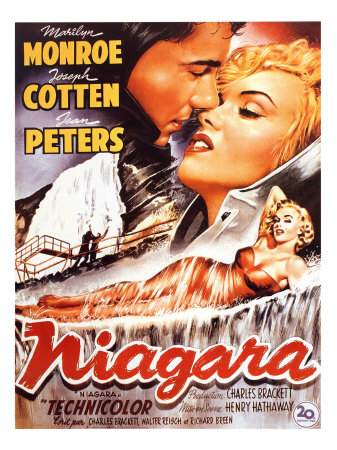
Niagara (1953)

(The following is another installment of reviews being written to celebrate the darkest month of all in Coleman's Corner with Dark City Dame. The previous reviews of film noirs for this tribute are here and here. The next two films to be reviewed in this series are Henry Hathaway's Kiss of Death and Otto Preminger's Where the Sidewalk Ends.)


Henry Hathaway is a fascinating, intrinsically arresting directors with a keen visual aptitude. His use of frames, arches and other compositionally delineative objects create cleanly-photographed portraits of his characters. These framed portraits usually connote a kind of personal or even metaphysical entrapment, excellently communicated with richly detailed sequences of foreground-background struggles. Those foreground-background struggles usually tell two different character stories in one shot, and Niagara displays this stylistic technique. Hathaway's affinity for water and water-based settings such as this film and 23 Paces to Baker Street, is interesting to consider as well. He often shoots the background water through a frame, a window or some kind of portal—frequently in close approximation to the characters, drawing the connection between character and setting that helps to distinguish his admittedly workmanlike approach to certain parts of filmmaking, such as pacing.

Niagara is a beautiful, Technicolor film from 1953, starring Marilyn Monroe, Joseph Cotten and Jean Peters. Melodramatic, as well as splashy both in its brightly colorful visualizations and in its lurid storyline, the film may in some ways belong as much to the 1950s melodrama as to film noir. However, the opening, with Cotten's acidic, pained and mocking narration is certainly at one with noir: “Why should the Falls drag me down here at five o'clock in the morning? To show me how big they are and how small I am? To remind me they can get along without any help? All right, so they've proved it. But why not? They've had ten thousand years to get independent. What's so wonderful about that? I suppose I could, too, only it might take a little more time.” Cotten's character is the married dupe familiar to film noir—George Loomis, married to Rose Loomis (Monroe)—and his bitterness is to be completely explained to the viewer through the narrative's unfolding.

The picture is paced slightly leisurely, though it never begins to stall. At ninety-two minutes, it is given periodical punctuations of action that make it altogether brisk, and Monroe's almost outre and, in this context, purposefully furbelow sensuality make the film's more underdeveloped portions quite sustainable. Cotten's performance as the man driven to madness and murder by the scheming, adulterous wife is eerily believable, despite some of the melodramatics the screenplays coerces him to indulge in. Whereas certain actors would likely have chewed scenery in the part, Cotten understates his predicament as best he can. Peters plays Polly Curtler—Anne Baxter was the studio's first choice for the part; after she withdrew the entire film was dramatically reworked to emphasize Monroe and her part— who is the loving wife to Ray Curtler (an annoyingly ineffective Max Showalter, made all the worse by a deliberately irritating and under-written character). Peters begins piecing together the pieces of the Loomis puzzle, and is continually rebuffed by her own husband, who insensitively insists that she must simply be seeing things for no good reason. Besides being carried to unrealistic levels by the screenplay, Ray's behavior is repetitive and paradoxically weirder than anyone else's neurosis in its own way, and far less interesting than anyone else's.

The screenplay does indeed suffer at least somewhat from what the old saw describes as too many chefs spoiling the broth, giving the film some unsure beats in its midsection—and the Baxter factor had to have left a considerable impact on the final product. Here the broth is diluted, but adequate. Charles Brackett, Walter Reisch and Richard L. Breen wrote the screenplay, which has a simpler plot than its structure would suggest. Hathaway takes the template of noirish thriller conventions and makes the screenplay's occasional banalities more engrossing by establishing relationships with wordless visual communication. And even scenes that were probably written in the screenplay, relying on silence, are brought to sharper, more penetrative meaningfulness by Hathaway's suasively solid craftsmanship. The first scene between Monroe's Rose and Cotten's George tells the tale of their relationship without needless words: he is knocking on the door and she is resting abed, smoking a cigarette; knowing that her husband has returned, she snuffs the cigarette out and pretends to be sleeping. It is the whitest layer of duplicity that the film will explore.

Where Niagara earns its place in the broader filmic fiefdom of noir is in its psychology, and in its internecine conflicts between Cotten's dupe and Monroe's seductress, and between Peters' intrigued wife and Cotten's seemingly malevolent intentions toward her. Irony is employed, free from cynicism. A sequence in a bell tower is heartbreakingly beautiful, evocatively photographed by Joseph MacDonald (who photographed John Ford's My Darling Clementine, Hathaway's Call Northside 777, and some of Elia Kazan's directorial work). Chemistry is unnecessary between Cotten and Monroe, since their parts call for, if anything, the opposite—and their screentime together is surprisingly sparse—but the effects her Rose's marital malpractice has on his George is profoundly brought to life by Cotten in one of the actor's more offbeat performances. Peters, meanwhile, makes her part register with a performance that balances all of the character's narrative-driven necessities, including her intelligence and naivete, her gentleness and high-spiritedness. Hathaway allows for the screenplay's lack of central focus—is it George's point-of-view from which the film forms itself? Rose's? Polly's?—to become a positive attribute, as it squeezes logically unreasonable tension out of George's whereabouts, motives and location in large swathes of the film, especially when relating from Polly's observant spectator.

Niagara follows the noirish pattern of sending its protagonist into an entrapping web of betrayal and murder, spurred by lust and greed, giving the protagonist an opportunity to right the course, only to see his choices continually backfire and drag him down into the quicksand of anguish all the more forcefully. In the third act, Cotten's George scrambles to escape the trap he has, in a hideously ironic manner, fallen into. It is here that the film tightens its grip, losing in atmosphere while gaining in high drama. It may be said that it is in that harrowing but sumptuous bell tower sequence—understandably considered to have been a possible inspiration for Alfred Hitchcock in making Vertigo—where the oneiric qualities of Niagara unmask themselves to describe not a limpidly pellucid dream but a terrifying nightmare. And in a definitive way, Niagara postulates that the viewer reconsider noir, at least ever so briefly. For in Niagara, perhaps the most literal definition of the struggle that lives and breathes in the very heart of film noir may be conceived: a man on a small boat that has run out of fuel, being drawn inexorably to the mighty Niagara falls he so contemptuously recognized as so much greater than himself, drifting to his doom.

Tuesday, May 13, 2008

Point Blank (1967)

Nine years after Hitchcock's Vertigo possibly kicked off "neo-noir" in San Francisco, John Boorman's sophomore film, Point Blank, breathed fresh, truly groundbreaking vanguard "New Hollywood" air into the genre. This visually arresting, creepily atmospheric motion picture is a film that earns the moniker "haunting." Boorman's film has inspired many filmmakers, as it not only continues and enlivens noir in the abstract, but represents a practical cinematic neologism: a thoroughly fascinating blending of New Wave aesthetics and old-fashioned noirish revenge storytelling.

Based with extreme looseness on Donald Westlake's novel, "The Hunter," Boorman's very '60s, psychedelic film begins with twenty minutes of little dialogue. It remains quite laconic throughout. The visuals communicate in a primordial, dreamlike manner, making the film unspool in a kind of rotating, repetitious and Sisyphean narrative. With each thug and obstacle the protagonist vanquishes, another problem arises for him.

Walker is the only name the protagonist of this film has. The film commences where it will eventually conclude, on Alcatraz, where a gang of drug dealers are using the recently abandoned island (Alcatraz ceased being a prison in 1963) as a clandestine drop-off point. Walker and his friend, Mal Reese (John Vernon) and his wife, Lynne (Sharon Acker), ambush the dealers. When the amount of money is not what Mal was hoping for, he decides to cut Walker out of the deal by killing him, taking all of the money and Walker's traitorous wife.

Walker is played by Lee Marvin, who, as I noted in my otherwise unrelated review of The Devil's Brigade (1968), when comparing that war film to The Dirty Dozen (1967), is probably the most fiercely sedulous actor in all of American cinema. As the revenant, Walker, a man who comes back from the dead to reclaim $93,000 after being completely ballasted with bullets by his friend, Marvin finds a role that, for the entirety of the picture, despite the several scenes of physical violence and eruptive righteousness--stemming solely from Walker's belief that the $93,000 belongs to him; evidently he cares not a whit about the double-barreled blast of betrayal he received from his friend and wife beyond their stealing of his money--finds its decibel number small, found in the occasional low growl, perfectly realized in a kind of serene sotto voce.

If Vertigo was about the decimation and eventual deconstruction of its protagonist's humanity, Point Blank is about the spiritually enriching experience of reclaiming it: the entire 92-minute film plays like a meditative afflatus, weighing the metaphysical scales above with Walker's entire being and core. In the DVD commentary, Boorman makes the case that more than any other performance, Walker is the closest approximation to Marvin the man. At one point, Boorman states with chilling eloquence that the "sensitive seventeen-year-old boy" who went to war for his country came back "brutalized." In essence, the war changed the soft-spoken boy into a consummate, still soft-spoken and sensitive tough guy, who, according to Boorman, attempted to express himself through the violence of life and movies. In Point Blank, Marvin is given the opportunity to metaphorically slay the demons of being a sniper for the United States Marines. The revenant he portrays ably and persistently embodies the ethos of the wronged, possibly left for dead soldier, desiring only so much as what he believes he is owed.

Boorman plays with the metaphorical and allegorical, cutting between the realistic world and the symbolic realm of Walker's quest. On a boat that encircles the dreary Alcatraz, the tour guide informs the passengers that escaping Alcatraz is practically an impossibility against the freezing currents that surround the island and Boorman cuts to the celestially mellifluous but entirely illogical imagery of Walker floating on his back, under the aegis of a higher power, as his broken body fantastically makes it back to San Francisco. The ghostly Walker refuses to linger on the shattering reality of his wife's death by suicide. Rather, he focuses with trancelike devotion to the broken perfume and shampoo bottles in the foreboding sink, swirling and pouring about like volcanic streams of lava cascading downward.

Much has rightly been made out of the fact that Walker does not directly kill anyone in Point Blank. His "victims" commit suicide and humorously stumble off of balconies and shoot each other. He uses violence and roughs up multiple thugs, acting more like an uncontrollable elemental force more than a human being, but the deaths that accompany his whole enterprise seem to be more the result of a haunting than the work of an earthly man's involvement. Just as importantly, Walker's emotions are more vividly engendered by the lights and shadows Boorman deftly uses than by emotionally considered narrative beats. Walker, the ultimate sotto voce bad-ass in movie history, moves about like an inwardly feverish, outwardly cool monster. The emotions he experiences are manifested by the rich, psychedelic coloring that splashes across his stoically entrancing face, at a disco light-show where Walker's deceased wife's sister, Chris (Angie Dickinson) works, the cellblock bars--the last sight of Walker's life--are recreated by the swallowing of said face by the deathly chilling shadow of a freeway column, the redoubtable light-and-shadow patterns that fall across said face by the subtly eerie construction scaffolding and even the traditional noir staple of the shadows of Venetian blinds finds itself given newer meaning against Walker's countenance.

Point Blank, despite its 1967 release date, should also be noted for its almost Kafkaesque depiction of the individual fighting off, quite literally, the Organization. In this way Point Blank is a clean bridge between noir/neo-noir and the paranoid cinema of the 1970s (like The Parallax View and The Conversation). Beyond the existential gloominess there is a vibrating, social malaise. It is as though Boorman was able to see into the future and make a film set at a later time that viewed the 1960s without the veneer of joviality that characterized many films (Boorman's first film was Catch Us If You Can, one of the many knock-offs of A Hard Day's Night) of the era. One must wonder if David Fincher looked at Point Blank as a point of reference in making Zodiac, another meditation on the malicious moral pollution permeating beneath the surface of '60s and '70s San Francisco.

The conclusion is equally powerful and ambiguous. By the end of the film, Walker has truly become an eidolon; his presence has slowly but surely become more of an idea, perhaps even an ideal, as he stands in the all-consuming darkness of his own, lived-out, from-the-grave nightmare. The Sisyphean struggle reaches its logical conclusion, and for Sisyphus, once the mountainous ordeal is accomplished all there is to do is to accomplish it all over again. For Walker, with greater insularity than ever before, the mission has finally concluded, as the ghost Walker watches on the island his body never truly escaped. Yet what is superficially a victory becomes the most crushing and depressing of truisms: his quest is all he has left, and so he chooses to prolong it and recreate it, lost forever in the horrors of his own vengeful machinations. Again, with a film this influential among both budding and veteran filmmakers, one must wonder what kind of influence this conclusion had on the ending of Memento (2001).

Point Blank is an elliptical, Resnaisian and Antonioniesque neo-noir made into a wholly engaging experience by the wonderfully truthful lead performance by Marvin, who, with this film, achieved a great, paradoxical feat. He makes Walker into a vulnerable apparition, and a morally beckoning revenant who wields a .357, always coiled like a merciless rattlesnake.

Monday, January 26, 2009

Slightly Scarlet (1956)


Slightly Scarlet is a fascinating, grippingly trimmed, splashily Technicolor film noir starring John Payne, Rhonda Fleming and Arlene Dahl. The film is a consanguineous addition to the broader canon of American film noir but has the lurid intemperance of a 1950s “kitchen sink” melodrama, and has become quite beloved in France in recent years. Payne plays the humorously named Ben Grace, a slithery, unscrupulous mercurial manipulator of the smoke-filled rooms he traverses, which host the likes of thuggish syndicate master Solly Caspar (Ted de Corsia).Fleming and Dahl play redheaded sisters—Fleming as June Lyons, the secretary/girlfriend of fictitious Bay City mayoral candidate Frank Jansen (Ken Taylor), a reform-minded agitator and Dahl as the kleptomaniac and nymphomaniac “bad girl” sister, Dorothy Lyons (often shortened to “Dor”). Directed by Allan Dwan, the film finds its rhythmic surreality by famed cinematographer John Alton, whose work in color enlivens Slightly Scarlet to dimensions that truly, lastingly, distinguish the picture. Alton makes Slightly Scarlet look like a live-action, unspooling 1950s movie poster, with its garish reds, brilliant whites and deliciously, darkly and inky clothes, guns and eyes all converging to create a sumptuous visual experience.

Alton's use of key-lighting is reined in, but he sloshes the frame with opulent oranges, picturesque pinks and gorgeous greens, often sharply contrasting the characters with colors that accentuate whichever complexion and iridescent glow they bring before the camera. Taking an intrinsically black background, befitting noir, Alton shoots in Technicolor with bombastic fervency, creating a palette that is sparkling and alarming in equal measure. The cinematography is an irreplaceable property belonging to Slightly Scarlet—the oneiric chiaroscuro of black-and-white suitably replaced by mid-'50s, bountifully colorful bespattering that is fiery in its luridness.

The performances are all seismically wrought, with Payne playing a character who is never exactly what the audience suspects he is—while occasionally appearing to be far worse. Grace's gangsterism finds itself at the film's epicenter, as he is battered and slapped around by his “boss,” Caspar, only to eventually try to take the mob over himself. Fleming plays her part with a firmness that befits her “straight” character. Her nearly maternal handling of Dahl's “Dor” is at times quite touching without being sentimentalized. Dahl, however, is given the scene- and film-stealing role, and she plays it to the juicy hilt. In the picture's denouement, Dor is depicted as a woman descending into utter madness—perhaps she had been there all along and had been barely able to obscure it from others beforehand—and Dahl makes it believable. Never falling over the precipice of sheer camp, Dahl makes her character firstly a “strong woman,” accursed by a weak mind. Ted de Corsia is brutal and burly as the film's most poisonous malefactor, tossing a dead man out of a building and instructing his underlings, “C'mon, let's see if we can beat him down.”

Dwan and Alton collude to create memorable and sometimes mesmerizing visual spectacles. As Payne's Grace discusses Dor with June, Dahl's Dor is captured by the camera through an open door, laying in the backyard, listening to their conversation. The visualization speaks to the essentially triangular relationship that emerges, with Dor affixing herself between Grace and June whenever she can. As Grace and June continue their dialogue, Dor finally stands upright, and slowly walks through the door, which, it is finally revealed, has been open all along. She introduces herself to Grace by calling herself “Dor”—an “open door,” which carries with it both the sexual innuendo and verbal stroke delineating the space through which she has just listened and finally traveled.Much later, as June and Grace talk, Dor is seen between them once again, descending down stairs, which feature phallic-shaped structures.

The visual components underly the film's deterministic psychopathology, which, rather beautifully, seems to seek to make reason out of varied forms of insanity. This paradoxic dramatic undertaking separates itself in some ways from James M. Cain's novel, Love's Lovely Counterfeiter, from which the film is only nominally based. More daring and breathlessly embroidered than Cain's book, Slightly Scarlet, adapted by screenwriter Robert Blees, is powerfully pulpy. The characters are all motivated by some form of self-interest, even the “good girl,” June, whose efforts to keep her little sister on a leash can be interpreted to be, to one degree or another, driven by her own relationship with the mayoral candidate. Likewise, Grace's romantic pursuing of both June and Dor portrays the desire of a man to have everything the symbiotic siblings have to offer, though when Dor shoots a harpoon near him, he is shaken by the younger woman's instability.

Slightly Scarlet is finally an intriguing melange of noir attributes with more romantic inclinations. The film finally places Grace in the position of the hero, being compelled to save the true love, June, from a fate engineered by his ruthless employer, Solly and the compliantly docile Dor. The climax also brings forth the matter of sacrifice, both literal and figurative, as Grace finally acts in a way that just may make his name rightly descriptive. Alton frames him as he makes his final decision against the blunt, dark background behind him.

Slightly Scarlet's depiction of big-city political corruption is in some ways the picture's “MacGuffin,” which is utilized to propel the bare necessities that drive the narrative early on, leaving the rest of the work of storytelling to be done through the engaging characters. American cinema in the 1950s was becoming increasingly paranoid about the powerful, and took repeated shots at institutions and figures of great clout. Some of this doubtless arose from the Hollywood backlash against McCarthyism, seeing governmental force as a more malevolent force than it had often been interpreted as earlier. Slightly Scarlet is an exemplary case belonging to this vein of 1950s cinema, but, befitting its cotton-candy rainbow bowl of mixed colors, it is a mixture of that, of domestic melodramas and of crime drama noir.

Saturday, January 24, 2009

Deadline--USA (1952)


(Deadline—USA was shown Friday night, January 23, at the San Francisco Castro Theatre as part of the film noir series, Noir City 7.)

“A free press is like a free life—it's always in danger.”

That pithy twelve-word, melodiously planate maxim is spoken by Humphrey Bogart's The Day newspaper editor Ed Hutcheson. Hutcheson is a weary and weathered man, played by the increasingly weary and weathered movie star, Bogart, to nearly utter perfection. Deadline—USA is not truly a film noir but rather a newspaper business expose, complete with an ostensibly prescient essaying of the tergiversation by a moneyed elite that desires not the civic responsibly role of the press, but rather to simply sell newspapers off, and kill them. Bogart's editor is a principled traditionalist who recoils at the ridiculous extravaganza of sensationalism that he sees steadily overtaking the role of the “news.” Despondent, and still pungently wounded by the divorce that shattered his marriage two years earlier, he has only the newspaper to live for, and now that is being taken away. New York City's The Day is being sold off by its owner, the offspring of its creator, a mercenary daughter, who, according to Hutcheson, loathed her father and, after his death, can only kick him in his grave by killing the thing for which he lived. Hutcheson sees how the rival newspaper is churning revenue—with equally prurient and puerile emphases.

As Hutcheson says at the newspaper's unofficial “wake” at an Irish pub to his largely sullen journalistic cohorts (busily drowning their pangs and fears with alcohol), “It's not enough any more to give 'em just the news. They want comics, contests, puzzles. They want to know how to bake a cake, win friends, and influence the future. Ergo, horoscopes, tips on the horses, interpretation of dreams so they can win on the numbers lottery. And, if they accidentally stumble on the first page... news!” Bogart delivers the monologue with as much conviction as writer-director Richard Brooks could ask for, and he continues delivering many astringent, lacerating lines of acerbic and ill-tempered hostility and anger. Brooks continually reinforces Hutcheson's bitterness with reasonable idealism, which he fears he may be forced to abrogate. The dialogue is composed of numerous speeches, most of which are delivered by Bogart, but Brooks' gift for making the verbiage realistically compelling and convincing vivifies the proceedings.

Where Brooks typically falls short is in the visual realm of filmmaking and though Deadline—USA is surely always serviceable, one of the reasons it is not truly a noir is its more static, unimaginative optics. Fortunately, strong cinematography is provided by Milton Krasner (All About Eve and a few noirs such as The Set-Up, No Way Out and Vicki), casting Bogart and the supporting players in an ever slightly monochromatic ablution of lightness and darkness.
Primarily, however, the film's greatest strengths are its actors' fine turns. Ed Begley plays Hutcheson's most stalwart ally, Frank Allen, and though the character is more of a concept, he fits in as such. Brooks' screenplay deals with axiological matters, and utilizes the characters as bulwarks. The crime story that impels the narrative's forward motion, which takes place throughout a three-day span, is interesting but functions most sharply as a fulcrum against which the ensemble's numerous characters rotate. Those characters, from Hutcheson, to Allen, to Hutcheson's ex-wife Nora Hutcheson (Kim Hunter), to Martin Gambel's sinister Sicilian gangster whose existence supplies Hutcheson with a possible out from his predicament named Thomas Rienzi to an elderly immigrant lady named Mrs. Schmidt (Kasia Orzazewski) are, springing from Brooks' screenplay, Platonic representatives of variegated philosophical and conceptual panoramas.

Taken as more of a meat-and-potatoes drama, Brooks' film is a solid pressure-cooker single-picture repertory, Deadline—USA is at its most proturberant, a vehicle for Bogart, whose performance—not unlike almost all of his latter turns—is both challengingly different from his past efforts but also comfortingly akin to them. Bogart was especially adept at playing parts intended to be viewed as inspirational figures of one variation or another, as his onscreen persona was a constant contrast to the simpler, more linear trajectories his characters often traversed. Bogart was seemingly an inherently cynical figure, his dour, scuffing and caustically erosive exterior camouflaging the beneficence that lurked beneath his abrasiveness. As the oft-crusading editor, Bogart tremendously softens the role's potential hoariness; the eyes are so casual, so indifferent, that they mask the vociferous portrait of righteousness. It is quite a spectacle to watch Bogart make his case, pleadingly advancing on a character late in the film in what seems like a futile endeavor to save the newspaper. His demeanor suggests apathy while the words he spouts directly from Brooks denote zealous passion.

The issue of martyrdom is presented by Brooks. The gangster Bogart's Hutcheson is investigating tells him in the back of a car, "Show me a martyr and I'll show you a dead man." Brooks repeatedly allows "The Battle Hymn of the Republic" (which in 1855 did not include a verse about John Brown or include the melody of "John Brown's Body," but was later changed to include him as the abolitionist "martyr"). Drawing from this perspective of martyrdom, influenced by the song and its reverential constitution, Brooks draws the comparison between Hutcheson and supposed martyrs like Brown, and suggests that through the press, "His truth keeps marching on!" (Changed again from the original, "His soul's marching on!") Brooks' handling of this is, and various symbolic gestures, are not subtle, but it lends some strong commentary on the film's plot and main character.

Viewing the fate of newspapers entire as an integral element of society and its healthful saliency, Brooks, born Ruben Sax, worked as a newspaperman in his early life for several newspapers. He worked primarily as a sports reporter. Drawing on some of his past experiences, and projecting the love he had for the profession, he crafts a solid screenplay that allows for substantial supporting turns to develop as greater components of the whole. Paul Stewart plays what would appear to be Brooks' onscreen alter-ego, fearless, quick-witted and sardonic sports reporter, who becomes pivotal in Hutcheson's investigation of the powerful, corrupting gangster.

Deadline—USA may not quality as a film noir in a fairly strict sense, and it is not without flaws, but it is agreeable entertainment with sterling performances. Bogart is the film's beating heart, and the role loses nothing from having him essentially reprising his own established archetype while modifying it once again. Brooks' screenplay is peppered with suspense, and made whole by the performers. One of the best attributes of the film is the authenticity that acts as a foundational support for the entire drama. The long, powerful scene in the pub early in the film demonstrably showcases the ensemble as a whole, and convinces the viewer that these characters have worked with one another for many a year. Finally, it is this small, intimate community of journalists that makes the viewer care. Brooks created a perfectly feasible small world of Platonic constructs, enriching abstractions and artfully making them into actively animated humans. Deadline—USA is a film that wins the viewer over with its sincerity, and its shining adoration of its struggling personages.

Monday, August 11, 2008

Out of the Past (1947)


(This is a review for http://www.moviezeal.com/ and its month-long look at classic film noir...)


With Out of the Past, Jacques Tourneur crafted the most somberly poetic, unforgettably spellbinding of all American film noirs. Never has the ineluctably rendered force of doom been more palpably, hauntingly captured. Noir at its essence is about people making bad choices, and having to live with the consequences of their actions. Many noirs take place in flashback, meticulously detailing the protagonist's descent into the muck and mire of the grim, harsh world in which he has woefully found himself. Others are linear in presentation, mysteriously and dramatically emphasizing the twists, blind alleys and unforgiving bumps in the road. The metaphysical imperative of Out of the Past's dreamlike narrative—which has an approximately thirty-minute flashback in which the principal lets another character know some dirty secrets before returning to the perpendicular story—is foretold in its title. The protagonist has tried to outrun his past and hide from it, and for a while he succeeds. Yet he cannot escape it. No one ever can.

Robert Mitchum plays Jeff Bailey, henceforth Jeff Markham, a role offered to Dick Powell and John Garfield among others. Despite the superficial similarities to other performances by those and other actors, it is impossible to now see anyone as the character but Mitchum. With his performance, he would create his on-screen persona—a dour, laconic, sleepy-eyed inscrutability. That aura could be molded to fit the qualities of probity (as it already had been in his Oscar-nominated performance in the 1945 William A. Wellman war picture, Story of GI Joe) or villainy. Tourneur, the gifted humanist, approaching a genre some insist represents the withering of humanism while others contend it is just a filmically dark mirror held up to humanism, whose astonishing cinematic fluency and melange of emotional and cerebral flourishes enabled him to gracefully delve into the humanity of the inhuman specters of his excellent horror films for RKO (Cat People, I Walked with a Zombie and The Leopard Man), opted for the richest course. Markham is merely a man whose meaninglessly factitious and unpleasant life as half of a lowly two-man detective agency (“We called ourselves detectives,” he says with mocking ruefulness) has led him nowhere fast. When he spots a deliriously sensual exit ramp he decides to turn off, all the while knowing that tragedy inevitably awaits him on this new course. Tourneur communicates the intoxicating, ill-fated pull of temptation with immeasurable sensitivity and skill. For Mitchum, the conscious acceptance of his own doom seems to be an innate piece of his entire being, remarkably heightened by the equally scintillating and profound skein of a screenplay written by Daniel Mainwairing (as Geoffrey Homes), based on his novel, “Build My Gallows High” (the title of the film in Great Britain). Markham is not a simplistically pathetic dope who dreams of a bright future that will never be. Out of the Past's extirpation of any hope for Markham is exhaustively mounted but entirely serene, leaving the conditions so that the final effect is like watching a fish resignedly swimming upstream, doomed to be overtaken.

While immediately portraying the emerging threat to Markham's solitude, Out of the Past begins by illustrating the basic, jejune pleasures Markham could forever partake in. He is fishing at a lake with his girlfriend, the gentle, simple Ann (Virginia Huston). He's a man at ease, his knowing guard finally whittled down just a little as he has taken to his new life. He now owns a gasoline station in the small town of Bridgeport, California, near Mono Lake, far away from the gritty, seedy New York City streets of his past. He contentedly flirts with Ann. This opening scene is the happiest and lightest of the picture (both temperamentally and visually). Yet an ominousness is faintly cast upon it. Ann notices that clouds are gathering in the sky above. She continually questions him, and the way he answers her, by slyly dodging the pointedness behind her subtly probing inquiries demonstrates the underlying tension between he and her based on matters unknown to her that relate to his shadowy past. Markham demonstrably does not fit in as he is truly of another, darker world, at least still partly bound to his past. The tragic inevitability of Markham's past revisiting him and pulling him back from this time and place is perhaps the quintessence of film noir. This scene is the moment through which the rest of the story pierces, shattering the idyllic congruence by overturning its basis. That Markham's new life is built on a lie—or, at best, a concealment of the entire truth, primarily from Ann—could have been a cornerstone of many a film's ethical treatise. Yet Tourneur is vastly more mature than that; Out of the Past delicately mourns the unraveling of Markham's well-intentioned impulse to seek refuge, physical, emotional and spiritual, just as surely as it possesses a distinctively, limpidly sober assessment of every character and their tragic turns.

The emerging threat to Markham's possible paradise is a henchman for a powerful, rich gangster named Whit Sterling. Sterling is played by Kirk Douglas in his second film role, his performance honed to perfection, its unctuousness and businesslike gravity conveying mercilessness beneath the collected exterior. Sterling's employee, Joe Stefanos, played by Paul Valentine, who gives a quietly sensitive portrayal in what is usually a shallow role, contacts Markham and instructs him that Sterling wishes to see him. This act, of the past catching up with Markham, propels everything that follows. Markham drives Ann on his way to Sterling's palatial estate overlooking Lake Tahoe, telling her everything about his past life as an unscrupulous gumshoe after warning her that much of it will hurt her. Ann accepts the burden of the truth. Firstly, his real name is Markham, not Bailey. Subsequently, Markham recounts a sordid tale of theft, selfishness, lust, murder and betrayal.

In the first scene of the flashback, we are introduced to Sterling and Markham's partner, Jack Fisher (Steve Brodie). Sterling has been shot by his very own woman, who has apparently stolen $40,000 from him. Yet Sterling cares more about possessing the woman than the lost money. Meanwhile, Fisher reckons that Sterling is still alive because, “A dame with a rod is like a guy with a sewing needle.” Words to remember. Sterling wants Markham to find his moll, Kathie Moffat, and “bring her back.” He will pay Markham $10,000, half now, half when she has been brought back to him. Markham thinks it over for a couple of seconds and says, “Okay.”

Eventually Markham, in his hunt for Moffat, finds himself in Acapulco. He's sitting in a little cafe staying cool, positioned so he can watch who enters and exits the establishment. In one of the great iconic shots of noir, Jane Greer's Kathie Moffat almost magically appears, walking in from the oppressive heat, dressed in an ostentatious white outfit and ladies hat. The effect is startling in a plethora of ways. Viewed from Markham's perspective, her pulchritudinous features instantly demand our attention; the contrast between her figure's movements against the cool darkness of the large room is breathtaking; the use of the ceiling light illuminating the table at which she sits brings her into clear focus just as she accentuates her shapeliness by sitting down; between the white dress and the large circular hat, she may look like an angel. She certainly looks like a heaven-sent dream to Markham, who is unable to belie his true reading of Moffat, even to Ann: “And then I saw her, coming out of the sun, and I knew why Whit didn't care about the forty grand.”

Moffat is one of the grandest creations in the lexicon of noir. Surpassing the tropes of the femme fatale while constituting an archetypal breakthrough all at once, she is more powerfully natural and seductively vulnerable than any other temptress the genre has to offer. She is the ne plus ultra of her type. Her crystalline, enigmatically dark and knowing eyes emit an incapacitating nimbus. Her words are often as sweet as nectar, their rhythm a steady, lustful tonic. She is fierce and sexy, girlish and womanly all at once. Her ability to playact is astounding, and the speed with which she is able to morph into something darkly malevolent, intensely unsettling. Not knowing her back-story, we are left to speculate where she comes from and what she genuinely is. Why did she allow herself to become a hoodlum's central fixation? Her maid tells Markham that she was pushed around and beaten by Sterling. Was it this kind of treatment that created the stone-hearted cruelty beneath her beguiling exterior? Or had she been long scheming for an opportune moment in which to brazenly attempt to murder Sterling and steal some of his “dough” for herself? The courting between Markham and Moffat is linearly realistic, yet the filmic technique of Tourneur's, marinating the long flashback in an achingly erotic phantasmagoria of alluring cinematic compositions bathes the entire affair in a heady sultriness. She tests him as women are apt to do, making herself only more irresistible, all the while “sizing him up,” perceptively sensing his identity as a tenacious, professional man Sterling would deploy to find her.

Moffat, while a comprehensively, empathetically drawn character, like every considerable personage in the film, is also the most poisonous and lethal of all femme fatales, her avarice unquenchable, her ruthlessness unsurpassed. Greer is a wonderment, and at her most devastating when using every last ounce of the femme half of femme fatale. Beyond her beauty, Moffat is an especially sinister and effective seductress because she holds a certain power over men, who continually underestimate her, and her emotional pleas and retorts are weaved with the adroitness of a spider spinning its web. Upon seeing her and only barely speaking with her, Mitchum's Markham finds his stoic cynicism melted away by sheer carnality. Their respective outlooks on the world are encapsulated when they go out on the town. She's playing roulette. Markham takes note of her unchecked exuberance, her willingness to put it all on the line and admonishes, “That's not the way to win.” She counters, “Is there a way to win?” “There's a way to lose more slowly,” he notes, explaining his fatalistically droll outlook on life. On a moonlit Mexican beach he becomes wholly lost to her. Much of the sequence is excellently composed against the backdrop of fishing nets, indicating Markham's capture. Moffat attempts to disarm him. “I didn't know what I was doing. I, I didn't know anything except how much I hated him,” she says, speaking of Sterling. With each new word she tilts her bewitching face closer and closer to Markham's. “But I didn't take anything. I didn't, Jeff. Don't you believe me?” He's already disarmed, and now a goner. “Baby, I don't care.” Their consummation is imminent.

Every character is drawn with enriching compassion. Moffat and Markham enjoy a dizzyingly blithe period similar to that of a “honeymoon”; Moffat's entire demeanor is one of unchecked happiness. Beyond the trappings of cynically using “the dupe,” Moffat seems truly infatuated with Markham, as he is with her. Only when their past catches up with them does she change (revert?) into something far darker and colder. What would have happened had such a situation not presented itself? The past found Markham and Moffat, however, just as it finally finds Markham in the film's first ten minutes. Sterling, though abusive and cruel, understandable in his fits of anger and jealousy when he confronts Markham and Moffat, both of whom have betrayed him. Valentine's Stefanos envies Markham's intelligence, and as such displays surprising depths. He is haunted by an act of violence he commits, shuddering as he recalls it to Moffat.

The chiaroscuro lighting by cinematographer Nicholas Musuraca (who photographed the 1940 Stranger on the Third Floor, often considered the quintessential pre-Maltese Falcon noir) is nothing short of being thoroughly mesmeric. Musuraca superlatively etches complex monochromatic moving paintings, brought to exacting detail exceptionally composed with a gentle fill light. In another case of the film being both a standard-bearer for film noir and a truly transcendent motion picture, Musuraca's fill light allowed Musuraca to play, usually quite subtly, with the key lights, while going against the much more familiar genre convention of casting stark pools of dark and light. The result befits the picture perfectly; the lighting captures the ambidexterity and tonal nuances of the story and all of the dramatic participants.

Evidently, according to Jeff Schwager, who read all versions of the screenplay for Film Comment, Mainwaring's as well as James M. Cain's drafts were largely “lousy” and that the bulk of the dazzling dialogue was written by Frank Fenton, a “B-movie” writer who in 1957 co-wrote John Ford's The Wings of Eagles. The screenplay contains an enormity of lacerating lines of dialogue for all of the main characters, directed at one another, but it is the self-inflicted wounds that cut most deeply. This, before Markham has made love to the black widow: “I went to Pablo's that night. I knew I'd go every night until she showed up. I knew she knew it. I sat there and drank bourbon and I shut my eyes, but I didn't think of a joint on 56th Street,” he recalls after being told by Moffat that Pablo's, adjacent to a cinema, will remind him of a place on 56th Street in New York City. “I knew where I was and what I was doing. What a sucker I was.”

Roy Webb's darkly romantic main theme helps distill the essence of the tale, its loveliness heavily tinged with tragic despondence. Webb's lush score, which he often distills into dissonant chords to underline certain moments of ominousness, helps enable one to more fully comprehend the theme of contrasts. Markham, at separate times, has found himself in two triangles. One, from his past, with a “bad” woman, and her “bad” man, and one in a small California town, with a “good” woman and a “good” man named Jim (Richard Webb), who, as he tells Markham, has known Ann since they were children, when he long ago “fixed her roller skates.” Markham's interventions with one pairing, too awful for him, and with another, too innocent for him, are both underscored by the enchantingly melodious languidness of Webb's evocative score and the contrast is made singularly accurate by the fidelity with which it is associated with Markham. Webb composed terrific horror movie scores for Tourneur's Val Lewton films as well as usually sparse and terse themes for noirs like Alfred Hitchcock's Notorious, Robert Siodmak's The Spiral Staircase and Fritz Lang's Clash by Night along with many other films.

The socio-political implications of Tourneur's tapestry are, like the film, subtle but charged with stunning potency. In the wake of the greatest tragedy of the twentieth century, in a time of rampant disillusionment and crushing disappointment, not unlike the common experience that greatly influenced the writings of men in the wake of the Great War in which they had found themselves—Hemingway, Faulkner, and Dos Passos—Tourneur creates a societal commentary. The jubilant licentiousness that Markham finds is in Mexico, outside the borders of America. At this time, without a genuine friend in the world he knows, he latches on to the brightly and burningly lascivious life he believes will be an answer to his life of endless questions and furtive dealings. Postwar discontentment in this way mutates into a vast, sorrowful breeding ground for greater efforts of self-evaluation and highly possible amorality. Tourneur, the son of Maurice Tourneur, seemed to cherish the outdoors and countryside, and as his other film noir, Nightfall (1957) demonstrated, his interpretation of the country, as represented by the harmonic beauty that belonged to it was a natural contrast to the suffocating sprawl, paranoia and unease of the gloomy urban setting. No noir has captured this paradigm as gracefully as this film, however.

Tourneur's command is glorious, his mise-en-scene continuously the art of a master at the absolute height of his powers. Consider one shot, early in the picture, when Markham has opened the car's passenger door for Ann to get in, before he drives her off so he can tell her the entire lurid affair. Tourneur fastidiously composes a powerful shot of Ann sitting in the passenger seat while Markham walks around the car, drops in and positions himself behind the driver's wheel. She is framed precisely so that the passenger side of the window creates a frame around her, and Markham remains outside of it even after he has entered the vehicle. It lasts for ten seconds, and it's Tourneur's incisive way of informing the viewer that this relationship will not conclude on a note of happiness only just seen at the lake five minutes earlier in the film's running time. This plays out partly as a provocatively visual reinforcement of Markham's statement to Ann seconds earlier, when speaking of their relationship, “It's not going to work, is it?”

When Markham exits his car in the morning and walks up to Sterling's estate overlooking Lake Tahoe, watching Ann move into the driver's seat and begin driving away, Tourneur composes a stately, important shot that illustrates Markham's virtual imprisonment. He is shot from behind against the estate driveway's steel gate, looking like a prisoner dwarfed by imposing bars.

The story shifts after Markham meets Sterling again. Sterling has another job for Markham and it involves tax evasion and blackmail. Markham soon discovers that Sterling has taken Moffat back into the fold. In the end she ran back to what she knew. A tense, outstandingly written scene over breakfast finds the three of them attempting to find some kind of civilized ground on which to discuss their current position as relates to one another. Douglas and Tourneur allow the gangster's cruelty to show more, as Sterling plays it into a cutting interlocutory, taking actual digs at Markham while formally complimenting him. Afterwards, Moffat whines that she couldn't help concluding her odyssey back in Sterling's treacherous orbit. “You can never help anything, can you?” Markham states with hurtful anger. “You're like a leaf that blows from one gutter to another.”

When Markham at least nominally goes along with Sterling's assignment (there is no need to rob anyone of the surprises that come with the details) he finds himself in a nightmarishly bizarre urban jungle called San Francisco during one long, labyrinthine night. Important characters and places begin to take particular meanings (the slippery and slimy “Leonard Eels”; the self-absorbed femme fatale doppelganger to Moffat and ephemerally loyal Meta Carson, played by Rhonda Fleming; even the establishment “Teeter's” points to the precariousness of certain fates to be decided). Tourneur and Musuraca display greater fidelity to noirish lighting staples here, but the backdrop is of significant import, as the entire experience is like one elaborate cat-and-mouse game as well as a particularly engrossing charade and slyly sinister simulacrum created by nefarious foes with whom Markham must contend.

Tourneur actually frames Markham during another sequence against a framed picture of Moffat just as the theme of a character being framed is narratively explored. Late in the picture, when it seems Markham and Moffat have, in their own ways, perhaps resigned themselves to a certain ignominious fate together Tourneur shoots Markham in a light foreground while Moffat, appearing completely at peace, reservedly sedate, wearing what oddly resembles a nun's habit, emerges from the depths of the dark shadows behind him. It's a scene of troubling tranquility, ambiguously, abstractedly eerie, fatalism given a pulsating heartbeat.

Out of the Past is the consummate film noir, yet it completely exceeds such designations. It's an elegant crime drama that plays out like a forlorn ballad, with each note leading into the next integral piece of the reverie. Peopled with definitively carved but wholly natural, extensively rounded individuals who encircle one another in an almost predetermined contest with earthly lives and eternal souls on the line, hopelessly doomed, and ostensibly given the worst of burdens: knowing that they are.