Showing posts sorted by date for query noir. Sort by relevance Show all posts

Tuesday, June 15, 2010

Shutter Island (2010)

Like all Martin Scorsese pictures, his newest, Shutter Island, is chiefly about sin. How it helps to define the human condition, how it affects the protagonist in life and the detrimental value it has to the eternal soul. Catholic filmmakers have varying ways of addressing sin and most pointedly guilt—but Scorsese's pictures are laced with it like a poisonous substance hidden in a cinematic tonic. As he has aged, Scorsese's films have become increasingly somber in tone. No longer is the rabidly gnawing theme allowed to remain a largely unspoken undercurrent beneath the characterizations and their journeys but it has emerged, front and center, as the monstrous entity meriting its own blunt manifestation. Consequently, Scorsese's films have become ostensibly more garish, brassy and intentionally meretricious. Whether it be an aging Scorsese's shift into the darkest underbelly of city life juxtaposed with deeply religious iconography and sacrificial angst (Bringing Out the Dead); his personifications of brutish, unforgiving violence (Bill the Butcher in Gangs of New York); or Satanic depravity and unyielding narcissism (Frank Costello in The Departed)—the latter of whom are each allowed to be viewed as seductive demons with Jack Nicholson's gangster explicitly uttering, Non Serviam, a quote directly from James Joyce's own embodiment of Satan; or the despairing madness of Howard Hughes partly viewed through the prism of masculine dominance over the female (The Aviator).

Scorsese characters have tended to mature with him. From the perplexing sexual frustration of Who's That Knocking at My Door? to the feral screaming and yelling of Mean Streets serving as backdrop to prayerful hope to the inchoate, raving ramblings of Travis Bickle in Taxi Driver, Scorsese's principal characters now speak of the decay and rot of civilization (Gangs of New York), are once-in-a-lifetime inventive eccentrics (The Aviator) and judiciously quote Joyce and Nathaniel Hawthorne (The Departed). To take on two of Scorsese's mobster odysseys, Goodfellas and Casino, part of the fun is recognizing the punchline about two hours before the characters do: what they are engaged in cannot last forever, and they will, to quote Scorsese himself concerning the former, “pay and pay and pay.” Goodfellas remains a compelling gangland tale not because any character voices his innermost unease—here Scorsese's characters remain frustratingly standoffish and deeply insecure with themselves, telling (through voice-over) the details of their myriad crimes and underworld schemes but never letting on that they wish they had changed something about themselves rather than the simple, unfortunate details. (This is probably because the characters are sincere. Henry Hill's final address to the audience is unconcerned with forgiveness or genuine remorse. It's actually a pathetic cry of self-pity.) Casino, openly more grand and operatic as early on as its opening credits (again, not coincidentally Bach's "Passion According to St. Matthew") before which the protagonist is engulfed in hellish flame, operates similarly, though the visual and musical motifs are more robustly signposting ruin and damnation. The 1995 picture's tagline, “No one stays at the top forever,” is quite the understatement.

Just as Jewish artists become more concerned with Jewish questions as they age (for two current American examples, the Coen brothers and Steven Spielberg), Scorsese's admitted fixation on religion and his Catholic faith has found itself increasingly naked within his films. The Last Temptation of Christ posited the question of Christ's divinity as a kind of test. And that is most fitting: Scorsese's films are tests, and he is most comfortable in letting his characters fail because Catholic teaching demonstrates that we all fail. That is a most sobering realization, demanding stringent acceptance, and it is unsurprising that Scorsese's films have only become more consumed by this as the consummate filmmaking artist becomes an older man. With Shutter Island, Scorsese approximates the late Catholic, Alfred Hitchcock, as well as the horror “B movies” produced by Val Lewton. Scorsese produced and acted in the 2007 documentary, Martin Scorsese Presents: Val Lewton—The Man in the Shadows and his appreciation for the films shepherded by Lewton and directed by such noted stylists as Jacques Tourneur and Robert Wise is heralded by Shutter Island. The film is a kind of melange of eerie horror, suspenseful film noir and psychological drama with Scorsese's own fascinations embedded throughout. Based on a Dennis Lehane novel of the same name, Scorsese stays only too faithful the the original source material (much more on this later), but provides the visual palette with a richly-defined atmospheric dread that seems all his own. Imitating the stark black and white cinematography of such noted directors of photography as Nicholos Musuraca in numerous “grade-B” cult classics, Scorsese and his cinematographer Robert Richardson etch a color scheme that is riddled with sinister shadows, unsettling silhouettes and the disorienting contrast between characters' flesh-colored faces and the gray, nubilous backgrounds. Almost jarringly, this aesthetic is bracingly layered under an epical emulation of the works of Michael Powell and Emeric Pressburger in the skyward fantasias: in particular, a cliff sequence recalls Black Narcissus almost impeccably.

Shutter Island is said to be, at its heart, a genre piece, but that term becomes more of a self-contained statement of compromise than anything else. Scorsese is not so timid as to avoid linking his “genre piece” to Hitchcock, Lewton, Merian C. Cooper (Shutter Island's opening involving a fog-shrouded ship approaching an eerily beckoning island cannot help but remind the viewer of another favorite classic of the director's), Scorsese favorite Samuel Fuller and Robert Aldrich (the picture's specific plot points to Fuller's Shock Corridor and the comments concerning red-baiting and fear of hydrogen bombs from insane patients echoes similar concerns as Fuller and Aldrich's Kiss Me Deadly). If films by those and other helmers can be more rigorously appraised than merely labeling them a “genre piece,” surely Scorsese's imitation of same can be surveyed in similar fashion. Scorsese is something of a cinematic extremist, which can yield diverse reactions in an audience when he is approaching an ostensibly more traditional canvas of content (all that has to be read is the basic plot synopsis and suddenly every imaginable suspense/mystery- and horror-tinged Hollywood trope presents itself: spooky island, hurricane, mental asylum, a missing woman, a possible neo-noir conspiracy). Shutter Island's opening is so deliciously old-fashioned—hardly a better term exists for it—with the terse, hardboiled dialogue with deliberate, hair-raising beats (Mark Ruffalo's Chuck: “All I know is it's [the complex on the island they are approaching by ferry] a mental institution...” Leonardo DiCaprio's Teddy lets the words soak in, squints as he wrestles with his cigarette and chimes in for sheer effect: “For the criminally insane....”). This is linked to the most shamelessly ominous, drumming thriller score for a major Hollywood picture made by an A-list filmmaker this side of a Spielberg-John Williams collaboration—here, Scorsese and famed songwriter and singer for The Band, first documented by Scorsese's 1978 rock show documentary The Last Waltz, Robbie Robertson, go all out, complementing the foghorn of the vessel in the opening seconds of the film with ascending French horns adorning Ingram Marshall's marvelously piquant and frightening “Fog Tropes.” The picture is bursting at the seams with ingenius musical inclusions of such noteworthy artists as John Adams, John Cage, Morton Feldman, Gyorgy Ligeti, Lou Harrison, Alfred Schnittke, Max Richter, Nam June Paik and Giacinto Scelsi, as well as Brian Eno, Mahler and Dinah Washington (for the end credits). Though scoffed at as being excessively melodramatic, the score and soundtrack of Shutter Island are no more inappropriate or distancing than the Penderecki-influenced Jonny Greenwood score for There Will Be Blood. Some critics have perhaps misjudged the extent to which Scorsese and his collaborators (Robertson, Richardson and longtime Scorsese editor Thelma Schoonmaker) have gone in attempting to not merely imitate but recreate the pounding psychological barrage of sight and sound filmmakers of the era depicted (mid-1950s) sought to create in their time.

Scorsese has long named Orson Welles and John Cassavetes as two directors who inspired him the most. This paradoxical appreciation of the respectively robustly theatrical and the sincerely quotidian means of presentation has long found itself deep within Scorsese's canon. What makes Scorsese's more propulsive pictures rather outstanding is the way in which he celebrates the artifice of filmmaking itself. This most increasingly rare celebration of filmmaking finds itself compactly molded into each sequence and sometimes each frame of a Scorsese picture. This Hitchcockian adulation of artifice and artificial cinema creates an immediately more meta reading of Scorsese's films. The viewer may not be gasping when a police captain falls to his death in The Departed—he may be counting the X's and chuckling at the connection to the Howard Hawks gangster saga Scarface, which, with its sheer animalistic ferocity, can be seen as a clear precursor to Scorsese's own mob chronicles. Likewise, when Shutter Island's psychologically and sensorially wracked protagonist hurriedly ascends a lighthouse's spiral staircase, the viewer may not be entirely wrapped up in the moment of the plot's winding down, but rather note how the lighthouse serves as firstly ominous location, secondly as a tangible goal for the hero's journey narrative, thirdly as a thematic pun, particularly in how the mysteries locked away inside are to shed light on the protagonist's sacred quest and fourthly as the venue in which Scorsese recreates the final climax of Hitchcock's Vertigo, also about a deeply troubled man haunted by guilt and subconscious yearning to spiritually self-immolate while apparently searching for all of the answers of his own entrapping conspiracy; meanwhile, the spiral staircase itself is a reminder of director Robert Siodmak and his atmospherically gothic mystery The Spiral Staircase while creating the same physical and spiritual ascension to answers that Hitchcock engendered for Vertigo's conclusive movement.

Shutter Island's underlying theme resonates as a Scorsese motif unto itself. DiCaprio's Federal Marshall, Teddy Daniels, is, according to one of the more sinisterly-depicted doctors of the institution, Doctor Naehring (Max von Sydow, once again playing a German immigrant), a “m[a]n of violence.” This common Scorsese archetype wedded to the director's obsession with guilt finds itself at the center of Shutter Island, but in the case of the actual plot, serves as a kind of running joke (of the dark-humored variety) tying in with the realities of the picture's climax. Though some of the connections may be overtly artificial, it is not invalid to pursue what certain details mean in Scorsese's oeuvre. Teddy, like Travis Bickle, is a veteran of war. The wartime experiences of Teddy are narratively drawn out by the inclusion of a Mahler record. Scorsese's own flourishes are vivid and reminders for later on when the viewer attempts to appreciate the picture a second time, of how subjective memories truly operate. (For two examinations for how vitally subjective sensorial memory plays out when beautifully rendered through recent cinema, Eternal Sunshine of the Spotless Mind and Tetro are suitable excursions into not entirely dissimilar territory.) What Scorsese recognizes is that the mind thinks and remembers in cinematic fashion (and to accommodate the haphazardness of the mind, Scorsese fractures the backstory flashback narrative, since, unlike film, memory does not unspool from beginning to end in perfect linear fashion). A row of Germans is mowed down at the Dachau concentration camp, and Scorsese's camera follows in one of his usual tracking shots, as each guard is killed in nearly flawless right-to-left order (for the American soldiers). Is this an artistic flurry or commentary on the lack of realism? One of the admittedly enjoyable aspects of Shutter Island is that its plot, characterizations, usage of flashbacks and even the memorable final sequence stir debate and questions as to what is real (in the context of the film, since none of it is actually real, to paraphrase Brian De Palma's editorial on cinema) and most importantly what is intended. How much of the picture's facade is directly tied to the mechanics of the plot—sometimes rewarding (such as a couple of cute cutaways to a character who's “in on it” all along while being spoken of by a mental patient questioned by another character), sometimes dubious at best (the entire premise, without being too liberal in how Lehane's narrative resolves itself, is ultimately a less convincing and vastly more earnest variation on William Peter Blatty's The Ninth Configuration)—and how much of it is simply part and parcel of Scorsese's filmic auto-critique on film?

Lehane's novel is honestly one of his better offerings, and it is not difficult to see why Scorsese would be attracted to the material. The novel is intrinsically cinematic, with many potentially juicy visuals for the big screen, and it more than dabbles in Scorsese's aforementioned concerns of masculine violence and exhausting guilt. Scorsese gifts Lehane's clumsier bits and pieces with a gracefulness, and condenses much of what needs to be condensed: Michelle Williams as DiCaprio's deceased wife haunting him dreams is probably the most pointed example of both improvements, and the way in which Scorsese shoots her, from her demise into ash that blows away in Teddy's longing arms to mimicking the famed Vertigo sequence by panning the camera around DiCaprio and Williams ala James Stewart and Kim Novack. The beautifully-rendered interweaving of Teddy's concentration camp experiences with his long destroyed domestic life to the case he is working on at the institution in an extended dream sequence is disconcertingly jarring and authentic to the way in which the mind constructs epic settings for symbolic chimeras to sometimes run amok. One character has himself created a monster responsible for a most heinous crime. The figure is a grievously scarred, terribly ugly embodiment of all that represents wrongdoing to the character who has created him. The screenplay by Laeta Kalogridis includes cutting comments by at least two inmates whose insanity may make them perversely more sane than others: they are horrified by the reality of the hydrogen bomb. And the unnamed warden of the mental institution, played by Ted Levine, is given a chilling speech about Teddy's violent tendencies and the violence of God (exemplified by a devastating hurricane storm on the island). The warden's comment that he and Teddy have “known each other for centuries” posits the picture's weightier delineation between violent men on possibly opposing sides. The warden's remarks that the only moral order is, “Can my violence overcome your violence?” ties in with Teddy's earlier statement that the warden looked like an “ex-military prick,” reestablishing the correlation between the role of the military in conditioning men of different times in different wars like Teddy and Travis, to countless late '40s and early '50s film noir protagonists, into creatures of violence. (Max von Sydow's Dr. Naehring offers the difference between referring to Teddy and Chuck as “men of violence” and calling them plainly “violent men.”)

Shutter Island is home to numerous solid performances. DiCaprio is a pleasure to watch for most of the film, in part because his patina of innocence serves as a suitable contrast to the picture's generally gloomy mood and environs. Mark Ruffalo is perfectly cast as Chuck, and he is as adapt as any current Hollywood actor at playing roles in a straightforwardly naturalistic way. Here, Ruffalo reminds of an early 1950s Dana Andrews. Perhaps more importantly, in the case of Chuck in Shutter Island, a novel and motion picture leave a character underdeveloped for an important reason. A certain early scene in which DiCaprio eyes Ruffalo's handing of his sidearm provides the groundwork for their chemistry as actors and characters throughout the rest of the picture while touching upon Scorsese's more blunt approximation of the gun as masculine phallic symbol. Ben Kingsley as Doctor Cawley is a case of an actor being almost too well-cast in a certain role. Patricia Clarkson acts up a storm as a red herring character whose primary function is to provide a fairly provocative retelling of Plato's Allegory of the Cave while cranking up the viewer's senses of paranoia. Emily Mortimer has a standout scene that plays out quite differently depending on the context of the quantity of the viewer's acquired information (several performances, including a brief visit by Jackie Earle Haley, fall under this classification in Shutter Island).

Most troublesome is predictably the picture's protracted explanation-laden denouement. The voluminous, tiring expository feels decidedly mechanical, as though Scorsese himself is almost gritting his teeth at the alleged necessity of it. That the film struggles in aping the novel at this juncture comes as no surprise at first, though Scorsese does rebound with reasserting a visually rewarding aftertaste involving the final flashback's staging, and optically rendering the stinging reality of Teddy's identity. Scorsese's most disconsolate films always end on one last, final, excellent statement, and here Scorsese finds his best, most natural and memorable coda since The Age of Innocence saw Daniel Day-Lewis's Newland Archer found himself utterly forceless and feckless, unable to muster the slightest measure of resistance to his fate. Ruffalo initially steals the scene with a powerful head movement that resonates long after the final credits. Yet DiCaprio's best line of the entire picture is saved for last, and its evident duality plays to the ambiguousness of his condition as the film's running time expires. Is he, like Jake La Motta in Raging Bull, beyond all hope, wounding himself as surely over and over as the boxer piteously did in one of Scorsese's most iconic scenes? Or is he following an epiphany and pursuing it through a zealous martyr's conviction?

Whether or not Shutter Island succeeds in its key goals is up for the viewer to decide, as with any film, but at least the Scorsese picture feels like new ground for the filmmaker. The Departed was understandably chided by some as a kind of “leftovers” picture for Scorsese, and his previous two films were deemed by many as vaguely empty lunges at Oscar's approval for decades of great filmmaking (ironically, it was the “leftovers” movie-movie that gifted Scorsese with his long-elusive Oscars for Best Director and Best Picture). All of those films, however well-crafted, did not seem to boast much in the way of artistic progression for their creator. While Shutter Island is itself a contradiction of sorts—a movie-movie on the surface that is actually a formal genre exercise, an outwardly “minor” work that nevertheless recalls some of Scorsese's most personal works such as the ethereal parable Bringing Out the Dead—there is an unmistakable joyfulness to watching it, even if it comes with the knowledge that it is flawed. Whether one wishes to see the institution's various wards as Scorsese's meditations on Giovanni Boccaccio's The Decameron with its almost bitingly caustic manner in which each level of the asylum's heirarchy is depicted like medieval avatars of the church (which would follow with the film's essaying of science—psychiatric as well as physical, in the overpowering of mind and population with psychopharmacy and hydrogen bombs—as the twentieth century's religion); the fetishization of Scorsese's leading man for the umpteenth time (Scorsese's specifically Catholic linkage between the spirit and the flesh finds expression in both the ritualized disrobing of the male protagonist and also, as in the 1991 remake, Cape Fear, iconic Christian tattoos reappear in one of Shutter Island's more disturbing sequences upon the back of a Ward C “patient”); to Scorsese's establishing of Teddy's images of his deceased wife to correlate with the “Scorsesean” trope of the whitely “virginal” femme prototype (arguably complemented by the wife's pallid, almost ghostly complexion); to simply creating a film his long-ago cinematic shepherd, Roger Corman, would admire and be proud of, Shutter Island is at least indicative of a director taking a step forward and reaching back to his roots, all at once.

Monday, June 15, 2009

China Moon (1994)


The 1991 (finally released theatrically by Orion Pictures in 1994) romantic neo-noir thriller China Moon establishes early its central character's most palpable traits and attributes, which deceptively foretell his eventual unraveling and undoing. Ed Harris plays cagey, intuitive (fictional) Brayton, Florida (filmed in Lakeland, Florida and the surrounding area) detective Kyle Bodine, whose observant attention to detail allows him to read murder scenes like road signs, knowing within minutes who the perpetrator is. Because he is good at his job, he rarely considers why he is doing it; when questioned by his somewhat green, and in Bodine's words, “okay,” partner, Lamar Dickey (Benicio Del Toro) why he is a cop, Bodine replies that he knew there was a reason. He will think about it sometime.

Bodine's intelligence and awareness prove to be indirect vulnerabilities when placed alongside his ostensible lack of greater motivation. When he discovers a beautiful, mysterious woman named Rachel Munro—played with almost vampiric luminescence by Madeleine Stowe—he falls head over heels for her. Unfortunately she happens to be married to an equally powerful and abusive local banking kingpin, Rupert Munro (a one-note Charles Dance). Gradually, the film's tone shifts from the fairly sumptuous tale of passion between Bodine and Rachel to a serpentine murder mystery.

China Moon is longtime cinematographer John Bailey's (whose credits include American Gigolo, The Pope of Greenwich Village and Mishima: A Life in Four Chapters) directorial debut. The lighting the seasoned director of photography utilizes allows for some mesmerizing visualizations which enhance what is fundamentally a routine potboiler. The screenplay, by Roy Carlson, is sufficiently serviceable when it must be, providing just enough in the way of narrative glue for the picture's subtly dyspeptic yarn to give impetus to the ocular pleasures China Moon offers to the viewer. Bailey and Belgian cinematographer Willy Kurant ably conspire to create a visually rich canvas of coolly colored nighttime vistas and interiors. One particularly memorable setting is the lushly romantic setting of a lake. The reflection of the “china moon”—Bodine tells Rachel that his mother used the term for a full moon, under which people would “do strange things,” he states—is captured against the smooth, seemingly tranquil surface of the body of water in delicately composed shots.

When finding himself in the unenviable position of covering up a murder, Bodine's mercurial gifts are turned against him, and as the cliché goes, the hunter becomes the hunted. Bailey and Kurant's occasionally delicious visages figuratively brighten and literally dim the picture as Harris' detective becomes not only wholly entangled in the mystery but the most suspected figure in the film by his fellow officers, including his partner. Following the time-honored noir template, the protagonist's apparent strengths prove to be strangely debilitating, as Bodine's certainty and sharpness leave hints of hubris. Those seeds are indeed immediately sown in the film's prologue, during which Bodine surveys the scene of a homicide with all of the clinical precision of a genuine expert. “Sooner or later,” he says derisively of murderers, “they all fuck up.” Little does he know his tumultuous future when he makes this comment to his colleagues.

China Moon's most sound component of all, however, is the lead performance by Ed Harris. Harris is dynamic and subtle, forceful and equable all at once. He gives a compelling, convincing performance that keeps the film humming even when too many coincidences and plot holes needlessly distract from the vastly more important emotional through-line with which Harris endows the humble film. Harris' eyes are especially captivating in a film peopled with indelible pools of light as eyes, most notably his costar, Stowe's, which accurately belie her truer nature. Harris makes every little movement of his eyes matter, and it fits wonderfully with his character's chief gift of observation. There is a doom in his eyes, and it is matched, if not with straightforward and engrossing presence, then with a complementary sense of intrigue by Stowe, working off of the guilelessness and fierceness Harris supplies.

Where Stowe comes up short is in the range of her performance; the screenplay and Bailey's uneven handling of his actors contrive to limit her. Whereas many noirs allow for the female presence to display greater shades of character, China Moon is actually the opposite. Stowe's Rachel is if anything too nebulous and murky a figure, and the fact that the very ending hinges on her true motivations leaves a peculiar aftertaste as there has been minimal buttressing of her emotional state beyond common, hoary and hackneyed abused-wife syndrome scenes. As with other conventional neo-noirs that follow similar storylines, the husband, here played by Dance, is completely one-dimensional and totally unsympathetic; if and when such a character meets a violent end, the ramifications of his demise are almost always only of interest insomuch as they relate to the other characters' fates.

Nevertheless, Harris' carefully calibrated turn excellently draws the viewer in with great, meticulous thoughtfulness. When Bodine finally reaches his breaking point and lashes out, the viewer is caught up with him; it's not an entirely different sensation than relishing the confused, furious righteousness of James Stewart's John “Scottie” Ferguson confronting the inscrutable Kim Novak in the closing moments of Vertigo when Harris' Bodine points the finger of indignation at the untrustworthy Rachel. The sophistication that is missing in other parts of the film is evident whenever Harris makes his presence profoundly felt. In a landscape of noir, marked by countless dupes, sometimes what matters is simply trying to get the last word in. Bodine tries his best, and this flawed film is better for it.

Wednesday, March 25, 2009

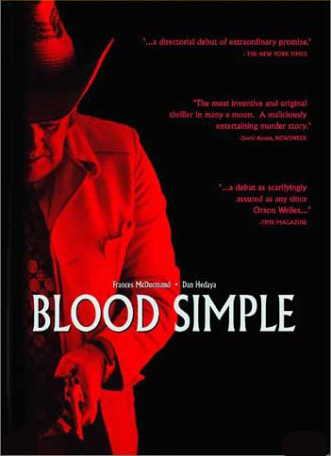
Blood Simple (1984)


“The world is full of complainers. An' the fact is, nothin' comes with a guarantee. Now I don't care if you're the Pope of Rome, the President of the United States or Man of the Year, something can all go wrong. Now go on ahead, ya know, complain, tell your problems to your neighbor, ask for help, 'n watch 'im fly. Now, in Russia, they got it all mapped out so that everybody pulls for everybody else... that's the theory, anyway. But what I know about is Texas, an' down here... you're on your own.”

The film begins with melancholic, almost rueful, narration, visually matched with shots of a long, barren and desolate Texas road. Later, characters will dwell underneath ominous ceiling fans, which seem to hauntingly view down upon the hapless. The camera, fluid but controlled, focuses on doors, particularly at nighttime, heightening the palpable fear of who or what is lurking behind them. A blade of light slicing through the darkness underneath a door is snuffed out. An emphasis on the patulous Texas outdoors pervades the film, contrasted and juxtaposed with the stifling, closed interiors in which people struggle. Shots of cowboy boots populate much of the picture. Blood is found on the ground with great regularity. Otherwise decent people make highly unfortunate decisions. An otherworldly creature mercilessly stalks his prey. This, however, is not No Country for Old Men but rather Blood Simple, the 1984 film debut for Joel and Ethan Coen.

Blood Simple is a subtly mind-bending neo-noir crime thriller in which communication is hampered by circumstance and refuge is denied by the apparent intervention of fate. The picture, photographed with blue-tinted deliriousness by Barry Sonnenfeld, is laced with an oneiric imperishability of location and personage, which meticulously creates a moony pattern that courses through the picture—and the Coen oeuvre entire. Characters move through the film like stationary objects pushed, as they are compelled to vacate their respective natural habitats. As will be proven true with their later efforts, Blood Simple demonstrably essays the Coens' obsessions and idiosyncrasies, their fixations and concerns. As a debut, the film is as pure and distilled an introductory declaratory statement as any before or since.

After the film's dry, almost supernatural opening narration, Blood Simple brings its perspective, literally, with Ray and Abby (John Getz and Frances McDormand) driving at night. The road is visible again, and “The Road” will remain a recurring Coen motif. Abby's first line informs where the picture's plot is headed: her possessive husband gave her a .38 handgun as a gift, but she fears she would use it on him if she did not leave him. The camera remains behind Ray and Abby, he behind the steering wheel of his car, she in the passenger seat. The windshield is spattered with rain, which is furiously flung off by the windshield wipers. With each passing car's briefly blinding headlights moving past them, the main cast members have their names flash against the black of night in cool blue.

The Coens' penchant for quirky, offbeat humor—here typically slathered atop the film's laconic dialogue—makes Blood Simple less familiar than its superficially derivative story would suggest. Rooted in the work of James M. Cain, Jim Thompson and other authors of stories about lust and murder, Blood Simple takes on a twisted viewpoint characterized by mordant humor and razor-sharp wit. As Abby's husband, owner of the bar at which Ray works, Julian Marty (Dan Hedaya), confronts Ray in the back of the bar, the Coens use a bug-zapper to simultaneously underline and subvert Marty's dramatic lines. “You think I'm funny, I'm an asshole? No, no, no... what's funny is her... what's funny is, I had you two followed because if it's not you she's sleeping with, it's somebody else... what's funny is when she gives you that look and says, 'I don't know what you're talkin' 'bout, Ray. I ain't done nothin' funny.' But the funniest thing to me is... you think she came back here for you... That's what's fucking funny!” The “bug-zapper” humorously emits its incongruously appropriate and inappropriate noise just as Marty concludes his angry, jealous speech, poking fun at the character, campy films with thunder and lightning emphasizing characters' dramatic lines and the film itself, with its budgetary limitations and ostensible lack of scope.

After having a finger broken by his wife in an ugly front-yard confrontation—masterfully captured with a racing, fevered camera—Marty seeks out the man he hired to follow Ray and Abby, sleazy private investigator Loren Visser (played with villainously cretinous relish by a superb M. Emmett Walsh). Visser is the Coens' first outsider—less so in terms of his geographical and cultural identity and more so in his complete lack of moral boundaries (the theme would become increasingly literalized in the Coen canon, culminating with the angel from hell, or at least some foreign country, Anton Chigurh, in No Country for Old Men). Visser is fat and sweaty with a devilish cackle and scaly, clammy features. Flies buzz around and about his face. Several of the best scenes in the entire Coen filmography are of Marty and Visser conversing, each holding the other in contempt as they go about their unseemly business. A terse, funny exchange buttresses the Coens' sensibility and interest. Marty: “I got a job for you.” Visser: “Well, if it's legal, and the pay's right, I'll do it.” Marty: “It's not strictly legal.” Visser: “Well, if it pays right, I'll do it.”

In its noirish iconography and air of morbidity, Blood Simple foreshadows the Coens' future efforts. Small-town Americana is the frequent home to Coen narratives, with its seemingly limpid innocence and relative tranquility being brutally invaded by outside forces, always unleashed by their bosses who egomaniacally call the shots behind their big desks—a Coen motif, from Nathan Arizona played by Trey Wilson unwittingly unleashing Leonard Smalls in Raising Arizona to Jerry Lundegaard played by William H. Macy hiring Carl and Gaear to kidnap his own wife in Fargo to the crooked businessman in No Country for Old Men embodied by Stephen Root letting out the demon. In each case, and others, the man behind the big desk believes he can control his fate, and in every instance, the weapon they let loose proves to be uncontrollable. Often, they are even killed by the very demon they let out of the box. The crushing absence of empathy for others informs the Coens' fiendish rogues gallery. Like those who would follow him in the Coens' art, Visser is a serpentine phantasm, putting about in his Volkswagen Beetle. The exchange between Marty and Visser encapsulates what would be re-imagined in Police Chief Marge Gunderson's famed tabulation in Fargo: counting the victims, she concludes, “And for what? For a little bit of money. There's more to life than money, ya know. Don'tcha know that?”

For Visser, like Peter Stormare's coldblooded sociopath, however, the temptation of money is too great to resist. Which is what, in part, separates the voracious, beastly outsiders from the people who are victimized by their own bad luck and poor choices. Ray and Abby are unable to enjoy one another's company, as Marty successfully plants the seed of distrust in Ray's mind. Everything flows from that; and as Ray finds himself covering up a crime he believes Abby has committed, he becomes the most plaintive character of Coen sagas. Like H.I. McDunnough in Raising Arizona, and Tom Reagan in Miller's Crossing, and Llewellyn Moss in No Country for Old Men, each character loses a piece of their soul in sacrificing for those they love, in one way or another. In this picture, Ray and Abby misconstrue one another's motivations and hearts. Finally, when pressed by Ray, Abby states, “I don't know what you're talking about, Ray. I ain't done anything funny,” just as Marty predicted.

Symbolism and representation is to be found in Blood Simple's thematically rich visual subtext. Acknowledging the influence of Roman Polanski and specifically his The Tenant in crafting the horror of the nearly abandoned hotel in Barton Fink, Blood Simple's use of four rotting fish may be an homage to the Polanski picture Repulsion, in which a decaying rabbit mirrors the psychological state of the protagonist. The fish in Blood Simple fester and spoil with greater alacrity just as the film's storyline spirals out of control for all of the characters. In two perfectly corresponding shots, a flock of birds at a roadside lift off to the air, and, in the next shot, their cumulative shadow splashes against the road's morning daylight. Ceiling fans—one of which hypnotizes Marty, who appears to be dead in his chair as he stares at it—accentuate the film's sense of insularity and loneliness, as the devices connote futility and fatalism in the overpowering face of the oppressive Texas heat. The Coens use windows to communicate the naivete and contrasting innocence of Ray and Abby, whose windows are never curtained or covered as Visser watches them couple and sleep together. The windows of an apartment purchased by Abby appear like two gigantic, watchful eyes. Ray realizes only too late how feckless the two have been (“No curtains on the windows,”) as he stares out into the night through Abby's enormous windows.

Carter Burwell's simple, eerily repetitious score starkly conveys the picture's insidious tension and sense of overarching doom. The Coens' gripping aesthetic control—which was yet another sign of things to come—finds itself expressed in the glide of the camera, such as when it flies through a bar, and hovers upward to avoid a motionless drunk. In the film's most widely noted scene, a man crawls on the unforgiving hard pavement of a road, illuminated by passing headlights. Once again “The Road” becomes paramount as the wounded man continues to struggle, his body convulsing as he spews blood. Isolation, most recently revisited in No Country for Old Men, seems to close off the participants of the tale, so that the whole world in all of its moral and recondite complexity is reduced to a single series of events, which, as always in the Coen universe, seem equally predetermined and manipulated. As in their later work, Blood Simple offers the explanation that seems the most logical: choice results in what is frequently labeled “destiny”; chance and fate are acolytes of cognizant decisions. This makes the Coens more interesting than the behaviorist scientists they are often described as being (which is, as far as it goes, accurate). Ray may believe the worst about Abby but he chose to let Marty into his head; he chose to dispose of Marty on behalf of Abby; he chose to not alter his personality so much as to clearly explain what transpired during one of the film's most eventful evenings. People are who they are, the Coens freely admit—but their choices determine what they are. Javier Bardem's psychotic killer in No Country for Old Men chooses fate to be his idol, his golden calf, so by the end of the story it has chosen him.

Like the somewhat pitiable but whimsically fanciful H.I. in Raising Arizona describing the background of his relationship with Ed, or the corporate mountebank in The Hudsucker Proxy, or Sam Eliot's rambling, forgetful “The Stranger” in The Big Lebowski, or Ed Crane in The Man Who Wasn't There—whose titular distinction makes his narration questionable at the outset—or Sheriff Ed Tom Bell in No Country for Old Men, who confesses to Carla Jean Moss that his mind wanders, Blood Simple's narrator, the reptilian Visser is not to be trusted. In each case, their recollection of events or perspective of the same is severely limited. Indeed, each character seems to romanticize and nearly fetishize certain aspects of the events, or people, or places, about which they are speaking. Which, the Coens seem to gently remind the viewer, is only natural.

This narration, however, is predominantly limited in its usage, and is intrinsically a doorway through which the Coens seamlessly articulate the diverging portraitures of the world known, in which evil is inexplicable in almost all ways but its avarice (money is, after all, at the heart of the Coens' stories, the motivating force for the unscrupulous), and the world of the mind. The Coens' characters are endlessly fixated on better places, happier times and idyllic havens. Voiced by Johnny Caspar (Jon Polito) in Miller's Crossing, the Coens are, not esoterically, but defiantly, almost contumaciously, fascinated by the “morality and ethics” into which they repeatedly delve. The Coens' comprehensive interest in these themes, however, does not reduce matters to mere abstract philosophical concepts. Finding a more Aristotelian vein in which to survey these considerations and quandaries, the Coens are not interested in presumptuously crafting an artistic equivalent to Descartes' call for a rationalist revolution or Locke's insistence on creating a “moral algebra,” by which all problems of morality would be reduced to calculations of abstract formulas. There is a consistency to the Coens' compilation, but both the consequences and evaluations (judgments, though not incorrect, is probably too loaded a term) are not predestined. Successive good characters either perish or are wretchedly tormented in the Coens' embroidery, and many evil ones seem almost invincible, but for unforeseeable circumstance, or seeming mischance, or possibly plain bad luck. Yet which is which, and who is to say what shapes events on earth? Abby believes it is Marty, or an avenging ghost of Marty, stalking her in the film's final sequence, completely unaware of the truth. H.I. manages to pull a grenade pin, perhaps by accident, as Smalls punches him away. Marge follows through on a hunch because of an old friend's lies, and then stumbles on one of the perpetrators disposing of his accomplice. In The Ladykillers, G.H. Dorr and his colleagues are flicked away as though they are ants annoying God. Chigurh had his eyes off the road at the worst possible time. In each case, the killers and criminals have largely already triumphed or failed in their objective (usually succeeding insofar as their original scheme goes, only to encounter greater asperity and trouble).

In Blood Simple's taut denouement—the final movement between McDormand's Abby and Walsh's Visser—the Coen predisposition becomes evident, and speaks volumes about their cinema. Like the scene in which Smalls kills little, harmless creatures (“He was especially cruel to little things,” H.I. tells the viewer, as he seems to have manufactured Smalls out of a nightmare), and especially the horrifying scene in which Carl and Gaear nonchalantly break into the unsuspecting Mrs. Lundegaard's home, and Anton Chigurh confabulating with Carla Jean in her own home, the chimerical meets the quotidian, the poisonous shadows the obedient and kindhearted. Blood Simple is charged, eccentrically meticulous filmmaking—precise and loose, focused and in disarray all at once. The Coens' affinity for marrying the most apparently antithetical properties to one another—tragedy and quirkiness, fear and amusement, the anagogic and the everyday—may very well stem from the very texture of their cinematic dissertations on the conflicting characters they observe. Like the all-powerful dirty money in No Country for Old Men, which seems to corrupt all who cross its path, the efficacy of the Coens' more mature filmic disquisitions is arrestingly potent, luring the viewer like Marty's little illicit offering to Mr. Visser.

Thursday, March 12, 2009

Two Lovers (2008)

Like Martin Scorsese with Mean Streets or Victor Nunez with Ulee's Gold, James Gray makes films about the area he knows. That area is Brighton, which has served as Gray's dramatic stage for Little Odessa, The Yards and We Own the Night. Gray's cinema is influenced by the pulverant pictures of the 1970s, and his first three works seemed to gestate within the womb of genre filmmaking. Within that framework, however, Gray strove to leave an indelible artistic impression on the content. Little Odessa is so equally impressive and precocious, that despite its limitations--Gray's determination to wring the most recondite ramifications from his Bergmanesque familial dichotomy is insatiable to the point of near-suffocation--it leaves an admirable afterglow that cannot be denied. The Yards is a scabrous generational portrait, and it plays like Gray's version of The Godfather (even to the point of James Caan graduating from Sonny Corleone to the Don Vito role). That the film does not quite reach in thematic importance what it maintains in textural and aesthetic consistency and agility--each tragic occurrence marked by an ominous glow into fading out darkness--again buttresses the picture's most visceral peaks such as a brutally realistic fight between Mark Wahlberg and Joaquin Phoenix. We Own the Night yearns to offer another telling of the Biblical contest of brothers, but Gray's contrasting properties of authorial filmmaking--graced by an objectivism not wholly dissimilar from Otto Preminger or Stanley Kubrick but with a dynamic cylinder of mythical filmic interpretation rooted in bonds of blood like a young Francis Ford Coppola or perhaps Spike Lee--is finally too great a melange at the picture's center for it to wholly succeed.

Two Lovers marks Gray's clean departure from crime dramas. Some have noted the picture as Gray's abandonment of genre filmmaking. However, Two Lovers may be best received as another genre exercise, but Gray has endeavored to craft an incisive romantic drama. Displaying great deference to the American films of the 1970s yet again, Two Lovers is an intensely discomfiting cine that feels like the American arthouse films that were, ironically, influenced by the French New Wave masterpieces that were themselves inspired by Hollywood classics in that exceedingly important decade for American cinema. In truth, Two Lovers is separate from Gray's three excursions into neo-noir neither in atmospherics nor tone--Gray's four pictures put aside one another could play like one long, chilly and autumnal autobiographical fever dream of life in Brighton--but simply in its story, grafted by Gray and Ric Menello's somber screenplay. As a result, the film features all of the disparate components that make Gray's work intriguing, though now with his latest film he may be compared to Hal Ashby, creator of some memorably prickly, vexing and emotionally complicated romances.

Two Lovers stars Joaquin Phoenix, whose performance is his third for Gray and probably his best. Phoenix plays what would appear to be another artistic silhouette belonging to Gray, an unstable, deeply troubled young man named Leonard Kraditor who is living with his parents and working for his father's dry-cleaning shop. Like Gray's previous filmic incarnations, Phoenix's Leonard and his family are Russian-Jewish inhabitants of Brighton, and Gray once again essays the particulars of this ethnic clan and the commodious personalities who populate it. Two Lovers details Leonard's tribal obligations to the patriarchal and matriarchal forces of his Jewish family, who both urge him to establish a serious relationship with Sandra Cohen (Vinessa Shaw), the daughter of a family friend with whom the Kraditors wish to merge their respective dry-cleaning operations. Meanwhile, he is quickly becoming hopelessly infatuated with the mysterious Michelle Rausch (Gwyneth Paltrow). Two Lovers as a title refers not only to the two respective women in Leonard's life but the duality of Leonard himself, who behaves like two different lovers with them. Basing his story in part on Dostoevsky's "White Nights" and "Notes on the Underground," Gray revisits the idea of the inevitable. That journey, however, is made considerably less archetypal than Gray's more testosterone-fueled underworld sagas.

Viewing the mating process through the delicate personal, ethnic and financial considerations, Gray delineates a painful and powerful film about a man so devastated by past romantic tragedy he has become suicidal. Phoenix, though perhaps on paper too old for the part, is more than up to the challenge posed by his director, displaying a vulnerability and enervation of being that is nothing less than mesmerizing. Shaw's part is small but she enhances her appearances with a sincerity that is deceptively moving. Paltrow has the larger and more opulently emotive part and she works with the screenplay to embody a flaky mirage of an idea as a person from Leonard's love-sick perspective.

As with Gray's previous work, a sense of seeping and creeping foreboding, signposted with stark, caliginous photography by Joaquin Baca-Asay, haunts the film. The environs are shadowy, the climate cold and hibernal. Paltrow is repeatedly shot from disorienting angles, as though to accentuate the off-kilter, enormously affected point-of-view of Leonard's whenever she is around. The actress's flowing blonde hair often shrouds her countenance, and she appears eerie. The visual communication that makes Gray's work peculiarly vivid in its offbeat, low-key gradations of light and dark, is refined in Two Lovers, entrusting the viewer to take note when the director utilizes his protagonist as the portal through which the film's images play, simultaneously experienced by Leonard and the viewer.

With his latest film, nominated for a Cesar for Best Foreign Language Picture in France, Gray has indeed continued to comment on his own singular obsessions and experiences. Two Lovers is a melancholic, unironic and simply-unfurled drama that contuses with scenes of potent, unadorned honesty like Leonard slyly following Michelle at a train terminal so she can finally notice him. This is a film in which the relationships all feel painfully authentic, and the misunderstandings and moments of isolation, bitterness and anger are earned responses to situations that seem beyond rational control. Gray's film is a maturely and finely crafted, composed and detailed account of a man in rebellion against his own existence, and all that existence entails. Such decidedly heartfelt, unmannered art is an increasingly rare delight.

Monday, February 23, 2009

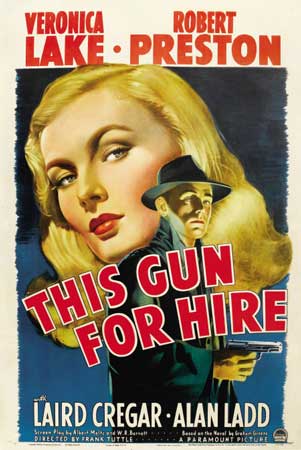
This Gun for Hire (1942)


(In the first weekend of 2009 I was kindly asked by Steve Eifert over at http://www.noiroftheweek.com/ to write a review of the film noir This Gun for Hire. This review is available to be read there. Noir of the Week is a fine website managed quite well by Mr. Eifert, featuring many detailed reviews of classic film noirs. Not to be missed.

Briefly, I would like to inform my readers that the ten-day absence of posts was a time of dealing with many other matters. I love writing for this blog and want to diligently maintain it but at the same time blogging should not be allowed to become one's life. I plan to finish February out strong with several upcoming reviews, starting with at least one or two films from 2008 to be examined as well as much more. Thank you for your patience...)

Frank Tuttle's early film noir, This Gun for Hire, made Alan Ladd a star in the role of Philip Raven, a mentally deranged and psychologically disturbed contract killer. As Raven, Ladd would employ the particular assets that he would continue to bring to his best roles: a laconic mysteriousness and nuanced, cerebral lethality of presence that distinguished him as a rara avis among the quotidian ordinary. Having soujourned for a decade in colorlessly inconsequential parts in approximately forty films, Ladd was finally given an opportunity to demonstrate his captivating talent. Ladd's commanding ubiety in This Gun for Hire is established by Tuttle in the star's first scene, which likewise begins to etch the dour artistry of lighting by Tuttle and cinematographer John Seitz. In a scene to be mimicked by Jean-Pierre Melville for his Le Samourai (1967), the insularly framed lone gunman stays in a slightly unsettlingly empty room. In This Gun For Hire, Ladd's Raven is loving toward only one kind of creature: cats, and when Tuttle's camera captures him smiling, in two of the three cases the predominantly uncharacteristic grin is aroused by the sight of a feline. In Le Samourai, Delon's killer showed love for a pet canary. (Delon would later love cats playing a ruthless spy in the Michael Winner thriller Scorpio.) Le Samourai starred Alain Delon in the role from which Ladd's Raven serves as a template, whose similar first name draws an unintended comparison as well.

Tuttle's mise-en-scene is often rather precise, and is repeatedly marked by dazzlingly expressionist chiaroscuro lighting. As Raven holds his tool of the trade, his handgun, the low-angle camera angle accentuates the man's isolation and power all at once. The shadowy lines that span the wall behind him, and framing square and triangular shapes in the wall and ceiling, connote a subtle gradation of entrapment and doom. As piano playing gently seeps into the room, the killer behaves like a man apart, and when a pushy maid attempts to shoo the kitten away from the room's windowsill, he snaps, spinning the woman around and slapping her. As the film continues, Raven's affinity for cats juxtaposed with his moderately bemused, glassy-eyed distrust of and dislike for people will serve as an important implement of narrative and character indicia. In this instance the episode serves to highlight the character's respectful admiration for the feline as solitary animal fighting for its own survival. Later, as he strokes a cat, he will remark that a cat brings luck—which is one of the only universal things he believes in as a force of aid.

When asked by the effeminate and rotund man who has last hired him to eliminate a chemist how he feels when working, he callously replies, “I feel fine.” Ladd's delivery is flawlessly deadpan, portraying Raven's coldblooded demeanor as a sort of deeply ingrained psychical state rather than mere remoteness of attitude and feeling. Ladd's physical conciseness and verbal succinctness endows the character's most consistent attributes with a naturalness that seamlessly matches the vision of screenwriters Albert Maltz and R.W. Burnett in their fascinating adaptation of Graham Greene's novel, “A Gun for Sale.” Greene's novel was set in Great Britain, but while the Los Angeles setting significantly changes some of the atmospheric qualities of the film from Greene's book, Tuttle conjures a similar percolating quality to the narrative developments. Tuttle does this by utilizing the visual language of cinema that helped to signify the oncoming flurry of aesthetically attractive and visually communicative 1940s Hollywood film noirs.

That man with whom Raven converses after rubbing out the chemist is Willard Gates, played with an effective amalgamation of smarmy unctuousness and bubbly jocoseness by Laird Cregar. Gates is a manager at the Nitro Chemical Corps. who moonlights as manager of the Neptune nightclub, where he finds himself enchanted by an auditioning gorgeous blonde magician Ellen Graham, sensuously brought to life by Veronica Lake. Graham is clandestinely working for United States Senator Burnett (Roger Imhof), who believes the Nitro Chemical Corps. is guilty of selling secrets to America's wartime enemies. Aboard a train from San Francisco to Los Angeles, Raven and Graham find themselves linked to one another when they sit next to one another. The noirish emphasis on luckless circumstance and seemingly random misfortune is palpably rendered. When, at the twenty-nine minute mark, Graham attempts to make contact with Raven, he fittingly asks her the future question of Travis Bickle's from Taxi Driver: “You talkin' to me?”

Tuttle's mise-en-scene is especially sharp in the early and late stretches of the film. A midway excursion into an estate with a thunder-and-lightning storm appears like a horror film. When Raven and Graham are on the run together, Tuttle's camera examines them as an impossible pairing—he is a stoic killer for hire, she is the girlfriend of a police detective named Michael Crane (a feckless Robert Preston) trying to solve a robbery from which Gates has paid Raven with marked bills. The compilation of multiple threads tying into one knot is one of the more satisfying, but possibly distracting aspects of This Gun for Hire's narrative. As Raven and Graham are physically adjoined to one another, with Raven on the run from the police as he attempts to exact revenge for Gates' double-crossing, This Gun for Hire slows down and the screenplay endeavors to explain the chief source of Raven's psychological trauma. Visually and thematically dark, the scene is lit with expressionistic intensity. As Raven and Graham look out through the gaps between wooden planks in a filthy warehouse window, the light skips down diagonally on the two. As Raven describes a recurring dream in which a tyrannical woman continually beat him as a child.

“I dreamed about a woman. She used to beat me—to get the bad blood out of me, she said. My old man was hanged. My mother died right after that and I went to live with that woman. My aunt. She beat me from the time I was three to when I was fourteen. One day she caught me reaching for a piece of chocolate... she was saving it for a cake... a crummy piece of chocolate. She hit me—with a red-hot flat-iron! Smashed my wrist with it. I grabbed a knife—I let her have it! In the throat! They stuck a label on me: killer. Shoved me into a reform school and they beat me there, too. But I'm glad I killed her. What's the use? [There is] nothing I can do.”

This legitimate effort to create melodrama out of the hitman's origins of spiritual, mental and physical (the permanent scarring on his left wrist is used by the police to identify him) disrepair and wounds is successful in creating an empathetic attachment to the character when he continues to run away from the police. As the police struggle to locate the elusive Raven, the film takes a pessimistic but almost lightheartedly comic shot at the cops as bungling and ineffective. Raven rather easily escapes the clutches of the cops who know he is aboard when he exits the train. Over the course of the film, policemen make tragicomic mistakes when attempting to capture Raven. In one such especially personal confrontation, a lone policeman tries to handcuff Raven late in the film, only to fatally underestimate the killer, who shoots him to death for his trouble. Quite late in the film, as Raven tries to satisfy his blood lust, he finds himself looking directly at Detective Crane, who he could have effortlessly eliminated—but he knows he is Graham's man (“You're a copper's girl,” he once dismissively sneers)—and consequently spares him. Graham's gentleness and kindness toward Raven endears her to him and when a villain suggests she ought to be killed, Raven furiously comments that she has been “nice to me,” a most sparse—and perhaps, the film seems to subtly suggest, nonexistent—way in which someone has ever treated him. With a plot that veers perilously close to making This Gun for Hire another propaganda picture—in which even the stone-hearted assassin is finally moved to defend his country from despicable traitors—the screenplay and Tuttle's interpretation of it keep the dilemmas and choices personal and almost disconnected from politics. As with other Greene novels, it is the personal that informs the politics of the story, and This Gun for Hire is finally, gratifyingly, no different.

This Gun for Hire's climax would also be borrowed by Jean-Pierre Melville for his Le Samourai as the hunted killer is chased on an ominous rail bridge. As Ladd's Raven once again outmaneuvers the police, Tuttle captures the entire chase sequence in a bravura depiction of action. The memorable long shot of Raven jumping off the rail bridge onto a moving train is exciting, and the interest and care the audience has for Raven makes it genuinely meaningful. This Gun for Hire is an early film noir and its limitations and imperfections—some of the supporting players give uninspired performances and Tuttle's direction is somewhat lax in the film's midsection, as is the screenplay—while not to be overlooked, should be considered with fairness when assessing it. As such, this is a most thoughtful, interesting and important film.

Tuesday, February 10, 2009

Scandal Sheet (1952)


(Scandal Sheet was screened at the San Francisco Castro Theatre on Friday, January 23 along with Deadline USA as part of Noir City 7.)

Scandal Sheet is directed with a particularly pungent, uncensored acumen by Phil Karlson, whose fidelity to the screenplay by Ted Sherdeman, Eugene Ling and James Poe, based on the novel “The Dark Page” by Samuel Fuller, enriches the film for its entire eighty-two minute runtime. (The film's title in the United Kingdom was The Dark Page.) Karlson, aided by cinematographer Burnett Guffey—whose lens seems to inescapably capture every last sealed crevice on the gritty sidewalks or clammy characters' faces—creates a verisimilitude out of mise-en-scene that perfectly imparts the scabrousness of the picture's very story. Surveying the relationships in a scandal rag “newsroom” controlled by a bulldog of a man who behaves almost like a centurion guard, managing editor Mark Chapman (a relentless Broderick Crawford), Karlson makes the camera an impartial observer, making casual note of the rampant, anfractuous headline-grabbing (and -making) that is made into a virtue by the avaricious Chapman. Chapman's running of the newspaper, once a respectable publication, The Comet, creating a “scandal rag,” has dramatically increased the circulation of the paper, and he reminds the partnered owners of the institution of that unalterable fact.

Fuller's novel, “The Dark Page,” came about when he decided to write a book about some of the more outstanding experiences of his career as a newspaperman. Fuller had to serve in World War II (with the “Big Red One”) and was notified by his mother while he was away that a publisher was quite interested in purchasing the rights to his first draft. Only a couple of years later, Fuller learned that none other than Howard Hawks was quite interested in adapting the book into a film, and bought the rights for $15,000. Fuller's mother was ecstatic and sent her son $1,000 while he and his unit were fighting in Europe. Sadly, Hawks never made the film, and sold the rights for several times what he paid for them. The buyer was Columbia Pictures, and Karlson would direct it.

The atmospheric component Karlson brings to the picture makes it somehow more compulsively watchable than most films with similar “set-ups.” Crawford's Chapman, like almost all of the best noir protagonists, is a man who has skillfully managed to escape his past, but, as in so much of noir, it is the past that he cannot truly evade. And, as in most noir, the chilling hand of irony finds itself practically slapping Chapman's face—it is through a very idea originated from his greedy mind that his past catches up with him. The newspaper actually hosts a “lonely-hearts ball,” where many companionless people are brought to one venue. Chapman's cynicism is unrestricted, and he guarantees a prize to a couple who marry on the very evening they meet one another: a bed, with a built-in television set.

It is at this “lonely-hearts club” event that Chapman's past runs into him and he is eventually placed in an unenviable position. Suffice it to say he makes a mess out of an already unfortunate situation, and is compelled to cover up a crime he has committed. In pursuing that crime, however, his ace reporter, the young, handsome Steve McCleary (an exceedingly effective motor-mouthing John Derek), digs up just enough dirt to make it into a story—and one so sensationalistic that Chapman is practically forced to run his reporter's story in the newspaper, despite it being highly dangerous to himself. The delicious paradoxical scenario—the potential undoing of Chapman's person due to his own recalcitrant desire to see the most controversial subject matter splash across his front page to ensure wider and wider circulation—is quite the cinematic meal to be engorged.

Fuller is widely attributed the line that the very beginning of a film should give the viewer a “hard-on,” which crudely approximates what his directorial outings would later achieve. (Including the fine newspaper noirish melodrama Park Row from the very same year.) Scandal Sheet almost achieves that standard of criteria—Derek's McCleary behaves like a policeman gleaning gruesome details of a murder, only to be thrown out of the crime scene by a disgusted cop—but unlike Fuller's dyspeptically fast-paced book, it is has less alacrity to its rhythm. Whereas Chapman's irredeemable act occurs right at the beginning of Fuller's novel, Karlson's film is slower to uncover it. Fortunately, Scandal Sheet gains momentum in its aftermath. One highly memorable scene involves a group of woebegone drunkards being questioned by McCleary and his partner Biddle (a well-realized and queasily comical Harry Morgan), as the newspapermen attempt to get to the bottom of the crime at the film's center. Donna Reed as morally upright Julie Allison sometimes veers into didactic, lifeless platitudes, but her relationship with the borderline courting McCleary is well-rendered and believable.

In many ways, however, Scandal Sheet is a film that would not be nearly so sibilating without Crawford's ardent performance. Known for barking like a bulldog, Crawford utilizes his (at this point in his career, especially after winning the Oscar for All the King's Men) on-screen identity, and creates an indelible noir protagonist driven to sheer desperation. As he finds himself committing yet another unspeakable crime against a sympathetic character simply to hide his earlier ones, the audience may find in him, not quite empathy, but responsive connection. It may help that Crawford's Chapman is softened and curiously mollified; in Fuller's novel he is far more incorrigibly awful a person. In Karlson's film noir, however, that aforementioned callous hand of fate entraps Chapman, and makes an already ugly person only far uglier. The very ending of Scandal Sheet may be interpreted as a sight gag of sorts, but it reinforces the smoke-filled verbal lacerations that have come before. (For an example of only one brutal comment to be found throughout the film, McCleary once refers to a dead woman as a wonderment to Reed's Allison—a dame “with her mouth shut.”) The last shot of Scandal Sheet in actuality surpasses its apparent comicality, and comments on the paradoxes that haunt Chapman, driving a man to destroy himself through his own megalomania.

Saturday, February 7, 2009

The Harder They Fall (1956)


(The Harder They Fall was screened along with Johnny Stool Pidgeon on Tuesday, January 27 at the San Francisco Castro Theatre as part of the film noir festival, Noir City 7.)

The Harder They Fall was Humphrey Bogart's final film, which has forever endowed it with an historic import transcending the content of the film. Bogart had played so many haggard, world-weary characters that perhaps his rather obviously tired comportment and demeanor in The Harder They Fall seemed completely natural to many moviegoers. The movie star would die shortly after completing the film, leaving behind one last wholly solid performance. The Harder They Fall would probably not work as well with anyone else in the part, if for no other reason than Bogart's placement as the picture's star bestows upon it a stipulation: like so many other Bogart avatars, his down-on-his-luck ex-sportswriter Eddie Willis is another archetypal representation of the figure that would partly serve to define the “Bogart mystique,” that of the apparent cynic busily, dispassionately pursuing his own interests, only to finally melt before the sweltering heat of conscience and indignation.

One of the gravest problems with The Harder They Fall, however, is that Bogart's final redemption comes too late, and its impact is too little. The screenplay by Philip Yordan, based on novelist Budd Schulberg's book, miscalculates in its manipulation of the “Bogart mystique”; Willis is, while empathetically drawn and comprehensively rounded, a fairly dirty character. That the selling of his soul is done with Bogart coolly inviting audience sympathy from time to time—looking on in abject horror and disgust at the rampant wrongdoings (always laced with nauseating self-righteousness) of the mobster Nick Benko (Rod Steiger)—does not diminish the fact that Willis has sold his soul. Benko believes he has found the greatest meal-ticket in the world, a giant Argentinean he can shamelessly market as a heretofore unknown boxing powerhouse in America, to be ridden all the way to a championship title bout in New York City. Willis (only barely reluctantly) agrees to be Benko's front-man for the press, issuing statements that always help Benko in achieving his ends.

Mark Robson directed The Harder They Fall; he had directed the noirish boxing saga Champion (1949) starring Kirk Douglas. That film was fearless in its zeroing in on the machinations of media in making the Douglas character—a brutish, unsympathetic raging bull—into something of a hero. The Harder They Fall is likewise interested in media manipulation and the manner in which the fourth estate can be so readily utilized by the crooked. Robson's direction of Champion, which was predominantly confident and visually arresting, is not matched here. An opening sequence of cars racing to a boxing studio is a bravura set-piece, laying the gauntlet down for the rest of the picture, but Robson cannot sustain that kind of nervous energy. Much of the film takes place in close quarters, with hotel rooms, arena locker rooms and home living rooms making up the majority of the various, vaguely monotonous settings. Robson finds a certain sizzle in the boxing bouts, with arenas full of people viewing the spectacle of the giant Argentinean Toro Moreno (Mike Lane), and Bogart and Steiger are up to their respective tasks but the film's lack of visual prowess from Robson makes The Harder They Fall dependent on Yates' screenplay and the actors.

The Harder They Fall, introduced by the always highly knowledgeable Eddie Muller at Noir City 7, is, as Muller recounts, loosely based on the astonishing career of 1930s heavyweight champion Primo Carnera, a gargantuan-sized lumbering Italian titan. Pushed to the top of the boxing world, and attaining the championship, the unscrupulous promoters behind his meteoric rise allowed him to be devastated in the ring. In his title fight with Max Baer, he was knocked down eleven times, losing the championship to Baer. As Muller noted in his introduction, two powerful gangsters on the east coast attempted to take over the game of boxing. Muller assured the audience that he was not manufacturing their names—Paul John “Frankie” Carbo and Frank “Blinky” Palermo. Carnera was their prized selection, and so Steiger's Benko is informed by these shadowy real-life men by Schulberg's fire-breathing, outraged novel.

Where The Harder They Fall succeeds most vociferously is in its almost documentarian examination of boxing; in an ad-libbed, unscripted scene, a physically and economically broken-down ex-boxer named Joe Greb is interviewed. Bogart's Willis is forced to view the scene in all of its pathetic unsightliness. Yates' adaptation of Schulberg's fiery indignation still stings. Bogart makes the shame that periodically swells and rises up in him like indigestion palpable, though the foreordained resolution of his character—based on sportswriter and promoter Harold Conrad—neither diminishes nor validates Willis' unseemly involvement in many of the film's most repugnant moments. One painful episode details a gracious veteran brain-scrambled boxer's efforts to leave the boxing game with one final, losing fight against Toro, only to be served as a veritable lamb led to slaughter. Willis' anger and hurt at this makes him a compelling figure, but the unvarnished truth of the aforementioned boxer's condition makes the final redemptive moments only hollower.

“The fight game is like show business. There are no great fighters anymore. Whoever is the best showman becomes the champ.” So declares Benko (with Steiger giving the dialogue everything he has) to Willis. The scathing cynicism is unleashed by Bogart's Willis, to Toro: “What do you care if a bunch of bloodthirsty, screaming people think of you? Did you ever get a look at their faces? They pay a few bucks hoping to see a man get killed. To hell with them! Think of yourself. Get your money and get out of this rotten business.” When a certain boxer is being wheeled out of an arena, a venomous woman screams at him for losing his match. While Robson's mise-en-scene is awkward and stilted at times, Yates' screenplay knows exactly what its target is, and that surpasses only Benko and his henchmen. This makes for a somewhat schizophrenic film, which simultaneously has designs on being a movie with a message and a story about some crooks cashing in on boxing. As Toro is finally mercilessly beaten to a pulp in the picture's final contest, with onlookers booing and hissing him in his moment of agony, it is prudent to remember Muller's first comment in his introduction to the film at the San Francisco Castro: boxing is noir.

Saturday, January 31, 2009

Shakedown (1950)

(Shakedown was screened Wednesday evening at the San Francisco Castro Theatre along with While the City Sleeps as part of the film noir festival, Noir City 7.)

Howard Duff plays a homme fatale in Shakedown, a sordidly gritty “B” film noir about an unconscionable newspaper photographer who climbs his way to the top of his profession through shooting the most eventful happenings in San Francisco—with his camera. Creepily insouciant with a glassy, pitiless pair of eyes, Duff, as directed by Joseph Pevney, makes his Jack Early a cipher. This ethical black hole of a man is the film's repellent central character, and Shakedown's narrative incrementalism—Early becomes more pronouncedly brackish and more irrevocably insatiable and insufferable as a person as the film continues—makes the picture more engrossing. Following Duff's Early in his pursuits of photographing major, newsworthy moments in the city, the film takes a methodically masticating viewpoint, developing a sort of partially indifferent stance with regards to Early's actions. This intriguing approach makes the film more meta than it may initially appear to be. Pevney sagaciously mimics his protagonist's all-seeing amorality—the film follows him wherever he goes, just as he follows budding stories and dramatic episodes that seem to be cajoled into existence by the very existence of the urban jungle from which they sprout. This, naturally, befits the environment of film noir, and makes what could have been a merely melodramatic jeremiad into something more nutritious and rewarding.

Working from a story by Nat Dallinger, Martin Goldsmith's screenplay periodically stumbles from bouts of excessive literalism and prosaic formula. Yet there are some solid little touches that buttress the greater vein the narrative delineates. Early's homme fatale status is hinted at early when one pretty woman after another cannot avert their enamored gaze as he confidently marches into what he hopes will be the arena in which he will succeed at all costs, the city newspaper. When Early—quite literally—moves in on the cajoling girlfriend of his employer and intrepid newspaperwoman Ellen Bennett (Peggy Dow), the picture of the employer and timid beau of Ellen's, David Glover (Bruce Bennett) is pushed off of a desk, and falls down, to the ground and off camera range.

As the film gracefully concatenates Early in all of his lurid photography, from snapping sensationalist (and manipulated) shots of drowning men and defenestrating women, the atmospherically pitch-black cynosure of Shakedown becomes more perilously foreboding. Gangsters are introduced, such as Nick Palmer (Brian Donlevy) and Harry Colton (Lawrence Tierney). Ann Vernon plays Palmer's French wife, Nita—who quickly attracts the attention of Early. One of the more ambivalently delectable components of Shakedown is the efficacy with which the picture compels the audience to sympathize with the gangsters routinely exploited, coaxed and finessed by Early. The conflicted emotions provide greater detachment from the characters, a sanctuary from which the viewer can remain neutrally engaged for the entirety of the picture while remaining appalled by Early's outrageous antics.

Duff's performance zeros in on his character's gifts—an effortlessly natural charisma and prepossession that seem like necessities for any solid homme fatale—which manage to disguise his more ravenously ugly personality. Like any plausible seducer, Duff's Early is in no small way a feat of muted chicanery and profound deviousness. Securely ensconced within the more saporous property of his persona that ably lures sexual and professional foe alike, these gradually blossoming fragments of more perspicuous wrongdoing are given greater aromatic potency. Scenes in which Early, confronted by the prospect of making money, nonchalantly agrees to one crooked deal after another, pile up like so many sins to never quite be confessed.

Many films have portrayed the conflicts, turmoils and philosophical underpinnings of the art-form of both cinematic and still photography. From the Buster Keaton-starring Edward Sedgwick-Keaton film, The Cameraman to Michael Powell's Peeping Tom, to Michelangelo Antonioni's Blow-Up and many other examples, the act of photographing people in one context or another has left an indelible impression on those who partake in these films' cogent inquiries. Perhaps informed by the Platonic visage of concepts represented by the varied objects that populate the lives of people, the photographs made pivotal in the narratives of these pictures may likewise be avatars of effulgence, mayhem or clandestinely captured and unearthed secrecy. These visual representations are endowed by a finely tuned animistic perspective. Pictures, predominantly suspended in idyllic timelessness, are, a fortiori, typically portals into convivial illustrations. It is when this symmetrical concinnity is breached by invasive, world-altering misfortune that the preternaturally established environment finds itself poisoned. As master-manipulator Early massages one tragedy after another to personally gain from it, Shakedown comments on the dual egoisms of the character himself, circuitously, and the art form he exploits.

Photography finally distilled persuasively records Plato's eidos, while remaining neutral in Aristotle's divergent consideration, and rejection, of independently existing forms. Brought to the modernity in which Early's calculatedly emotive photography thrives, Heidegger's teacher, Husserl, finds relevancy in his “eidetic” application of Platonic phenomenology—but, a photograph may in actuality be the most finely sublimated literal snapshot, humorously, of Plato's eikasia, his comprehension and signification of the elusive human imagination, which is invariably focused on temporal imagery and appearance. Powell and Antonioni (and later Francis Coppola, who would adapt Antonioni's sight for sound in The Conversation) exquisitely detailed this. In Shakedown, however, the noirish storyline finds Early feasting on the sociological ailments that plague the urban jungle with his lethal weapon (the poster for the film notes that his camera was more deadly than the gangsters' guns). This media orchestration befits postwar American cynicism in pervasive institutions and even broad societal relationships, such as between the fourth estate and the populace. This bitterness would find scalding expression in Billy Wilder's Ace in the Hole from the next year. Shakedown places the role of media-sensitive conductor of bewildering machinations in a more achingly personal light, which leaves a different, but no less intriguing mark. Kirk Douglas' reporter in Ace in the Hole was ultimately a self-aggrandizing huckster. As wonderful as Douglas was in that film, his character was not psychologically crippled, and he, though reluctantly, could see the harm he had selfishly administered. Duff's Early is a man with emotional parts simply missing. That barrenness makes this film noxiously arresting; the passive act of watching functions as a recoiling sense of despair. Though Shakedown cannot match the aforementioned films in either ambition or execution, it is a searing documentation of irresponsible turpitude.

Wednesday, January 28, 2009

Night Editor (1946)


(Night Editor was screened along with Alias Nick Beal on Monday evening at the San Francisco Castro Theatre as part of the film noir festival, Noir City 7.)

Night Editor is a stalwart “B” film noir that paddles through an appealingly tawdry narrative with characters who are not among the more virtuous committed to celluloid. Based on the radio program of the same name, the film is shackled to a cumbersomely clunky and illogical framing device—a group of newspapermen conversing about old stories to one another late at night (the device utilized for the radio show)—but this matters little. The actual plot is not outstanding, either, but it does provide the habitat in which its bracing characters move about. William Gargan plays Tony Cochrane, a man who grew up poor and became a cop, becoming a homicide lieutenant. His unfaithfulness to his loving wife and child, and compulsive attraction to a wicked sadomasochistic socialite named Jill Merrill, played to hyperbolic delirium by the shapely blonde beauty Janis Carter, seals his fate as the archetypal dupe. Night Editor's dyspeptic narrative is lively and allows these two characters carte blanche to display all of their unsightly traits. Night Editor is a mammoth-sized, slightly viscid cheeseburger that is only scarcely grilled and all the better for it.

Directed by Henry Levin and adapted from Hal Burdick's radio program and Scott Littleton's story, “Inside Story,” by Hal Smith, the film's most pronounced presence is doubtless Carter's Jill. Carter is Night Editor's fire-breathing, coldblooded embodiment of the exteriorly hot but interiorly icy femme fatale. Carter's interpretation of her character, adorned with an eerily itchy, equally playful and disconcerting leering smirk, is what lingers well after the picture has ended. Wracked by neurosis, Jill is sexually excited by violence, and, when she and her illicit lover enjoy one another's company in a parked car, they witness a ferocious murder-by-tire iron. Tony wants to act, and nearly does—but finally heeds Jill's shrill commentary on the situation, which is that scandal will erupt if he intervenes in catching or killing the murderer. Shamed by his inaction, Tony returns to the car, where the aroused Jill maniacally squirms and writhes in her seat, demanding that he show her the battered body.

This set-piece is the springboard for the rest of the tale, and what abides in the viewer's mind days after watching the film is the pulchritudinous but pernicious Jill. Carter's performance is gloriously histrionic but never deleteriously so. She outshines the rest of the cast, most of whom are men. Like many a femme fatale—crafted at a time supposedly more sociologically askew in its male-dominant perspective—the femme figure is, while definitively peccant, also far more charismatically bedecked than all of her male counterparts combined. Carter's performance—underneath all of the immoral maneuvering and aberrant amorousness—is simply nectarous. Her allure is overwhelming, but she is so mentally imbalanced and perverse that Tony knows she is completely wrong for him. Tony's somewhat humorously mousy wife, Martha (Jeff Donnell), serves as the contrast to Jill—upstanding and good, but bland, and lacking the spicy sizzle that the incorrigible Jill brings with her.

Femme fatales in Hollywood film noirs are formed from varied shades, but they do share commonalities. Their origin is particularly historically and culturally rich. As ancient as the Hebrew mythological figure Lilith, from Sumerian wind and storm demons like Lilitu at approximately 4,000 BC, a Judaic night demon and a screech owl in the King James Bible. Eve herself is depicted as an easily tempted creature of sensuality whose misleading of Adam doomed man. Other figures from the Judaic and Christian history include Delilah and Salome, the latter of whom used her physical endowments and wiles to ensure John the Baptist's beheading. Greek mythological goddesses, historical figures and specters like Aphrodite, the Sphinx, the Siren, Helen of Troy and Agamemnon's murderous wife, Clytemnestra set the Hellenistic foundation for modern depictions of unsavory females. Just as noir's femme fatales are noted for their exotic magnetism, Cleopatra's manipulations of Roman men established her as a permanent fixture of Roman antipathy.

Night Editor is arguably a minor noir, but the depiction of the femme fatale makes the film deserving of greater recognition. Other aspects of the film are chronically conventional to the genre, including Burnett Guffey and Philip Tannura's cinematography, but Hal Smith's scorching screenplay, pied with livid, exceptional pieces and dialogue, and Carter's gusting performance recommend it, and in a way pay great homage to the fatales of history and literature. Indeed, Jill is not unlike John Keats's Matilda, whose tempting of the once-incorruptible hero (Keats's The Monk) through the luridly “transgressive” (pace the literary term) and duplicitous means at her disposal entrap him. Night Editor is not nearly a film wholly worth comparisons to such past representations of such dramatic tales, but Jill's irrepressible constitution stands apart from anything that could be termed generic.

The film hits its stride just when it should—its conclusive passage—as the femme fatale once again disarms and enchants her male victim through her beguiling beauty, only to violate his being in the most personal of ways. The sequence is scary, sad, funny and powerful all at once, a flamboyant feat perhaps only a “B” film could achieve. Gargan and director Levin must have known that he (along with his character) was no match for Carter's Jill, and the actor underplays everything, including this most noteworthy moment of the film. Gargan does not cover much range, yet when the screenplay demands that he be shocked and horrified by events encircling him, he does so well. The apathetic, practically suicidal foreknowledge he has—he is insane, stupid or simply so pathetically overcome by Jill and her sex, to even barely trust her—enriches his actions, making him both more and less pathetic all at once. Levin's mise-en-scene is mostly unremarkable, but he paces the action sufficiently well, and occasionally stages his actors in ways that heighten the tension. The film belongs completely to its leading lady, however, whose feigned, wide-eyed innocence seems to ensnare every male viewer with a pulse, despite their being endowed by the verisimilitude-separating knowledge that they are watching a film, and Carter is playing a character of sheer villainy. Jill is perverse in a way that is rare even among the rottenest femme fatales. That feminine nastiness has rarely been so much fun; when Gargan's Tony refuses to basely satisfy Jill's needs, it would not be difficult to find many a fellow watching the film who would gladly volunteer.

Monday, January 26, 2009

Slightly Scarlet (1956)


Slightly Scarlet is a fascinating, grippingly trimmed, splashily Technicolor film noir starring John Payne, Rhonda Fleming and Arlene Dahl. The film is a consanguineous addition to the broader canon of American film noir but has the lurid intemperance of a 1950s “kitchen sink” melodrama, and has become quite beloved in France in recent years. Payne plays the humorously named Ben Grace, a slithery, unscrupulous mercurial manipulator of the smoke-filled rooms he traverses, which host the likes of thuggish syndicate master Solly Caspar (Ted de Corsia).Fleming and Dahl play redheaded sisters—Fleming as June Lyons, the secretary/girlfriend of fictitious Bay City mayoral candidate Frank Jansen (Ken Taylor), a reform-minded agitator and Dahl as the kleptomaniac and nymphomaniac “bad girl” sister, Dorothy Lyons (often shortened to “Dor”). Directed by Allan Dwan, the film finds its rhythmic surreality by famed cinematographer John Alton, whose work in color enlivens Slightly Scarlet to dimensions that truly, lastingly, distinguish the picture. Alton makes Slightly Scarlet look like a live-action, unspooling 1950s movie poster, with its garish reds, brilliant whites and deliciously, darkly and inky clothes, guns and eyes all converging to create a sumptuous visual experience.

Alton's use of key-lighting is reined in, but he sloshes the frame with opulent oranges, picturesque pinks and gorgeous greens, often sharply contrasting the characters with colors that accentuate whichever complexion and iridescent glow they bring before the camera. Taking an intrinsically black background, befitting noir, Alton shoots in Technicolor with bombastic fervency, creating a palette that is sparkling and alarming in equal measure. The cinematography is an irreplaceable property belonging to Slightly Scarlet—the oneiric chiaroscuro of black-and-white suitably replaced by mid-'50s, bountifully colorful bespattering that is fiery in its luridness.

The performances are all seismically wrought, with Payne playing a character who is never exactly what the audience suspects he is—while occasionally appearing to be far worse. Grace's gangsterism finds itself at the film's epicenter, as he is battered and slapped around by his “boss,” Caspar, only to eventually try to take the mob over himself. Fleming plays her part with a firmness that befits her “straight” character. Her nearly maternal handling of Dahl's “Dor” is at times quite touching without being sentimentalized. Dahl, however, is given the scene- and film-stealing role, and she plays it to the juicy hilt. In the picture's denouement, Dor is depicted as a woman descending into utter madness—perhaps she had been there all along and had been barely able to obscure it from others beforehand—and Dahl makes it believable. Never falling over the precipice of sheer camp, Dahl makes her character firstly a “strong woman,” accursed by a weak mind. Ted de Corsia is brutal and burly as the film's most poisonous malefactor, tossing a dead man out of a building and instructing his underlings, “C'mon, let's see if we can beat him down.”

Dwan and Alton collude to create memorable and sometimes mesmerizing visual spectacles. As Payne's Grace discusses Dor with June, Dahl's Dor is captured by the camera through an open door, laying in the backyard, listening to their conversation. The visualization speaks to the essentially triangular relationship that emerges, with Dor affixing herself between Grace and June whenever she can. As Grace and June continue their dialogue, Dor finally stands upright, and slowly walks through the door, which, it is finally revealed, has been open all along. She introduces herself to Grace by calling herself “Dor”—an “open door,” which carries with it both the sexual innuendo and verbal stroke delineating the space through which she has just listened and finally traveled.Much later, as June and Grace talk, Dor is seen between them once again, descending down stairs, which feature phallic-shaped structures.

The visual components underly the film's deterministic psychopathology, which, rather beautifully, seems to seek to make reason out of varied forms of insanity. This paradoxic dramatic undertaking separates itself in some ways from James M. Cain's novel, Love's Lovely Counterfeiter, from which the film is only nominally based. More daring and breathlessly embroidered than Cain's book, Slightly Scarlet, adapted by screenwriter Robert Blees, is powerfully pulpy. The characters are all motivated by some form of self-interest, even the “good girl,” June, whose efforts to keep her little sister on a leash can be interpreted to be, to one degree or another, driven by her own relationship with the mayoral candidate. Likewise, Grace's romantic pursuing of both June and Dor portrays the desire of a man to have everything the symbiotic siblings have to offer, though when Dor shoots a harpoon near him, he is shaken by the younger woman's instability.

Slightly Scarlet is finally an intriguing melange of noir attributes with more romantic inclinations. The film finally places Grace in the position of the hero, being compelled to save the true love, June, from a fate engineered by his ruthless employer, Solly and the compliantly docile Dor. The climax also brings forth the matter of sacrifice, both literal and figurative, as Grace finally acts in a way that just may make his name rightly descriptive. Alton frames him as he makes his final decision against the blunt, dark background behind him.

Slightly Scarlet's depiction of big-city political corruption is in some ways the picture's “MacGuffin,” which is utilized to propel the bare necessities that drive the narrative early on, leaving the rest of the work of storytelling to be done through the engaging characters. American cinema in the 1950s was becoming increasingly paranoid about the powerful, and took repeated shots at institutions and figures of great clout. Some of this doubtless arose from the Hollywood backlash against McCarthyism, seeing governmental force as a more malevolent force than it had often been interpreted as earlier. Slightly Scarlet is an exemplary case belonging to this vein of 1950s cinema, but, befitting its cotton-candy rainbow bowl of mixed colors, it is a mixture of that, of domestic melodramas and of crime drama noir.

Dispatches from Noir City 7


Friday night at the San Francisco Castro Theatre was a great deal of fun, as it opened up the ten-day schedule of festivities. After entering the building, I conversed with the "czar of noir," Eddie Muller, and pointed out that he commented on my August 24, 2008 review of The Big Heat when it was posted at http://www.moviezeal.com/. (The review can also be found here, for those who wish to brave eye strain.)
Dark City Dame, I promise I'll tell "EM" you said hello sometime tonight or in the very near future; I'll be sure to run into him some more over the course of the next seven evenings.

Moments later, my dad and I found terrific seats--the center of the front row of the balcony--though those balcony seats are not as comfortable as the downstairs seats. The seats in the balcony seem to have remained the same seats for a long time. Eddie Muller came out on-stage and introduced the evening's two films, Deadline--USA and Scandal Sheet, both "newspaper noirs" from 1952. (Though the former is not, strictly speaking, a noir. It is fun, however.) Broderick Crawford is excellent in the latter film, as an amoral managing editor of a newspaper-turned-scandal sheet. The film is based on Samuel Fuller's novel, The Dark Page, and is very well-directed by Phil Karlson, whose visual keenness is quite exciting. (I recently reviewed his 1959 The Scarface Mob, which kicked off television's crime series, The Untouchables.) One I may review in the near future.

Saturday was a marathon day, as the matinee double feature was comprised of Blind Spot (1947), a fairly "light" mystery about a drunken writer (Chester Morris), mulling a plot for a mystery novel, the details of which seem crucial in a real murder investigation--of which he's the prime suspect. The Castro program notes, "Martin (Detour) Goldsmith’s script is particularly amusing for its backhanded take on crime writing." After that, the Alan Ladd-starring 1949 newspaper noir, Chicago Deadline, was up. I'm strongly considering reviewing this whenever I have an opportunity--underneath the surface of the plot, Chicago Deadline has many thematic similarities to Laura (1944).

Saturday evening, after having dinner at Orphan Andy's restaurant, my father and I returned to the Castro. I met Arlene Dahl upstairs at the mezzanine. I was in line to sit down with her on a comfortable red couch and have a picture I printed out from the Internet autographed. Just as I handed her the picture, some crazy person lost control of their alcoholic drink and splattered poor Arlene Dahl and yours truly--and my picture--with liquor. Unfazed by the occurrence, Arlene Dahl happily signed the picture--which is the one at the top of this post.

Wicked as They Come (1956), starring Dahl as a social-climbing gold-digger, was screened. Sitting in what I consider the best row of the theatre, I was pleasantly surprised to learn that Ms. Dahl and five others--including her son, Loranzo Lamas, the offspring of her four-year marriage with actor and two-time costar, Fernando Lamas--sitting to my left, taking up the far-left three seats of my row and the one ahead of it. As the Castro program notes, "Arlene Dahl is a sizzling sensation as Kathleen Allen, a woman who learns early that sex is how she’ll get ahead in the world. Her high heels leave puncture wounds in a trail of saps stretching from America to England. British writer-director Ken Hughes adapts Bill Ballinger’s novel Portrait in Smoke, and the result lives up to its re-titling."

After this film was screened, a tribute reel of some of Ms. Dahl's career highlights, and moments of great passion--often violently kissing men or violently throwing objects at them--and Ms. Dahl took the stage with Mr. Muller. The interview was quite good, and moved along at a brisk pace. Ms. Dahl opened up about how she reached Hollywood, and it sounds like something out of a movie. She had joined a theatre's musical production in New York City and on opening night found herself visited backstage by Jack Warner himself, who asked her to come out to Hollywood for a screen testing. Ms. Dahl said that she believed this was all an enormous practical joke, committed by friends she knew who enjoyed pulling off stunts (though this would have been an awfully elaborate practical joke, she rightly figured). After her screen test, which she believed to be "terrible," she was signed to a seven-year contract with Warner Brothers. She recounted her stories, such as replacing Ann Sheridan in My Wild Irish Rose opposite Dennis Morgan, whose compassion and helpfulness were, she believed, indispensable in aiding her before the camera. As she and Mr. Muller downed glasses of champagne, Ms. Dahl discussed seeing Gary Cooper, her relationship with John F. Kennedy and many other interesting stories. She said she had seen Slightly Scarlet screened in France, where it is revered, and Mr. Muller gave the French credit for "getting" film noir.

After the interview, there was another break and I was amused by the terribly long line at the concession stand for popcorn and candy; as a "passport" holder, I moved my way up to the mezzenine again, and found an assortment of goodies to munch on. My favorite was easily the red potato wedges with the sour cream-horseradish sauce for dipping.

Slightly Scarlet (also 1956) followed. To be reviewed soon here at Coleman's Corner.

Sunday it was a return to the matinee, with the obscure "swamp noir," as it was billed, Cry of the Hunted (1953), shown. Formed by a strange screenplay from Jack Leonard, and helmed by Joseph H. Lewis, director of Gun Crazy and The Big Combo, this film, not surprisingly, also features some strong sexual undercurrents. I may return to this film as well, if I ever have an opportunity! It's a wild, fascinating picture, with a memorable dream sequence by the protagonist, played by William Conrad.

After an intermission, Billy Wilder's Ace in the Hole (1951) was screened. Possibly Wilder's most viciously cynical film, starring Kirk Douglas as a manipulative reporter who uses a cave-in to put him back to the top of his profession. As the Castro program boldly states, "On its release, critics called this the most bitter, cynical, mean-spirited movie ever made. It still might hold the honor."

Thus far, it has been a fine festival of film noir. Stay tuned here for more developments, reviews and whatever else strikes my fancy.