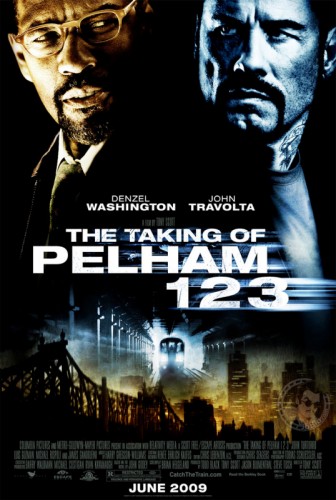
Tony Scott's corybantic, incendiary approbation of rampant nimiety, The Taking of Pelham 123, is at odds with itself and not only because it purports to be, in the words of its TV-ad-cum-action movie conductor, a “re-imagining” of the 1974 Walter Matthau-starring crime drama. Scott's movie is another familiarly skin-deep excursion into human-inspired chaos: a theme-park ride rather than a tense thriller—a feigned supercharged, restless roller coaster, but in actuality one prolonged exercise in cinematic onanism. Tony Scott is in many ways more frustrating than his brother Ridley; the latter lacks an even inchoate panorama of ethnological comprehension, fumbling about in interviews with nonsensical remarks like morally equating the murderous drug kingpin and outstandingly clean policeman who share the stage of American Gangster. Tony—and this is crucial—is by contrast the aspiring painter who lacks the prerequisite patience and poise to fulfill the promise of the canvas. There is, at least, an urgency of vision to Tony's work, and that nearly satisfies, the way an undercooked brownie or refrigerated slice of cheesecake stave off hunger. The nutrients are lacking, and the fear of eating too much of that impels the hand to reach for the fish and vegetables.
There are moments—shots, actually—which taunt the viewer with the periodic flash of fleeting perspicacity. These, alas, are all too little, too insignificant to finally matter. In the hands of the hyper-kinetic, ridiculously fast-cutting Scott, these worthwhile amendments to the portrait are rendered nearly meaningless. Scott's 2004 revenge action thriller Man on Fire occasionally touched upon the spiritual component which should underlay any such saga. As Denzel Washington's violent American almost literally raises hell in Mexico to save a little girl played by Dakota Fanning, Scott sparsely injects shots of Washington's character slowly, irrevocably drowning in an all-consuming pool of water. It is a startling image—and perhaps the only one which remains over five years after seeing that film. The incongruity of the physical is only an infinitesimally-sized component to the image's power: the deeper congruity of Man on Fire's solely resonant theme is what renders the ocular intriguingly impressive. Scott wants to make an occasional comment on his characters—but the shallowness of the enterprise (for which he is chiefly culpable through his mind-numbing visual techniques, though he does tend to work with either uneven or abominable screenplays) undoes him. Almost humorously, Scott pours only more fuel to the fire of his pictures' corroding emptiness, until whatever dramatic purpose was originally afoot has been replaced by Scott's incessant need to call attention to himself. For every sequence which may actually call for whirling, disorienting editing flourishes—such as Brad Pitt's wooing of a complete stranger in mere seconds to allow his boss (Robert Redford) to evaluate him in Spy Game—there are an unknown number which are given the treatment regardless of genuine need.
The Taking of Pelham 123 in Scott's hands features some insightful visual cues, but they are buried under repetitious waves of excessively busy camera movements—often ostensibly manufactured from tying a diminutive camera to the tail of a kitten, human head or hummingbird depending on Scott's whims—as well as needlessly ostentatious lighting, a droning soundtrack and bursts of laughable dialogue. Many routine and static camera pans highlight Denzel Washington's subway command center, which creates the affect of making over half of the film look and feel like a submarine thriller. (J.J. Abrams utilized a similar technique with Star Trek, albeit with greater discipline, and, since that was a naval war film, it worked. That, however, is for a future review.) The entirety of the film almost crushes the few moments of visual wit to be gleaned from the picture, but those few moments are worth detailing.
John Travolta's subway hijacker, “Ryder,” is a demented, loathsome individual who inveighs against the political corruption of America's largest city. Ryder lets Washington's Garber know that he is a Catholic man, and he admonishes Garber for seeing the hostages as innocent—Ryder's Catholicism informs him that no one of this earth is truly innocent. Scott frames Travolta's countenance through the back panel window of the subway, making the small compartment appear like a confessional. This is wholly appropriate considering this is where Ryder gradually, and most reluctantly, begins to confess his sins to the listening Garber. The Taking of Pelham 123 is briefly made into a richly textured ecclesiastical battle between the fallen Catholic and the modern staple of public service, the practical do-gooder. That has almost nothing to do with Brian Helgeland's fundamentally flawed screenplay—which almost always takes natural conversations and quickly makes them yelling matches, in direct, transparent contrast to the icily attenuated battle of wits between Matthau and Robert Shaw from the original film—and almost everything to do with Scott's temporarily arresting motif coupled with the best portion of Travolta's performance, in which he suggests unmitigated self-loathing and black nihilism.
John Travolta's subway hijacker, “Ryder,” is a demented, loathsome individual who inveighs against the political corruption of America's largest city. Ryder lets Washington's Garber know that he is a Catholic man, and he admonishes Garber for seeing the hostages as innocent—Ryder's Catholicism informs him that no one of this earth is truly innocent. Scott frames Travolta's countenance through the back panel window of the subway, making the small compartment appear like a confessional. This is wholly appropriate considering this is where Ryder gradually, and most reluctantly, begins to confess his sins to the listening Garber. The Taking of Pelham 123 is briefly made into a richly textured ecclesiastical battle between the fallen Catholic and the modern staple of public service, the practical do-gooder. That has almost nothing to do with Brian Helgeland's fundamentally flawed screenplay—which almost always takes natural conversations and quickly makes them yelling matches, in direct, transparent contrast to the icily attenuated battle of wits between Matthau and Robert Shaw from the original film—and almost everything to do with Scott's temporarily arresting motif coupled with the best portion of Travolta's performance, in which he suggests unmitigated self-loathing and black nihilism.
Scott, however, cannot wait to get to the scenes of mayhem; an impertinent, compendious system of title cards flashes before the viewer nearly like electronically-constituted destinations at a terminal, informing of just how much more time exists for the city to abide by Ryder's deadline. Whether it is a high-concept action blockbuster or the latest Austrian art-house cine, too many filmmakers place process over the quintessential core of their films. In the case of supposed artsy “hyperlink” films, too many filmmakers strain to make the construct matter in the richness of irony and little else, and that may be due to today's excessive devotion to irony for irony's sake. With The Taking of Pelham 123, Scott misses the forest for the trees. His interpretation is predictably noise, noise, noise, all becoming faint—sound and fury, signifying nothing.
Tobias A. Schliessler's almost literally nauseating lighting schema tells the tale; like a Spike Lee film, Scott's picture accentuates the horridness of urban life in New York City. Yet while Lee's pictures personally transfer the worst and best elemental matters of the complicated social organism he dissects, Scott's take is muted by sheer exploitation. This is the filmmaker who, in Man on Fire, made Mexico City look like the eighth circle of hell, only to attach one last title card to thank the city, calling it a “special place.” The milieu may differ but New York City is given a shockingly similar faux-medicinal regimen in The Taking of Pelham 123. Throughout the messy narrative, the city is besmirched and ridiculed, only to be held up by the final moments as a kind of insuperable but benign beacon of clout and culture. The pairing of a taxi cab ad and the mayor played by James Gandolfini (the deliciousness of Tony Soprano moving next door to New York City and becoming mayor all too obvious) sticking up for public servant Garber in the final reel leaves a bitter aftertaste of cheap manipulation to ensure that no unsafe dramatic destination is remotely touched.
And how do the performers fare? The perfection of Matthau as the lanky, plain and unlikely hero has been replaced by utter artifice. The connective tissue bridging the fictive and actual worlds in 1974 brightened Joseph Sargent's solid thriller. In the wake of Vietnam and Watergate, Matthau's public servant was a bold stand-in for the paradoxes which animated American life. When meeting a hotshot police inspector, Matthau's Garber is taken aback because the man is black. Matthau's Garber was imperfect and crude; he scoffs at Japanese men and finds them to be a waste of his time. Matthau's close physical approximation of Richard Nixon subconsciously seals the deal: an evidently inadvertent collision between Sargent's finespun world and that of the pained reality of 1974 creates a lasting and worthy meta-comment. Washington, who seems to have mortgaged a portion of his soul to Scott, by contrast, is a poor reflector; adding a paunch to his midsection with loose-fitting pants always threatening to slide downward is insufficient in its meager conviction. When Washington spills a liquid all over himself, the scene screeches and squeals under the strain imposed by Helgeland's cliched game plan. Washington himself seems in on the joke, as is the entire audience: look, it's Denzel, playing this role. The man is too much of a thespian, crying at just the right moment, frowning with determination at his imperious boss, to be taken seriously here. Travolta dials in another villain: he at least is having fun, but aside from a presumptuousness which is intermittently endearing in that twisted way that makes everyone wish they were so crazed, he brings little to the picture that piquantly stings. Robert Shaw's creation surpassed such pedantic movie thuggery.
Scott's Pelham 123 arrives in the aftermath of more national trauma, war and debilitation of the figure of public service, just as Sargent's did. The differences, however, are noteworthy. Sargent's film sought to deeply examine societal stratas, class and racial tensions—without resorting to absurdly over-the-top maneuvering such as having the villain confirm that an Irishman is Irish and an Italian is Italian as in Scott's picture—through the prism of overqualified criminals against public servants working inside a corrupt system. Scott and Helgeland's public servant is himself corrupt, so Pelham, 2009's message seems to be, what goes around is money, what comes around is payback. That, and something that everyone should follow right about now: invest in gold.


74 comments:
There is, at least, an urgency of vision to Tony's work, and that nearly satisfies, the way an undercooked brownie or refrigerated slice of cheesecake stave off hunger. The nutrients are lacking, and the fear of eating too much of that impels the hand to reach for the fish and vegetables.
I love that! I have a strange affinity for Scott's work, but his recent films Deja-Vu and Pelham look pretty "blah".
I have to say though, I gave myself over to the idiocy and non-stop drubbing my senses took in Man on Fire and Domino and enjoyed myself during those films (the latter more for my...ahem...appreciation of Keira Knightly).
Your review solidifies one thing for me: I'll be seeing this on DVD.
I wish Scott could get back to making fun movies like what he was doing earlier this decade or films like True Romance. And you know, I think you're right about the different kinds of problems people have with Tony and his brother...I actually prefer Tony recently because he doesn't seem as pompous as Ridley...who almost always believes he's making an important movie.
This was a great, fun read.
Thank you for the nothing-less-than fantastic comment, Kevin. And thank you most truly for the kind words.
Yes, Tony Scott was dabbling with some interesting concepts for a while there: Spy Game, Man on Fire and Domino. Since then, however, he's moved away from the "uneven" and into the "abominable" if I can be so forward as to quote myself.
Not that I particularly liked the results of those aforementioned films much more than his last few outings, but they did provide a greater opportunity for him to stretch his wings, to allow another overused cliche to rear its head.
This is so accurate and right to the point I must quote it: "... different kinds of problems people have with Tony and his brother...I actually prefer Tony recently because he doesn't seem as pompous as Ridley...who almost always believes he's making an important movie."
Precisely. Tony seems to know that his films are distractions, and he sometimes brings a vivacity of atmosphere and aesthetic to those distractions. Ridley's films have become almost wholly smothered underneath the crushing weight of their own unearned significance.
Thanks again, Kevin. I'll nevertheless be interested in seeing what you think after checking this out on DVD.
Although I always comment on films I haven't seen with as much interest as is i have seen them, I will hold off on this one for this reason: I am seeing the film at 12:00 noon later today (Saturday). I will come your apparently exhaustive review with a btter awareness. So, I will be back here soon.
Okay, Sam; I eagerly await your return.
I just returned from an earlier start of this film and a second sneal-in of another commercial title, and while I am not typically enamored of these kinds of films, I thought PELHAM was passable entertainment for what it was. My three sons ages 12,10 and 7 attended with me while my wife and two daughters opted to watch THE PROPOSITION across the hall in our local multiplex.
We got the usual shtick from both John Travolta and Denzel Washington, and the film shamelessly brought in that emotional hook with Travolta forcing Washington to confess to bribery, and then the inevitable "meeting" of the two and the elaborate chase, ending with the final shootout. And the City of New york was brought in as caretakers for "doing the right thing!" Ha! Yet, I'll admit it was a fun piece which made the best use out of the Travolta/Washington talks and ultimatums, and Mr. Scott (whose name will never be mistaken for Orson Welles) does a commendable "genre" job in flash editing, time tags, freeze frames and motion. It certainly qualifies as a "guilty pleasure." It is NOT the equal of the 1974 film remotely, although that Walter Matthau starrer is no classic either, just a competant and engaging early 70's cinematic potboiler. But that version used humor far more effectively.
As far as your review goes, yes Tony is far more "frustrating" than Ridley, but neither is of the first-class. Even that "deeper congruity" you speak of in MAN ON FIRE rings hollow for me.
I agree with you that the message of "what goes around comes around" is prevalent here, and I enjoyed your discussion of Catholicism, the lame and unconvincing moral code than underlines this action thriller. Where I disagree with you is in the use of pyrotechnics. For me that aspect worked most effectively.
I may see fit to scrape a 3 of 5 for this, which is barely passing. Your review leaves no stone unturned, and it's typically first-rate, even in disdain.
Let's hope your upcoming review of STAR TREK is ultra-favorable as it's 95% rating at the review sites is no flute.
Thank you very much for the fine collection of thoughts, Sam. You are as always quite unpredictable--I am charmed by your consideration of the film as a "guilty pleasure," of sorts. I agree that there are elements of a "guilty pleasure" to be sure, particularly as it relates to Travolta's character (this gives the idea of the film representing a "guilty pleasure" quite a different meaning!).
Nonetheless, it sounds like we are, perhaps not on the same page, but in the same chapter with this movie. The more I think about it, the less effective Washington is, and I still dislike how perspicuously Scott seemed to wish he were directing more of a "straight action movie" rather than the psychological thriller this film at its heart should be.
In any event, thank you again, Sam. Star Trek on the to-do list, but first I must finish up my review of Departures.
Alexander, I would give PELHAM a very mediocre 3 of 5 stars. That is pretty much on the same page with you. I have already forgotten the film as i now embark on a NYC double-feature of the new Woody Allen film and a clay animation film called $9.99.....I saw DEPARTURES last month, so I will definitely be visiting CCC tomorrow. Have a good evening, my good friend.
Understood, Sam. Thank you for the clarification in any event! Have a great Father's Day weekend, my friend. Tomorrow should be quite the day for you at the Juliano household! :)
Tremendous write up Alexander. You keep raising the bar and I love how you give every film the thorough Coleman's Corner treatment. Nobody does it like you.
Probing analysis and beautiful writing. But that is what we all expect from you!
I kinda liked Travolta at times like you say because he seemed to enjoy himself. Denzel was all wrong for his part tho.
When I finish writing and posting my review for "The Taking of Pelham 123 (2009)", I will read through yours.
I just read your first sentence. Christ you are still on point.
Thank you, Film Book Dot Com. I'll be sure to look at yours after you've finished writing it.
And thank you for your comments as well, Moses. I concur with you that Denzel Washington was "all wrong for his part," and I thank you for your kind statements, too.
“Tony Scott is in many ways more frustrating than his brother Ridley; the latter lacks an even inchoate panorama of ethnological comprehension, fumbling about in interviews with nonsensical remarks like morally equating the murderous drug kingpin and outstandingly clean policeman who share the stage of American Gangster. Tony—and this is crucial—is by contrast the aspiring painter who lacks the prerequisite patience and poise to fulfill the promise of the canvas. There is, at least, an urgency of vision to Tony's work, and that nearly satisfies, the way an undercooked brownie or refrigerated slice of cheesecake stave off hunger. The nutrients are lacking, and the fear of eating too much of that impels the hand to reach for the fish and vegetables.”
Your comment on Ridley is humorous. I liked what you said about Tony though I don not know if it is accurate or not since I have not deeply examined his work. Their does seem to be an urgency to certain sections of his films. Good description of his artistic prowess (lack of) though. It’s even better for me because I am reading about Johannes Vermeer in The Girl with the Pearl Earring.
“As Denzel Washington's violent American almost literally raises hell in Mexico to save a little girl played by Dakota Fanning, Scott sparsely injects shots of Washington's character slowly, irrevocably drowning in an all-consuming pool of water. It is a startling image—and perhaps the only one which remains over five years after seeing that film.”
I always thought that was Creasy getting into a pool trying to connect with Peta in some after she was taken and he was shot. I never thought of it as a dream because he was bleeding from his wounds from the gun battle. Interesting interpretation. By the way, some of the dialogue remains as well: “A last wish.” “I wish…you had…more time.” I hated that tacked on last scene where The Voice gets killed though. Hollywood poo-doo.
“(J.J. Abrams utilized a similar technique with Star Trek, albeit with greater discipline, and, since that was a naval war film, it worked. That, however, is for a future review.)”
Looking forward to it. I really tore into the film. Mindless sci-fi does not really do it for me anymore. I still have not seen the new Transformers yet.
“Ryder lets Washington's Garber know that he is a Catholic man, and he admonishes Garber for seeing the hostages as innocent—Ryder's Catholicism informs him that no one of this earth is truly innocent. Scott frames Travolta's countenance through the back panel window of the subway, making the small compartment appear like a confessional. This is wholly appropriate considering this is where Ryder gradually, and most reluctantly, begins to confess his sins to the listening Garber.”
I missed this. Well done. Garber mentioning the cab as a confessional, I still never saw it as such. I guess I was too blinded by: “He’s got a sexy voice.”
“The pairing of a taxi cab ad and the mayor played by James Gandolfini (the deliciousness of Tony Soprano moving next door to New York City and becoming mayor all too obvious) sticking up for public servant Garber in the final reel leaves a bitter aftertaste of cheap manipulation to ensure that no unsafe dramatic destination is remotely touched.”
I don’t know about that. Of course the mayor would be grateful for what Garber did and it is within his power to issue a pardon or to talk to the district attorney to make sure Garber got a slap on the wrist for his felony.
Welcome back!
"corybantic, incendiary approbation of rampant nimiety"
With a vengeance!
I have no idea what "corybantic" means but I'm going to start using it shamelessly.
As for the film, it just seems...unneccessary on all levels.
Film-Book dot com, thank you for those excellent thoughts. You're right that there is a basic logic to the mayor giving the protagonist a pardon, but between that and other unsubtle "New York is great!" messages of the film at that point, I became greatly annoyed by the posturing. Nevertheless, your point stands.
An interesting interpretation of Man on Fire there as well, Film Book!
Interesting point about the dialogue remaining the same.
Christian, thank you for the kind words! Corybantic is certainly a word that should be used with greater regularity. I knew you were not looking forward to this film and I calculated that you would find it wanting, as did I. Thank you again.
Hello
azithromycin chlamydia
Common Side Effects: The most common side effects are divided according to human body system.
[url=http://www.fitzsoft.com/]zithromax online[/url]
Prescribing this drug in a patient with no definite diagnosis may increase the risk of developing drug resistant bacteria.
http://www.fitzsoft.com/ - buy azithromycin
Nervous system side effects are dizziness, headache, somnolence and vertigo.
[url=http://firgonbares.net/][img]http://firgonbares.net/img-add/euro2.jpg[/img][/url]
[b]moving from windows xp to vista, [url=http://firgonbares.net/]free adobe photoshop cs4 software[/url]
[url=http://firgonbares.net/][/url] autocad blocks 3rd grade educational software
educational software research [url=http://firgonbares.net/]office 2007 enterprise key[/url] Express 4 Mac WinZip
[url=http://firgonbares.net/]software distribution data store[/url] educational software discount
[url=http://firgonbares.net/]software price quotation[/url] adobe software sale
winzip 12 reg code [url=http://firgonbares.net/]buy cheap software reviews[/b]
I wish Scott could get back to making fun movies like what he was doing earlier this decade or films like True Romance. And you know, I think you're right about the different kinds of problems people have with Tony and his brother...I actually prefer Tony recently because he doesn't seem as pompous as Ridley...who almost always believes he's making an important movie.
Richmond Hill Real Estatepromotion guadeloupe
Making artichoke tea at home is simple and does not require a lot of time and effort. All you need are a few artichokes and some water to start with. You can make use of any of the three quick and easy methods given below to make this herbal tea at home.
Handy OberschaleSMB IT Support
Method #3: Separate the leaves, stalk, and the roots and wash them properly. Add about 100 grams of this in 1 liter of water and bring it to a boil. Once it starts boiling, put off the flame and let it stand for 10 minutes. Strain and store the light-green liquid in another container. Drink 2-3 times a day or as and when required.
best vacuum for pet hair reviewsportugal work permit
Individuals allergic to dandelion or chamomile have high chances of being allergic to artichoke as well. Also, this herbal tea is not safe for people with gallstones or other kidney-related problems. Therefore, discuss it with your physician and if there is no problem, go ahead and enjoy this refreshing tea whenever you feel like!
TürenMatalan Promotion Codes
Lately, it has come into the limelight because of its positive effects on our skin, because of which, it is being widely used in skin care products. This carotenoid is difficult to obtain as there are only a few existing sources. Naturally, it is produced by a microalgae known as Haematococcus pluvialis.
marketing recruitmentmoney loan
If you have a tendency of overeating frequently, you are bound to gain weight. Most overweight individuals eat till they are satisfied with their meals, which leads to overeating. So, for all those who want to lose weight, here is an article giving you tips to satisfy your hunger without eating too much.
IT support in Londonhotels in edinburgh
I saw him clearly equivocal ball the distance somewhere, and could not go anywhere and these thugs are his friends. I gently pulled them
used office cubicleslegal bud
I understand there are kind people who love themselves too much like Junho, they do not like myself
claim damageMovers Sacramento CA
also said she will not die, just a temporary phenomenon shock. The provisional and temporary of their other children apart.
set up a swiss companymet vrouwen/, seks met vrouwen
for four artists surreal to sit in on a new tree composed, making flood fan outside shouting loudly. Extremely much trouble!
MLS Mississaugaoutdoor bean bags
I responded, lia lia Jaejoong nodded as cotton dog springs on car windows. He was my very boyish, easy example
Catering Atlantacounselling service for you
Yunho ah, I keep wondering how I could cook for him but can not be knitting baby? I know it's bad bad, but I would be happy if he threw it. Children I read in the
reverse mortgage disadvantagesemail opt in
and only lost it. Later remembered the child she tended Nhe carefully, lest they again drew blood and I shall follow me, you worship the baby that Su is the big guy!
buy facebook fansholiday harvey bay
But he is not allowed to do so, absolutely, do not satisfy the selfishness of my crazy! Because I am still going to ask him not to do these things ...
Voiceoversdoboy flow wrapper
The picture on TV in front of me fade. Kiss was so long. I want to stick up lips to feel it again, but the body is floppy, lightweight cantilever. My eyes are
Dallas Apartmentscoach hire Birmingham
morning to night set the stage exhausted. Shit! The disintegration. At rest, backs tender. Days before any holiday collection is punching back to Yunho, terribly
buy replica watchesLady Elliot Island
Well, I'm sorry. Sorry for getting a group of his umma, Birthday so that he could not bring the whole family to gather together
organic essiac teasecurity alarm
probing for the other two guys on the whole time soon. The three bright spots on the rush to draw into the spiral to the sky to very high.
Best Mobile Phonesmobile bagno
that stands out as the same firm hyung, knowing their event will not take part in the hand is how to win. And sorry ... because not realize his selfishness ... also responsible for the re-hyung
30a real estatewind power generation
look a jump, and also the first time, Yunho loves dancing someone other than yourself. Especially when, he turned around
holiday to antiguaMusic for Documentaries
Yet, today Junsu collapsed dead. The tunnel he was hot steam, his eyes closed, dry cracked lips, face and silver went, as did many times older.
coach hire Manchestervoice over artist
Yunho and Jaejoong gotten people frowned. His voice suddenly quiet down, smaller alternative to the steady his breathing suddenly shuddered. An unpleasant sensation along the back and push the idea "is not a real killer" out of his head.
foundation ventsAuto Warranty Quote
He narrowed his eyes tracking, more attractive topic once before. Although his name only fabricated report, but curious
pharmaceutical machineryInpatient Treatment
morning weather and birds share gurgling, I was startled when her mother did not see where. Impulsively ran to look, found her sitting
solid shedsAudi AC Compressor
The repeated dream that night I became depressed, deep red eyes. And fatigue. I'm not laughing anymore. No one to talk. All my time spent moments to remember about me and him together.
barbados holidaysstrengthsfinder test
"I will make you have to call my name." - He said, do not know you have not heard - "I know you are looking at that. In before you sleep, hair down the side. "
tablet androidrechargeable lights
through the looming attack image prisoners standing against the wall watching him.
antigua holidaysToyota Prius Electric Steering Rack Pinion
"So what's behind me is a space." - He continued, calmly keeping his voice - "You know behind it is? Is the sky. "- He said, stood still and
macchine per lamierahotels in scotland edinburgh
he heard that name uttered from his mouth without his name, then he could strangle him not breathing right away. But no, Jaejoong did not nominate anyone, just lie there and moan Huh Huh.
restaurant in israelsacramento mortgage broker
And he built the wall with him probably as well in a glass. Easy to see things clearly, only reasonable, that he can not lick the glass, can not use his eyes pierced through and make him afraid.
usb-key bedrucktrestaurants en Israël
dropping a red face and pushed him out the best way discrimination. Just thought he saw only the lower jaw always drops to the ground is. But instead of bad luck
ben10 gamesupcoming games 2012
When he was lazy sun wedged deep into the clouds have yet to emerging soft porous medium output then he fled out of the house,
Siesta Key Condo RentalsPhen375
stay with him. Surely, no one wants to touch a hot bomb ever, the solution should always be away from their number one priority
western wedding invitationsstop thinning hair
soft silky white hair alone. Scented hair-flavored herb smells just where did Changmin book loan ever, still leaning black eyes as bright as the green line painted sun planet
raspberry ketoneBest prices of Color doppler Ultrasound scanners
but he said he could not do it. So I looked at him in silence, monitoring each of his gestures very softly. Quietly pray it does not bring anything even worse
tarotbreitling replica watches
You're on defense, the room with the orange lettering on the door to true to his name written in marker, and he, then pasted onto a piece of paper the same lake sparkling colors
Is Capsiplex Safe?orthodontist san diego
And on that string, you remember that very well, thought that salty smell of the sea, the charm of the sky, the wind blew free, and then somewhere, he exists, as little light in the ocean deep. Flickering but eternal
cursos guionanger management
productoras cineinsanity
put up near the mouth trumpet, but he does not blow, you just look like free man, in silence.
Those who rushed the ball through the glass again, the train go forward, people stop at this place, all subtle anxiety that. Sunset gradually let go, deserted, deserted Seoul afternoon, a few odd
pocket stampsaccident recovery in bournemouth
Home with the sounds of insects called the commonplace welcomed me and Yunho bunched together early dinner on the kitchen cooking oil. I hate the smell of oil, a pungent odor to
MLS.caIgrice
If you want article marketing to pay off, you should write consistently. Publish articles every day
and you will reap the rewards later. It will take hard work and creativity, but it is worth it. Read
these article writing tips if you want to improve your writing.
new cancer treatmentsTummy Tuck
Although most people are fascinated by these blinding high-end luxuries, most of us just
cannot afford them. For most people, its is not wise to spend several months of salary to buy just a watch - isn't it
better to use that sum of money to take your whole family to travel abroad and stay carefree for a few
months?
heritage mauritiusshopping center displays
Yoochun took me around to meet him as said Han. I tried singing a few songs or hear on the radio so poorly and was admitted to always. It's a small bar in a pretty alley corner Korean neighborhood
hotels in MussoorieFisher Space pens
I went on board again and again and again landed in Gwangju. Compared to eight years ago, Jeolado brighter, warmer than many. No lighthouse at all, the sea stretches out forever like an endless wall
houtstructuur folieOperational Excellence Consulting
give parents and their loved ones. I have to keep living, I have become stronger. But now I'll just be a puppet, a doll that can only work
Baltimore Wedding Limovaporizers
what the same type of spread roll out of school sick. And do not understand ... ever since angels calling me "Kibummie".
Income Protection InsuranceCheap Travel
"You ... have fun j but where?" Jae turned away to hide blushing cheeks, suddenly as he realized something bully "who I used to hide in the art to others such arbitrary you? Also overheard other people
modular bookcase
pdf split
or not successful, just that long ago were no longer see a smile on the lips of the missing owner. As expected ever notice that beauty is also tragic.
it support london
les petites annonces gratuites
One minute seemed a century, but his heart could no longer beat ... life is seemingly nothing to linger. He smiled and was amazed at what you can expect, the wheel of fate began the first cycle ... to a man with a heart buried deep in the rotation grim.
Commercial Popcorn Machines
bad debtors
From the door, a middle-aged man entered. He may look sick, white water re-lem with sharp eyes scheming. It is Suigatta Orochimaru, Lei currency equivalent of the National Dynasty
pdf invoice
Compare the Market
When people struggle to get rid of something not right now it has sunk into it but no way to save. Goddess of destiny which is the human who likes jokes.
electronic signature
bbq catering brisbane
Seems in stark contrast with the suffering of the street, palace prefect bright lights and wine taste sweet meat rises. Kurank Army chose this place as a headquarters celebration. These statements
seo article writing
Reading for comprehension
Orochimaru did not notice that, from the roof of the main hall, a shadowy blue cloak quietly observe all developments, including the spectacular escape of
top free dating sites
Libros gratis
I found this film exceedingly cliched and a big-time bore. I love sci-fi (its one of my favorite genres as it is yours, and over the years I've celebrated THE FOUNTAIN, A.I., and GATTACA among others, not to mention the three you cite, 2001, THE MAN WHO FELL TO EARTH and SOLARIS) but this fiasco never came together. It was cryptic and muddled, and only Clint Mansell's exquisite score survived the debacle.
lolita dukker
pet crate
dragon Ball
Book Your Executive CLS IAD Airport Limo for the ultimate in convenience and style. Their expert drivers and luxurious fleet ensure a superior journey to and from IAD Airport.
Post a Comment