Friday, January 16, 2009
The Wrestler (2008)
Thursday, January 15, 2009
The Reader (2008)
Tuesday, January 13, 2009
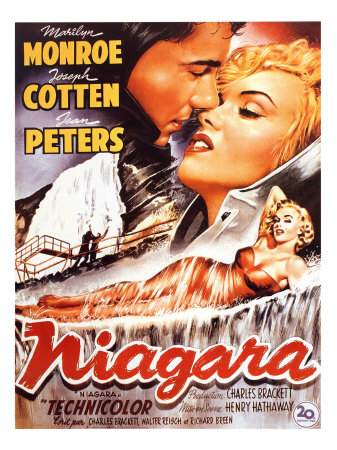
Niagara (1953)
Henry Hathaway is a fascinating, intrinsically arresting directors with a keen visual aptitude. His use of frames, arches and other compositionally delineative objects create cleanly-photographed portraits of his characters. These framed portraits usually connote a kind of personal or even metaphysical entrapment, excellently communicated with richly detailed sequences of foreground-background struggles. Those foreground-background struggles usually tell two different character stories in one shot, and Niagara displays this stylistic technique. Hathaway's affinity for water and water-based settings such as this film and 23 Paces to Baker Street, is interesting to consider as well. He often shoots the background water through a frame, a window or some kind of portal—frequently in close approximation to the characters, drawing the connection between character and setting that helps to distinguish his admittedly workmanlike approach to certain parts of filmmaking, such as pacing.
Niagara is a beautiful, Technicolor film from 1953, starring Marilyn Monroe, Joseph Cotten and Jean Peters. Melodramatic, as well as splashy both in its brightly colorful visualizations and in its lurid storyline, the film may in some ways belong as much to the 1950s melodrama as to film noir. However, the opening, with Cotten's acidic, pained and mocking narration is certainly at one with noir: “Why should the Falls drag me down here at five o'clock in the morning? To show me how big they are and how small I am? To remind me they can get along without any help? All right, so they've proved it. But why not? They've had ten thousand years to get independent. What's so wonderful about that? I suppose I could, too, only it might take a little more time.” Cotten's character is the married dupe familiar to film noir—George Loomis, married to Rose Loomis (Monroe)—and his bitterness is to be completely explained to the viewer through the narrative's unfolding.
The picture is paced slightly leisurely, though it never begins to stall. At ninety-two minutes, it is given periodical punctuations of action that make it altogether brisk, and Monroe's almost outre and, in this context, purposefully furbelow sensuality make the film's more underdeveloped portions quite sustainable. Cotten's performance as the man driven to madness and murder by the scheming, adulterous wife is eerily believable, despite some of the melodramatics the screenplays coerces him to indulge in. Whereas certain actors would likely have chewed scenery in the part, Cotten understates his predicament as best he can. Peters plays Polly Curtler—Anne Baxter was the studio's first choice for the part; after she withdrew the entire film was dramatically reworked to emphasize Monroe and her part— who is the loving wife to Ray Curtler (an annoyingly ineffective Max Showalter, made all the worse by a deliberately irritating and under-written character). Peters begins piecing together the pieces of the Loomis puzzle, and is continually rebuffed by her own husband, who insensitively insists that she must simply be seeing things for no good reason. Besides being carried to unrealistic levels by the screenplay, Ray's behavior is repetitive and paradoxically weirder than anyone else's neurosis in its own way, and far less interesting than anyone else's.
The screenplay does indeed suffer at least somewhat from what the old saw describes as too many chefs spoiling the broth, giving the film some unsure beats in its midsection—and the Baxter factor had to have left a considerable impact on the final product. Here the broth is diluted, but adequate. Charles Brackett, Walter Reisch and Richard L. Breen wrote the screenplay, which has a simpler plot than its structure would suggest. Hathaway takes the template of noirish thriller conventions and makes the screenplay's occasional banalities more engrossing by establishing relationships with wordless visual communication. And even scenes that were probably written in the screenplay, relying on silence, are brought to sharper, more penetrative meaningfulness by Hathaway's suasively solid craftsmanship. The first scene between Monroe's Rose and Cotten's George tells the tale of their relationship without needless words: he is knocking on the door and she is resting abed, smoking a cigarette; knowing that her husband has returned, she snuffs the cigarette out and pretends to be sleeping. It is the whitest layer of duplicity that the film will explore.
Where Niagara earns its place in the broader filmic fiefdom of noir is in its psychology, and in its internecine conflicts between Cotten's dupe and Monroe's seductress, and between Peters' intrigued wife and Cotten's seemingly malevolent intentions toward her. Irony is employed, free from cynicism. A sequence in a bell tower is heartbreakingly beautiful, evocatively photographed by Joseph MacDonald (who photographed John Ford's My Darling Clementine, Hathaway's Call Northside 777, and some of Elia Kazan's directorial work). Chemistry is unnecessary between Cotten and Monroe, since their parts call for, if anything, the opposite—and their screentime together is surprisingly sparse—but the effects her Rose's marital malpractice has on his George is profoundly brought to life by Cotten in one of the actor's more offbeat performances. Peters, meanwhile, makes her part register with a performance that balances all of the character's narrative-driven necessities, including her intelligence and naivete, her gentleness and high-spiritedness. Hathaway allows for the screenplay's lack of central focus—is it George's point-of-view from which the film forms itself? Rose's? Polly's?—to become a positive attribute, as it squeezes logically unreasonable tension out of George's whereabouts, motives and location in large swathes of the film, especially when relating from Polly's observant spectator.
Niagara follows the noirish pattern of sending its protagonist into an entrapping web of betrayal and murder, spurred by lust and greed, giving the protagonist an opportunity to right the course, only to see his choices continually backfire and drag him down into the quicksand of anguish all the more forcefully. In the third act, Cotten's George scrambles to escape the trap he has, in a hideously ironic manner, fallen into. It is here that the film tightens its grip, losing in atmosphere while gaining in high drama. It may be said that it is in that harrowing but sumptuous bell tower sequence—understandably considered to have been a possible inspiration for Alfred Hitchcock in making Vertigo—where the oneiric qualities of Niagara unmask themselves to describe not a limpidly pellucid dream but a terrifying nightmare. And in a definitive way, Niagara postulates that the viewer reconsider noir, at least ever so briefly. For in Niagara, perhaps the most literal definition of the struggle that lives and breathes in the very heart of film noir may be conceived: a man on a small boat that has run out of fuel, being drawn inexorably to the mighty Niagara falls he so contemptuously recognized as so much greater than himself, drifting to his doom.
Monday, January 12, 2009
More Thoughts on Gran Torino
In my review of Clint Eastwood's Gran Torino, I elected to not cover certain issues that were primarily germane to the film's climax.
Seeing as the film is now in wide release, I have decided to share some thoughts I have had on Gran Torino since seeing it but have stayed quiet about for fear of "spoiling" the film.
So, a full spoiler warning is in effect:
- One of the subtler points about the film is Eastwood's character, Walt Kowalski, using his cigarette lighter, which has the symbol of the First Cavalry Division (the yellow shield with the black diagonal stripe and black horse's head). This establishes three things: firstly, Kowalski takes care of his lighter; he has had the lighter since 1951, when he bought it in Korea, so it symbolizes simple American manufacturing durability which is today lost; and finally, if one is allowed to make such an assumption, Kowalski--who is coughing up blood from his lungs--is a victim of the Korean War. Since soldiers were given cigarettes to smoke, and encouraged to smoke, many became addicted to nicotine. In a certain way, then, Kowalski is one of the more slowly-realized casualties of a war. (Again, this final thought is assumption, but not unreasonable speculation.)
- The Christ imagery, and particularly of the final scene with Kowalski alive, may at first glance appear to be "too much," but there is something to be said for what Eastwood's characters have long represented. Kowalski is ultimately giving up his life for his friends. What makes the imagery work for me is the way Eastwood's hand opens up so the camera can take a good, long look at the aforementioned lighter. The shot looking down on his corpse takes in the stream of blood that is trickling down his wrist--with the militarism represented by the lighter, this crucifix imagery is rendered, in a way, more universal.
- Just as I noted in my review, the film does linger like an older John Ford or Howard Hawks picture. It is essentially fairly complicated, but with a simple coating that makes it quite accessible and a little deceptive in its form.
- Likewise, the film should be--and doubtless is being--compared to The Shootist. John Wayne's final performance, in which he finally lays down his life, in part for the son figure of Ron Howard's, remains poignant today. Eastwood's borrowing of these motifs is worthy homage, and there is no other actor-director who could get away with it--but he can and should be able to. The film is in this way a billet-doux to the American heroes of varying stripes, like Bogart or Wayne, who often acted gruffly or insensitively but, finally, tried to do good.
- Kowalski's repeated comments of slaying a "gook," a "kid," who wished nothing more than to surrender in Korea recalls Eastwood's Iwo Jima films--and especially Letters from Iwo Jima, in which American soldiers are shown mercilessly snuffing out the lives of Japanese soldiers wishing to surrender and survive. Kowalski tells one of the Hmong gangbangers that he could shoot his head off, go back inside and sleep like a baby--obviously thinking of his past in Korea.
- Eastwood's depiction of sybarites again seems to indicate that Eastwood views this kind of person to be rather worthless.
- The phone call of Kowalski's to one of his man-child sons has lingered with other fairly "small" scenes. The look on his son's face after his father hangs up is rather perfect: the quizzical realization that his father would never call--so why did he now?--hits home.

- Gran Torino is an interesting film, and a fine vehicle--pun intended--to be Eastwood's acting swansong. The one thing that hit me just as Kowalski was being shot at the end was that he was entrusting the Hmong community to rat out "their own," despite it being established repeatedly that "the Hmong keep their mouths shut." Similarly, the police and judicial system is suddenly entrusted to save the day, and keep the Hmong gangbangers locked up, as one cop says. This is most ironic coming from Dirty Harry Eastwood--trusting above all else the Hmongs he had seen as alien, and "the system" he had, in earlier incarnations, seen as bankrupt. A strange, fascinating send-off.
Sunday, January 11, 2009
The Tall T (1957)
Saturday, January 10, 2009
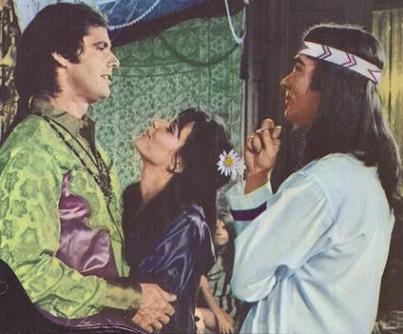
Psych-Out (1968)
Friday, January 9, 2009
La Ronde (1950)
Thursday, January 8, 2009
Cadillac Records (2008)
Judged, therefore, on the sheer emotional thrust of its own worthwhile story, Cadillac Records is a triumph on its own terms. Martin's blending of wildly antithetic characters and the consequent sub-plots that weave throughout is thorough, measuredly following the story of Chess Records. The picture terrifically clamps down on the bitter acrimony in a markedly different kind of workplace that so often characterizes the relationships between people who truly love one another. Martin is still finding herself visually, perhaps, but she has a knack for stitching together potently punctuating dramatic scenes that refuse to go away quietly for fear of embarrassment. This film, too, deals with drug abuse, but the pivotal, highly-charged and emotionally complicated scene that takes on the brunt of the film's time on the indignities of drug abuse is unlike any other in a film remotely like this. Playing out between the strung-out Etta and the sympathizing Chess before a fireplace, the scene establishes a superb contradiction that bedevils the characters: the pit of smothering heartbreak, loss and excruciating memories against the mocking promise of romance.
And Martin maintains that high-wire act of emotionality, which is a truly welcome sight. If she cannot reinvent the wheel, she can make it durable, and she does, with great integrity. Not everything works. The narration is in its own way affable and mildly interesting, but there are several times when its pedantic laying out of the literal, particularly in the ambiguously political relating of the racial discord and angst of the era, seems superfluous, like title cards explaining the cultural meaning of numerous scenes' drama for anyone who did not “get it.” However, when Martin and her cast launch off the ground, they soar. And none fly higher than Beyonce, whose performance must be seen and heard; the immediacy she brings to the role of Etta is something truly inspiring to witness. So much of the character's introduction is seeped in time-worn cliché, with her throwing hissy fits and temperamentally demanding things in the studio. Brody's Chess has to threaten to pull the plug before extracting the kind of singing he needs to hear from her. Beyonce succeeds because she grabs the cliché and breaks down its pulverulent coating until what seems like the real Etta emerges through her. Yes, the musical biopic staples are almost all still here, but they hit harder. The best example? Beyonce's singing of “I'd Rather Go Blind.” As in Ray, a pivotal moment is made out of a singer truly singing a song to someone in their immediate proximity. As Beyonce's Etta ferociously sings the song of embittered, crushed and impossible love to the man she loves, and who loves her, the married Chess, the faithfulness to Etta's vocal work is noteworthy. Viewed from Chess's perspective, Etta is as beautiful as ever. Yet while the camera closes in on Etta, her countenance is dented; a defiant sneer develops. As the scene and song both swell in bombast, with the crying Etta belting out her lyrics directly at Chess, Martin courageously keeps the close-up of Beyonce's Etta running, finally breaking the shot for good when Chess walks out of the room just as the song addresses his action (“Then to see you walk away from me...”). And so Martin completes her cinematically rendered essay on race relations in mid-century America through the power of music. History is simplified, and the delicately recounted black-and-white history of Chess and his musicians is made accessible to follow, from his offering of Cadillacs to his most prized finds to a back-alley assault at the hands of blacks he withstands as "South Chicago... was changing," according to the narration. But movies do that. And good movies do that well. Cadillac Records may not be the most rigorous motion picture out now, but it has one attribute missing in at least some of the supposed titans of this Oscar season: soul.
Wednesday, January 7, 2009
Laura (1944)
It is that belletristic sensibility that in no small measure comprehensively disguises the frequent subversively risque content of Preminger's films. This enticing thematic blending begins in earnest with the film that catapulted Preminger's reputation in Hollywood, Laura. (Preminger was nominated for Best Director for the film, one of five Academy Award nominations the picture received.) Originally to be directed by Rouben Mamoulian and lit by Mamoulian's master cinematographer Lucien Ballard, the cinematography was provided by Joseph LaShelle, whose gorgeously shadowy black-and-white compositions and beautiful lighting schema provided the film with the aesthetic accentuation that so richly buttressed the action of the plot. (The cinematography of LaShelle's won the film's only Academy Award.) LaShelle's cinematography sweetens the strong brew of Laura, lending a nearly constant luminosity to the characters and places in which they are captured.
Laura, in major, definable ways, marks the most attractive beginning of Preminger's refined technique as authorial voice. If Laura's ensemble cast is made up of possible suspects in a murder case, then the great Austrian director's latter films likewise portray multifarious characters, in plentiful and disparate environments, denominated as much by the director's correlation between persons and the movements by which they traverse as any narrative-determined consequence of their actions. In Preminger's work, characters stand out in overwhelmingly large rooms, walking about and speaking to one another with purpose, forging identities for themselves through their actions as impeccably as his camera gradually posits their true natures. Taken as something as trifling as a simplistic whodunit, Laura in actuality provides the framework for Preminger's later work, including Daisy Kenyon, Whirpool, Where the Sidewalk Ends and Angel Face, as well as the late epics of one manner or another—characterized by speech-making, having to do with the personal, the political, the legal, the dutiful—Exodus, Advise and Consent, Anatomy of a Murder and In Harm's Way, respectively.
It is in the former group of films wherein an observer of Preminger finds the keenness attendant to swiftness and narrative economy. Marked as they are by mutual incisions and tokens—beautiful black-and-white creations out of which despair and humiliation fester, sometimes uncontrollably, these pictures are emphatically accompanied by masculine obsessional behavior, juxtaposed against wantonness and perversity of the feminine. Laura deserves a special place as an unsettlingly gleeful meditation on the kinkiness that resides in the hearts and minds of pundits, of playboys and of policemen. As much of the film takes place in flashback, it is intriguing to linger on the lack of veracity supplied by the narrator, one acidic theatre critic, Waldo Lydecker (the openly homosexual Clifton Webb, in his first “talkie” performance, and first film in nineteen years, the security of his role consequently threatened by studio boss Darryl F. Zanuck, giving a virtuoso performance). This untrustworthiness of the storyteller is an indelible contrast to the objectivity that characterizes Preminger's mise-en-scene. The risque qualities of later Preminger pictures such as The Moon is Blue, which was disallowed the Production Code's seal of approval and withheld due to supposedly provocatively dirty dialogue such as the word “virgin” and The Man With the Golden Arm, about a heroin addict played by Frank Sinatra, find in part their inspiration the director's interest of pushing the proverbial envelope, for the sake of greater, more unvarnished truth.
Laura is a perverse romance of sorts, with three different men loving a woman who is apparently dead. The portrait of Laura, often accompanied by David Raksin's famed “Laura” theme, hangs on the wall like a specter, and magnetic lure for the widely different men who pine for her. This beguilingly melancholic component of Laura speaks to the noirish feature of entrapment, beckoning the three men out of their respective pits of alienation and despondency. For Lydecker (who was evidently based on New Yorker theatre critic and broadcaster Alexander Woolcott, his tale of how he came to know Laura is tinged by his personal stake in the matter of the titular character, and how he attempted to evoke the socialite buried within the woman as he viewed her. The opening of the film revealingly ushers in the exclusivity that is at once outstanding and simply complementary to Preminger's greater style—like characters incongruously captured alone, usually stolidly and quietly, in a more subduedly static framing that richly unravels the layers of protective artifice, in this instance before the figure is able to ever display such self-supported aegis. And yet this character, Lydecker, a preening fop, is matchlessly anomalous, so endowed he is with a shield of support that he carries it with him wherever he goes, including the large, beautiful marble bathtub in which he furiously writes his corrosively astringent editorials. Literally, this is especially rewarding, as Preminger's insistence on portraying Lydecker's nakedness—including the subsequent reaction of another character, in which case the columnist is soon seen by homicide police detective Mark McPherson (Dana Andrews). The visual scheme is brilliant, as Preminger's objective viewpoint demonstrably articulates with stunning eloquence and economy the literalism that authentically supplements the metaphorical bulwark of Lydecker's. His nudity is blocked by his typewriter—a bit of sly commentary unto itself that hides in plain sight.
Lydecker recounts in the opening scene, “I shall never forget the weekend Laura died. A silver sun burned through the sky like a huge magnifying glass. It was the hottest Sunday in my recollection. I felt as if I were the only human being left in New York. For Laura's horrible death, I was alone. I, Waldo Lydecker, was the only one who really knew her.” Lydecker's pomposity and pretense, coupled with his supercilious haughtiness and sense of self-importance are conveyed with a campy, almost caustic delirium by Webb, who savors every lacerating line of insult and self-deluding romanticism. Viewing himself as Laura's social creator, his unrestrained amour-propre is joyfully brought to animated, cerebral life. Through narration, monologue and dialogue, Webb's vocal delivery is amplified and mellifluously enunciated. Yet the actor places just the necessary amount of dignity to the role, so Lydecker does not descend into mere buffoonish caricature. The almost botanically aggregate creation by Caspary's story, the character is a dense cluster whose divergent parts and carpels only underline the uncondensed quantities to be found in his form. The humor at the character's expense is admittedly significant. In one of the film's most bizarre beats, early in the picture Lydecker stands up in his bathtub, fully nude (off-camera), standing before the questioning McPherson, asking the policeman to hand him his robe. Andrews' McPherson stares at Lydecker, looks down and smirks, reaching for the writer's robe.
McPherson himself is slowly drawn into a pathological, perverse love affair with the murdered Laura. An offbeat, hardboiled cop—with handsome but ambiguously sabulous features and demeanor—McPherson is a steadied, thinking man, who literally enjoys playing puzzles for amusement and satisfaction. Andrews is marvelously understated as the cop whose laconically verbalized comments to other main characters such as Lydecker and the duplicitous, two-timing playboy fiance Shelby Carpenter (an unassailably indecorous Vincent Price), acknowledge a knowingness to the policeman that is nevertheless corrupted by his own budding, quixotically romantic feelings for Laura. As he longs for the woman, gazing through the shadowy haze in which Preminger and LaShelle so persuasively immerse the viewer, the character is further fleshed out. McPherson's blunt language infuriates Lydecker, particularly the cop's use of the term “dame” to describe all women, including Laura. A chain-smoker, known for his heedless dauntlessness, McPherson is etched as something of a self-destructive man, with an unhealthy crasis that stresses the decisions he makes.
Yet a case can be made that it is Gene Tierney who makes the most memorable impression, or at least lends the most vital luminescence to the proceedings. As McPherson works tirelessly to entrap her murderer, the screenplay provides an estimable examination of the woman at the center of the whodunit. As viewed through the male lenses of Lydecker, McPherson and Carpenter, Laura is perhaps an incomplete figure, or at least could easily have become as much without such a bedazzling actress. Equally wispy and strong, Tierney as Laura is a contradiction amidst others. As McPherson and Laura stare at one another—he at her portrait, she back at him while he stews—he is busily chasing any clues or hunches he can uncover, practically living in the woman's apartment. She is projected through long flashback sequences, the details of which are provided by the questionable source of Lydecker. These, among other points, serve to illustrate just how divinely paradoxical and conflicting so many disparate paradigms established by the film. Laura's very identity is most intrinsically related to the viewer through the cockeyed viewpoint of Lydecker's. Preminger's camera brilliantly conveys the smoky murkiness of Laura's personage, and in one instance shoots her through a cloud of cigarette smoke blown by Price's Carpenter at a party. This framing of Tierney's, and Laura's, ethereal beauty through such impediments and accretions further transmits the thematic touchstone of excavating the role the unreliable brume that accompanies the male gaze, and discovery of love, plays in the story.
The contrasting lightness and darkness of the film is intriguing; Laura's sumptuous cinematography often points to film noir, but much of the picture's events take place in fully lit rooms that could have belonged to a 1930s crime picture. The greater the sensuality present, the more seductive the lighting patterns become. Sitting before the haunting portrait of Laura, McPherson, drinking, finally falls asleep. Preminger gently nudges the camera towards the protagonist. A moment transpires in which McPherson is caught as totally still, sleeping away; time has elapsed. The camera reels back from him, and soon a woman enters the apartment. Much later, as this woman is interrogated in a darkly foreboding room by McPherson with strong lights beaming directly into her face, her breathtaking beauty radiates, glowing like light itself. The woman's pulchritudinous countenance shimmers in the shot, exquisitely framed by Preminger's taut control of mise-en-scene.
In many sequences, Preminger opts for the triangular compositional schema that he would perfect in subsequent pictures. (Where the Sidewalk Ends must be noted for this tremendously consistent stylistic. That will be reviewed in this space soon.) In numerous shots, one central figure hosts the primary line of view, forming a the pivoting point that bisects between the two characters on either side. (Again, Where the Sidewalk Ends powerfully brings this directorial signature-branding device to greater fruition and elan, as it conveys the tightening tension that wraps around Andrews' different, more recognizably noirish cop protagonist like a noose.) The first major three-person configuration occurs at the eight-minute mark, as McPherson questions Lydecker and Carpenter in the early afternoon. Another highly engaging composition features this three-person framework at the forty-minute mark. (This is almost immediately followed by a painterly shot of a man walking on a sidewalk on a very rainy evening.) At the fifty-one minute mark, a variation of the three-figure staple is utilized, with McPherson and another individual serving as bookends, separated by a brightly lit lamp. In Laura, Preminger's configurations speak to the disorder of the whodunit plot; the aesthetic brings a semblance of visual order and symmetry to the film's dyspeptically twisty tale.
Laura is an entrancing picture, which at the very least grazes the supernatural and horror film elements that decoratively contribute to the forlorn mood the film conjures. As for the perversion at the center of the plot—driven by deleterious masculine obsession—the film may be able to go only so far in graphic terms. Nevertheless, the screenplay is taken by Preminger fully, and directed with fine perspicacity, melding an austere formalism that does not betray a rigidity with an unpredictable playfulness that does not descend into parody. Gothic, humorous, satirical and cognizant in matters relating to the social strata to which Lydecker belongs, Laura is a kind of cinematic buffet, well worth revisiting.
Tuesday, January 6, 2009
The Scarface Mob (1959)
Embodying Eliot Ness is the perfectly cast Robert Stack, whose relentless sternness and almost limitless sense of propriety made him seem to be the ideal Ness. Stack possessed the ascetic screen presence with that immediately recognizable voice, which seemed to bring Ness to life, whether or not it was indeed true to the real man. Neville Brand plays his great nemesis, mobster Al Capone, adorned with a scar on his face for the role. Brand lets loose as Capone, and in one of the most memorable scenes, alternately laughs hysterically and glowers menacingly at his gangland associates. Bruce Gordon is Frank Nitti, Capone's chief enforcer. Keenan Wynn shines in the juiciest good guy part as ex-convict-turned-crime-fighter Joe Fuselli, whose knowledge of the Sicilian and Neapolitan dialects, some of the inner-workings of the Chicago gangs and indispensable “street smarts,” as they would be called today, are proven to be invaluable in aiding Ness and his unit of “Untouchables.”
Karlson's mise-en-scene transcends The Scarface Mob's television-production origins. Aided by standout television cinematographer Charles Straumer—who would go on to light seventy-eight episodes of the television crime saga—Karlson creates a Chicago underworld that seems quite unnervingly authentic. A dark room in which Ness and his colleagues begin to ensnare Nitti and his confreres by acting like dirty cops accepting a bribe becomes a habitat that, in its aphotic, dimly lit texture portends the duplicity employed by both lawman and outlaw. Straumer casts face-splitting shadows that indelibly cast the characters in the context of being two-faced. When one hood tries to kill Ness with a knife, and is stopped from doing so (partly thanks to Fuselli knowing what the knife-wielding killer was saying to Nitti in Sicilian), Karlson focuses on the weapon with appropriately penetrative focus. Fuselli angrily stabs a table with the knife, and the light caught on the blade increases the thick tension between Ness, Nitt and their respective forces.
One frame through which to look at The Scarface Mob is the controversial depiction of Italian- and Sicilian-Americans. Drawing the ire of the Knights of Columbus, The Untouchables television series slowly softened the unmistakably strong ethnic tropes that were interwoven in the depiction of the gangster characters. Nearly every conceivable manner in which to highlight the hoodlums' ethnicity is employed, from the raucous yelling matches to the repeated line of “Stupido!” to one another. It is understandable why the Knights of Columbus were concerned with the depictions of Italian- and Sicilian-Americans. Some of the mannerisms and details do call attention to themselves, prodding the viewer to recognize the “hot-blooded”—as it is called in both The Scarface Mob and later Untouchables episodes—emblematic figurative lineaments of the characters' ethnicity. (In one early episode, Stack's Ness says the only member of Capone's gang who doesn't have his brain holstered against his side is Jake "Greasy Thumb" Guzik, the Polish-born Jew, and Capone's accountant as well as financial and legal adviser, thus establishing dual ethnic typecasting, however based in reality, in one statement.) Occasionally the prominently embossed characterizations are almost oppressive in the borderline outré ethnic stereotypes. Yet the emphasis on a solid verisimilitude makes much of this both forgivable and understandable, given the almost intimate relationship The Scarface Mob establishes between the viewer and all of the characters. The intricacies of the Sicilian gangsters are brought to full, vivid life. One such chilling detail: the process through which a killer is chosen to commit a murder in the “bacio di morte” (“kiss of death”).
Where The Scarface Mob (and later The Untouchables) counters the very valance against which its drama transpires is the depictions of sympathetic characters belonging to the same ethnic background as the villains. Most especially, Wynn as Fuselli is outstanding in subtly creating an entirely fleshed out, endearing character. Fuselli's selflessness is given both quiet and bold expression, and the screenplay by Paul Monash based on the novel “The Untouchables” by Eliot Ness and Oscar Fraley creates a fully rounded, compassionate arc for this most pivotal character. The hairpin twists that dot the crime story's trajectory like speed limit signs next to a road are always plausible, if bedecked. What occurs to Fuselli leaves a last impression, and is forcefully moving. Likewise, Wolfe Barzell as an older man named Picco, a kindhearted but fearful Sicilian father figure to Fuselli, Picco, is palpably effective. In the first hour-long episode, The Empty Chair, a new man joins The Untouchables team—a brave Italian-American, Enrico Rossi, whose moral outrage at the unrelentingly cruel barbarism of criminals who share his ethnic background informs the character as much as his honorable courage. In these characters, considerable balance is provided.
Quasi-documentarian in its form, The Untouchables television series continually provoked intense responses from the viewer. Winchell's narration often criticized a “dangerously indifferent public.” Paradoxically, Al Capone is referred to on at least two occasions as the most infamous result of “America's experiment with Prohibition.” Viewing the issue of the ethnically centroidal matter, the fittingness of the real-life historical drama cannot be dismissed. Prohibition was but one major triumph of the progressive era. The temperance advocates who associated alcoholic consumption with poverty, insanity and criminality from approximately the 1830s onward in America began to target German and Irish immigrants in the mid-nineteenth century as groups that were in need of significant collective reform. Whether evidenced by the powerful and propagandistic Anti-Saloon League of 1893-1933 or the anti-Catholic Immigration Restriction League born in Boston in 1894, which assailed the “undesirable immigrants” of southern and eastern Europe (Italians, Sicilians, Poles, Jew, etceteras), the crusade finally became the national Constitutional law after achieving great success in local jurisdictions and states. That certain criminal elements belonging in no small measure to the immigrant populations against whom many of the progressive era's most vehement constituents and representatives won success after success arose to cash in on the sudden illegality of something so many people wanted is fittingly amusing, and, in a somewhat warped way, perhaps almost a strange, ugly form of cosmic justice.
Friday, January 2, 2009
Valkyrie (2008)
"It is true we Germans are barbarians; that is an honored title to us. I free humanity from the shackles of the soul; from the degrading suffering caused by the false vision called conscience and ethics. The Jews have inflicted two wounds on mankind: circumcision on its body and conscience on its soul. They are Jewish inventions. The war for the domination of the world is waged only between these two camps alone, the Germans and the Jews. Everything else is but deception."