Thursday, January 15, 2009
The Reader (2008)
Tuesday, January 13, 2009
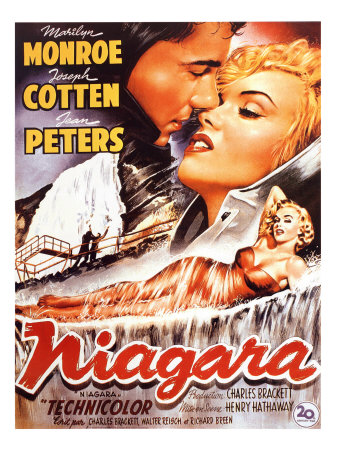
Niagara (1953)
Henry Hathaway is a fascinating, intrinsically arresting directors with a keen visual aptitude. His use of frames, arches and other compositionally delineative objects create cleanly-photographed portraits of his characters. These framed portraits usually connote a kind of personal or even metaphysical entrapment, excellently communicated with richly detailed sequences of foreground-background struggles. Those foreground-background struggles usually tell two different character stories in one shot, and Niagara displays this stylistic technique. Hathaway's affinity for water and water-based settings such as this film and 23 Paces to Baker Street, is interesting to consider as well. He often shoots the background water through a frame, a window or some kind of portal—frequently in close approximation to the characters, drawing the connection between character and setting that helps to distinguish his admittedly workmanlike approach to certain parts of filmmaking, such as pacing.
Niagara is a beautiful, Technicolor film from 1953, starring Marilyn Monroe, Joseph Cotten and Jean Peters. Melodramatic, as well as splashy both in its brightly colorful visualizations and in its lurid storyline, the film may in some ways belong as much to the 1950s melodrama as to film noir. However, the opening, with Cotten's acidic, pained and mocking narration is certainly at one with noir: “Why should the Falls drag me down here at five o'clock in the morning? To show me how big they are and how small I am? To remind me they can get along without any help? All right, so they've proved it. But why not? They've had ten thousand years to get independent. What's so wonderful about that? I suppose I could, too, only it might take a little more time.” Cotten's character is the married dupe familiar to film noir—George Loomis, married to Rose Loomis (Monroe)—and his bitterness is to be completely explained to the viewer through the narrative's unfolding.
The picture is paced slightly leisurely, though it never begins to stall. At ninety-two minutes, it is given periodical punctuations of action that make it altogether brisk, and Monroe's almost outre and, in this context, purposefully furbelow sensuality make the film's more underdeveloped portions quite sustainable. Cotten's performance as the man driven to madness and murder by the scheming, adulterous wife is eerily believable, despite some of the melodramatics the screenplays coerces him to indulge in. Whereas certain actors would likely have chewed scenery in the part, Cotten understates his predicament as best he can. Peters plays Polly Curtler—Anne Baxter was the studio's first choice for the part; after she withdrew the entire film was dramatically reworked to emphasize Monroe and her part— who is the loving wife to Ray Curtler (an annoyingly ineffective Max Showalter, made all the worse by a deliberately irritating and under-written character). Peters begins piecing together the pieces of the Loomis puzzle, and is continually rebuffed by her own husband, who insensitively insists that she must simply be seeing things for no good reason. Besides being carried to unrealistic levels by the screenplay, Ray's behavior is repetitive and paradoxically weirder than anyone else's neurosis in its own way, and far less interesting than anyone else's.
The screenplay does indeed suffer at least somewhat from what the old saw describes as too many chefs spoiling the broth, giving the film some unsure beats in its midsection—and the Baxter factor had to have left a considerable impact on the final product. Here the broth is diluted, but adequate. Charles Brackett, Walter Reisch and Richard L. Breen wrote the screenplay, which has a simpler plot than its structure would suggest. Hathaway takes the template of noirish thriller conventions and makes the screenplay's occasional banalities more engrossing by establishing relationships with wordless visual communication. And even scenes that were probably written in the screenplay, relying on silence, are brought to sharper, more penetrative meaningfulness by Hathaway's suasively solid craftsmanship. The first scene between Monroe's Rose and Cotten's George tells the tale of their relationship without needless words: he is knocking on the door and she is resting abed, smoking a cigarette; knowing that her husband has returned, she snuffs the cigarette out and pretends to be sleeping. It is the whitest layer of duplicity that the film will explore.
Where Niagara earns its place in the broader filmic fiefdom of noir is in its psychology, and in its internecine conflicts between Cotten's dupe and Monroe's seductress, and between Peters' intrigued wife and Cotten's seemingly malevolent intentions toward her. Irony is employed, free from cynicism. A sequence in a bell tower is heartbreakingly beautiful, evocatively photographed by Joseph MacDonald (who photographed John Ford's My Darling Clementine, Hathaway's Call Northside 777, and some of Elia Kazan's directorial work). Chemistry is unnecessary between Cotten and Monroe, since their parts call for, if anything, the opposite—and their screentime together is surprisingly sparse—but the effects her Rose's marital malpractice has on his George is profoundly brought to life by Cotten in one of the actor's more offbeat performances. Peters, meanwhile, makes her part register with a performance that balances all of the character's narrative-driven necessities, including her intelligence and naivete, her gentleness and high-spiritedness. Hathaway allows for the screenplay's lack of central focus—is it George's point-of-view from which the film forms itself? Rose's? Polly's?—to become a positive attribute, as it squeezes logically unreasonable tension out of George's whereabouts, motives and location in large swathes of the film, especially when relating from Polly's observant spectator.
Niagara follows the noirish pattern of sending its protagonist into an entrapping web of betrayal and murder, spurred by lust and greed, giving the protagonist an opportunity to right the course, only to see his choices continually backfire and drag him down into the quicksand of anguish all the more forcefully. In the third act, Cotten's George scrambles to escape the trap he has, in a hideously ironic manner, fallen into. It is here that the film tightens its grip, losing in atmosphere while gaining in high drama. It may be said that it is in that harrowing but sumptuous bell tower sequence—understandably considered to have been a possible inspiration for Alfred Hitchcock in making Vertigo—where the oneiric qualities of Niagara unmask themselves to describe not a limpidly pellucid dream but a terrifying nightmare. And in a definitive way, Niagara postulates that the viewer reconsider noir, at least ever so briefly. For in Niagara, perhaps the most literal definition of the struggle that lives and breathes in the very heart of film noir may be conceived: a man on a small boat that has run out of fuel, being drawn inexorably to the mighty Niagara falls he so contemptuously recognized as so much greater than himself, drifting to his doom.
Monday, January 12, 2009
More Thoughts on Gran Torino
In my review of Clint Eastwood's Gran Torino, I elected to not cover certain issues that were primarily germane to the film's climax.
Seeing as the film is now in wide release, I have decided to share some thoughts I have had on Gran Torino since seeing it but have stayed quiet about for fear of "spoiling" the film.
So, a full spoiler warning is in effect:
- One of the subtler points about the film is Eastwood's character, Walt Kowalski, using his cigarette lighter, which has the symbol of the First Cavalry Division (the yellow shield with the black diagonal stripe and black horse's head). This establishes three things: firstly, Kowalski takes care of his lighter; he has had the lighter since 1951, when he bought it in Korea, so it symbolizes simple American manufacturing durability which is today lost; and finally, if one is allowed to make such an assumption, Kowalski--who is coughing up blood from his lungs--is a victim of the Korean War. Since soldiers were given cigarettes to smoke, and encouraged to smoke, many became addicted to nicotine. In a certain way, then, Kowalski is one of the more slowly-realized casualties of a war. (Again, this final thought is assumption, but not unreasonable speculation.)
- The Christ imagery, and particularly of the final scene with Kowalski alive, may at first glance appear to be "too much," but there is something to be said for what Eastwood's characters have long represented. Kowalski is ultimately giving up his life for his friends. What makes the imagery work for me is the way Eastwood's hand opens up so the camera can take a good, long look at the aforementioned lighter. The shot looking down on his corpse takes in the stream of blood that is trickling down his wrist--with the militarism represented by the lighter, this crucifix imagery is rendered, in a way, more universal.
- Just as I noted in my review, the film does linger like an older John Ford or Howard Hawks picture. It is essentially fairly complicated, but with a simple coating that makes it quite accessible and a little deceptive in its form.
- Likewise, the film should be--and doubtless is being--compared to The Shootist. John Wayne's final performance, in which he finally lays down his life, in part for the son figure of Ron Howard's, remains poignant today. Eastwood's borrowing of these motifs is worthy homage, and there is no other actor-director who could get away with it--but he can and should be able to. The film is in this way a billet-doux to the American heroes of varying stripes, like Bogart or Wayne, who often acted gruffly or insensitively but, finally, tried to do good.
- Kowalski's repeated comments of slaying a "gook," a "kid," who wished nothing more than to surrender in Korea recalls Eastwood's Iwo Jima films--and especially Letters from Iwo Jima, in which American soldiers are shown mercilessly snuffing out the lives of Japanese soldiers wishing to surrender and survive. Kowalski tells one of the Hmong gangbangers that he could shoot his head off, go back inside and sleep like a baby--obviously thinking of his past in Korea.
- Eastwood's depiction of sybarites again seems to indicate that Eastwood views this kind of person to be rather worthless.
- The phone call of Kowalski's to one of his man-child sons has lingered with other fairly "small" scenes. The look on his son's face after his father hangs up is rather perfect: the quizzical realization that his father would never call--so why did he now?--hits home.

- Gran Torino is an interesting film, and a fine vehicle--pun intended--to be Eastwood's acting swansong. The one thing that hit me just as Kowalski was being shot at the end was that he was entrusting the Hmong community to rat out "their own," despite it being established repeatedly that "the Hmong keep their mouths shut." Similarly, the police and judicial system is suddenly entrusted to save the day, and keep the Hmong gangbangers locked up, as one cop says. This is most ironic coming from Dirty Harry Eastwood--trusting above all else the Hmongs he had seen as alien, and "the system" he had, in earlier incarnations, seen as bankrupt. A strange, fascinating send-off.
Sunday, January 11, 2009
The Tall T (1957)
Saturday, January 10, 2009
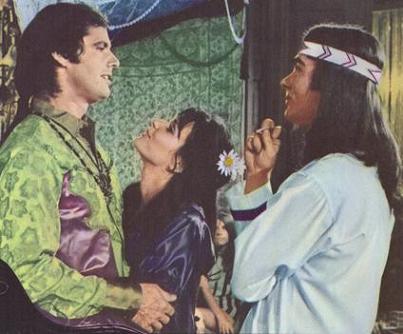
Psych-Out (1968)
Friday, January 9, 2009
La Ronde (1950)
Thursday, January 8, 2009
Cadillac Records (2008)
Judged, therefore, on the sheer emotional thrust of its own worthwhile story, Cadillac Records is a triumph on its own terms. Martin's blending of wildly antithetic characters and the consequent sub-plots that weave throughout is thorough, measuredly following the story of Chess Records. The picture terrifically clamps down on the bitter acrimony in a markedly different kind of workplace that so often characterizes the relationships between people who truly love one another. Martin is still finding herself visually, perhaps, but she has a knack for stitching together potently punctuating dramatic scenes that refuse to go away quietly for fear of embarrassment. This film, too, deals with drug abuse, but the pivotal, highly-charged and emotionally complicated scene that takes on the brunt of the film's time on the indignities of drug abuse is unlike any other in a film remotely like this. Playing out between the strung-out Etta and the sympathizing Chess before a fireplace, the scene establishes a superb contradiction that bedevils the characters: the pit of smothering heartbreak, loss and excruciating memories against the mocking promise of romance.
And Martin maintains that high-wire act of emotionality, which is a truly welcome sight. If she cannot reinvent the wheel, she can make it durable, and she does, with great integrity. Not everything works. The narration is in its own way affable and mildly interesting, but there are several times when its pedantic laying out of the literal, particularly in the ambiguously political relating of the racial discord and angst of the era, seems superfluous, like title cards explaining the cultural meaning of numerous scenes' drama for anyone who did not “get it.” However, when Martin and her cast launch off the ground, they soar. And none fly higher than Beyonce, whose performance must be seen and heard; the immediacy she brings to the role of Etta is something truly inspiring to witness. So much of the character's introduction is seeped in time-worn cliché, with her throwing hissy fits and temperamentally demanding things in the studio. Brody's Chess has to threaten to pull the plug before extracting the kind of singing he needs to hear from her. Beyonce succeeds because she grabs the cliché and breaks down its pulverulent coating until what seems like the real Etta emerges through her. Yes, the musical biopic staples are almost all still here, but they hit harder. The best example? Beyonce's singing of “I'd Rather Go Blind.” As in Ray, a pivotal moment is made out of a singer truly singing a song to someone in their immediate proximity. As Beyonce's Etta ferociously sings the song of embittered, crushed and impossible love to the man she loves, and who loves her, the married Chess, the faithfulness to Etta's vocal work is noteworthy. Viewed from Chess's perspective, Etta is as beautiful as ever. Yet while the camera closes in on Etta, her countenance is dented; a defiant sneer develops. As the scene and song both swell in bombast, with the crying Etta belting out her lyrics directly at Chess, Martin courageously keeps the close-up of Beyonce's Etta running, finally breaking the shot for good when Chess walks out of the room just as the song addresses his action (“Then to see you walk away from me...”). And so Martin completes her cinematically rendered essay on race relations in mid-century America through the power of music. History is simplified, and the delicately recounted black-and-white history of Chess and his musicians is made accessible to follow, from his offering of Cadillacs to his most prized finds to a back-alley assault at the hands of blacks he withstands as "South Chicago... was changing," according to the narration. But movies do that. And good movies do that well. Cadillac Records may not be the most rigorous motion picture out now, but it has one attribute missing in at least some of the supposed titans of this Oscar season: soul.
Wednesday, January 7, 2009
Laura (1944)
It is that belletristic sensibility that in no small measure comprehensively disguises the frequent subversively risque content of Preminger's films. This enticing thematic blending begins in earnest with the film that catapulted Preminger's reputation in Hollywood, Laura. (Preminger was nominated for Best Director for the film, one of five Academy Award nominations the picture received.) Originally to be directed by Rouben Mamoulian and lit by Mamoulian's master cinematographer Lucien Ballard, the cinematography was provided by Joseph LaShelle, whose gorgeously shadowy black-and-white compositions and beautiful lighting schema provided the film with the aesthetic accentuation that so richly buttressed the action of the plot. (The cinematography of LaShelle's won the film's only Academy Award.) LaShelle's cinematography sweetens the strong brew of Laura, lending a nearly constant luminosity to the characters and places in which they are captured.
Laura, in major, definable ways, marks the most attractive beginning of Preminger's refined technique as authorial voice. If Laura's ensemble cast is made up of possible suspects in a murder case, then the great Austrian director's latter films likewise portray multifarious characters, in plentiful and disparate environments, denominated as much by the director's correlation between persons and the movements by which they traverse as any narrative-determined consequence of their actions. In Preminger's work, characters stand out in overwhelmingly large rooms, walking about and speaking to one another with purpose, forging identities for themselves through their actions as impeccably as his camera gradually posits their true natures. Taken as something as trifling as a simplistic whodunit, Laura in actuality provides the framework for Preminger's later work, including Daisy Kenyon, Whirpool, Where the Sidewalk Ends and Angel Face, as well as the late epics of one manner or another—characterized by speech-making, having to do with the personal, the political, the legal, the dutiful—Exodus, Advise and Consent, Anatomy of a Murder and In Harm's Way, respectively.
It is in the former group of films wherein an observer of Preminger finds the keenness attendant to swiftness and narrative economy. Marked as they are by mutual incisions and tokens—beautiful black-and-white creations out of which despair and humiliation fester, sometimes uncontrollably, these pictures are emphatically accompanied by masculine obsessional behavior, juxtaposed against wantonness and perversity of the feminine. Laura deserves a special place as an unsettlingly gleeful meditation on the kinkiness that resides in the hearts and minds of pundits, of playboys and of policemen. As much of the film takes place in flashback, it is intriguing to linger on the lack of veracity supplied by the narrator, one acidic theatre critic, Waldo Lydecker (the openly homosexual Clifton Webb, in his first “talkie” performance, and first film in nineteen years, the security of his role consequently threatened by studio boss Darryl F. Zanuck, giving a virtuoso performance). This untrustworthiness of the storyteller is an indelible contrast to the objectivity that characterizes Preminger's mise-en-scene. The risque qualities of later Preminger pictures such as The Moon is Blue, which was disallowed the Production Code's seal of approval and withheld due to supposedly provocatively dirty dialogue such as the word “virgin” and The Man With the Golden Arm, about a heroin addict played by Frank Sinatra, find in part their inspiration the director's interest of pushing the proverbial envelope, for the sake of greater, more unvarnished truth.
Laura is a perverse romance of sorts, with three different men loving a woman who is apparently dead. The portrait of Laura, often accompanied by David Raksin's famed “Laura” theme, hangs on the wall like a specter, and magnetic lure for the widely different men who pine for her. This beguilingly melancholic component of Laura speaks to the noirish feature of entrapment, beckoning the three men out of their respective pits of alienation and despondency. For Lydecker (who was evidently based on New Yorker theatre critic and broadcaster Alexander Woolcott, his tale of how he came to know Laura is tinged by his personal stake in the matter of the titular character, and how he attempted to evoke the socialite buried within the woman as he viewed her. The opening of the film revealingly ushers in the exclusivity that is at once outstanding and simply complementary to Preminger's greater style—like characters incongruously captured alone, usually stolidly and quietly, in a more subduedly static framing that richly unravels the layers of protective artifice, in this instance before the figure is able to ever display such self-supported aegis. And yet this character, Lydecker, a preening fop, is matchlessly anomalous, so endowed he is with a shield of support that he carries it with him wherever he goes, including the large, beautiful marble bathtub in which he furiously writes his corrosively astringent editorials. Literally, this is especially rewarding, as Preminger's insistence on portraying Lydecker's nakedness—including the subsequent reaction of another character, in which case the columnist is soon seen by homicide police detective Mark McPherson (Dana Andrews). The visual scheme is brilliant, as Preminger's objective viewpoint demonstrably articulates with stunning eloquence and economy the literalism that authentically supplements the metaphorical bulwark of Lydecker's. His nudity is blocked by his typewriter—a bit of sly commentary unto itself that hides in plain sight.
Lydecker recounts in the opening scene, “I shall never forget the weekend Laura died. A silver sun burned through the sky like a huge magnifying glass. It was the hottest Sunday in my recollection. I felt as if I were the only human being left in New York. For Laura's horrible death, I was alone. I, Waldo Lydecker, was the only one who really knew her.” Lydecker's pomposity and pretense, coupled with his supercilious haughtiness and sense of self-importance are conveyed with a campy, almost caustic delirium by Webb, who savors every lacerating line of insult and self-deluding romanticism. Viewing himself as Laura's social creator, his unrestrained amour-propre is joyfully brought to animated, cerebral life. Through narration, monologue and dialogue, Webb's vocal delivery is amplified and mellifluously enunciated. Yet the actor places just the necessary amount of dignity to the role, so Lydecker does not descend into mere buffoonish caricature. The almost botanically aggregate creation by Caspary's story, the character is a dense cluster whose divergent parts and carpels only underline the uncondensed quantities to be found in his form. The humor at the character's expense is admittedly significant. In one of the film's most bizarre beats, early in the picture Lydecker stands up in his bathtub, fully nude (off-camera), standing before the questioning McPherson, asking the policeman to hand him his robe. Andrews' McPherson stares at Lydecker, looks down and smirks, reaching for the writer's robe.
McPherson himself is slowly drawn into a pathological, perverse love affair with the murdered Laura. An offbeat, hardboiled cop—with handsome but ambiguously sabulous features and demeanor—McPherson is a steadied, thinking man, who literally enjoys playing puzzles for amusement and satisfaction. Andrews is marvelously understated as the cop whose laconically verbalized comments to other main characters such as Lydecker and the duplicitous, two-timing playboy fiance Shelby Carpenter (an unassailably indecorous Vincent Price), acknowledge a knowingness to the policeman that is nevertheless corrupted by his own budding, quixotically romantic feelings for Laura. As he longs for the woman, gazing through the shadowy haze in which Preminger and LaShelle so persuasively immerse the viewer, the character is further fleshed out. McPherson's blunt language infuriates Lydecker, particularly the cop's use of the term “dame” to describe all women, including Laura. A chain-smoker, known for his heedless dauntlessness, McPherson is etched as something of a self-destructive man, with an unhealthy crasis that stresses the decisions he makes.
Yet a case can be made that it is Gene Tierney who makes the most memorable impression, or at least lends the most vital luminescence to the proceedings. As McPherson works tirelessly to entrap her murderer, the screenplay provides an estimable examination of the woman at the center of the whodunit. As viewed through the male lenses of Lydecker, McPherson and Carpenter, Laura is perhaps an incomplete figure, or at least could easily have become as much without such a bedazzling actress. Equally wispy and strong, Tierney as Laura is a contradiction amidst others. As McPherson and Laura stare at one another—he at her portrait, she back at him while he stews—he is busily chasing any clues or hunches he can uncover, practically living in the woman's apartment. She is projected through long flashback sequences, the details of which are provided by the questionable source of Lydecker. These, among other points, serve to illustrate just how divinely paradoxical and conflicting so many disparate paradigms established by the film. Laura's very identity is most intrinsically related to the viewer through the cockeyed viewpoint of Lydecker's. Preminger's camera brilliantly conveys the smoky murkiness of Laura's personage, and in one instance shoots her through a cloud of cigarette smoke blown by Price's Carpenter at a party. This framing of Tierney's, and Laura's, ethereal beauty through such impediments and accretions further transmits the thematic touchstone of excavating the role the unreliable brume that accompanies the male gaze, and discovery of love, plays in the story.
The contrasting lightness and darkness of the film is intriguing; Laura's sumptuous cinematography often points to film noir, but much of the picture's events take place in fully lit rooms that could have belonged to a 1930s crime picture. The greater the sensuality present, the more seductive the lighting patterns become. Sitting before the haunting portrait of Laura, McPherson, drinking, finally falls asleep. Preminger gently nudges the camera towards the protagonist. A moment transpires in which McPherson is caught as totally still, sleeping away; time has elapsed. The camera reels back from him, and soon a woman enters the apartment. Much later, as this woman is interrogated in a darkly foreboding room by McPherson with strong lights beaming directly into her face, her breathtaking beauty radiates, glowing like light itself. The woman's pulchritudinous countenance shimmers in the shot, exquisitely framed by Preminger's taut control of mise-en-scene.
In many sequences, Preminger opts for the triangular compositional schema that he would perfect in subsequent pictures. (Where the Sidewalk Ends must be noted for this tremendously consistent stylistic. That will be reviewed in this space soon.) In numerous shots, one central figure hosts the primary line of view, forming a the pivoting point that bisects between the two characters on either side. (Again, Where the Sidewalk Ends powerfully brings this directorial signature-branding device to greater fruition and elan, as it conveys the tightening tension that wraps around Andrews' different, more recognizably noirish cop protagonist like a noose.) The first major three-person configuration occurs at the eight-minute mark, as McPherson questions Lydecker and Carpenter in the early afternoon. Another highly engaging composition features this three-person framework at the forty-minute mark. (This is almost immediately followed by a painterly shot of a man walking on a sidewalk on a very rainy evening.) At the fifty-one minute mark, a variation of the three-figure staple is utilized, with McPherson and another individual serving as bookends, separated by a brightly lit lamp. In Laura, Preminger's configurations speak to the disorder of the whodunit plot; the aesthetic brings a semblance of visual order and symmetry to the film's dyspeptically twisty tale.
Laura is an entrancing picture, which at the very least grazes the supernatural and horror film elements that decoratively contribute to the forlorn mood the film conjures. As for the perversion at the center of the plot—driven by deleterious masculine obsession—the film may be able to go only so far in graphic terms. Nevertheless, the screenplay is taken by Preminger fully, and directed with fine perspicacity, melding an austere formalism that does not betray a rigidity with an unpredictable playfulness that does not descend into parody. Gothic, humorous, satirical and cognizant in matters relating to the social strata to which Lydecker belongs, Laura is a kind of cinematic buffet, well worth revisiting.
Tuesday, January 6, 2009
The Scarface Mob (1959)
Embodying Eliot Ness is the perfectly cast Robert Stack, whose relentless sternness and almost limitless sense of propriety made him seem to be the ideal Ness. Stack possessed the ascetic screen presence with that immediately recognizable voice, which seemed to bring Ness to life, whether or not it was indeed true to the real man. Neville Brand plays his great nemesis, mobster Al Capone, adorned with a scar on his face for the role. Brand lets loose as Capone, and in one of the most memorable scenes, alternately laughs hysterically and glowers menacingly at his gangland associates. Bruce Gordon is Frank Nitti, Capone's chief enforcer. Keenan Wynn shines in the juiciest good guy part as ex-convict-turned-crime-fighter Joe Fuselli, whose knowledge of the Sicilian and Neapolitan dialects, some of the inner-workings of the Chicago gangs and indispensable “street smarts,” as they would be called today, are proven to be invaluable in aiding Ness and his unit of “Untouchables.”
Karlson's mise-en-scene transcends The Scarface Mob's television-production origins. Aided by standout television cinematographer Charles Straumer—who would go on to light seventy-eight episodes of the television crime saga—Karlson creates a Chicago underworld that seems quite unnervingly authentic. A dark room in which Ness and his colleagues begin to ensnare Nitti and his confreres by acting like dirty cops accepting a bribe becomes a habitat that, in its aphotic, dimly lit texture portends the duplicity employed by both lawman and outlaw. Straumer casts face-splitting shadows that indelibly cast the characters in the context of being two-faced. When one hood tries to kill Ness with a knife, and is stopped from doing so (partly thanks to Fuselli knowing what the knife-wielding killer was saying to Nitti in Sicilian), Karlson focuses on the weapon with appropriately penetrative focus. Fuselli angrily stabs a table with the knife, and the light caught on the blade increases the thick tension between Ness, Nitt and their respective forces.
One frame through which to look at The Scarface Mob is the controversial depiction of Italian- and Sicilian-Americans. Drawing the ire of the Knights of Columbus, The Untouchables television series slowly softened the unmistakably strong ethnic tropes that were interwoven in the depiction of the gangster characters. Nearly every conceivable manner in which to highlight the hoodlums' ethnicity is employed, from the raucous yelling matches to the repeated line of “Stupido!” to one another. It is understandable why the Knights of Columbus were concerned with the depictions of Italian- and Sicilian-Americans. Some of the mannerisms and details do call attention to themselves, prodding the viewer to recognize the “hot-blooded”—as it is called in both The Scarface Mob and later Untouchables episodes—emblematic figurative lineaments of the characters' ethnicity. (In one early episode, Stack's Ness says the only member of Capone's gang who doesn't have his brain holstered against his side is Jake "Greasy Thumb" Guzik, the Polish-born Jew, and Capone's accountant as well as financial and legal adviser, thus establishing dual ethnic typecasting, however based in reality, in one statement.) Occasionally the prominently embossed characterizations are almost oppressive in the borderline outré ethnic stereotypes. Yet the emphasis on a solid verisimilitude makes much of this both forgivable and understandable, given the almost intimate relationship The Scarface Mob establishes between the viewer and all of the characters. The intricacies of the Sicilian gangsters are brought to full, vivid life. One such chilling detail: the process through which a killer is chosen to commit a murder in the “bacio di morte” (“kiss of death”).
Where The Scarface Mob (and later The Untouchables) counters the very valance against which its drama transpires is the depictions of sympathetic characters belonging to the same ethnic background as the villains. Most especially, Wynn as Fuselli is outstanding in subtly creating an entirely fleshed out, endearing character. Fuselli's selflessness is given both quiet and bold expression, and the screenplay by Paul Monash based on the novel “The Untouchables” by Eliot Ness and Oscar Fraley creates a fully rounded, compassionate arc for this most pivotal character. The hairpin twists that dot the crime story's trajectory like speed limit signs next to a road are always plausible, if bedecked. What occurs to Fuselli leaves a last impression, and is forcefully moving. Likewise, Wolfe Barzell as an older man named Picco, a kindhearted but fearful Sicilian father figure to Fuselli, Picco, is palpably effective. In the first hour-long episode, The Empty Chair, a new man joins The Untouchables team—a brave Italian-American, Enrico Rossi, whose moral outrage at the unrelentingly cruel barbarism of criminals who share his ethnic background informs the character as much as his honorable courage. In these characters, considerable balance is provided.
Quasi-documentarian in its form, The Untouchables television series continually provoked intense responses from the viewer. Winchell's narration often criticized a “dangerously indifferent public.” Paradoxically, Al Capone is referred to on at least two occasions as the most infamous result of “America's experiment with Prohibition.” Viewing the issue of the ethnically centroidal matter, the fittingness of the real-life historical drama cannot be dismissed. Prohibition was but one major triumph of the progressive era. The temperance advocates who associated alcoholic consumption with poverty, insanity and criminality from approximately the 1830s onward in America began to target German and Irish immigrants in the mid-nineteenth century as groups that were in need of significant collective reform. Whether evidenced by the powerful and propagandistic Anti-Saloon League of 1893-1933 or the anti-Catholic Immigration Restriction League born in Boston in 1894, which assailed the “undesirable immigrants” of southern and eastern Europe (Italians, Sicilians, Poles, Jew, etceteras), the crusade finally became the national Constitutional law after achieving great success in local jurisdictions and states. That certain criminal elements belonging in no small measure to the immigrant populations against whom many of the progressive era's most vehement constituents and representatives won success after success arose to cash in on the sudden illegality of something so many people wanted is fittingly amusing, and, in a somewhat warped way, perhaps almost a strange, ugly form of cosmic justice.
Friday, January 2, 2009
Valkyrie (2008)
"It is true we Germans are barbarians; that is an honored title to us. I free humanity from the shackles of the soul; from the degrading suffering caused by the false vision called conscience and ethics. The Jews have inflicted two wounds on mankind: circumcision on its body and conscience on its soul. They are Jewish inventions. The war for the domination of the world is waged only between these two camps alone, the Germans and the Jews. Everything else is but deception."
Wednesday, December 31, 2008
The Curious Case of Benjamin Button (2008)
As crafted by Roth and screen story-credited Robin Swicord, the screenplay with which Fincher works seems indebted to some of the more suspect Oscar-winners of the 1990s such as Titanic and the aforementioned Gump, the latter of which may have served to provide the framing device of an old woman near death's doorstep reminiscing on the glorious past of her lover. For greater dramatic effect and symbolism—a staggering washing away of the past—the “contemporary” setting is placed against the background of the oncoming Hurricane Katrina. A bothersome television monitor in the hospital at which this old woman, Daisy, is preparing to perish in the company of her thirty-seven-year old daughter, Caroline (Julia Ormond) repeatedly informs the audience of the hurricane's movements. Roth and Fincher do not allow the accessory to distract too much, but it is manipulative and unnecessary nevertheless.
Cate Blanchett plays Daisy (a name that immediately connotes springtime and earthly renewal as well as paying homage to the object of Gatsby's desire in The Great Gatsby), the great love of Benjamin Button's life. As played by Brad Pitt, Benjamin is perpetually informed by the people nearest to his orbit. Born with the decrepitude of an old man, the child Benjamin is taken to a house of “Negroes” by his father in New Orleans only moments after his birth. The allusion to Moses taken in by “the other,” and a little later the Biblical references in a black church (Acts 14:3 emblazoned on a banner in the background, referring to “sings and wonders...” to come through the hands of those who speak boldly upon the Lord) seem to initially cast Fitzgerald's tale in Judeo-Christian tinting. Yet as the film progresses, Fincher takes Benjamin on a more tellurian, and, indeed, physical journey.
It is in that continual emphasis on the physical that Fincher remains. When those who question Fincher's fingerprints on the picture opine their consideration, the answer must come that The Curious Case of Benjamin Button displays—for better and worse—the tonal instincts of its director. Fincher's best films, Se7en and Zodiac—and especially the latter—succeeded so smashingly because they played perfectly into the filmmaker's prismatically sealed obsessiveness. The more Fincher adds to his body of work, the more apparent it becomes that for all of his considerable talent, he has yet to surpass the tonal confinements that practically define the essence of his finest and culminating oeuvre. That helps when Fincher's art is directly irradiated by the subject matter—two entirely different policemen united in their objective in Se7en; a man finding his past brought to the present with devilish relish by an uncontrollable corporate conspiracy (The Game); a curious man driven by puzzles seeking out the identity of a notorious serial killer (Zodiac).
Yet Fincher and his screenwriters have opened up the saga of Benjamin Button to the point where Fincher's best attribute is turned against him. Panic Room was a minor movie in which Fincher tried to summon visual importance out of outre and vainglorious camera movements and CGI configurations. Fincher's blunt visual language likewise was perfect for the uniformly downcast Se7en. Yet spurts of Fincher's conceptual workings portray a filmmaker with a solid grasp of his own strengths made occasionally frustratingly literal or at least undistinguished from earlier films. To convey the passage of time in Zodiac, Fincher allows the screen to become a window through which the viewer watches the CG construction of the Transamerica Pyramid building in San Francisco over the course of a few seconds. This is an interesting bit of cinematic shorthand, and in its own way far more meaningful than the hypocritical and almost paralyzed-by-pretense closing imagery of Fight Club, yet Fincher deploys an assortment of vistas and almost visional panaceas meant to take the viewer's breath away in Benjamin Button that, for all of their grandiosity, tend to veer toward the perfunctory.
With a story that should be sweepingly biographical—considering Roth's massive screenplay and the film's final running time—Fincher's technique tends to make all of the hills and valleys play out as flat. Comparisons to Stanley Kubrick are naturally interesting, yet Kubrick's pictures, concerned as they were with the disintegration of the humanity of human beings, followed the arc with a keen direness that eloquently described the tragedy at his films' foundation. Fincher's films tend to close themselves off, denominating the very sequestered protagonists in the changeless epitome of the pictures' portraitures. Taking Fitzgerald's short story and expanding on it to the point of creating a chimerical biographical account, Fincher is unable to properly convey the most bottomless sorrows and stratospheric highs of his main character. Instead, he and Roth rely on one of the great crunches of cinema history to describe how people—and especially Benjamin—felt about what was happening to them: nearly ceaseless voice-over. Narrated, in a way, by three different people (Benjamin through his diary; Caroline, reading Benjamin’s words to Daisy; the old woman supplying the joining parts occasionally missing from Benjamin’s written history), the film finds itself placed at the mercy of Roth's effectualness as a screenwriter.
Roth's writing is normally well-structured, if nothing else, and Benjamin Button is broken up in three cleanly arranged acts. The first takes up the film's first hour, expiring when Benjamin leaves his old habitat overseen by his adoptive mother, Queenie (Taraji P. Henson, who, in a way, seems to know what kind of film she is in, gesticulating with a theatricality otherwise limited to Blanchett's truly “mesmerizing”—as Benjamin once calls it—dancing as Daisy). The second, middling both in quality and placement, advances Benjamin’s story as a sailor with an avuncular and charismatic Captain Mike, to his brief but memorable affair with an English woman living in a Russian hotel played with palpable acuity and restraint by Tilda Swinton. The third details the meeting of Benjamin and Daisy, colliding in age the way people meant for one another do so, only with attendant complications arising from Benjamin's curious condition.
Roth's leitmotifs are made apparent, repeatedly, almost to exhaustion. The comparisons to his Forrest Gump cannot be dismissed. When Benjamin Button is at its most prosaic, the film seems like Forrest Gump in its best dress. Benjamin is amazed by the appearance of a hummingbird, far out at sea and relates it in a wondered awe that recalls Tom Hanks' simple appreciation of seemingly all things. Roth once again portrays the woman as selfish, wanton and pushy—all the while knowing that the man followed by his screenplay through thick and thin is The One.
Rather than self-destruct through drugs in a long, torturous stint as an agitating counterculture chick, Daisy is a dancer who, Roth seems to insist, has allowed her success to go to her head. At age twenty-three she dismisses Benjamin's efforts to, as he says, “sweep [her] off [her] feet,” enjoying her bubbly, meaningless dalliances while he stoically stews in the shadows. Again moments of syrupy ruminations on death (rather than cultural icons and politicians being “shot” in Gump, characters close to Benjamin die out while he de-ages through the twentieth century) populate the narrative, almost from the beginning, unfortunately missing the key ingredient of Fitzgerald's wit. Fitzgerald's famous statement, “After all, life hasn't much to offer except youth, and I suppose for older people, the love of youth in others,” may in its own dimensional context serve as a springboard for the story, but Roth and Fincher seem at a loss as to what to say about this condition except a long-winded version of, “Too bad it's all this way, but there's nothing you can do about it, so just keep living through it.”
That message grows tiresome. In a way, it's no less patronizing than Forrest Gump's (which, it has often been said, exalted the virtue of being sufficiently stupid to always enjoy life). It cannot be a coincidence that Roth transfers Forrest's condition as a threat against his progeny to Benjamin's worry that his child will be born like he was. It is a legitimate avenue on which to narratively travel and yet both the screenplay and Fincher's direction are unable to engrossingly illustrate the contentment of parenthood Benjamin says he feels. The aforementioned mattress montage, which seems to somehow exemplify the tuned-out happiness of the 1960s, including the Beatles on television, describes the gleeful repletion that the luckiest in the world fleetingly experience. Fincher tries his hand at romance and the audience believes in it because the words Pitt and Blanchett speak are delivered with such earnestness but his pictorial representations of the unrequited and then finally completely reciprocal love between the two never entirely convince.
Fincher's picture does not lack some bright spots. Blanchett gives one of her better performances. She is playing a person, not an avatar or representation as in The Aviator. Fincher is able to balance Daisy's dual role as aesthetically-minded artistic dancer and as something approximating Benjamin's own beckoning green light. Blanchett steals the film, and glows with a warmth that suggests the acclaim that sometimes seems closely related to puffery is not undeserved. Perhaps, however, some of her excelling screen presence is made all the more evident by the corresponding vacuity presented by Pitt. Whether adorned by old-age make-up or driving his motorcycle at his true pretty boy stage, Pitt never registers. There is a difference between underplaying and simply not making anything of an impact to the character. Fincher seems to keep Pitt on a tight leash, and the actor seems perfectly fine trusting in the director's strategy.
The Curious Case of Benjamin Button is not desultory, it simply never surpasses the surface patina polish of Fincher's CG recreations of naval warfare, space shuttles and cityscapes. Nor the admittedly fascinating work done on Pitt himself, who seems to briefly strive to make something of an impression underneath all of the artifice. Ironically it is when he is again completely recognizable that he slips into his lazy on-screen persona, recently left behind when he played Jesse James as a ghostly specter avenging his own sins. That describes much of the film itself. There are fits and starts, sequences that are compelling by themselves. The film never congeals, it never formulates beyond the “and then this happened” linear one-two-three storytelling. Many aspects, including the latter name of Benjamin's and its origins—and the very role of buttons supposedly drawn by the humorously buttoned studio logos—are touched upon with all of the fervor of a weary parent reading a story to their child for the fourth time in a row. Roth and Fincher, and Pitt, are in a profound way hamstrung by the very high-budgeted dazzle that has received so much attention. Lost beneath the surface is Fitzgerald's own Benjamin Button.