 (The following is another installment of reviews being written to celebrate the darkest month of all in Coleman's Corner with Dark City Dame. The previous reviews of film noirs for this tribute are here and here. The next two films to be reviewed in this series are Henry Hathaway's Kiss of Death and Otto Preminger's Where the Sidewalk Ends.)
Henry Hathaway is a fascinating, intrinsically arresting directors with a keen visual aptitude. His use of frames, arches and other compositionally delineative objects create cleanly-photographed portraits of his characters. These framed portraits usually connote a kind of personal or even metaphysical entrapment, excellently communicated with richly detailed sequences of foreground-background struggles. Those foreground-background struggles usually tell two different character stories in one shot, and Niagara displays this stylistic technique. Hathaway's affinity for water and water-based settings such as this film and 23 Paces to Baker Street, is interesting to consider as well. He often shoots the background water through a frame, a window or some kind of portal—frequently in close approximation to the characters, drawing the connection between character and setting that helps to distinguish his admittedly workmanlike approach to certain parts of filmmaking, such as pacing.
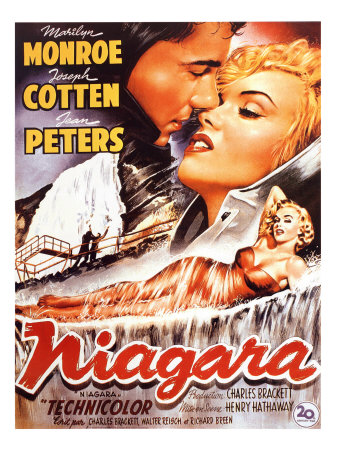
Niagara is a beautiful, Technicolor film from 1953, starring Marilyn Monroe, Joseph Cotten and Jean Peters. Melodramatic, as well as splashy both in its brightly colorful visualizations and in its lurid storyline, the film may in some ways belong as much to the 1950s melodrama as to film noir. However, the opening, with Cotten's acidic, pained and mocking narration is certainly at one with noir: “Why should the Falls drag me down here at five o'clock in the morning? To show me how big they are and how small I am? To remind me they can get along without any help? All right, so they've proved it. But why not? They've had ten thousand years to get independent. What's so wonderful about that? I suppose I could, too, only it might take a little more time.” Cotten's character is the married dupe familiar to film noir—George Loomis, married to Rose Loomis (Monroe)—and his bitterness is to be completely explained to the viewer through the narrative's unfolding.
The picture is paced slightly leisurely, though it never begins to stall. At ninety-two minutes, it is given periodical punctuations of action that make it altogether brisk, and Monroe's almost outre and, in this context, purposefully furbelow sensuality make the film's more underdeveloped portions quite sustainable. Cotten's performance as the man driven to madness and murder by the scheming, adulterous wife is eerily believable, despite some of the melodramatics the screenplays coerces him to indulge in. Whereas certain actors would likely have chewed scenery in the part, Cotten understates his predicament as best he can. Peters plays Polly Curtler—Anne Baxter was the studio's first choice for the part; after she withdrew the entire film was dramatically reworked to emphasize Monroe and her part— who is the loving wife to Ray Curtler (an annoyingly ineffective Max Showalter, made all the worse by a deliberately irritating and under-written character). Peters begins piecing together the pieces of the Loomis puzzle, and is continually rebuffed by her own husband, who insensitively insists that she must simply be seeing things for no good reason. Besides being carried to unrealistic levels by the screenplay, Ray's behavior is repetitive and paradoxically weirder than anyone else's neurosis in its own way, and far less interesting than anyone else's.
The screenplay does indeed suffer at least somewhat from what the old saw describes as too many chefs spoiling the broth, giving the film some unsure beats in its midsection—and the Baxter factor had to have left a considerable impact on the final product. Here the broth is diluted, but adequate. Charles Brackett, Walter Reisch and Richard L. Breen wrote the screenplay, which has a simpler plot than its structure would suggest. Hathaway takes the template of noirish thriller conventions and makes the screenplay's occasional banalities more engrossing by establishing relationships with wordless visual communication. And even scenes that were probably written in the screenplay, relying on silence, are brought to sharper, more penetrative meaningfulness by Hathaway's suasively solid craftsmanship. The first scene between Monroe's Rose and Cotten's George tells the tale of their relationship without needless words: he is knocking on the door and she is resting abed, smoking a cigarette; knowing that her husband has returned, she snuffs the cigarette out and pretends to be sleeping. It is the whitest layer of duplicity that the film will explore.
Where Niagara earns its place in the broader filmic fiefdom of noir is in its psychology, and in its internecine conflicts between Cotten's dupe and Monroe's seductress, and between Peters' intrigued wife and Cotten's seemingly malevolent intentions toward her. Irony is employed, free from cynicism. A sequence in a bell tower is heartbreakingly beautiful, evocatively photographed by Joseph MacDonald (who photographed John Ford's My Darling Clementine, Hathaway's Call Northside 777, and some of Elia Kazan's directorial work). Chemistry is unnecessary between Cotten and Monroe, since their parts call for, if anything, the opposite—and their screentime together is surprisingly sparse—but the effects her Rose's marital malpractice has on his George is profoundly brought to life by Cotten in one of the actor's more offbeat performances. Peters, meanwhile, makes her part register with a performance that balances all of the character's narrative-driven necessities, including her intelligence and naivete, her gentleness and high-spiritedness. Hathaway allows for the screenplay's lack of central focus—is it George's point-of-view from which the film forms itself? Rose's? Polly's?—to become a positive attribute, as it squeezes logically unreasonable tension out of George's whereabouts, motives and location in large swathes of the film, especially when relating from Polly's observant spectator.
Niagara follows the noirish pattern of sending its protagonist into an entrapping web of betrayal and murder, spurred by lust and greed, giving the protagonist an opportunity to right the course, only to see his choices continually backfire and drag him down into the quicksand of anguish all the more forcefully. In the third act, Cotten's George scrambles to escape the trap he has, in a hideously ironic manner, fallen into. It is here that the film tightens its grip, losing in atmosphere while gaining in high drama. It may be said that it is in that harrowing but sumptuous bell tower sequence—understandably considered to have been a possible inspiration for Alfred Hitchcock in making Vertigo—where the oneiric qualities of Niagara unmask themselves to describe not a limpidly pellucid dream but a terrifying nightmare. And in a definitive way, Niagara postulates that the viewer reconsider noir, at least ever so briefly. For in Niagara, perhaps the most literal definition of the struggle that lives and breathes in the very heart of film noir may be conceived: a man on a small boat that has run out of fuel, being drawn inexorably to the mighty Niagara falls he so contemptuously recognized as so much greater than himself, drifting to his doom.