Friday, June 26, 2009

Up (2009)

Pixar singlehandedly embodies the very paradoxes of the flowering of imaginations, a notion which is commonly linked to the steady maturation of children. Simultaneously challenging itself with the stimulating, increasingly hungry idiosyncrasy tied to the best qualities of a budding abecedarian and indulging in the whimsical fantasy-land, storybook logic, and linear narratives, bustling and humming with the fervent determination of a child unwilling to retire for the evening when he or she could continue playing, Pixar is an intriguing macrocosmic extrapolation of children. Since children are the predominant target group for Pixar animation, perpetually yanking on the apparel of mothers and fathers to see the latest animated treat of the cinema, Pixar would be unwise to limit its appeal by pursuing a strictly unconventional course. Yet because Pixar promises parents an enjoyably engaging, often meaningful excursion into the luminous dreamworld of its filmmakers, those mothers and fathers are more inclined to relinquish a little of their money to attend the film than they likely are for other studios' animated fare.

Up is the latest Pixar picture, co-directed by Pete Docter and Bob Peterson, and written by Peterson based on a short story by Peterson and Tom McCarthy, and it too holds its contradictions steadfastly. Firstly, the film is based on a short story, and at ninety-six minutes long, probably wrings and rinses as much material from that yarn as possible. Which, incidentally, helps to expose the film's most obvious flaw. Secondly, the picture is imbalanced in its morphology. The first fifteen minutes or so are sublime and practically flawless. It may almost be rightly desired that a short animated film had been made from this stitched embroidery. The opening passage of Up recalls the recent Academy Award-winning animated short film La Maison des Petits Cubes, a quietly, evocatively stirring account of a man's life, and his innate, palpable connection to his home. Up's montage of image and sound here is breathtaking; Michael Giacchino's melodious score conveys the joyfulness, sweetness and heartache which roam and rotate around one another like cars through the boulevards of life.

This haunting poignancy stalks the remainder of the picture, lurking deceptively about through the more plainly robust, temerarious convolutions of most of the film's plot. Carl Fredericksen (voiced with gusto and curmudgeonly geniality by Ed Asner) is a weary, widowed, seventy-eight year old man by the time the film's proper narrative proceeds. His dignity is stripped away from him by a callous cabal of developers—the kind of largely faceless, unstoppable force of a Madusa-headed hydra villain that usually stands in as Pixar's butter to its bread. As he watches his mailbox—with which he associates memories of his dearly departed wife—be violently pried from the ground and run over by the developers' machinery, Carl loses his composure and strikes out, resulting in his banishment to an “old folks' home,” called “Shady Oaks,” where it is unlikely that the oaks are the only things which are shady. Consequently, Carl finds himself placed in an unenviable predicament, and rather than meekly surrender to the authorities, he launches his home by allowing thousands of balloons tied to his home to take him Up.

Up eases itself into a vastly more comfortable routine at approximately this juncture, however. Tediousness creeps into the film; bland, uninteresting and poorly-motivated characters intrude upon Carl's journey to South America to fulfill a lifelong promise to his wife. Droplets of jejune frivolity would have been not only tolerable but encouraged—Pixar's filmmakers may receive almost unanimous encomiums from professional film critics, but they are probably not to be burdened with delving into Bergmanesque awakenings and reawakenings of the soul, consciousness and yearnings of the metaphysical. Up in the hands of artistic puritans would probably be a failed, 3D re-imagining of Wild Strawberries. Yet Up nearly represents base cynicism in its most forgettable moments, like the staging of an armada of carnivorous, talking dogs approximating the reward for sitting through the comparatively emotionally dire realities of life's shockingly mundane fragility.

Nevertheless, Up succeeds when it is fluently communicating through the crisp, irrefutable language of cinema, placing the viewer amidst its abundant riches with a warmth and wit of uncommon depth. Worth noting: the banal, “adult” perspective of monogamous, wedded bliss would be to linger on the Fredericksens' bed. Up establishes marriage through childlike glee and innocence, connecting the armchairs of the respective seats in which Carl and his wife so interminably sat, speaking to one another, or not speaking at all because it was unnecessary, to the resilience of lasting human relationships. The wife's childhood scrapbook. A picture of the wife. The aforementioned mailbox. An almost worthless soda bottle cap inspires selfless fealty from one spouse to another in an immeasurably beautiful, unspoken form of curiology. It is in the rapid, dazzling concatenation of images that Up periodically rebounds, finally fully lifting again as the consequences and points to the excessively busy plot finally play out.

The 3D is a pleasurable ornamentation, and works fairly well with the brilliantly colorful palette with which the Pixar filmmakers work. Giacchino's score is a standout invention, spinning untold layers of pathos to Carl's fundamentally heartwarming world. And those first fifteen minutes are worth the price of admission, beckoning beyond the final credits as an indelible cinematic montage worthy of a silent era genius. The cuts triggering humor such as child Carl having a broken arm after a dangerous fall, or despondency such as a panning shot from a hospital hallway, or simply the passage of time through a dizzying compilation of ties for adult Carl, are nothing short of exemplary. It may be a reasonable theory that even the most troubled, unattractive films have within them mini-films—moments of genuine greatness, tucked away underneath a comparative blizzard of misshapenness. There need be no exhaustive search for Up's ineffably piercing stretch of filmic harmony. However it is viewed—as a perfect short film which precedes an acceptably diverting family movie or the ideal prologue—Up's great claim to fame is its gorgeous crown jewel and mellifluously beating heart.

Thursday, June 25, 2009

Moon (2009)


The conceptual richness of the lone figure stranded by himself has caught the imaginations of innumerable individuals. This is a particularly post-Enlightenment differentia of the west's general complexion—from Byron's Manfred to Defoe's Robinson Crusoe, to the cinematic self-ostracized and stranded creations such as Robert De Niro's Travis Bickle in Taxi Driver and Tom Hanks' Chuck Noland in Cast Away—marking a noteworthy separation from antiquity. Greek and Roman societies predominantly viewed the threat of exile as a suitable alternative to capital punishment: the possibility of complete divorcement from civilization and community was an incomprehensibly awful fate. Asian readers of Byron's poetry and Defoe's novel would evidently recoil at the subject matter. The Aristotelian aphorism from his Politics, Book One, “Hence it is evident that the state is a creation of nature and that man is by his nature a social animal,” is tested by these aforementioned works in the most literal manner.

Duncan Jones, son of rock star David Bowie, has set out to mount an eerily similar tale. Like previous science-fiction space opuses like Kubrick's 2001: A Space Odyssey and Tarkovsky's Solaris, the physically infinitesimal human being, or human beings, set against the boundlessly illimitable backdrop of space, is at the forefront of Jones's essaying of the solitary man. How much of an impact Jones' father had on the idea behind his feature debut—Bowie's sci-fi-tinged music and his starring part in Nicolas Roeg's The Man Who Fell to Earth seem to preternaturally prophesize Moon. Fittingly for this moment, Jones swaps the components of the narrative insofar as he posits not the importance of the earth's properties—Roeg's film sprung from the realization that the earth was singular in its harboring of water—but in its possible deficiencies. Jones, who wrote and directed, begins his picture informing the viewer of a future in which earthlings are searching for sources of energy beyond their planet's atmosphere. Ergo, one man is sent to the moon on a mission whose time is determined by his signing a three-year contract with the energy/space travel company. (Almost humorously, NASA is conspicuous by its absence; apparently, in the future the United States federal government's multiple ongoing wars, and purchasing of car companies, banks and previously-governmentally-chartered mortgage behemoths has made the overseeing of a space program too exorbitant in cost to continue.) Astronaut Sam Bell is tasked with excavating the moon for Helium 3, the light isotope first hypothesized by Australian nuclear physicist Mark Oliphant in 1934. In Jones' lightly sketched future, solar-soaked Helium 3 will become a panacea for mankind, solving the quandaries of finite energy supplies on earth.

Sam Rockwell plays Bell, and contributes to Jones' vision a performance of nearly startling emotional complexity and breadth. The words “nearly startling” should not take away from Rockwell's turn; it is only nearly startling because for those who have experienced Rockwell's performances, his starring tour de force performance in Moon will not be seen as altogether surprising. There is already a doomed existentialism to Rockwell, which at its fiercest is unshakable. Especially desperate moments in films such as The Assassination of Jesse James by the Coward Robert Ford and Snow Angels are punctuated by Rockwell's fidgety earnestness and convincing verisimilitude. Here is an actor who always possesses an air of doom and attrition. Rockwell's isolated self is an amazing performance, worth seeking out.

The film brushes up against and in actuality embraces many cliches of science-fiction. A resourceful robot named “Gerty” (voiced quite well by Kevin Spacey) aids astronaut Bell. “Gerty” is an intriguing creation. Much of the creepiness of 2001's HAL remains, but “Gerty” is not the boringly hackneyed malicious computer that HAL enormously helped to usher into the genre or from other recent computer-dominated pictures like Eagle Eye. “Gerty” is doctor, chef, friend and almost paternal figure, a multitasking entity which may both beautifully and frighteningly describe the end of the rainbow for human beings increasingly relying on technology for convenience. The blending of sci-fi and religious allegory is posited through the names Bell assigns his robots, rovers and antennas. One is named Luke, and another is Judas. Bell seems to mark time by drawing a simple face on the metallic wall. The faces appear to represent his daily moods—sadness, happiness, ambivalence, imperfectly represented through Bell's little black-marker avatars. The happy-face image is flashed back from machine to man as well, with “Gerty” smiling and frowning depending on the emotional situation for Sam Bell.

Moon's production design is quite dazzling in its chromatic, partially sterilized environment. (Though plant life is lovingly depicted as surviving on Bell's otherwise inorganic base of operations.) The use of models is the film's most lasting and memorable effect, creating a visage of recurring potency. The mobile rover of Bell's moving about the surface of the moon, mining and harvesting the Helium 3 for the “Lunar” company, is a repeated, visual soughing, the philter between man, device and the action of movement. Jones' reliance on the models pays off in a meta-commentary on filmmaking without it being too ostentatious: Bell nervously works on a sprawling model of “Fairfield,” (Fairfield, California?) Bell's hometown at a workstation table.

Unfortunately, Moon, ironically, seems to run out of energy in its sagging denouement. Once Bell has discovered some painful, shattering truths about his own existence, the film seems to lack a cogent philosophical destination—or even a basic narrative one. Rockwell is given less and less to do at this point, but he remains strong. It is the screenplay which slackens. Moon partly tells the tale of Plato's shadows on the cave wall, though through the anomalistic mirroring between self and id. Here, Moon brings about questions of alter-egos and projections of such. Having done this, however—from an eye-catching “flash-forward” of a female specter aboard the base to Sam recognizing himself in one being only to consider the attitudinal and psychological gulf between the two—Moon is almost too reticent for its own good. Raising many questions and points about these matters, Moon finally disintegrates, its conclusion dissatisfying in its uncharacteristic conventionality. A last-second voice-over, doubtless intended to be piquant and acidic in its black humor, seems to help the film merely wrap things up too neatly, avoiding a large number of the issues it had earlier broached. Nevertheless, Moon is too engrossing for much of its existentialist odyssey to dismiss or ignore.

Saturday, June 20, 2009

Departures (2008)


As Asian moviegoers heartily laughed at moments and situations which seemed unhumorous to this frequent denizen of the cinema, the thought crystallized with utmost exactitude, swiftly appearing like a person who had been interminably sitting alongside you for so long that they had gradually dissolved for an inestimable period of time. With exponential fierceness, the voluminous gamut the mind so meticulously runs through was conquered. Departures, directed by Yojiro Takita from a screenplay by Kundo Kayama, is a firmly Nipponese dramatic journal detailing the wistful hope of compromise between a culture's deeply ingrained stigmas of death and its own duteous veneration of those who pass on with euphonious humanism. The picture is at times tonally wandering and disordered, its episodic construct sometimes giving way to ostensible incoherence and overwhelmingly instinctive and facile manipulation. Yet as time passes its greater, more perdurable qualities tend to partly supersede and diminish its blemishes and deviances.

Departures is, intriguingly, however, itself a departure from popular Japanese cinematic perceptions. This disconsonantly diametric stance—antipodal and complementary all at once, steeped in Japanese traditions and simultaneously tottering about in search of a highly significant rapprochement with occidentally treasured modernism—nearly necessitates such drastic modifications and alterations to Departures' inflection. Determining how much of this vacillation is more mundanely tied to the demands of Takita's filmmaking—Departures' morbid subject matter and attendant heartache arguably call for audience-softening badinage, jocoseness and even some limited forays into near-slapstick—remains literally recondite. The story is of Daigo Kobayashi, fledgling cellist, turned encoffinner apprentice. (It should be noted that the film's most robust humor is intrinsically tied to the Japanese fear of uncleanliness, chiefly derived in this picture from the corpses with which the protagonist must routinely deal.) Insofar as Departures evidences social impediments, it does not follow through with the strenuous strictures which laced Akira Kurosawa's own socially conscious explorations of bodily and spiritual decrepitude leading to gradational putrefaction of the noumenal (pace Kant) and rectification of the discarnate. In that it too deals with the moribund certainty that follows infirmity and senectitude, Departures most immediately calls to mind Ikiru, though the catholic mien of the picture shrouds the subtextually grimy and complex sociological realism of Kurosawa's oeuvre—but perhaps more apropos would be Drunken Angel with a paternal older man overlooking the addling progression of a young, unsure man.

It is in this regard where Departures makes its most pointed claim as being a film worth seeking out on Father's Day weekend. The film's hero, Daigo (a fairly sensitive, but occasionally quite overbearing Masahiro Motoki), suffers from continual Oedipal longing and disquietude due to his father abandoning him when he was at a tender age. Daigo's employer, a stereotypically crusty, amusingly soft-spoken old man named Ikuei Sasaki (a warmly tender Tsutomo Yamazaki) oversees Diago's budding maturation as a man. In one memorable scene, Diago, after having been humiliated by those for whom he cares once they have learned what he does, and now wishing to quit his job, goes upstairs from the front office of the encoffining establishment, to where Ikuei lives, only to be unwittingly persuaded to not leave by the old man's tale of how he became an encoffiner and embalmer—his dearly departed wife was the first person for whom he plied his newfound trade.

Daigo's peregrination from cellist to encoffiner finds greater artistic resonance through director Takita's compassionate staging of Daigo's physical manipulation of the corpses which are so stigmatized by the salubriously hygienic parameters of Shinto as unclean. As Daigo and Ikuei enact one ritualized passing after another for the deceased, however, it becomes apparent that they are in their own, loving way, appeasing and honoring Kami. Takita's compositional focus, aided greatly by cinematographer Takeshi Hamada, finds Daigo and Ikuei's respective journeys—one ebbing, the other still rising—as parables, not so much demystifying the “casketeering” process, but impeccably detailing it. Avoiding prosaic linkings between the phenomena and the process, Takita and Hamada conspire to create a honeyed placidness out of colors like Japanese water painting. The oriental-occidental cross-cultural conversation has been ongoing for a long time now: each side has commented on each other's redoubtable attributes, whether they be artistic, political or otherwise. Monet's inspiration from Japanese water prints leading to his creation of the water garden, with weeping willows, water lilies, wisteria and bamboo, which further inspired him to create some of his most gorgeous paintings such as the Japanese Bridge and Water Lilies. Viewing Departures, it may be said that Takita has been inspired by Monet, particularly in the transcendental light that accompanies so many of the rooms in which Daigo works. The pictorial communication between European and Asian artists of the eighteenth and nineteenth centuries continues, and cinema has helped to make it only more comprehensive.

The beams of sunlight that slice through rooms and people, the hot, smoking grills and pans on which food is promptly cooked, the golden kerosene lamps, all equally dulcify and anticipate the fiery cremation which awaits those in whom Daigo invests so much time, patience and care. Daigo's musically trained, and expertly dexterous fingers and hands, caress the dead with singular circumspection. The act of beautification is not solely intended to satiate the Kami or the departed, but those who in life held the deceased dear to their heart. Ministerial considerations can only go so far; with a deeply empathizing credulity, one man informs Daigo and his employer that his wife never looked so beautiful in life as she did after they had finished transforming her from a sallow corpse to a ravishing alter-avatar of herself, readying her for the transmigration about which characters repeatedly speak.

Unfortunately, Departures is not satisfied to be a touching tale of acceptance of an ostracized vocation, and excavation of Japan's complicated, tiered social stratas, but by the endmost chapter, Daigo's throes of Oedipal dejection and bitterness are purified in an unnecessary and maudlinly lachrymose denouement. Takita's direction finally slackens in discipline; the score by Joe Hisaishi, often swelling at dramatic points, becomes too distracting for the sake of the imagery it is intended to support. At this point, Departures has departed the track on which it had succeeded, depicting Daigo's debilitating troubles stemming from his father's abandonment as the firing table from which the remainder of the tale emanated. The risk of unwarranted manipulation seems to not deter Takita, however, as he at the very least finds the encircling ardency of feeling to convey something meaningful, if not especially fruitful. Departures is fittingly organic in that way, as it chronicles the nearly agestral-like naturalness of the decomposition of the human body, touched up afterwards. Departures becomes overripe in its concluding passage, but that does not take everything away from its lovelier properties.

Friday, June 19, 2009

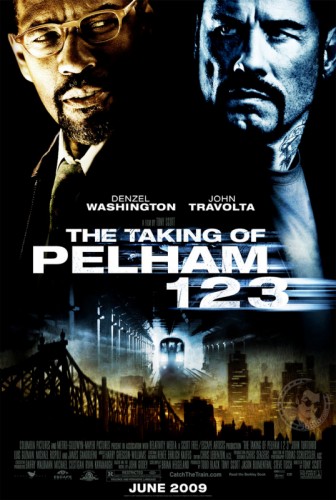
The Taking of Pelham 123 (2009)


Tony Scott's corybantic, incendiary approbation of rampant nimiety, The Taking of Pelham 123, is at odds with itself and not only because it purports to be, in the words of its TV-ad-cum-action movie conductor, a “re-imagining” of the 1974 Walter Matthau-starring crime drama. Scott's movie is another familiarly skin-deep excursion into human-inspired chaos: a theme-park ride rather than a tense thriller—a feigned supercharged, restless roller coaster, but in actuality one prolonged exercise in cinematic onanism. Tony Scott is in many ways more frustrating than his brother Ridley; the latter lacks an even inchoate panorama of ethnological comprehension, fumbling about in interviews with nonsensical remarks like morally equating the murderous drug kingpin and outstandingly clean policeman who share the stage of American Gangster. Tony—and this is crucial—is by contrast the aspiring painter who lacks the prerequisite patience and poise to fulfill the promise of the canvas. There is, at least, an urgency of vision to Tony's work, and that nearly satisfies, the way an undercooked brownie or refrigerated slice of cheesecake stave off hunger. The nutrients are lacking, and the fear of eating too much of that impels the hand to reach for the fish and vegetables.

There are moments—shots, actually—which taunt the viewer with the periodic flash of fleeting perspicacity. These, alas, are all too little, too insignificant to finally matter. In the hands of the hyper-kinetic, ridiculously fast-cutting Scott, these worthwhile amendments to the portrait are rendered nearly meaningless. Scott's 2004 revenge action thriller Man on Fire occasionally touched upon the spiritual component which should underlay any such saga. As Denzel Washington's violent American almost literally raises hell in Mexico to save a little girl played by Dakota Fanning, Scott sparsely injects shots of Washington's character slowly, irrevocably drowning in an all-consuming pool of water. It is a startling image—and perhaps the only one which remains over five years after seeing that film. The incongruity of the physical is only an infinitesimally-sized component to the image's power: the deeper congruity of Man on Fire's solely resonant theme is what renders the ocular intriguingly impressive. Scott wants to make an occasional comment on his characters—but the shallowness of the enterprise (for which he is chiefly culpable through his mind-numbing visual techniques, though he does tend to work with either uneven or abominable screenplays) undoes him. Almost humorously, Scott pours only more fuel to the fire of his pictures' corroding emptiness, until whatever dramatic purpose was originally afoot has been replaced by Scott's incessant need to call attention to himself. For every sequence which may actually call for whirling, disorienting editing flourishes—such as Brad Pitt's wooing of a complete stranger in mere seconds to allow his boss (Robert Redford) to evaluate him in Spy Game—there are an unknown number which are given the treatment regardless of genuine need.

The Taking of Pelham 123 in Scott's hands features some insightful visual cues, but they are buried under repetitious waves of excessively busy camera movements—often ostensibly manufactured from tying a diminutive camera to the tail of a kitten, human head or hummingbird depending on Scott's whims—as well as needlessly ostentatious lighting, a droning soundtrack and bursts of laughable dialogue. Many routine and static camera pans highlight Denzel Washington's subway command center, which creates the affect of making over half of the film look and feel like a submarine thriller. (J.J. Abrams utilized a similar technique with Star Trek, albeit with greater discipline, and, since that was a naval war film, it worked. That, however, is for a future review.) The entirety of the film almost crushes the few moments of visual wit to be gleaned from the picture, but those few moments are worth detailing.
John Travolta's subway hijacker, “Ryder,” is a demented, loathsome individual who inveighs against the political corruption of America's largest city. Ryder lets Washington's Garber know that he is a Catholic man, and he admonishes Garber for seeing the hostages as innocent—Ryder's Catholicism informs him that no one of this earth is truly innocent. Scott frames Travolta's countenance through the back panel window of the subway, making the small compartment appear like a confessional. This is wholly appropriate considering this is where Ryder gradually, and most reluctantly, begins to confess his sins to the listening Garber. The Taking of Pelham 123 is briefly made into a richly textured ecclesiastical battle between the fallen Catholic and the modern staple of public service, the practical do-gooder. That has almost nothing to do with Brian Helgeland's fundamentally flawed screenplay—which almost always takes natural conversations and quickly makes them yelling matches, in direct, transparent contrast to the icily attenuated battle of wits between Matthau and Robert Shaw from the original film—and almost everything to do with Scott's temporarily arresting motif coupled with the best portion of Travolta's performance, in which he suggests unmitigated self-loathing and black nihilism.

Scott, however, cannot wait to get to the scenes of mayhem; an impertinent, compendious system of title cards flashes before the viewer nearly like electronically-constituted destinations at a terminal, informing of just how much more time exists for the city to abide by Ryder's deadline. Whether it is a high-concept action blockbuster or the latest Austrian art-house cine, too many filmmakers place process over the quintessential core of their films. In the case of supposed artsy “hyperlink” films, too many filmmakers strain to make the construct matter in the richness of irony and little else, and that may be due to today's excessive devotion to irony for irony's sake. With The Taking of Pelham 123, Scott misses the forest for the trees. His interpretation is predictably noise, noise, noise, all becoming faint—sound and fury, signifying nothing.

Tobias A. Schliessler's almost literally nauseating lighting schema tells the tale; like a Spike Lee film, Scott's picture accentuates the horridness of urban life in New York City. Yet while Lee's pictures personally transfer the worst and best elemental matters of the complicated social organism he dissects, Scott's take is muted by sheer exploitation. This is the filmmaker who, in Man on Fire, made Mexico City look like the eighth circle of hell, only to attach one last title card to thank the city, calling it a “special place.” The milieu may differ but New York City is given a shockingly similar faux-medicinal regimen in The Taking of Pelham 123. Throughout the messy narrative, the city is besmirched and ridiculed, only to be held up by the final moments as a kind of insuperable but benign beacon of clout and culture. The pairing of a taxi cab ad and the mayor played by James Gandolfini (the deliciousness of Tony Soprano moving next door to New York City and becoming mayor all too obvious) sticking up for public servant Garber in the final reel leaves a bitter aftertaste of cheap manipulation to ensure that no unsafe dramatic destination is remotely touched.

And how do the performers fare? The perfection of Matthau as the lanky, plain and unlikely hero has been replaced by utter artifice. The connective tissue bridging the fictive and actual worlds in 1974 brightened Joseph Sargent's solid thriller. In the wake of Vietnam and Watergate, Matthau's public servant was a bold stand-in for the paradoxes which animated American life. When meeting a hotshot police inspector, Matthau's Garber is taken aback because the man is black. Matthau's Garber was imperfect and crude; he scoffs at Japanese men and finds them to be a waste of his time. Matthau's close physical approximation of Richard Nixon subconsciously seals the deal: an evidently inadvertent collision between Sargent's finespun world and that of the pained reality of 1974 creates a lasting and worthy meta-comment. Washington, who seems to have mortgaged a portion of his soul to Scott, by contrast, is a poor reflector; adding a paunch to his midsection with loose-fitting pants always threatening to slide downward is insufficient in its meager conviction. When Washington spills a liquid all over himself, the scene screeches and squeals under the strain imposed by Helgeland's cliched game plan. Washington himself seems in on the joke, as is the entire audience: look, it's Denzel, playing this role. The man is too much of a thespian, crying at just the right moment, frowning with determination at his imperious boss, to be taken seriously here. Travolta dials in another villain: he at least is having fun, but aside from a presumptuousness which is intermittently endearing in that twisted way that makes everyone wish they were so crazed, he brings little to the picture that piquantly stings. Robert Shaw's creation surpassed such pedantic movie thuggery.

Scott's Pelham 123 arrives in the aftermath of more national trauma, war and debilitation of the figure of public service, just as Sargent's did. The differences, however, are noteworthy. Sargent's film sought to deeply examine societal stratas, class and racial tensions—without resorting to absurdly over-the-top maneuvering such as having the villain confirm that an Irishman is Irish and an Italian is Italian as in Scott's picture—through the prism of overqualified criminals against public servants working inside a corrupt system. Scott and Helgeland's public servant is himself corrupt, so Pelham, 2009's message seems to be, what goes around is money, what comes around is payback. That, and something that everyone should follow right about now: invest in gold.

Wednesday, June 17, 2009

Drag Me to Hell (2009)


How much better is Sam Raimi's Drag Me to Hell for having Alison Lohman as its lead actress rather than the early choice, Ellen Page? Lohman—who lent the impersonal Ridley Scott a lovely pathos in the otherwise mediocre Matchstick Men (2003)—was born in 1979 but she looks not a day over twenty-five and imports a vibrant youthfulness and little-girl giddiness and magnetism of a high school student. Page, by contrast, was born in 1987, yet she pollinates her work with an ever so slightly brash cynicism and despondency. Lohman radiates a welcoming patina to the men who share the screen with her; Page's subtle attitudinal negativism would suit a young woman with a worldview tinged by misandry. Page would probably have succeeded in the role of ascendant loan officer Christine Brown but she would have had an uphill climb—for Lohman, however, the role is ostensibly like playing a variation of herself.

Raimi's long absence from the unadulterated horror of his Evil Dead pictures has made the wait for Drag Me to Hell nearly unbearable. The payoff, however, is so grandiose that there is no fear of disappointment or letdown. Drag Me to Hell—as the title itself vociferously declares—is no halfbreed excursion into the mundane passing for direly rampaging terror: it is the real deal. Like Raimi's grin-inducing cult films, Drag Me to Hell is wacky and warped. Reprieves from the assaulting horror—most conspicuously whipped about on the big screen and in the cinema by the exuberantly impressive and Academy Award-worthy sound-editing and -mixing—are short and exist not to banally contrast with the thrills and chills as in all too many films belonging to the loosely-defined genre, but to inform it. Raimi's newest picture is a smashing, exhausting triumph because he and his screenwriting collaborator brother Ivan so consummately embed the everyday quotidian world of Christine's with the oncoming gypsy curse which threatens her at every turn.

Lohman's performance never drives the film, because Christine as a construct is intended to make pivotal choices and continually react. Some critics have perhaps docked Raimi points for this—they may raise their thumb in approval but quibble with some of the particulars. They have it backwards. As a horror film, Drag Me to Hell, while featuring a dazzling facade, is not truly unique. As a complete film, however, it is an enticingly intimate composition. Raimi's art, even when anchored and occasionally buried by cheesiness (The Quick and the Dead) or apathetic bloat (Spider-Man 3), beams through. It is academic to suggest that all of drama comes down to choices made by characters, but Raimi's particular—sometimes feverish—interest in the consequences of choices endows his films with an unusual heft for such a populist-minded filmmaker. Raimi's multifarious interpretations of morality and choice is an articulate, somewhat astral stand against rampant positivism. Raimi's characters are burdened by the inestimable accountability out of which their metaphorical bed is made.

Whether it be Peyton Westlake/Darkman or Peter Parker/Spider-Man, or the poor Mitchells of the melodramatically charged, deathly ashen A Simple Plan, Raimi's characters are in command of their own destinies, subjects to their own administration. They are infused with the culpability and original sin with which Catholics ceaselessly wrestle. Some critics may chide Raimi's “moralistic” approach—they are mistaken. As in the under-appreciated The Gift and the amiable but quite uneven For Love of the Game, Drag Me to Hell echoes beyond its running time because of the repercussions against which Christine, like Raimi protagonists before her, so tirelessly chafes. As rudimentary as Spider-Man's outstanding line of dialogue may in truth be (“With great power comes great responsibility...”) it remains potent—and in a vein deeper than materialistic or paternal noblesse oblige, which were the oversimplified readings of that film's tonal substance—in no small measure because Raimi is not a pedestrian journeyman ensuring the line readings were recorded; he believes the words.

Now opting for more visceral representations of that implication, Raimi allows the conveyed statement to reverberate with action. Christine's position at her bank is uncertain: she is desirous of a promotion but she must overcome the daunting obstacles of a weasely rival and the all too easily discerned air of sexism and buddy-buddy networking which plagues her professional life. On numerous planes, Christine is a symptomatic creature of modern American society. Gradually pushed to the brink of myriad possibilities such as taking shortcuts, fulfilling vengeance-laden gratification and aiming to please her fickle boss, Christine's journey is an enriching etching of feminine vim and dynamism set against the backdrop of a largely insensitive and hard-featured world. Lohman's sweetly angelic and innocent features italicize the Raimi brothers' point: the darkness of the world is always seeking out the beautiful for retribution, whether deserving of its presence or not.

The meshing of the most base elements of the corporeal and the unthinkable devastation of the otherworldly has rarely been this rivetingly staged. In Drag Me to Hell, bodily fluids, insects and varied repulsive creatures and pests ground the presence of inconceivable evil like the “pea soup” of The Exorcist. While the visages of the picture sometimes play out like grotesque freak show acts strung along together, they cumulatively inspire a level of fright that surpasses mere sensorial reaction. Raimi's manipulative tricks taken by themselves are not breathtaking; the final, haunting tableau they engender is. This is a major accomplishment for Raimi, who proves that his prolonged stint with elephantine budgets has not irreversibly diminished his keen cinematic senses.

Everything aforementioned handsomely buttresses Drag Me to Hell's delirious banquet of Raimi's self-proclaimed “spook-a-blast”; and at his best Raimi communicates to the viewer with wordless irony. Many scenes begin with a scare and conclude with a laugh, but there is a sensation of knowing attached to that laugh, which hurts. Pretty girls having nosebleeds has become a periodical staple of horror and science-fiction (any fan of The X-Files will attest to that) but Raimi pushes the accelerator all the way down to the floor (and in doing so proves that PG-13 need not be synonymous with toothless)—partly for the gasps and chuckles the more robustly animated mise-en-scene inspire but also because it is through the excellently explored absurd that reality finds itself most nakedly revealed. In this instance, a nosebleed becomes a Biblical flood, and a sight gag segues into primal, human fear. “Did any get in my mouth?” Christine's boss frantically asks. The fear itself is futile, as Raimi continually evidences: evil is already lodged within us, perpetually fighting to get out.

Monday, June 15, 2009

Terminator: Salvation (2009), aka Contextualizing "The Terminator" Franchise


When James Cameron made The Terminator (1984), he successfully coupled low-budget gravel with high-concept gravy. Within literally seconds, he established an alternate universe in which an entire (admittedly downbeat) mythology would play itself out. This was slightly unlike any other science-fiction film insofar as it succinctly detailed the players—both present and future—as well as the stakes of its epical tale by transplanting all of the combatants to the contemporary universe the audience readily recognized. Cameron may not be widely considered a high cinematic artist but this was the baptismal instance in which his interests in storytelling, with the aid of prudently utilized practical special effects, proved too excellent and refreshing a commixture to ignore.

The religious undertones to Cameron's first labor of love (Piranha 2 is frequently dismissed as “director-for-hire” work) helped to establish the gravitas of his nascent mythology. The connection between “John Connor” and “Jesus Christ” is obvious (is there a relation of some sort between “James Cameron” and “John Connor” as well?). Then there is Sarah Connor, named after the Biblical Sarah, foremother of the Israelites. The previously barren Sarah was gifted through a divine miracle to conceive and give birth to the providential, foretold son named Isaac. Linda Hamilton's Sarah Connor is impregnated through time travel: the man sent by a burnt-out veteran warrior, hero and resistance fighter John Connor proves to be Connor's father. (The less time spent debating the scientific merits of time travel, the better. Also: one may view the conclusion of Terminator 2: Judgment Day as the inversion of the story of Abraham and Issac, as the father figure—future California Governator Ahnuld—lays down his... life?... for the chosen son.)

For the first three Terminator pictures, this mythology was largely held intact in its basic configuration. For three straight films, poor John Connor—first, to be terminated before conception, then as a rebellious adolescent listening to Guns 'N' Roses (a trait he still possesses in the 2009 release) and finally as a nearly nihilistic, disillusioned twenty-something—was the target. With Terminator: Salvation, Connor is propped up as a man of action, finally resembling in the most perspicuous manner the “freedom fighter” the audience has been repeatedly told he will one day become. What Terminator: Salvation promises with its trailer (vastly superior to the film) is to finally delve deeply into the war between the humans and the machines first alluded to in the opening seconds of Cameron's 1984 modern classic. What all of the studio executives seem to have forgotten, however, is that not a single viewer of the original picture considered the idea of seeing the future apocalyptic war as necessary, or entertaining or even a good idea in the least. Cameron allows Kyle Reese and his combat trauma-induced flashbacks to be the portal through which the viewer sees the hellish carnage and destruction of the future: it's not particularly appetizing or pretty, and there is just enough of it to drive the point home.

This is not to even broach the subject of this series' thematic schizophrenia. The Terminator posited that human beings could fight for their ideals, for their humanity, as it were, against seemingly insurmountable odds, in the face of known horror. The film's release in the 1980s suggests latent Cold War paranoia of nuclear annihilation coupled with uncomfortable acceptance, which makes the picture surprisingly relevant and subversive in the post-9/11 era, too. Terminator 2 was far more upbeat—the future may be grim but “Judgment Day” can be averted with the coupling of humanity and machine as one force for good. “No fate but what we make,” was the 1991 picture's enormously appropriate declaration, seeing as the Cold War was melting away like so many ice cubes on a June porch and people of varied nationalities, ethnicities and histories were, in essence, rising up against a long-feared oppressor.

Unfortunately, the allure of money was too potent for the aforementioned studio executives to resist: Terminator 3, released less than two years after 9/11, seemed to consign humanity to the dustbin for good: there is no stopping “Judgment Day”; as the politically ambitious star remarked with mechanic chilliness, “You only postponed [the future nuclear holocaust]. Judgment Day is inevitable.” And with that, studio avarice blatantly rejected the entire pulsing message of the first two films as crafted by Cameron. Terminator 3's tagline should have read, “No fate but what we make—What a joke.” And thus, with the end of the world, and end of that picture, Nick Stahl self-importantly intoned that the future still lay ahead. In other words, prepare to sacrifice more money to see a franchise go in an entirely unnecessary direction and nullify the purpose and meaning of the first two films, which so many today still love and quote as nineteenth century American politicians recited Biblical verses in their speeches.

The basic skeleton of the first three Terminator films remained the same, despite the thematic muddling and inconsistency. Each film presented a dystopian future dictated by merciless machines. Cameron's vision entailed faith in humanity against the encroaching supremacy of a mechanized future. It is no coincidence that the greatest objective of all three earlier films was to leave Los Angeles as soon as possible. In each case, at least one Connor was tormented by an ostensibly unstoppable and unyielding force. The formula was enticing in the relaxed, almost innate way that recalls simple fairytales or traditional professional wrestling “booking”: the villain is seemingly invincible, but the hero is equally determined to triumph and save the day. As the series progressed, the assassin terminators had to be increasingly deadly, until, with the third film, a Scandinavian supermodel Terminatrix could just about literally do anything it set its electronic mind on accomplishing. A viewer may have asked, as JC did with T2, “Why doesn't it just become a bomb or something and get me?” Terminator 3, however, was a film consciously bathed in self-parody—and, in a way, how could it not be, considering how pervasive the first two films became in the realm of popular culture? At least the film was brisk, if not memorable, and its longest car chase was excitingly mounted in a way all too few action sequences are today.

Which takes this look at the Terminator franchise to the newest release. It is difficult to remember a film so wantonly self-destructive and wasteful. The most fertile substance from T3 was the emotional chemistry between Stahl and Claire Danes as Catherine Brewster, John Connor's future wife and mother of his children. So the terminally confused Terminator: Salvation elects to spend approximately three minutes of its running time on the relationship between man and wife, savior and maiden. Christian Bale and Bryce Dallas Howard make the 2003 pairing of Stahl and Danes look like Bogey and Bacall in comparison. Bale is wholly lost in his role, grunting and fuming, screaming and yelling, behaving more like an impotent teenager confronted by his parents than the bravely insubordinate trooper defying catastrophic orders the film apparently wishes to present. Howard is an empty vessel. The only performer who escapes unscathed from the film is Sam Worthington, whose most accomplished episodes almost convince that there is an entirely functioning brain behind this enterprise. As this film's Frankenstein's monster, he literally howls at the moon, his naked body covered in mud evidently symbolizing man's evolutionary emergence from the muck and mire of the earth, with the wet soil representing a mother's amniotic fluid.

Terminator: Salvation is reminiscent of the 1970s and 1980s James Bond movies of the frequently lamented “Roger Moore era,” as an old, aging and tired franchise begins to steal from newer, flashier populist cinema entries. The Matrix, Steven Spielberg's 2005 War of the Worlds and Michael Bay's Transformers, to name but three, are liberally borrowed from for action spectacles; Apocalypse Now, first poked in the ribs by Watchmen, is once again trotted out by director McG for yet another parading exercise in film geek pandering. Whereas The Terminator was a concisely paced, tersely eloquent exploration of dread, Terminator 2: Judgment Day a glossy action-packed marathon of mythological peregrination and a work of a man wanting to satisfyingly wrap up every loose end presented by his first opus, Terminator 3 an agile if nearly completely mindless compilation of action genre outbursts and obeisance to the superficialities of the two earlier pictures and simultaneously an utter rejection of their respective theses, Terminator: Salvation is a film adrift, with a character built up for three straight films who proves to be nothing less than boring in the flesh. Cameron had it right; the viewer did not need to see the much-ballyhooed war between the humans and the machines. Subtlety is not even the issue—T3 featured Danes' Brewster squeal, “I hate machines!” as one of her first lines. What Terminator: Salvation needs is the very hope of salvation once embraced, and later discarded, like so many long-forgotten cynical campaign promises.

China Moon (1994)


The 1991 (finally released theatrically by Orion Pictures in 1994) romantic neo-noir thriller China Moon establishes early its central character's most palpable traits and attributes, which deceptively foretell his eventual unraveling and undoing. Ed Harris plays cagey, intuitive (fictional) Brayton, Florida (filmed in Lakeland, Florida and the surrounding area) detective Kyle Bodine, whose observant attention to detail allows him to read murder scenes like road signs, knowing within minutes who the perpetrator is. Because he is good at his job, he rarely considers why he is doing it; when questioned by his somewhat green, and in Bodine's words, “okay,” partner, Lamar Dickey (Benicio Del Toro) why he is a cop, Bodine replies that he knew there was a reason. He will think about it sometime.

Bodine's intelligence and awareness prove to be indirect vulnerabilities when placed alongside his ostensible lack of greater motivation. When he discovers a beautiful, mysterious woman named Rachel Munro—played with almost vampiric luminescence by Madeleine Stowe—he falls head over heels for her. Unfortunately she happens to be married to an equally powerful and abusive local banking kingpin, Rupert Munro (a one-note Charles Dance). Gradually, the film's tone shifts from the fairly sumptuous tale of passion between Bodine and Rachel to a serpentine murder mystery.

China Moon is longtime cinematographer John Bailey's (whose credits include American Gigolo, The Pope of Greenwich Village and Mishima: A Life in Four Chapters) directorial debut. The lighting the seasoned director of photography utilizes allows for some mesmerizing visualizations which enhance what is fundamentally a routine potboiler. The screenplay, by Roy Carlson, is sufficiently serviceable when it must be, providing just enough in the way of narrative glue for the picture's subtly dyspeptic yarn to give impetus to the ocular pleasures China Moon offers to the viewer. Bailey and Belgian cinematographer Willy Kurant ably conspire to create a visually rich canvas of coolly colored nighttime vistas and interiors. One particularly memorable setting is the lushly romantic setting of a lake. The reflection of the “china moon”—Bodine tells Rachel that his mother used the term for a full moon, under which people would “do strange things,” he states—is captured against the smooth, seemingly tranquil surface of the body of water in delicately composed shots.

When finding himself in the unenviable position of covering up a murder, Bodine's mercurial gifts are turned against him, and as the cliché goes, the hunter becomes the hunted. Bailey and Kurant's occasionally delicious visages figuratively brighten and literally dim the picture as Harris' detective becomes not only wholly entangled in the mystery but the most suspected figure in the film by his fellow officers, including his partner. Following the time-honored noir template, the protagonist's apparent strengths prove to be strangely debilitating, as Bodine's certainty and sharpness leave hints of hubris. Those seeds are indeed immediately sown in the film's prologue, during which Bodine surveys the scene of a homicide with all of the clinical precision of a genuine expert. “Sooner or later,” he says derisively of murderers, “they all fuck up.” Little does he know his tumultuous future when he makes this comment to his colleagues.

China Moon's most sound component of all, however, is the lead performance by Ed Harris. Harris is dynamic and subtle, forceful and equable all at once. He gives a compelling, convincing performance that keeps the film humming even when too many coincidences and plot holes needlessly distract from the vastly more important emotional through-line with which Harris endows the humble film. Harris' eyes are especially captivating in a film peopled with indelible pools of light as eyes, most notably his costar, Stowe's, which accurately belie her truer nature. Harris makes every little movement of his eyes matter, and it fits wonderfully with his character's chief gift of observation. There is a doom in his eyes, and it is matched, if not with straightforward and engrossing presence, then with a complementary sense of intrigue by Stowe, working off of the guilelessness and fierceness Harris supplies.

Where Stowe comes up short is in the range of her performance; the screenplay and Bailey's uneven handling of his actors contrive to limit her. Whereas many noirs allow for the female presence to display greater shades of character, China Moon is actually the opposite. Stowe's Rachel is if anything too nebulous and murky a figure, and the fact that the very ending hinges on her true motivations leaves a peculiar aftertaste as there has been minimal buttressing of her emotional state beyond common, hoary and hackneyed abused-wife syndrome scenes. As with other conventional neo-noirs that follow similar storylines, the husband, here played by Dance, is completely one-dimensional and totally unsympathetic; if and when such a character meets a violent end, the ramifications of his demise are almost always only of interest insomuch as they relate to the other characters' fates.

Nevertheless, Harris' carefully calibrated turn excellently draws the viewer in with great, meticulous thoughtfulness. When Bodine finally reaches his breaking point and lashes out, the viewer is caught up with him; it's not an entirely different sensation than relishing the confused, furious righteousness of James Stewart's John “Scottie” Ferguson confronting the inscrutable Kim Novak in the closing moments of Vertigo when Harris' Bodine points the finger of indignation at the untrustworthy Rachel. The sophistication that is missing in other parts of the film is evident whenever Harris makes his presence profoundly felt. In a landscape of noir, marked by countless dupes, sometimes what matters is simply trying to get the last word in. Bodine tries his best, and this flawed film is better for it.

Friday, April 3, 2009

Murmur of the Heart (1971)


There is an almost inescapable infectiousness beaming from and residing in Louis Malle's best films. His vibrancy and effervescence, when judiciously meshed with a compelling, mythic anecdote—both of which he himself crafted with singular delicacy—is simply irresistible. It has doubtless often been said that Murmur of the Heart, like other Malle pictures, is a filmic essaying of innocence lost, but that is itself a faux pas. Malle's work, not irregularly maligned by critics who soured on Malle's admittedly tartly acidulous aromatic palette, is best consumed with a suspicion—not of his intentions but of his art, which seems to serve as a rejoinder to the oft-repeated phrase, trust the art, not the artist (which naturally remains true in Malle's case as well). Malle's films are about innocence, period, even when it is politically, sociologically or culturally skewed, benighted and spiritually subjugated to the banalities of polity, as in the mesmeric tarry through callow fascism that is Lacombe, Lucien. Malle's cinema—imbued with an innate plausibility, but purified by a tinting of phantasmagoria—is arrestingly deceptive without resorting to duplicity.

Murmur of the Heart stars Lea Massari and Benoit Ferreux (in his first film) as Clara Chevalier and her adolescent son, Laurent, in 1954 France. As in other Malle pictures, the main pubescent-to-young adult character's insouciance is juxtaposed with the geopolitical tumult that either directly or circuitously informs his peregrination into variegated definitions of manhood, most commonly finding sexual awakening, arousal and action as the definitive fulcrum against which all else pivots. The aforementioned Lacombe, Lucien made Malle's most trenchant points concerning wartime collaboration as seen through ambling indifference—ascetically apolitical in its painterly construction but highly, almost obdurately uncompromising in its most sweeping aspects of efficaciously rendered prevarication (Lacombe's chief imperious/sexual conquest and annexation is of the pulchritudinous girl named France Horn)—but with the earlier Murmur of the Heart, Malle's edifice remained with the entanglements of the familial. As reports stream into the consciousness of Frenchmen from the losing contest in Indochina, Laurent—who, in the film's prologue is found with a friend soliciting random people for aid for wounded veterans of the colonial strife—blossoms in both expected and unexpected ways. This is a most particularly oedipal telling of the nuanced love between a son and mother.

Like Francois Truffaut's The 400 Blows, the son, here Laurent, catches his mother engaging in extramarital love affairs. The love that once deeply marked the Italian-born mother's marriage to her gynecologist French husband, for whom she produced three sons—Laurent being the youngest—has been replaced by gentle but occasionally uncomfortable silences and arguments recurrently about Laurent's nature, with the nearly overprotective mother protesting that the misbehaving child is sensitive as her husband merely throws up his hands and refers to him as a pain in the neck. “He used to be so jealous,” Clara Chevalier tells her son late in the picture. At this time, however, Clara finds herself searching for excitement and warmth of feeling from other men. Laurent's sexual confusion and deep, abiding affection for his mother collide as he catches glimpses of her running off with other men. Clara will tease him late in the film: “You're my little, jealous French husband!” The relationship between Clara and her son doubtless inspires interest from receptive Freudians.

What partly separates Malle's pictures from many others is their curious, salient repetition of movement and form. Like the heartbroken, lonely solitary figure walking seemingly aimlessly about the arid night in Elevator to the Gallows, Murmur of the Heart's cohesion—seen from Laurent's point-of-view, but legitimately adjoined to his equally cogent and misaligned multi-peopled portraitures orbiting his mother—is made up of confident visual enactments that prop up Malle's thematic touchstones. In Murmur of the Heart, these are repeatedly quite funny. One especially rewarding sequence follows Laurent's delirious older brothers playing “spinach tennis” with one another, flinging globs of spinach to one another's plate from across the dinner table. Much later in the film, the actual sport of tennis will become a metaphorical simile for the battle of the sexes, and how the entire war is a stupendously childish game of a different sort, one of Malle's most propitiously important revisited themes.

What ultimately enriches Murmur of the Heart, however, is its densely literate subtexts. In one subtle scene, a brother of Laurent's hands him reading material: “Proust to entertain you and Tintin to instruct you.” As Laurent chastises a shallow suitor for Clara's affections at a health spa, he points to the intelligence of Proust. “But you don't read Jewish writers,” Laurent notes of the apparently nationalistic, colonialist-leaning young man. “A country is nothing without colonies. Look at the English,” Clara's suitor remarks. The allusions to Proust are important to examine, as they hint at Malle's narrative structure. Murmur of the Heart is fundamentally a retelling of Proust's “Within a Budding Grove, Volume 2” from “In Search of Lost Time.” The connective tissue is myriad in its configurations. Malle's health spa—which Laurent, like the story's narrator, is a sick child, attends for the sake of his heart which suffers from murmurs—appears to be a stand-in for Proust's Balbec; the pretty blonde girl Helene seems to be inspired by Proust's Albertine, who in both the story and Malle's film is suspected to be a lesbian; like the narrator, Laurent seeks to sexualize his relationship with Helene/Albertine—Proust's delineation followed the narrator's quest to kiss Albertine whereas the sexually fixated Laurent attempts to bed Helen; and like the narrator, Laurent professes a consummate love for his mother (which again, in Malle's tale, is more acutely sexualized).

As in Lacombe, Lucien and other Malle films, from the mutedly despairing, futuristic parable of the war between the sexes, Black Moon to another rendering of maladjusted childhood fantasia and tragic malignity, Au revoir les enfants, male dream-manufacturing, like spools from which airy cotton candy are proliferated, finds both reward and dejection, elation and despondence, in the ecstatic reverie of dazed abstraction. Where Murmur of the Heart differentiates itself from both Malle's earlier and later work is that its playfulness is more earnest—and therefore brighter and truer all at once—because the child is truly enraptured with not only a conception but a real-world visage of nearly ineffable familiarity and closeness. Oedipal or not, the relationship—superbly brought to life by the effortlessly charming child actor Ferreux and the window of the mortal divine that the impossibly endearing Massari most palpably represents—somehow resides beyond all of his other explications of humans in all of their confounding complexities. Profundity of a peculiarly alien, ethereal kind presents itself in Malle's exquisite denouement. After everything, all the Chevalier brood can do is laugh together, giggling and chuckling, chortling and cackling, in a fit of sustained cachinnation, surveying not so much the world—which for all of national and intimate changes, in immeasurable and decipherable ways alike, coupling the political with the sexual, has not been irreparably altered after all—but themselves. As with almost anyone with any hint of modesty, self-awareness and humility, they have burst together, as in the most reasonable reaction to a sustained episode of looking into a mirror.

Thursday, April 2, 2009

Hunger (2008)


Steve McQueen's feature film debut, Hunger, is an uneven but viscerally forceful picture. Where it fails in comprehensiveness and even filmic movement—McQueen's vignettes almost all stand apart, disparately creating momentary displeasure and disgust, never quite gelling into a substantive narrative, or at least only belatedly finding one to pursue—it succeeds in sensational conviction befitting its subject matter. Not unlike Mel Gibson's The Passion of the Christ, McQueen's film is fervent and nearly maniacal in its unblinking stare; unlike Gibson's film, McQueen's attempt to chronicle the sixty-six day hunger strike spearheaded by Irish Republican Army leader Bobby Sands (Michael Fassbender) is secular in its devotionally obsessive focus. Drawing a parallel between both the cruelty visited upon the defiant and disruptive prisoners of the Northern Ireland Maze Prison by the guards and Sands' self-inflicted choice to starve himself to Christ's passion on several occasions, McQueen and collaborator (and playwright) Enda Walsh seem to nevertheless yearn to unfurl their drama with a level of detachment.

That detachment, however, is occasionally made questionable, and McQueen's actual beliefs are ostensibly betrayed by his insistence of layering stylistic flourishes atop the occurrences his film essays. One repetitive touchstone is the usage of British Prime Minister Margaret Thatcher verbally condemning the Irish Republican Army members as violent terrorists unworthy of the political prisoner status for which they protested. McQueen creates significant sympathy for the Irish prisoners, demonstrating with an unalloyed minimalism, as they communicate through tiny wads of paper passed along through their mouths to one another during mass. However, McQueen and Walsh exhibit empathy for the guards as well; indeed, the film opens with an extended sequence during which the camera follows along a guard who is washing and soothing his scarred-over knuckles in water. In one scene of vicious brutality, one guard appears almost traumatized, weeping as he recognizes the levels of de-humanization to which he and his peers have descended.

While examining Hunger it is advantageous to consider the chiefest qualities of cinema; its immediate fluency, and proficiency when optimally used to convey information. For example, in many of the better unironic, under-appreciated “genre” films, it is almost always the acuity of the filmmaking that enhances the narratively prosaic. It is in these films where the visual craftsmanship and aesthetic stylishness benefits the films' unalloyed machinations. When appropriately meshed, visualization supersedes what is commonly called “plot.” From Taken to Point Break, and many other examples, it is the artful accession of élan that endows the familiar.
So it is with a slightly confounded mien that it is realized that McQueen's Hunger is almost arriving at the opposite spectrum of cinema—the “story” is at the service of his craftsmanship. McQueen is trained as a fine artist, and his debut film is delineated by ostentatiousness and precociousness. The entire ninety-six minute film plays out like an exercise in quaffing precious artfulness. With the proverbial tips of the hat to Robert Bresson (the meticulously detailed manner in which the prisoners communicate with one another cannot not remind of A Man Escaped) and Stanley Kubrick (the entire film accounts de-humanization—of prisoner and guard alike—and a sequence in which a group of jackbooted thugs stand in a long hallway cannot not bring images of Full Metal Jacket to most filmgoers who will actually watch Hunger), McQueen's confidence, at least bordering on arrogance, is doubtless.

Not that there is anything wrong with a stubborn, uncompromising artistic initiative—with Hunger, it is the imagery that stays, long after the final credits have unspooled, after all, but for its second and most impressive act. Nonetheless, McQueen's picture plays like numerous sketches aligned together for the purpose of making a film. Coherence is not an issue—Hunger is rigorously minimalistic and quite slowly paced, which contributes to the pervasive feeling of crushing, listless boredom that is as poisonous to the souls of the prisoners (and guards) as the ordeals to which they are subjected as a price of their disobedience. Ocular recording of the tellurian plays heavily into the visceral potency that is Hunger's most certain attribute. As a guard sedates himself with a quiet sojourn to the yard, smoking a cigarette in the wintry weather, snowflakes fall upon him. McQueen and director of photography Sean Bobbitt capture the subsequent moment on film with fine delicacy. The guard who had earlier soothed his beaten, battered and bloodied knuckles in water finds little snowflakes weep from the sky and landing on his scars and marks of self-inflection against the heads of many prisoners. McQueen's fine artist eye catches many more undisguised flourishes. Prisoners smear their own excrement upon the walls of their cells, and McQueen's camera seems particularly attuned to the spiral patterns one prisoner creates with feces-wall painting.

The best portion of the film, however, is a bravura, unbroken sequence in which McQueen's camera remains still and there are no interruptions of cutting. For over fifteen minutes, two men, Sands, and Father Moran (an extremely stirring and profound Liam Cunningham: his performance alone makes Hunger worth the investment) speak to one another in ostensible “real time,” volleying points to one another. The steadied duration of this puissant portion creates uneasy astriction and tautness, deftly providing an atmospheric contextual support for the final act of the film that details Sands' self-imposed bodily disintegration, wherein the film finally does become soporose in its hazily blurred perspective. When the camera finally does break the hypnotic spell, it is to emphasize Sands' words as he tells an allegorical story from his childhood about doing what was right and accepting the consequences with the peace, dignity and knowledge that he had the courage to do what was right. The conversation between Sands and Father Moran is utterly bewitching and fascinating, and an instance of actors correctly taking over a film and the director allowing them the freedom, space and time with which to tell a story.

It is, then, almost humorously appropriate to consider the inherent artifice of the entire riveting conversation. By all accounts, Sands and Father Moran never spoke to one another, whereas it is clear that such events as IRA members being beaten, refusing to wear certain prison uniforms and going on hunger strikes are part of recorded history. In Hunger's major and outstanding concession to filmic progress and peregrination, it actually extols the virtues of the cinematically schematic derived by storytelling strategies and considerations of scenario. Unlike The Class, which was made intentionally visually unappealing by its director, Hunger is a film with several toes dipped in the waters of vérité filmmaking and mise-en-scene construction but with other toes hanging on to almost wheezing exhalations of exhilaratingly intense abstract artistry. That the most dazzling set-piece of Hunger almost perversely proves the efficacy of what may be loosely defined as “make-believe” is deeply paradoxical.

In the film's foggy, more asomatously focused, denouement, Sands allows his body to waste away. McQueen follows the process with a serviceable melange of the dispassionate and the assertive, engendering a cumulative tableau of a man gradually drifting away. Misty flashbacks to his childhood, the personal history from which he told the emotional story to Father Moran, abut the film's apparent moroseness in its consideration of a young man's life concluding long before it should have. The correlation to Jesus Christ becomes less distancing than it was earlier in the film—a manufactured line of dialogue from Sands in which he says that Christ's disciples were merely jumping on a bandwagon after Christ laid it all on the line himself diminishes their own respectively harsh fates and credentials for martyrdom—as McQueen visualizes Sands' earthly demise. Long, uninterrupted takes with sepia-toned dissolves overlapping atop them punctuates Sands' sixty-six days of deprivation. A flock of birds flying off represents Sands' soul taking flight in a sequence that at least borders on the clichéd, but, like so much of the film, makes itself at least stand apart through sheer force of will.

Wednesday, April 1, 2009

The Night They Raided Minsky's (1968)


The Night They Raided Minsky's is an appropriate film to look over on April Fools' Day, as its narrative hinges on one large “trick” to be played on certain characters. William Friedkin's second feature film is an uneven but sweet and charming ode to the 1920s theaters of burlesque. As the film today exists in current form, it routinely cuts away from his own narrative and splices in many apparent pieces of footage from the time period itself, thick with grain and washed-out images. The screenplay, based on a book by Rowland Barber and written by Arnold Schulman, Sidney Michaels and Norman Lear, supplies a dangerously thin storyline, but the film is at its most fun when the mechanics of the picture are almost invisible, and mere gags and burlesque performances take the center stage.
Jason Robards, who plays central figure Raymond Paine, received mixed notices for The Night They Raided Minsky's, but today his performance seems stronger than it may have at the time of the film's release. Robards was never too much of a “leading man movie star” to diminish his own self-effacing and auto-critiquing tendencies; even in the testosterone-laden westerns in which he appeared, he often played characters either physically or psychologically wounded, such as the contemporaneous Once Upon a Time in the West, Hour of the Gun or The Ballad of Cable Hogue. With Minsky's, Robards allows his most winning attributes to mesh with his nearly continual semblance of debilitation—ever so slightly suave, his persona is crushed when confronted with hostility or projected dubiousness by others. It helps that Robards is given many of the film's best lines. When his longtime partner and friend, Chick Williams (an energetic Norman Wisdom), falls for the pulchritudinous Amish ingénue, Rachel Elizabeth Schpitendavel (a wide-eyed Britt Ekland), Robards' roguish huckster comedian undermines Chick's propriety. )(Which ties into their joined rendition of “Perfect Gentleman,” in which Robards' character sings along with Wisdom's about just how much of a gentleman he is. “You suffer from the three D's,” Raymond tells Chick, “you're decent, devoted and dependable. Good qualities in a dog—disastrous in a man.” He goes on: “Women love bastards. I am a BFC: Bastard First Class.” Robards likewise shines in a long scene in which he approaches a woman at the local deli—where a significant portion of the film's events take place—only to be surprised when her husband returns from the restroom. So Raymond smooth-talks the husband and is as smooth as the skin of a newborn. The humor is obvious but Robards is too excellent when at his best in this film to dismiss, balancing his motor-mouthed shtick with the fearfulness behind it.

Ekland is fine as the young runaway Amish woman who is blinded by the dazzling marquee. As Raymond and Chick contest one another over her affections, Ekland's debatable one-note performance never feels particularly calculated, which is key in making it fit with the long line of young ingénues who were transfixed on the idea of becoming a star of show-business. Considered unqualified for burlesque, Ekland's Rachel is manipulated by the scheming Raymond; his bright idea is to have her perform one night after being billed as “Mademoiselle Fifi,” the French starlet and heroine of pornographic literature, who is, it is constantly noted in her billing, “The Girl Who Drove a Thousand Frenchmen Wild.” Raymond figures Rachel will do what she has done in her Pennsylvania Amish community—perform a Biblical dance rather than a bawdy number. Thus, Secretary for the Suppression of Vice Vance Fowler (Denholm Elliott), determined to raid Minsky's in the event of Mademoiselle Fifi's appearance, will have no reason to shut the establishment down and Raymond's job will be safe.
Two other welcome performers are Joseph Wiseman and Elliot Gould as the father and son (Louis and Billy Minsky), who repeatedly enliven the picture. Wiseman and Gould play their parts as Jewish businessmen with significant emphasis on their ethnicity. The Night They Raided Minsky's pokes some fun at religion in general, as Rachel's stern and unforgiving Amish father, Jacob Schpitendavel (Harry Andrews), hunt her down and finally finds himself confronted with Wiseman's Louis Minsky. Louis educating two other religious men about the identities of each finger's meaning in religious terminology evokes laughter. The picture may satirize stoically religious individuals, but at this late point in the film, it does so with a genial warmth.

The Night They Raided Minsky's was released just as Hollywood films had largely been let loose; censorship in American cinema was coming to an end. So it is particularly amusing to view Minsky's as the film examines a different kind of show-biz thriving under the threatening thumb of censorship. As Elliott's Fowler chastises the men who run Minsky's, he is asked what he finds so objectionable. “Well, the women... They jiggle,” he remarks. The film is hilariously accurate in its depiction of the censoring force having to attend every show and write down in explicit detail what is to be considered lewd and improper.

Reportedly, Friedkin's cut of The Night They Raided Minsky's was a considerably different film from the eventually released 1968 picture—Friedkin's first cut was, it was almost universally agreed, a complete disaster. Editor Ralph Rosenblum worked on the film in postproduction for over a year, finding a coherent film through his assiduousness. Some may assume the concept of cutting to old footage was Friedkin's idea—perhaps an homage to Jean-Luc Godard's stylistics—but it was indeed Rosenblum who came up with the idea himself. Rosenblum, in effect, re-directed the film himself and made an alternative version of Minsky's which is today the one actually seen.

Some of the film's finest moments are simply of Robards and Wisdom engaging in song and dance with one another. The soundtrack is stuffed with modern classics as well as some songs by Lee Adams (the score was provided by Charles Strouse). The agreeable combination Robards' wise-guy next to Wisdom's naïve optimist makes The Night They Raided Minsky's seem so effortlessly mounted, though it actually was one of Hollywood's most painful births; likewise, Robards' history as a great stage actor and Wisdom's history as a great British comedian and music-hall star must have paid dividends as they excel at projecting an immediacy that draws in a live audience. Minsky's isn't a grand time at the movies, but it is fast, fun and frank—a valentine to all things just vaguely fulsome.

Tuesday, March 31, 2009

Point Break (1991)


Kathryn Bigelow's Point Break has been labeled many things. Frequently dismissed as a crassly commercial big-budgeted actioner, a rather silly, shallow over-the-top, action thriller with generous helpings of comedy, New Age philosophizing and romance, with protracted focus on surfing in the Los Angeles area, starring Keanu Reeves and Patrick Swayze, many critics seem to have either missed or perhaps scoffed at the contributions of the film's helmer, Kathryn Bigelow. Point Break's screenplay—by Rick King and Peter Iliff—is bursting at the seams with clichés and stereotypes, but Bigelow's direction allows for the characters to be predominantly expressed through cinematic shorthand. Some sections of the script—no, many sections of the script—are too talky, but whenever Bigelow has the opportunity, she cuts down the excess of words by supplying a rich palette of a marvelously packed 2:35 'Scope widescreen frame, ceaselessly offering a supremely confident brand of action-filmmaking. Rarely has an action filmmaker utilized this aspect ratio with as much gusto; Bigelow makes the 'Scope letterbox format a necessity, squeezing in as much geographical information as possible. Today's speed-freak fast-cutting action directors could take many pointers from Bigelow on how to sustain tension through genuinely comprehensible shooting of action sequences, not to mention merely allowing the audience to understand what is occurring and to whom it is occurring. The 'Scope aspect ratio gives her, and director of photography Donald Peterman, free rein. In one early exquisite shot, for instance, Bigelow and Peterman frame a group of bank robbers wearing masks (of Lyndon Johnson, Richard Nixon, Jimmy Carter and Ronald Reagan) as one unified group, separating and dispersing away from one another as they briefly seize a bank. Bigelow utilizes the spatial gulfs between characters to connote geography.

Considered the most famous alum of the San Francisco Art Institute, Bigelow matriculated as a painter. With her motion pictures, she displays the visual adroitness that flaunts her conception of the screen as a canvas. Action for her is not to be used to engender a whirling, disorienting blur for the viewer; in Point Break, for instance, her framing of surfing sequences is perfectly symmetrical, capturing Reeves' FBI agent Johnny Utah's development as a surfer with logical consistency. Shooting the horizon from beaches, Bigelow's painting talents must have helped significantly in mirthfully playing with the amplitude of space, locational margins and the breadth of artistic panels. Whether surfing seems like a fun hobby or not, Bigelow renders it with an air of excitement and awe.

Critics who mistake plot for meaning and theme tirelessly go about thrashing Point Break's borderline mindless lack of logic. Agent Utah, it is said, finished second in his class at Quantico, yet seems like a remarkably ineffective and unintelligent individual. Repeatedly certain events transpire with very little to buttress them with rational motivation and purpose but for the desire to keep moving the story along. A veteran, comically burnt-out agent (Gary Busey, who wisely enjoys himself in his part) behaves quite inappropriately with great regularity in almost every manner conceivable. The film indulges itself in myriad tropes of the crime thriller, with an overbearing FBI boss played by John McGinley periodically chewing out his subordinates' derrieres.

What makes Point Break.... break free from becoming just another derivative action extravaganza is Bigelow's virtuosity. As in the vampire cult film Near Dark, Bigelow laces her action with impressive flurries of technique. The most distinguishing trademark she applies to the dyspeptic proceedings is a bracing, breathless point-of-view perspective—mainly Utah's—as in a frenzied chase on foot through a Los Angeles neighborhood. By placing the viewer in the action, Bigelow emphatically connects the vista (typified by the many surfing scenes of the film's first stretch) to the individual (from which more and more of the film is seen).

The most wondrously exhilarating marrying of these respective elements is a tremendous sky-diving scene, in which Reeves' Utah descends from an airplane, joining the group of bank robbers with whom he has been undercover for some time. It is here where Point Break achieves something approximating sublimeness: like Enoch, the extraordinary mortal elevated to the status of the angelic, Utah joins his newfound friends/technical enemies in heaven, looking down upon the earth. Bigelow shifts perspectives with a fluid ease, once again placing the spectator perfectly into the heart of the action while completely detailing the entire panorama that encompasses the viewpoint (of a painter, an artist, an FBI agent...). This is bravura, accomplished and dazzlingly crafted filmmaking, lent to a deliriously preposterous high concept.

Bigelow's mise-en-scene accentuates the “small scenes” as well. One of the best sequences of Point Break is actually a nighttime beach football game. The camera finds itself arranged amidst the ongoing struggle as one player passes the ball to another. Hurriedly, Bigelow complements the topographic mastery with which she gifts the film with a kaleidoscopic recording of every physical ruction. What finally makes Bigelow's artfully composed helming of human movement come alive is the thematic weight that lurks beneath the superficies of the action. Reeves' FBI agent is drawn to the enigmatic, Zen-like leader of the bank-robbing surfers, Swayze's enigmatically self-named Bodhi. Swayze's charismatic performance is the film's most successful addition to Bigelow's propulsive filmic appliqué, with his surfer looks and steely cerulean eyes, he practically begs both Utah and the audience to join him in his rambunctious daredevil shenanigans. When Utah tackles the running Bodhi in the surf of the ocean, those who love Bodhi express anger with Utah, but Bodhi tells them who he is—a former college football quarterback star. In a confrontation with a group of beach-terrorizing brutes, Utah has to be rescued by Bodhi, who admires the undercover agent's fearlessness. Little by little, scene by the scene, Bigelow manages to sustain a fastidious telling of literally fabulous friendship between men. Bigelow's concerns suggest a woman truly, almost heedlessly, interested in the ties and connections between cosmetically adversarial men. As in Near Dark and Blue Steel, and later in the forgettable K-19: The Widowmaker, Bigelow is—most fittingly for a female director rightly celebrated for her breathtaking command of action—an expert fabulist of unlikely male bonding.

Monday, March 30, 2009

Coraline (2009)


At a time when too many animated family films needlessly coddle children at the expense of educating them through the mythical art of storytelling, along comes Coraline, which seems to stand athwart so many of the easy, uncomplicated children films routinely pumped out—a kind of cinematic over-medication of immediately attractive sights that are time-tested. A crushingly obvious example would be the recent Monsters vs. Aliens, which does nothing less (and certainly nothing more) than promise every child lots and lots of monsters and aliens on the screen. The story and characters do not matter in all too many instances; the pablum tacked on to make the experience at least nominally cohesive is rarely meaningful. Coraline, however, is a veritable one-film renaissance of family movie-making: Henry Selick's more intense, yet subtly transcribed, treatment of fairytale touches upon something more peculiar and universal all at once, because it seems legitimately childlike.

Selick's film is based on Neil Gaiman's book, and as in Selick's adaptation of the eccentric children's writer Roald Dahl's James and the Giant Peach (1996), Selick preserves the spirit of the source material by giving it literally moving, cinematic life without robbing it of its quintessence. Coraline is a rather unnervingly eerie story about a pre-teen girl (voiced here by Dakota Fanning) who finds her parents unpalatable to her wishes and desires. Her mother (a terrific Teri Hatcher) ignores her and the food she makes for her is uninspired; her father (John Hodgman) is too busy at his computer for his work to spend much time with her. Coraline sees herself as a child alone, in a gray, downcast world. If only she could escape.

It could be said that Coraline is perfect children's nightmare fodder because Selick makes the film follow nearly flawless nightmare-logic. In an impressive credits sequence that opens the film, a pair of menacing metallic hands hurriedly de-construct a doll, pulling out its button eyes and in an act that may linger in the minds of children, rip the innards of the doll out, after which the doll is re-fashioned, unmistakably looking like the film's heroine. Coraline as a narrative incisively comments on the remaking of children—through sundry forms of medication, for instance—as “happy.” Gaiman's story supersedes the potentially banal conclusion to be reached from his own tale (which can admittedly be useful as the film's tag-line—“Be careful what you wish for”); Coraline is in part about systematic perfecting of the corporeal at the expense of the spirit's obliteration. When little Coraline discovers a secret passageway to an alternate world, she initially believes she has found a panacea; her “Other Mother” (again voiced by Hatcher) cooks lavishly spectacular meals for her, and her “Other Father” (Hodgman, again) helps oversee a breathtaking garden that plays into the worst, most narcissistic impulses of children.

The blue-haired Coraline is put through the emotional wringer that hurts the most. Acceptance may be the story's most pointed “message”: at last, Coraline must begrudgingly accept her parents, as well as the strange and bizarre cast of neighborhood characters (two washed-up, has-been burlesque queens, Miss Spink and Miss Forcible and a hilarious Russian acrobat and trapeze artist named Mr. Bobinsky voiced by Ian McShane) who inhabit her world. The “Other World” characters are more superficially arresting, with more colorful personalities, but the superannuated qualities of the “real world” characters is gradually viewed in a new, radicalized light once Coraline realizes that the “Other World” is one horrifying snare run by the “Other Mother.” Only a talking black cat (perfectly voiced by Keith David) can move about each world along with Coraline, bringing childhood imagery full circle through gentle subversion: that which appears evil, such as a notorious haunter of bad luck like the black cat, proves indispensable to fighting against what looks like a heaven-sent paradise.

Dreadful menace permeates Coraline, and even the way in which Coraline moves about the Narnia- or Secret Garden-like entranceway connotes trepidation and tumult. To make this precisely, cinematically tangible, Selick utilizes stop-motion animation, which was an enriching choice. Like Ray Harryhausen's stop-motion animation, or perhaps the late Stan Winston's effects work, Selick's undertaking here bridges the human with the inhuman, bringing out an indelible cumulative effect that lends an uncommon verisimilitude to the fantastical. In one of the film's most bravura sequences, Coraline's “Other Father” leads her out to their garden, inviting the flowers to entrance the girl with their dancing. The scene, as well as a long, wonderful sequence in which the two show-business women—made younger and physically beautiful—in the fantasy world enthrall Coraline with a stunning number. Everything about Coraline's fantasy world seems so enticing, but the edifice of the entire facade proves to be one dishonest lure.

Like the merciless metallic hands at the film's opening, Selick brocades a textured, nuanced film. Informed by Gaiman's story, Coraline extrapolates what its imagery suggests: the “Other Mother” and her ilk are not only inhabitants of a child's fantasy world but also those who eagerly blind their progeny and others of the next generation, and therefore themselves. They exist in this world, and the blindness they inflict is just as painful in its many consequences as Hatcher's demonic alter-ego's obsession with replacing Coraline's eyes with buttons. As one ostensibly doomed character tells the blue-haired protagonist, “Find our eyes, and our souls will be free.” Thus, Selick, and Gaiman before him, provides the most elemental property of children's storytelling, wisely transmitting overwhelming concepts into perfectly accessible and understandable visual allegory, without reducing the potency of the amusing skein. The film powerfully stitches the truism that nothing is more pathetic than those who are so determined to enjoy themselves that they either help to create very industries based on such concepts or supply the demand for them. From Doctor Phil to the latest pill, to the “Other Mother,” faux contentment and happiness is not to be cherished or desired. If little Coraline can learn that, perhaps everyone can.

The Class (2008)


Laurent Cantet's Palme d'Or-winning Entre les murs, or The Class, strives to be a vérité documentarian portrait of the choppy few ups and many downs of a school year for a French high school that hosts as its student body a largely immigrant population. The Class thankfully lacks the platitudinous chicanery of many a film to essay a teacher-classroom dichotomy-turned-symbiosis, resorting not to maudlin sentiment but rather a mostly absorbing day-to-day grind of a young teacher attempting to educate the unruly and rebellious students. The end result is a film that is, at once, both perfectly even in its tone and refusal to ever once be ludic or affected and quite uneven in its asperous machinations not of plot but of its multi-character study. Fortunately, the picture avails itself to give voice to both the avatar of authority and those whose resentment may slowly thaw into something more benign.

Arguably at the film's thematic heart is the Stoic Epictetus's famed comment, “Only the educated are free.” Today Epictetus may be viewed with an accommodating distance and suspicion—he did, after all, contend that a man should mourn a stranger's wife's death with the passion and angst with which he would be racked in the event of his own. Stoic extremism does test one's patience. Nevertheless, his averment on behalf of the import of education does bring The Class into a brighter context. It may be said that the film pivots around the best and worst aspects of Epictetus's numerous insights—for if the French teacher Francois Begaudeau were to view his students as mere vessels of logical, rational growth, would he care so dearly about their respective futures in French society?

The Class is fundamentally a modified documentary featuring a cast of students and the author of the book on which the film's screenplay (also co-written by him, along with Robin Campillo and director Laurent Cantet). Often penetrating, and always cognitively entertaining, one of the finest aspects of The Class is the remarkably organic way in which classroom discussions break out, diverting and darting about in myriad directions—with frequently unfortunate results. Begaudeau has nearly ceaseless difficulty in maintaining comprehensive order, without which the classroom quickly disintegrates into open hostilities between students, and all too often finds itself manifested in insolence and disrespect toward him. The mainly immigrant student population is comprised of a vividly drawn disparate group of individuals, such as Souleymane, a confrontational Malian Muslim, a black girl named Khoumba whose relationship with Begaudeau is quite rocky, Esmeralda, a loud and disruptive girl who enjoys teasing her teacher, Wei, a bright Chinese immigrant who wonders whether many of his peers understand the concept of shame and Carl, a Caribbean who joins the class later in the year after having been expelled from other schools.

The subtlest and most sublime moment of the film is one in which the class is reading aloud from Anne Frank's Diary of a Young Girl. Khoumba has become increasingly unruly and abrasive in her demeanor and language with Begaudeau. When he calls on Khoumba to read from the book, she refuses, making Begaudeau angry and disappointed with her. Telling her to meet him after class, and allowing another student to read in her stead, the verbalized text from Frank's diary underlines what Khoumba is going through herself, as a girl who is seen in ways that obscure the truer image of her. It is an exceptionally rendered scene, punctuated by the after-class encounter in which Khoumba apologizes to Begaudeau only to leave, telling him as she departs that she did not mean it. Begaudeau's irritation and genuine distress are palpable.

The Class's “plot,” as such, is made up of various strands that are pushed along by individual students. Souleymane is considered a poor student by all of his teachers, but Begaudeau speaks up for him, noting that despite his academic deficiencies, he occasionally demonstrates a willingness to engage, and to be engaged. The film's most tender scene is of Begaudeau encouraging Souleymane in the posting of personal photographs of himself and his loved ones, culminating with the teacher telling the other students to take a look at Souleymane's work. Ironically, the film's most intense twist occurs when the two “class reps,” Esmeralda and a pretty French girl named Louise—whose job is to represent the class at faculty meetings—inform the other students what the teachers have said about their academic performances. At the meeting Begaudeau once again defended Souleymane, while admitting that he is “academically limited.” Esmeralda and Louise tell Souleymane about Begaudeau's most disparaging remark, precipitating a moment of havoc from which the final act of the film reels.

In this fraught environment of sociological and cultural conflict, the actions of Esmeralda and Louise seem to suggest that the very idealism and warmth with which Begaudeau views the students—always attempting to see the best in them and defending them to his colleagues—is perhaps misplaced. His efforts to treat the students almost as peers repeatedly appear to backfire, and it may be said that the very concept of “class reps,” for instance, is rebutted as almost senseless by Cantet's film. These, and other matters, are not offered definitive editorializing by the filmmakers, but in this case the film's thematic stimulation gives reason to make plausible assumptions about from which perspective the film is viewing such fixtures of modern schooling. Esmeralda and Louise's behavior impels Begaudeau to momentarily lose his patience and temper, which results in disaster.

The Class has been viewed as an important film; a keenly artful sociopolitical and sociocultural examination of modern French society and its apparent problems. Multiculturalism in France has achieved certain historical laudatory results, but for many of the students of today who do not view themselves as French and contend that the entire educational system is not far removed from the French imperialism of, say, West Africa, in which white Frenchmen were tasked with instructing Africans with the desire of making them into Frenchmen themselves, problems persist. In a way, The Class recalls the 2002 documentary Entre et Avoir in its chronicling of an entire academic school year, but at its absolute darkest there are hints of Mathieu Kassovitz's La Haine (1995), which explored the most frightening realities of modern urban French society. Animosity between a social order controlled by liberal French bureaucrats who insist their good intentions can erase matters of tribalism and ethnic and religious conflict and the immigrant population that seethes under what they interpret as cultural aggression has exploded, most notably around the issues of economic opportunity in France's class-based social scheme. At the film's sad end, a girl walks up to Begaudeau and tells him she did not learn anything all year. She hopes she does not have to be absorbed into the systematic directing of students into vocational training. The desperation she feels is but one of many microcosms the film looks at, and ultimately, its most important.