Friday, April 3, 2009

Murmur of the Heart (1971)


There is an almost inescapable infectiousness beaming from and residing in Louis Malle's best films. His vibrancy and effervescence, when judiciously meshed with a compelling, mythic anecdote—both of which he himself crafted with singular delicacy—is simply irresistible. It has doubtless often been said that Murmur of the Heart, like other Malle pictures, is a filmic essaying of innocence lost, but that is itself a faux pas. Malle's work, not irregularly maligned by critics who soured on Malle's admittedly tartly acidulous aromatic palette, is best consumed with a suspicion—not of his intentions but of his art, which seems to serve as a rejoinder to the oft-repeated phrase, trust the art, not the artist (which naturally remains true in Malle's case as well). Malle's films are about innocence, period, even when it is politically, sociologically or culturally skewed, benighted and spiritually subjugated to the banalities of polity, as in the mesmeric tarry through callow fascism that is Lacombe, Lucien. Malle's cinema—imbued with an innate plausibility, but purified by a tinting of phantasmagoria—is arrestingly deceptive without resorting to duplicity.

Murmur of the Heart stars Lea Massari and Benoit Ferreux (in his first film) as Clara Chevalier and her adolescent son, Laurent, in 1954 France. As in other Malle pictures, the main pubescent-to-young adult character's insouciance is juxtaposed with the geopolitical tumult that either directly or circuitously informs his peregrination into variegated definitions of manhood, most commonly finding sexual awakening, arousal and action as the definitive fulcrum against which all else pivots. The aforementioned Lacombe, Lucien made Malle's most trenchant points concerning wartime collaboration as seen through ambling indifference—ascetically apolitical in its painterly construction but highly, almost obdurately uncompromising in its most sweeping aspects of efficaciously rendered prevarication (Lacombe's chief imperious/sexual conquest and annexation is of the pulchritudinous girl named France Horn)—but with the earlier Murmur of the Heart, Malle's edifice remained with the entanglements of the familial. As reports stream into the consciousness of Frenchmen from the losing contest in Indochina, Laurent—who, in the film's prologue is found with a friend soliciting random people for aid for wounded veterans of the colonial strife—blossoms in both expected and unexpected ways. This is a most particularly oedipal telling of the nuanced love between a son and mother.

Like Francois Truffaut's The 400 Blows, the son, here Laurent, catches his mother engaging in extramarital love affairs. The love that once deeply marked the Italian-born mother's marriage to her gynecologist French husband, for whom she produced three sons—Laurent being the youngest—has been replaced by gentle but occasionally uncomfortable silences and arguments recurrently about Laurent's nature, with the nearly overprotective mother protesting that the misbehaving child is sensitive as her husband merely throws up his hands and refers to him as a pain in the neck. “He used to be so jealous,” Clara Chevalier tells her son late in the picture. At this time, however, Clara finds herself searching for excitement and warmth of feeling from other men. Laurent's sexual confusion and deep, abiding affection for his mother collide as he catches glimpses of her running off with other men. Clara will tease him late in the film: “You're my little, jealous French husband!” The relationship between Clara and her son doubtless inspires interest from receptive Freudians.

What partly separates Malle's pictures from many others is their curious, salient repetition of movement and form. Like the heartbroken, lonely solitary figure walking seemingly aimlessly about the arid night in Elevator to the Gallows, Murmur of the Heart's cohesion—seen from Laurent's point-of-view, but legitimately adjoined to his equally cogent and misaligned multi-peopled portraitures orbiting his mother—is made up of confident visual enactments that prop up Malle's thematic touchstones. In Murmur of the Heart, these are repeatedly quite funny. One especially rewarding sequence follows Laurent's delirious older brothers playing “spinach tennis” with one another, flinging globs of spinach to one another's plate from across the dinner table. Much later in the film, the actual sport of tennis will become a metaphorical simile for the battle of the sexes, and how the entire war is a stupendously childish game of a different sort, one of Malle's most propitiously important revisited themes.

What ultimately enriches Murmur of the Heart, however, is its densely literate subtexts. In one subtle scene, a brother of Laurent's hands him reading material: “Proust to entertain you and Tintin to instruct you.” As Laurent chastises a shallow suitor for Clara's affections at a health spa, he points to the intelligence of Proust. “But you don't read Jewish writers,” Laurent notes of the apparently nationalistic, colonialist-leaning young man. “A country is nothing without colonies. Look at the English,” Clara's suitor remarks. The allusions to Proust are important to examine, as they hint at Malle's narrative structure. Murmur of the Heart is fundamentally a retelling of Proust's “Within a Budding Grove, Volume 2” from “In Search of Lost Time.” The connective tissue is myriad in its configurations. Malle's health spa—which Laurent, like the story's narrator, is a sick child, attends for the sake of his heart which suffers from murmurs—appears to be a stand-in for Proust's Balbec; the pretty blonde girl Helene seems to be inspired by Proust's Albertine, who in both the story and Malle's film is suspected to be a lesbian; like the narrator, Laurent seeks to sexualize his relationship with Helene/Albertine—Proust's delineation followed the narrator's quest to kiss Albertine whereas the sexually fixated Laurent attempts to bed Helen; and like the narrator, Laurent professes a consummate love for his mother (which again, in Malle's tale, is more acutely sexualized).

As in Lacombe, Lucien and other Malle films, from the mutedly despairing, futuristic parable of the war between the sexes, Black Moon to another rendering of maladjusted childhood fantasia and tragic malignity, Au revoir les enfants, male dream-manufacturing, like spools from which airy cotton candy are proliferated, finds both reward and dejection, elation and despondence, in the ecstatic reverie of dazed abstraction. Where Murmur of the Heart differentiates itself from both Malle's earlier and later work is that its playfulness is more earnest—and therefore brighter and truer all at once—because the child is truly enraptured with not only a conception but a real-world visage of nearly ineffable familiarity and closeness. Oedipal or not, the relationship—superbly brought to life by the effortlessly charming child actor Ferreux and the window of the mortal divine that the impossibly endearing Massari most palpably represents—somehow resides beyond all of his other explications of humans in all of their confounding complexities. Profundity of a peculiarly alien, ethereal kind presents itself in Malle's exquisite denouement. After everything, all the Chevalier brood can do is laugh together, giggling and chuckling, chortling and cackling, in a fit of sustained cachinnation, surveying not so much the world—which for all of national and intimate changes, in immeasurable and decipherable ways alike, coupling the political with the sexual, has not been irreparably altered after all—but themselves. As with almost anyone with any hint of modesty, self-awareness and humility, they have burst together, as in the most reasonable reaction to a sustained episode of looking into a mirror.

Thursday, April 2, 2009

Hunger (2008)


Steve McQueen's feature film debut, Hunger, is an uneven but viscerally forceful picture. Where it fails in comprehensiveness and even filmic movement—McQueen's vignettes almost all stand apart, disparately creating momentary displeasure and disgust, never quite gelling into a substantive narrative, or at least only belatedly finding one to pursue—it succeeds in sensational conviction befitting its subject matter. Not unlike Mel Gibson's The Passion of the Christ, McQueen's film is fervent and nearly maniacal in its unblinking stare; unlike Gibson's film, McQueen's attempt to chronicle the sixty-six day hunger strike spearheaded by Irish Republican Army leader Bobby Sands (Michael Fassbender) is secular in its devotionally obsessive focus. Drawing a parallel between both the cruelty visited upon the defiant and disruptive prisoners of the Northern Ireland Maze Prison by the guards and Sands' self-inflicted choice to starve himself to Christ's passion on several occasions, McQueen and collaborator (and playwright) Enda Walsh seem to nevertheless yearn to unfurl their drama with a level of detachment.

That detachment, however, is occasionally made questionable, and McQueen's actual beliefs are ostensibly betrayed by his insistence of layering stylistic flourishes atop the occurrences his film essays. One repetitive touchstone is the usage of British Prime Minister Margaret Thatcher verbally condemning the Irish Republican Army members as violent terrorists unworthy of the political prisoner status for which they protested. McQueen creates significant sympathy for the Irish prisoners, demonstrating with an unalloyed minimalism, as they communicate through tiny wads of paper passed along through their mouths to one another during mass. However, McQueen and Walsh exhibit empathy for the guards as well; indeed, the film opens with an extended sequence during which the camera follows along a guard who is washing and soothing his scarred-over knuckles in water. In one scene of vicious brutality, one guard appears almost traumatized, weeping as he recognizes the levels of de-humanization to which he and his peers have descended.

While examining Hunger it is advantageous to consider the chiefest qualities of cinema; its immediate fluency, and proficiency when optimally used to convey information. For example, in many of the better unironic, under-appreciated “genre” films, it is almost always the acuity of the filmmaking that enhances the narratively prosaic. It is in these films where the visual craftsmanship and aesthetic stylishness benefits the films' unalloyed machinations. When appropriately meshed, visualization supersedes what is commonly called “plot.” From Taken to Point Break, and many other examples, it is the artful accession of élan that endows the familiar.
So it is with a slightly confounded mien that it is realized that McQueen's Hunger is almost arriving at the opposite spectrum of cinema—the “story” is at the service of his craftsmanship. McQueen is trained as a fine artist, and his debut film is delineated by ostentatiousness and precociousness. The entire ninety-six minute film plays out like an exercise in quaffing precious artfulness. With the proverbial tips of the hat to Robert Bresson (the meticulously detailed manner in which the prisoners communicate with one another cannot not remind of A Man Escaped) and Stanley Kubrick (the entire film accounts de-humanization—of prisoner and guard alike—and a sequence in which a group of jackbooted thugs stand in a long hallway cannot not bring images of Full Metal Jacket to most filmgoers who will actually watch Hunger), McQueen's confidence, at least bordering on arrogance, is doubtless.

Not that there is anything wrong with a stubborn, uncompromising artistic initiative—with Hunger, it is the imagery that stays, long after the final credits have unspooled, after all, but for its second and most impressive act. Nonetheless, McQueen's picture plays like numerous sketches aligned together for the purpose of making a film. Coherence is not an issue—Hunger is rigorously minimalistic and quite slowly paced, which contributes to the pervasive feeling of crushing, listless boredom that is as poisonous to the souls of the prisoners (and guards) as the ordeals to which they are subjected as a price of their disobedience. Ocular recording of the tellurian plays heavily into the visceral potency that is Hunger's most certain attribute. As a guard sedates himself with a quiet sojourn to the yard, smoking a cigarette in the wintry weather, snowflakes fall upon him. McQueen and director of photography Sean Bobbitt capture the subsequent moment on film with fine delicacy. The guard who had earlier soothed his beaten, battered and bloodied knuckles in water finds little snowflakes weep from the sky and landing on his scars and marks of self-inflection against the heads of many prisoners. McQueen's fine artist eye catches many more undisguised flourishes. Prisoners smear their own excrement upon the walls of their cells, and McQueen's camera seems particularly attuned to the spiral patterns one prisoner creates with feces-wall painting.

The best portion of the film, however, is a bravura, unbroken sequence in which McQueen's camera remains still and there are no interruptions of cutting. For over fifteen minutes, two men, Sands, and Father Moran (an extremely stirring and profound Liam Cunningham: his performance alone makes Hunger worth the investment) speak to one another in ostensible “real time,” volleying points to one another. The steadied duration of this puissant portion creates uneasy astriction and tautness, deftly providing an atmospheric contextual support for the final act of the film that details Sands' self-imposed bodily disintegration, wherein the film finally does become soporose in its hazily blurred perspective. When the camera finally does break the hypnotic spell, it is to emphasize Sands' words as he tells an allegorical story from his childhood about doing what was right and accepting the consequences with the peace, dignity and knowledge that he had the courage to do what was right. The conversation between Sands and Father Moran is utterly bewitching and fascinating, and an instance of actors correctly taking over a film and the director allowing them the freedom, space and time with which to tell a story.

It is, then, almost humorously appropriate to consider the inherent artifice of the entire riveting conversation. By all accounts, Sands and Father Moran never spoke to one another, whereas it is clear that such events as IRA members being beaten, refusing to wear certain prison uniforms and going on hunger strikes are part of recorded history. In Hunger's major and outstanding concession to filmic progress and peregrination, it actually extols the virtues of the cinematically schematic derived by storytelling strategies and considerations of scenario. Unlike The Class, which was made intentionally visually unappealing by its director, Hunger is a film with several toes dipped in the waters of vérité filmmaking and mise-en-scene construction but with other toes hanging on to almost wheezing exhalations of exhilaratingly intense abstract artistry. That the most dazzling set-piece of Hunger almost perversely proves the efficacy of what may be loosely defined as “make-believe” is deeply paradoxical.

In the film's foggy, more asomatously focused, denouement, Sands allows his body to waste away. McQueen follows the process with a serviceable melange of the dispassionate and the assertive, engendering a cumulative tableau of a man gradually drifting away. Misty flashbacks to his childhood, the personal history from which he told the emotional story to Father Moran, abut the film's apparent moroseness in its consideration of a young man's life concluding long before it should have. The correlation to Jesus Christ becomes less distancing than it was earlier in the film—a manufactured line of dialogue from Sands in which he says that Christ's disciples were merely jumping on a bandwagon after Christ laid it all on the line himself diminishes their own respectively harsh fates and credentials for martyrdom—as McQueen visualizes Sands' earthly demise. Long, uninterrupted takes with sepia-toned dissolves overlapping atop them punctuates Sands' sixty-six days of deprivation. A flock of birds flying off represents Sands' soul taking flight in a sequence that at least borders on the clichéd, but, like so much of the film, makes itself at least stand apart through sheer force of will.

Wednesday, April 1, 2009

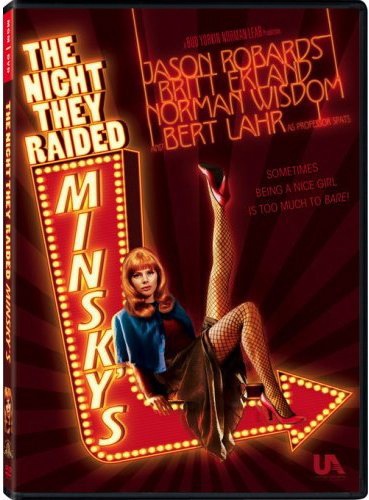
The Night They Raided Minsky's (1968)


The Night They Raided Minsky's is an appropriate film to look over on April Fools' Day, as its narrative hinges on one large “trick” to be played on certain characters. William Friedkin's second feature film is an uneven but sweet and charming ode to the 1920s theaters of burlesque. As the film today exists in current form, it routinely cuts away from his own narrative and splices in many apparent pieces of footage from the time period itself, thick with grain and washed-out images. The screenplay, based on a book by Rowland Barber and written by Arnold Schulman, Sidney Michaels and Norman Lear, supplies a dangerously thin storyline, but the film is at its most fun when the mechanics of the picture are almost invisible, and mere gags and burlesque performances take the center stage.
Jason Robards, who plays central figure Raymond Paine, received mixed notices for The Night They Raided Minsky's, but today his performance seems stronger than it may have at the time of the film's release. Robards was never too much of a “leading man movie star” to diminish his own self-effacing and auto-critiquing tendencies; even in the testosterone-laden westerns in which he appeared, he often played characters either physically or psychologically wounded, such as the contemporaneous Once Upon a Time in the West, Hour of the Gun or The Ballad of Cable Hogue. With Minsky's, Robards allows his most winning attributes to mesh with his nearly continual semblance of debilitation—ever so slightly suave, his persona is crushed when confronted with hostility or projected dubiousness by others. It helps that Robards is given many of the film's best lines. When his longtime partner and friend, Chick Williams (an energetic Norman Wisdom), falls for the pulchritudinous Amish ingénue, Rachel Elizabeth Schpitendavel (a wide-eyed Britt Ekland), Robards' roguish huckster comedian undermines Chick's propriety. )(Which ties into their joined rendition of “Perfect Gentleman,” in which Robards' character sings along with Wisdom's about just how much of a gentleman he is. “You suffer from the three D's,” Raymond tells Chick, “you're decent, devoted and dependable. Good qualities in a dog—disastrous in a man.” He goes on: “Women love bastards. I am a BFC: Bastard First Class.” Robards likewise shines in a long scene in which he approaches a woman at the local deli—where a significant portion of the film's events take place—only to be surprised when her husband returns from the restroom. So Raymond smooth-talks the husband and is as smooth as the skin of a newborn. The humor is obvious but Robards is too excellent when at his best in this film to dismiss, balancing his motor-mouthed shtick with the fearfulness behind it.

Ekland is fine as the young runaway Amish woman who is blinded by the dazzling marquee. As Raymond and Chick contest one another over her affections, Ekland's debatable one-note performance never feels particularly calculated, which is key in making it fit with the long line of young ingénues who were transfixed on the idea of becoming a star of show-business. Considered unqualified for burlesque, Ekland's Rachel is manipulated by the scheming Raymond; his bright idea is to have her perform one night after being billed as “Mademoiselle Fifi,” the French starlet and heroine of pornographic literature, who is, it is constantly noted in her billing, “The Girl Who Drove a Thousand Frenchmen Wild.” Raymond figures Rachel will do what she has done in her Pennsylvania Amish community—perform a Biblical dance rather than a bawdy number. Thus, Secretary for the Suppression of Vice Vance Fowler (Denholm Elliott), determined to raid Minsky's in the event of Mademoiselle Fifi's appearance, will have no reason to shut the establishment down and Raymond's job will be safe.
Two other welcome performers are Joseph Wiseman and Elliot Gould as the father and son (Louis and Billy Minsky), who repeatedly enliven the picture. Wiseman and Gould play their parts as Jewish businessmen with significant emphasis on their ethnicity. The Night They Raided Minsky's pokes some fun at religion in general, as Rachel's stern and unforgiving Amish father, Jacob Schpitendavel (Harry Andrews), hunt her down and finally finds himself confronted with Wiseman's Louis Minsky. Louis educating two other religious men about the identities of each finger's meaning in religious terminology evokes laughter. The picture may satirize stoically religious individuals, but at this late point in the film, it does so with a genial warmth.

The Night They Raided Minsky's was released just as Hollywood films had largely been let loose; censorship in American cinema was coming to an end. So it is particularly amusing to view Minsky's as the film examines a different kind of show-biz thriving under the threatening thumb of censorship. As Elliott's Fowler chastises the men who run Minsky's, he is asked what he finds so objectionable. “Well, the women... They jiggle,” he remarks. The film is hilariously accurate in its depiction of the censoring force having to attend every show and write down in explicit detail what is to be considered lewd and improper.

Reportedly, Friedkin's cut of The Night They Raided Minsky's was a considerably different film from the eventually released 1968 picture—Friedkin's first cut was, it was almost universally agreed, a complete disaster. Editor Ralph Rosenblum worked on the film in postproduction for over a year, finding a coherent film through his assiduousness. Some may assume the concept of cutting to old footage was Friedkin's idea—perhaps an homage to Jean-Luc Godard's stylistics—but it was indeed Rosenblum who came up with the idea himself. Rosenblum, in effect, re-directed the film himself and made an alternative version of Minsky's which is today the one actually seen.

Some of the film's finest moments are simply of Robards and Wisdom engaging in song and dance with one another. The soundtrack is stuffed with modern classics as well as some songs by Lee Adams (the score was provided by Charles Strouse). The agreeable combination Robards' wise-guy next to Wisdom's naïve optimist makes The Night They Raided Minsky's seem so effortlessly mounted, though it actually was one of Hollywood's most painful births; likewise, Robards' history as a great stage actor and Wisdom's history as a great British comedian and music-hall star must have paid dividends as they excel at projecting an immediacy that draws in a live audience. Minsky's isn't a grand time at the movies, but it is fast, fun and frank—a valentine to all things just vaguely fulsome.

Tuesday, March 31, 2009

Point Break (1991)


Kathryn Bigelow's Point Break has been labeled many things. Frequently dismissed as a crassly commercial big-budgeted actioner, a rather silly, shallow over-the-top, action thriller with generous helpings of comedy, New Age philosophizing and romance, with protracted focus on surfing in the Los Angeles area, starring Keanu Reeves and Patrick Swayze, many critics seem to have either missed or perhaps scoffed at the contributions of the film's helmer, Kathryn Bigelow. Point Break's screenplay—by Rick King and Peter Iliff—is bursting at the seams with clichés and stereotypes, but Bigelow's direction allows for the characters to be predominantly expressed through cinematic shorthand. Some sections of the script—no, many sections of the script—are too talky, but whenever Bigelow has the opportunity, she cuts down the excess of words by supplying a rich palette of a marvelously packed 2:35 'Scope widescreen frame, ceaselessly offering a supremely confident brand of action-filmmaking. Rarely has an action filmmaker utilized this aspect ratio with as much gusto; Bigelow makes the 'Scope letterbox format a necessity, squeezing in as much geographical information as possible. Today's speed-freak fast-cutting action directors could take many pointers from Bigelow on how to sustain tension through genuinely comprehensible shooting of action sequences, not to mention merely allowing the audience to understand what is occurring and to whom it is occurring. The 'Scope aspect ratio gives her, and director of photography Donald Peterman, free rein. In one early exquisite shot, for instance, Bigelow and Peterman frame a group of bank robbers wearing masks (of Lyndon Johnson, Richard Nixon, Jimmy Carter and Ronald Reagan) as one unified group, separating and dispersing away from one another as they briefly seize a bank. Bigelow utilizes the spatial gulfs between characters to connote geography.

Considered the most famous alum of the San Francisco Art Institute, Bigelow matriculated as a painter. With her motion pictures, she displays the visual adroitness that flaunts her conception of the screen as a canvas. Action for her is not to be used to engender a whirling, disorienting blur for the viewer; in Point Break, for instance, her framing of surfing sequences is perfectly symmetrical, capturing Reeves' FBI agent Johnny Utah's development as a surfer with logical consistency. Shooting the horizon from beaches, Bigelow's painting talents must have helped significantly in mirthfully playing with the amplitude of space, locational margins and the breadth of artistic panels. Whether surfing seems like a fun hobby or not, Bigelow renders it with an air of excitement and awe.

Critics who mistake plot for meaning and theme tirelessly go about thrashing Point Break's borderline mindless lack of logic. Agent Utah, it is said, finished second in his class at Quantico, yet seems like a remarkably ineffective and unintelligent individual. Repeatedly certain events transpire with very little to buttress them with rational motivation and purpose but for the desire to keep moving the story along. A veteran, comically burnt-out agent (Gary Busey, who wisely enjoys himself in his part) behaves quite inappropriately with great regularity in almost every manner conceivable. The film indulges itself in myriad tropes of the crime thriller, with an overbearing FBI boss played by John McGinley periodically chewing out his subordinates' derrieres.

What makes Point Break.... break free from becoming just another derivative action extravaganza is Bigelow's virtuosity. As in the vampire cult film Near Dark, Bigelow laces her action with impressive flurries of technique. The most distinguishing trademark she applies to the dyspeptic proceedings is a bracing, breathless point-of-view perspective—mainly Utah's—as in a frenzied chase on foot through a Los Angeles neighborhood. By placing the viewer in the action, Bigelow emphatically connects the vista (typified by the many surfing scenes of the film's first stretch) to the individual (from which more and more of the film is seen).

The most wondrously exhilarating marrying of these respective elements is a tremendous sky-diving scene, in which Reeves' Utah descends from an airplane, joining the group of bank robbers with whom he has been undercover for some time. It is here where Point Break achieves something approximating sublimeness: like Enoch, the extraordinary mortal elevated to the status of the angelic, Utah joins his newfound friends/technical enemies in heaven, looking down upon the earth. Bigelow shifts perspectives with a fluid ease, once again placing the spectator perfectly into the heart of the action while completely detailing the entire panorama that encompasses the viewpoint (of a painter, an artist, an FBI agent...). This is bravura, accomplished and dazzlingly crafted filmmaking, lent to a deliriously preposterous high concept.

Bigelow's mise-en-scene accentuates the “small scenes” as well. One of the best sequences of Point Break is actually a nighttime beach football game. The camera finds itself arranged amidst the ongoing struggle as one player passes the ball to another. Hurriedly, Bigelow complements the topographic mastery with which she gifts the film with a kaleidoscopic recording of every physical ruction. What finally makes Bigelow's artfully composed helming of human movement come alive is the thematic weight that lurks beneath the superficies of the action. Reeves' FBI agent is drawn to the enigmatic, Zen-like leader of the bank-robbing surfers, Swayze's enigmatically self-named Bodhi. Swayze's charismatic performance is the film's most successful addition to Bigelow's propulsive filmic appliqué, with his surfer looks and steely cerulean eyes, he practically begs both Utah and the audience to join him in his rambunctious daredevil shenanigans. When Utah tackles the running Bodhi in the surf of the ocean, those who love Bodhi express anger with Utah, but Bodhi tells them who he is—a former college football quarterback star. In a confrontation with a group of beach-terrorizing brutes, Utah has to be rescued by Bodhi, who admires the undercover agent's fearlessness. Little by little, scene by the scene, Bigelow manages to sustain a fastidious telling of literally fabulous friendship between men. Bigelow's concerns suggest a woman truly, almost heedlessly, interested in the ties and connections between cosmetically adversarial men. As in Near Dark and Blue Steel, and later in the forgettable K-19: The Widowmaker, Bigelow is—most fittingly for a female director rightly celebrated for her breathtaking command of action—an expert fabulist of unlikely male bonding.

Monday, March 30, 2009

Coraline (2009)


At a time when too many animated family films needlessly coddle children at the expense of educating them through the mythical art of storytelling, along comes Coraline, which seems to stand athwart so many of the easy, uncomplicated children films routinely pumped out—a kind of cinematic over-medication of immediately attractive sights that are time-tested. A crushingly obvious example would be the recent Monsters vs. Aliens, which does nothing less (and certainly nothing more) than promise every child lots and lots of monsters and aliens on the screen. The story and characters do not matter in all too many instances; the pablum tacked on to make the experience at least nominally cohesive is rarely meaningful. Coraline, however, is a veritable one-film renaissance of family movie-making: Henry Selick's more intense, yet subtly transcribed, treatment of fairytale touches upon something more peculiar and universal all at once, because it seems legitimately childlike.

Selick's film is based on Neil Gaiman's book, and as in Selick's adaptation of the eccentric children's writer Roald Dahl's James and the Giant Peach (1996), Selick preserves the spirit of the source material by giving it literally moving, cinematic life without robbing it of its quintessence. Coraline is a rather unnervingly eerie story about a pre-teen girl (voiced here by Dakota Fanning) who finds her parents unpalatable to her wishes and desires. Her mother (a terrific Teri Hatcher) ignores her and the food she makes for her is uninspired; her father (John Hodgman) is too busy at his computer for his work to spend much time with her. Coraline sees herself as a child alone, in a gray, downcast world. If only she could escape.

It could be said that Coraline is perfect children's nightmare fodder because Selick makes the film follow nearly flawless nightmare-logic. In an impressive credits sequence that opens the film, a pair of menacing metallic hands hurriedly de-construct a doll, pulling out its button eyes and in an act that may linger in the minds of children, rip the innards of the doll out, after which the doll is re-fashioned, unmistakably looking like the film's heroine. Coraline as a narrative incisively comments on the remaking of children—through sundry forms of medication, for instance—as “happy.” Gaiman's story supersedes the potentially banal conclusion to be reached from his own tale (which can admittedly be useful as the film's tag-line—“Be careful what you wish for”); Coraline is in part about systematic perfecting of the corporeal at the expense of the spirit's obliteration. When little Coraline discovers a secret passageway to an alternate world, she initially believes she has found a panacea; her “Other Mother” (again voiced by Hatcher) cooks lavishly spectacular meals for her, and her “Other Father” (Hodgman, again) helps oversee a breathtaking garden that plays into the worst, most narcissistic impulses of children.

The blue-haired Coraline is put through the emotional wringer that hurts the most. Acceptance may be the story's most pointed “message”: at last, Coraline must begrudgingly accept her parents, as well as the strange and bizarre cast of neighborhood characters (two washed-up, has-been burlesque queens, Miss Spink and Miss Forcible and a hilarious Russian acrobat and trapeze artist named Mr. Bobinsky voiced by Ian McShane) who inhabit her world. The “Other World” characters are more superficially arresting, with more colorful personalities, but the superannuated qualities of the “real world” characters is gradually viewed in a new, radicalized light once Coraline realizes that the “Other World” is one horrifying snare run by the “Other Mother.” Only a talking black cat (perfectly voiced by Keith David) can move about each world along with Coraline, bringing childhood imagery full circle through gentle subversion: that which appears evil, such as a notorious haunter of bad luck like the black cat, proves indispensable to fighting against what looks like a heaven-sent paradise.

Dreadful menace permeates Coraline, and even the way in which Coraline moves about the Narnia- or Secret Garden-like entranceway connotes trepidation and tumult. To make this precisely, cinematically tangible, Selick utilizes stop-motion animation, which was an enriching choice. Like Ray Harryhausen's stop-motion animation, or perhaps the late Stan Winston's effects work, Selick's undertaking here bridges the human with the inhuman, bringing out an indelible cumulative effect that lends an uncommon verisimilitude to the fantastical. In one of the film's most bravura sequences, Coraline's “Other Father” leads her out to their garden, inviting the flowers to entrance the girl with their dancing. The scene, as well as a long, wonderful sequence in which the two show-business women—made younger and physically beautiful—in the fantasy world enthrall Coraline with a stunning number. Everything about Coraline's fantasy world seems so enticing, but the edifice of the entire facade proves to be one dishonest lure.

Like the merciless metallic hands at the film's opening, Selick brocades a textured, nuanced film. Informed by Gaiman's story, Coraline extrapolates what its imagery suggests: the “Other Mother” and her ilk are not only inhabitants of a child's fantasy world but also those who eagerly blind their progeny and others of the next generation, and therefore themselves. They exist in this world, and the blindness they inflict is just as painful in its many consequences as Hatcher's demonic alter-ego's obsession with replacing Coraline's eyes with buttons. As one ostensibly doomed character tells the blue-haired protagonist, “Find our eyes, and our souls will be free.” Thus, Selick, and Gaiman before him, provides the most elemental property of children's storytelling, wisely transmitting overwhelming concepts into perfectly accessible and understandable visual allegory, without reducing the potency of the amusing skein. The film powerfully stitches the truism that nothing is more pathetic than those who are so determined to enjoy themselves that they either help to create very industries based on such concepts or supply the demand for them. From Doctor Phil to the latest pill, to the “Other Mother,” faux contentment and happiness is not to be cherished or desired. If little Coraline can learn that, perhaps everyone can.

The Class (2008)


Laurent Cantet's Palme d'Or-winning Entre les murs, or The Class, strives to be a vérité documentarian portrait of the choppy few ups and many downs of a school year for a French high school that hosts as its student body a largely immigrant population. The Class thankfully lacks the platitudinous chicanery of many a film to essay a teacher-classroom dichotomy-turned-symbiosis, resorting not to maudlin sentiment but rather a mostly absorbing day-to-day grind of a young teacher attempting to educate the unruly and rebellious students. The end result is a film that is, at once, both perfectly even in its tone and refusal to ever once be ludic or affected and quite uneven in its asperous machinations not of plot but of its multi-character study. Fortunately, the picture avails itself to give voice to both the avatar of authority and those whose resentment may slowly thaw into something more benign.

Arguably at the film's thematic heart is the Stoic Epictetus's famed comment, “Only the educated are free.” Today Epictetus may be viewed with an accommodating distance and suspicion—he did, after all, contend that a man should mourn a stranger's wife's death with the passion and angst with which he would be racked in the event of his own. Stoic extremism does test one's patience. Nevertheless, his averment on behalf of the import of education does bring The Class into a brighter context. It may be said that the film pivots around the best and worst aspects of Epictetus's numerous insights—for if the French teacher Francois Begaudeau were to view his students as mere vessels of logical, rational growth, would he care so dearly about their respective futures in French society?

The Class is fundamentally a modified documentary featuring a cast of students and the author of the book on which the film's screenplay (also co-written by him, along with Robin Campillo and director Laurent Cantet). Often penetrating, and always cognitively entertaining, one of the finest aspects of The Class is the remarkably organic way in which classroom discussions break out, diverting and darting about in myriad directions—with frequently unfortunate results. Begaudeau has nearly ceaseless difficulty in maintaining comprehensive order, without which the classroom quickly disintegrates into open hostilities between students, and all too often finds itself manifested in insolence and disrespect toward him. The mainly immigrant student population is comprised of a vividly drawn disparate group of individuals, such as Souleymane, a confrontational Malian Muslim, a black girl named Khoumba whose relationship with Begaudeau is quite rocky, Esmeralda, a loud and disruptive girl who enjoys teasing her teacher, Wei, a bright Chinese immigrant who wonders whether many of his peers understand the concept of shame and Carl, a Caribbean who joins the class later in the year after having been expelled from other schools.

The subtlest and most sublime moment of the film is one in which the class is reading aloud from Anne Frank's Diary of a Young Girl. Khoumba has become increasingly unruly and abrasive in her demeanor and language with Begaudeau. When he calls on Khoumba to read from the book, she refuses, making Begaudeau angry and disappointed with her. Telling her to meet him after class, and allowing another student to read in her stead, the verbalized text from Frank's diary underlines what Khoumba is going through herself, as a girl who is seen in ways that obscure the truer image of her. It is an exceptionally rendered scene, punctuated by the after-class encounter in which Khoumba apologizes to Begaudeau only to leave, telling him as she departs that she did not mean it. Begaudeau's irritation and genuine distress are palpable.

The Class's “plot,” as such, is made up of various strands that are pushed along by individual students. Souleymane is considered a poor student by all of his teachers, but Begaudeau speaks up for him, noting that despite his academic deficiencies, he occasionally demonstrates a willingness to engage, and to be engaged. The film's most tender scene is of Begaudeau encouraging Souleymane in the posting of personal photographs of himself and his loved ones, culminating with the teacher telling the other students to take a look at Souleymane's work. Ironically, the film's most intense twist occurs when the two “class reps,” Esmeralda and a pretty French girl named Louise—whose job is to represent the class at faculty meetings—inform the other students what the teachers have said about their academic performances. At the meeting Begaudeau once again defended Souleymane, while admitting that he is “academically limited.” Esmeralda and Louise tell Souleymane about Begaudeau's most disparaging remark, precipitating a moment of havoc from which the final act of the film reels.

In this fraught environment of sociological and cultural conflict, the actions of Esmeralda and Louise seem to suggest that the very idealism and warmth with which Begaudeau views the students—always attempting to see the best in them and defending them to his colleagues—is perhaps misplaced. His efforts to treat the students almost as peers repeatedly appear to backfire, and it may be said that the very concept of “class reps,” for instance, is rebutted as almost senseless by Cantet's film. These, and other matters, are not offered definitive editorializing by the filmmakers, but in this case the film's thematic stimulation gives reason to make plausible assumptions about from which perspective the film is viewing such fixtures of modern schooling. Esmeralda and Louise's behavior impels Begaudeau to momentarily lose his patience and temper, which results in disaster.

The Class has been viewed as an important film; a keenly artful sociopolitical and sociocultural examination of modern French society and its apparent problems. Multiculturalism in France has achieved certain historical laudatory results, but for many of the students of today who do not view themselves as French and contend that the entire educational system is not far removed from the French imperialism of, say, West Africa, in which white Frenchmen were tasked with instructing Africans with the desire of making them into Frenchmen themselves, problems persist. In a way, The Class recalls the 2002 documentary Entre et Avoir in its chronicling of an entire academic school year, but at its absolute darkest there are hints of Mathieu Kassovitz's La Haine (1995), which explored the most frightening realities of modern urban French society. Animosity between a social order controlled by liberal French bureaucrats who insist their good intentions can erase matters of tribalism and ethnic and religious conflict and the immigrant population that seethes under what they interpret as cultural aggression has exploded, most notably around the issues of economic opportunity in France's class-based social scheme. At the film's sad end, a girl walks up to Begaudeau and tells him she did not learn anything all year. She hopes she does not have to be absorbed into the systematic directing of students into vocational training. The desperation she feels is but one of many microcosms the film looks at, and ultimately, its most important.

Wednesday, March 25, 2009

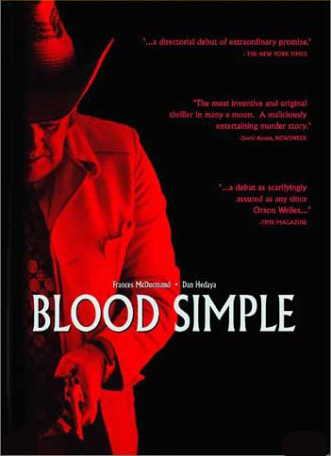
Blood Simple (1984)


“The world is full of complainers. An' the fact is, nothin' comes with a guarantee. Now I don't care if you're the Pope of Rome, the President of the United States or Man of the Year, something can all go wrong. Now go on ahead, ya know, complain, tell your problems to your neighbor, ask for help, 'n watch 'im fly. Now, in Russia, they got it all mapped out so that everybody pulls for everybody else... that's the theory, anyway. But what I know about is Texas, an' down here... you're on your own.”

The film begins with melancholic, almost rueful, narration, visually matched with shots of a long, barren and desolate Texas road. Later, characters will dwell underneath ominous ceiling fans, which seem to hauntingly view down upon the hapless. The camera, fluid but controlled, focuses on doors, particularly at nighttime, heightening the palpable fear of who or what is lurking behind them. A blade of light slicing through the darkness underneath a door is snuffed out. An emphasis on the patulous Texas outdoors pervades the film, contrasted and juxtaposed with the stifling, closed interiors in which people struggle. Shots of cowboy boots populate much of the picture. Blood is found on the ground with great regularity. Otherwise decent people make highly unfortunate decisions. An otherworldly creature mercilessly stalks his prey. This, however, is not No Country for Old Men but rather Blood Simple, the 1984 film debut for Joel and Ethan Coen.

Blood Simple is a subtly mind-bending neo-noir crime thriller in which communication is hampered by circumstance and refuge is denied by the apparent intervention of fate. The picture, photographed with blue-tinted deliriousness by Barry Sonnenfeld, is laced with an oneiric imperishability of location and personage, which meticulously creates a moony pattern that courses through the picture—and the Coen oeuvre entire. Characters move through the film like stationary objects pushed, as they are compelled to vacate their respective natural habitats. As will be proven true with their later efforts, Blood Simple demonstrably essays the Coens' obsessions and idiosyncrasies, their fixations and concerns. As a debut, the film is as pure and distilled an introductory declaratory statement as any before or since.

After the film's dry, almost supernatural opening narration, Blood Simple brings its perspective, literally, with Ray and Abby (John Getz and Frances McDormand) driving at night. The road is visible again, and “The Road” will remain a recurring Coen motif. Abby's first line informs where the picture's plot is headed: her possessive husband gave her a .38 handgun as a gift, but she fears she would use it on him if she did not leave him. The camera remains behind Ray and Abby, he behind the steering wheel of his car, she in the passenger seat. The windshield is spattered with rain, which is furiously flung off by the windshield wipers. With each passing car's briefly blinding headlights moving past them, the main cast members have their names flash against the black of night in cool blue.

The Coens' penchant for quirky, offbeat humor—here typically slathered atop the film's laconic dialogue—makes Blood Simple less familiar than its superficially derivative story would suggest. Rooted in the work of James M. Cain, Jim Thompson and other authors of stories about lust and murder, Blood Simple takes on a twisted viewpoint characterized by mordant humor and razor-sharp wit. As Abby's husband, owner of the bar at which Ray works, Julian Marty (Dan Hedaya), confronts Ray in the back of the bar, the Coens use a bug-zapper to simultaneously underline and subvert Marty's dramatic lines. “You think I'm funny, I'm an asshole? No, no, no... what's funny is her... what's funny is, I had you two followed because if it's not you she's sleeping with, it's somebody else... what's funny is when she gives you that look and says, 'I don't know what you're talkin' 'bout, Ray. I ain't done nothin' funny.' But the funniest thing to me is... you think she came back here for you... That's what's fucking funny!” The “bug-zapper” humorously emits its incongruously appropriate and inappropriate noise just as Marty concludes his angry, jealous speech, poking fun at the character, campy films with thunder and lightning emphasizing characters' dramatic lines and the film itself, with its budgetary limitations and ostensible lack of scope.

After having a finger broken by his wife in an ugly front-yard confrontation—masterfully captured with a racing, fevered camera—Marty seeks out the man he hired to follow Ray and Abby, sleazy private investigator Loren Visser (played with villainously cretinous relish by a superb M. Emmett Walsh). Visser is the Coens' first outsider—less so in terms of his geographical and cultural identity and more so in his complete lack of moral boundaries (the theme would become increasingly literalized in the Coen canon, culminating with the angel from hell, or at least some foreign country, Anton Chigurh, in No Country for Old Men). Visser is fat and sweaty with a devilish cackle and scaly, clammy features. Flies buzz around and about his face. Several of the best scenes in the entire Coen filmography are of Marty and Visser conversing, each holding the other in contempt as they go about their unseemly business. A terse, funny exchange buttresses the Coens' sensibility and interest. Marty: “I got a job for you.” Visser: “Well, if it's legal, and the pay's right, I'll do it.” Marty: “It's not strictly legal.” Visser: “Well, if it pays right, I'll do it.”

In its noirish iconography and air of morbidity, Blood Simple foreshadows the Coens' future efforts. Small-town Americana is the frequent home to Coen narratives, with its seemingly limpid innocence and relative tranquility being brutally invaded by outside forces, always unleashed by their bosses who egomaniacally call the shots behind their big desks—a Coen motif, from Nathan Arizona played by Trey Wilson unwittingly unleashing Leonard Smalls in Raising Arizona to Jerry Lundegaard played by William H. Macy hiring Carl and Gaear to kidnap his own wife in Fargo to the crooked businessman in No Country for Old Men embodied by Stephen Root letting out the demon. In each case, and others, the man behind the big desk believes he can control his fate, and in every instance, the weapon they let loose proves to be uncontrollable. Often, they are even killed by the very demon they let out of the box. The crushing absence of empathy for others informs the Coens' fiendish rogues gallery. Like those who would follow him in the Coens' art, Visser is a serpentine phantasm, putting about in his Volkswagen Beetle. The exchange between Marty and Visser encapsulates what would be re-imagined in Police Chief Marge Gunderson's famed tabulation in Fargo: counting the victims, she concludes, “And for what? For a little bit of money. There's more to life than money, ya know. Don'tcha know that?”

For Visser, like Peter Stormare's coldblooded sociopath, however, the temptation of money is too great to resist. Which is what, in part, separates the voracious, beastly outsiders from the people who are victimized by their own bad luck and poor choices. Ray and Abby are unable to enjoy one another's company, as Marty successfully plants the seed of distrust in Ray's mind. Everything flows from that; and as Ray finds himself covering up a crime he believes Abby has committed, he becomes the most plaintive character of Coen sagas. Like H.I. McDunnough in Raising Arizona, and Tom Reagan in Miller's Crossing, and Llewellyn Moss in No Country for Old Men, each character loses a piece of their soul in sacrificing for those they love, in one way or another. In this picture, Ray and Abby misconstrue one another's motivations and hearts. Finally, when pressed by Ray, Abby states, “I don't know what you're talking about, Ray. I ain't done anything funny,” just as Marty predicted.

Symbolism and representation is to be found in Blood Simple's thematically rich visual subtext. Acknowledging the influence of Roman Polanski and specifically his The Tenant in crafting the horror of the nearly abandoned hotel in Barton Fink, Blood Simple's use of four rotting fish may be an homage to the Polanski picture Repulsion, in which a decaying rabbit mirrors the psychological state of the protagonist. The fish in Blood Simple fester and spoil with greater alacrity just as the film's storyline spirals out of control for all of the characters. In two perfectly corresponding shots, a flock of birds at a roadside lift off to the air, and, in the next shot, their cumulative shadow splashes against the road's morning daylight. Ceiling fans—one of which hypnotizes Marty, who appears to be dead in his chair as he stares at it—accentuate the film's sense of insularity and loneliness, as the devices connote futility and fatalism in the overpowering face of the oppressive Texas heat. The Coens use windows to communicate the naivete and contrasting innocence of Ray and Abby, whose windows are never curtained or covered as Visser watches them couple and sleep together. The windows of an apartment purchased by Abby appear like two gigantic, watchful eyes. Ray realizes only too late how feckless the two have been (“No curtains on the windows,”) as he stares out into the night through Abby's enormous windows.

Carter Burwell's simple, eerily repetitious score starkly conveys the picture's insidious tension and sense of overarching doom. The Coens' gripping aesthetic control—which was yet another sign of things to come—finds itself expressed in the glide of the camera, such as when it flies through a bar, and hovers upward to avoid a motionless drunk. In the film's most widely noted scene, a man crawls on the unforgiving hard pavement of a road, illuminated by passing headlights. Once again “The Road” becomes paramount as the wounded man continues to struggle, his body convulsing as he spews blood. Isolation, most recently revisited in No Country for Old Men, seems to close off the participants of the tale, so that the whole world in all of its moral and recondite complexity is reduced to a single series of events, which, as always in the Coen universe, seem equally predetermined and manipulated. As in their later work, Blood Simple offers the explanation that seems the most logical: choice results in what is frequently labeled “destiny”; chance and fate are acolytes of cognizant decisions. This makes the Coens more interesting than the behaviorist scientists they are often described as being (which is, as far as it goes, accurate). Ray may believe the worst about Abby but he chose to let Marty into his head; he chose to dispose of Marty on behalf of Abby; he chose to not alter his personality so much as to clearly explain what transpired during one of the film's most eventful evenings. People are who they are, the Coens freely admit—but their choices determine what they are. Javier Bardem's psychotic killer in No Country for Old Men chooses fate to be his idol, his golden calf, so by the end of the story it has chosen him.

Like the somewhat pitiable but whimsically fanciful H.I. in Raising Arizona describing the background of his relationship with Ed, or the corporate mountebank in The Hudsucker Proxy, or Sam Eliot's rambling, forgetful “The Stranger” in The Big Lebowski, or Ed Crane in The Man Who Wasn't There—whose titular distinction makes his narration questionable at the outset—or Sheriff Ed Tom Bell in No Country for Old Men, who confesses to Carla Jean Moss that his mind wanders, Blood Simple's narrator, the reptilian Visser is not to be trusted. In each case, their recollection of events or perspective of the same is severely limited. Indeed, each character seems to romanticize and nearly fetishize certain aspects of the events, or people, or places, about which they are speaking. Which, the Coens seem to gently remind the viewer, is only natural.

This narration, however, is predominantly limited in its usage, and is intrinsically a doorway through which the Coens seamlessly articulate the diverging portraitures of the world known, in which evil is inexplicable in almost all ways but its avarice (money is, after all, at the heart of the Coens' stories, the motivating force for the unscrupulous), and the world of the mind. The Coens' characters are endlessly fixated on better places, happier times and idyllic havens. Voiced by Johnny Caspar (Jon Polito) in Miller's Crossing, the Coens are, not esoterically, but defiantly, almost contumaciously, fascinated by the “morality and ethics” into which they repeatedly delve. The Coens' comprehensive interest in these themes, however, does not reduce matters to mere abstract philosophical concepts. Finding a more Aristotelian vein in which to survey these considerations and quandaries, the Coens are not interested in presumptuously crafting an artistic equivalent to Descartes' call for a rationalist revolution or Locke's insistence on creating a “moral algebra,” by which all problems of morality would be reduced to calculations of abstract formulas. There is a consistency to the Coens' compilation, but both the consequences and evaluations (judgments, though not incorrect, is probably too loaded a term) are not predestined. Successive good characters either perish or are wretchedly tormented in the Coens' embroidery, and many evil ones seem almost invincible, but for unforeseeable circumstance, or seeming mischance, or possibly plain bad luck. Yet which is which, and who is to say what shapes events on earth? Abby believes it is Marty, or an avenging ghost of Marty, stalking her in the film's final sequence, completely unaware of the truth. H.I. manages to pull a grenade pin, perhaps by accident, as Smalls punches him away. Marge follows through on a hunch because of an old friend's lies, and then stumbles on one of the perpetrators disposing of his accomplice. In The Ladykillers, G.H. Dorr and his colleagues are flicked away as though they are ants annoying God. Chigurh had his eyes off the road at the worst possible time. In each case, the killers and criminals have largely already triumphed or failed in their objective (usually succeeding insofar as their original scheme goes, only to encounter greater asperity and trouble).

In Blood Simple's taut denouement—the final movement between McDormand's Abby and Walsh's Visser—the Coen predisposition becomes evident, and speaks volumes about their cinema. Like the scene in which Smalls kills little, harmless creatures (“He was especially cruel to little things,” H.I. tells the viewer, as he seems to have manufactured Smalls out of a nightmare), and especially the horrifying scene in which Carl and Gaear nonchalantly break into the unsuspecting Mrs. Lundegaard's home, and Anton Chigurh confabulating with Carla Jean in her own home, the chimerical meets the quotidian, the poisonous shadows the obedient and kindhearted. Blood Simple is charged, eccentrically meticulous filmmaking—precise and loose, focused and in disarray all at once. The Coens' affinity for marrying the most apparently antithetical properties to one another—tragedy and quirkiness, fear and amusement, the anagogic and the everyday—may very well stem from the very texture of their cinematic dissertations on the conflicting characters they observe. Like the all-powerful dirty money in No Country for Old Men, which seems to corrupt all who cross its path, the efficacy of the Coens' more mature filmic disquisitions is arrestingly potent, luring the viewer like Marty's little illicit offering to Mr. Visser.

Thursday, March 19, 2009

Waltz With Bashir (2008)


“To robbery, butchery, and rapine, they give the lying name of 'government'; they create desolation and call it peace.”

—Tacitus

There is a single, indelible moment—among many others—in Ari Folman's Waltz With Bashir that has lingered ever since the screen finally faded out. An Israeli soldier has run away from Palestinians who have shot down his fellow Israeli soldiers as they ran off toward the Mediterranean Sea from an ambush. This one Israeli soldier has hidden from the group of Palestinians—who successfully scared off an Israeli tank, which retreated from the scene—for hours on the Lebanese beach. Finally, as night descends on the Middle East, the Israeli begins to crawl like an animal to the water. Slipping into the soothingly lush Mediterranean water, the Israeli drifts far out, then turns leftward (southward), hoping to swim back to friendly territory. For what seems like an eternity, the soldier is a lone, solitary figure literally amidst a sea—not of turmoil as in most films (live-action and animated alike), but of refuge, of salvation, of escape. As the now-older man explains the remarkable story of his experience in the 1982 Israeli war in Lebanon, speaking of the sea and how he used it to rescue himself, Folman's animated sea, with the geographically correct shoreline landmass appearing in the distance like a disquietingly ominous sleeping beast, simply overwhelms the screen. It is unlike anything recently seen in a cinema—including the using of Hurricane Katrina for the sake of The Curious Case of Benjamin Button's final elegiac shot—and is some of the most tremendously effective suspense in quite some time.

It became apparent, as the scene unfolded, that Folman was, on a comparatively microcosmic level, doing here what he was endeavoring to for the film entire: he was inverting all expectations, all biases, all conventions, all predispositions. This includes the most innately inherent—mere, nebulous beliefs considered in purely ocular compositions. The sea has been and continues to be frequently utilized in literature, poetry, painting, drawing, sculpture and cinema to connote tumult and danger. The open water has been made to look like a horrible place to be, including in works that exploit common fear of the unknown like Jaws. Like many a tantalizing visage, the sea seems to forever obscure its more mysterious and frightening traits, including the many living things which call it home. In Waltz With Bashir, however, after (literally) bringing to the surface a huge, naked and voluptuously beautiful woman who comes to the aid of another Israeli soldier from the depths of the sea, Folman revisits the sea and extrapolates the sea's connection to people, and vice versa. Essaying migration, war and exodus, Folman mercurially pivots his film's myriad themes through the ever-present proximity of the sea to the bloodying of the Middle Eastern soil.

Indeed, the film's protagonist, Ari Folman himself (his 1982 self animated), slowly ascends with two fellow naked Israeli soldiers from the Mediterranean, like three separate forms of life moving to survive, lifting themselves out of the primordial liquid, and finally walking upright to the treacherous land before them. The animation is stark and gorgeous, with an orange-tinged yellow penumbra from the sky lighting the entire imposing (and recurring) scene. This is supremely confident, spare animated filmmaking and almost perceptively obtuse in its singular objective. Many a film has stated as vociferously as possible—“war is awful”—but Folman takes an incisively richer perspective (his own) and allows it to remain, writ small.

In another inversion of cliché, it is Folman himself who cannot remember the specter that must have been so unspeakably horrible he has suppressed it. This is a tortured soldier, yes, but his dreams are not of the actual atrocities and barbarities of “war”; the aforementioned ascension out of the peaceful, serene and tranquil into the most ungodly inferno is what he remembers, all he has allowed himself to retain. As he interviews one Israeli army friend after another, and pieces begin to slowly stick to one another and congeal, the film meticulously bridges the gaps between individuals' respective memories into one massive, oneiric painting. The accounts are all delivered through the voices of the disparate former soldiers, and though music is repeatedly used to great effect, the Hebrew language, with its guttural piquancy and ancient, embedded wisdom, supplies an accomplished auditory soundtrack all by itself.

The visuals are pulsating and powerfully pieced together. The animation is never less than wholly expert in its gradations of color—from the aquamarine blues and greens of the nighttime sojourns to the sea, to the dirty, dusty browns of so many buildings and devastated roads. Buildings and people are in scale, but frequently placed together in surreal panels that accentuate the individual over the setting but never at the expense of the film's haunting verisimilitude. The characters' faces are haunting—often jaundiced and visibly tormented. One character who has an affinity for petuly oil (used by him so that his men could always know where he was) looks like a bald, nearly emotionless gargoyle.

Waltz With Bashir has doubtless been compared to Rashomon and rightly so—the picture's competing memorial visions abundantly endow the proceedings with an intoxicating legerdemain of narrative and documentary filmmaking itself (which Folman has pursued before in Israel). Pregnant pauses in dialogue are unusually discomfiting; former soldiers, who have largely succeeded in moving past the deplorable experience, occasionally struggle to continue their stories, or have selectively edited out certain events too psychologically punishing. (Folman, fascinatingly, has done this more than anyone else.) One soldier's nightmare of twenty-six dogs demanding vengeance for having been killed by an Israeli soldier inaugurates the filmic action. Folman's inquiry into the self, into the mind, and into those with whom he shares an ineffable bond, is one of a consummately Judaic moral imperative. Just as the fear that each particle of memory may be inassimilable and useless to the whole pervades the film's most fiercely unnerved core, Folman manages to continue onward.

What finally bubbles to the surface of that alluring, seductively glistening sea is not an animated figure but a voice birthed from conscience. Not since Steven Spielberg's Munich has the Biblical pursual of Jewish ends at the expense of Jewish ideals been so cinematically palpable. The loss of righteousness for the Jewish State in permitting the 1982 genocide to take place was a heinously personal loss of righteousness for those who were charged with carrying it out. In vanquishing the ambiguously defined “enemy,” the victors in this case—firing flares and controlling the perimeters of the refugee camps for the proxy fighting force of Christian Phalangists—were in many ways the spiritual losers. The massacre of Sabra and Shatila, Folman finally reveals in a denouement of shockingly pained sorrow, may have butchered innocent Palestinians, but it left an eternal wound on the nation of Israel and himself.

Wednesday, March 18, 2009

Gomorrah (2008)

Why is it that some films feel like absolute cheats, whether they are intentionally so or not? And why is it—regularly—true that those which aspire to simply record life in all of its unpleasantness and foulness seem the most insincere? Not that what they are depicting is untrue. Well, at the risk of quoting a certain masked avenger, sometimes the truth isn't good enough. Sometimes people deserve more.

The birthplace of the Renaissance, Italy has bestowed upon the world art and philosophy of voluminous invaluableness. The Renaissance era humanists were extolling the humanism (which it would not be called for several centuries) of the middle ages (or the studia humanitatis), the field of which covered nearly everything beyond theology and the natural sciences. Specifically linking the acclaimed Italian neo-realism of the mid-twentieth century to Renaissance art, it is crucial to keep in mind the Catholic bridging of the mortal and the divine. This is extensively evidenced in Renaissance art by Da Vinci, Michelangelo, Bramante, Titian and Raphael to name but a few titans.

So it cannot come as any great surprise that Italian cinema is intrinsically a deeply humanistic one. Routinely heralded as the precursor to neo-realism, Alessandro Blasetti's 1860 (1934) depicted Garibaldi's conquest of Sicily from the perspective of two peasants played by nonprofessional actors. Neo-realism, however, though manifestly dwelling in the realm of the corporeal, is stanchioned by the transcendence of a culturally pervasive ecumenical fealty. Ladri di biciclette or The Bicycle Thieves for but one example targets the minutia of postwar Italian poverty through the story of a man and his child, yet also reaches an indubitable spiritual elucidation. Marrying an earthly compassion and natural law to the Catholic culture of the world's host for Vatican City through art is perhaps Italy's most singular graceful and (fittingly) thorough characteristic through all of its art, emanating from the Catholic cogitation itself.

Consequently, the recent Italian blockbuster Gomorrah is an even greater disappointment considering its national origin than it would be otherwise. Drab, dull and dire, Gomorrah is another one of those ugly films that look like they were shot on 16 MM (as Darren Aronofsky's The Wrestler actually was), but without any kind of counterbalancing incentive to watch the entirety of the picture aside from being fair to it. Italy, like most of Europe's nations (the most outstanding exception being Muslim Albania), is post-religious in its prevalent culture today, and most Italian films have become less and less anagogic as a result. Gomorrah, though ironically taking its title from the damned Biblical city, has no otherworldly pulse or even a hint of such. That may be writer-camera operator-director Matteo Garrone's scheme—to make a film entirely devoid of any hope, both bodily and beyond—but the effect is one of great, uninvolving tedium.

Some critics have evidently championed Gomorrah because this chronicle of the Camorra crime organization of Naples is the anti-Godfather, a bleak and starkly unromantic telling of the true Mafia in all of its depraved manifestations. However, the picture is only moderately worthwhile in one regard, which is its snapshot-like pictograph of a beleaguered city and the criminals who feast on it like scavengers assaulting a carcass. The film strives to make some scathing points about gangster films entire, particularly in its transparent juxtaposition of the fantasy that enthralls two idiotic Tony Montana-worshipers and Camorra gang recruits with the blighted, impoverished and crime-infested hellishness that Garrone's unblinking camera records. The entire affair reeks of gratuitous violence, such as an unnecessary, completely unconnected opening teaser passage in which a bunch of thugs murder a bunch of other thugs in a tanning salon.

Garrone's quasi-vérité stylistic is, theoretically, intended to bring the viewer up close to the events the film languorously tracks, but there is both too much and too little consistency of visualization to make anything look either as interesting or as pedestrian as they are probably meant to look. When a boy walks toward a camera as murder occurs in the background, Garrone finally creates a memorable image. Yet everything possibly interesting is stifled by too many plots (five in all, but they feel like ten) and one senses that Garrone and his large team of fellow screenwriters (Maurizio Braucci, Ugo Chiti, Gianni Di Gregorio, Massimo Gaudioso and Roberto Saviano, the latter providing the book from which the entire enterprise emerged) feel so obligated to cram in as much information as possible that the film cannot support all of its ambitions. This is proven by nothing less than the picture's conclusion, which meekly flashes a series of facts and statistics—presumably straight out of Saviano's book—as though the film's educational arsenal required one last textual barrage atop all of the scenes of insidious corruption, violent mayhem and licentiousness. Indeed, perhaps Garrone recognizes what is sadly evident—his film is at best a dissatisfying compilation of truisms that ultimately lead to nowhere but frustration. Myth is rightly viewed through a skeptical prism here, and Hollywood films which have glorified the gangster lifestyle from the 1930s to the 2000s should not be the only perspective when exploring this subject matter. However, when pain, pointlessness and plight are unwed to anything interesting or merely colorful, the unappealing flatness of simply watching the world continue to destroy itself is far less than arresting.

Friday, March 13, 2009

My Blueberry Nights (2008)


The art of Wong Kar-Wai, both luminous and numinous, is dauntlessly irrepressible in its romanticism. Like a body of water with a deceptively smooth surface against which a brilliant sheen of light playfully dances—under which a hidden bubbling tumult secretly resides—Wong's pictures are spectacles of bleating, bellowing amour. It is within these excursions into the matters of the heart that Wong's characters caress one another. Wong's characters are all in essence serving prison terms, and the prison constructed for them is one of neon lights reflecting in damp night streets. Time itself, and memory—that most quintessential human tool, gift and burden, which haunts, spoils and entices—are elastically bent until the characters no longer seem capable of steering their own ship. The bedazzling visualizations Wong employs are incisive punctuation marks, such as the skip-frame slow-motion and fast-motion or freeze-frame, with which he chronicles the perturbation and despondency, passion and depression. The tools at Wong's disposal do more than communicate—which is naturally their chiefest raison d'etre—they implement wordless poeticism, both amplifying and moderating moments either too nimble or serene or agonizing to ever be forgotten no matter how his characters, imprisoned by love, try. His most favored tool may be the folding dissolves, which he lays atop one another like a stack of steaming pancakes. It may be said that Wong's most repeated punctuation mark is a visual realization of an ellipses. It is that ellipses that most distinguishes and beckons, and perhaps even frustrates those unacquainted or impatient with the director's marked, seemingly innate form of ever-burgeoning nascence of being. To label it an indulgence is a poor misreading; Wong's cinema glistens like that body of water, in which the characters both struggle and thrive. Mastery of the waves, the ebb and flow, may be temporary (perhaps truly temporal), but the thrill guarantees that the characters slowly unlearn their own histories, and resume their swimming.

My Blueberry Nights, the director's first feature film made in English, shot in America, has been assailed by Wong aficionados and novices, admirers and critics, alike. For a significant portion of the critical establishment, the film was a gangrenous revelation—a fat, easily slain cow of a film, which provided them with sufficient armaments to assault Wong's entire filmography. The lack of subtitles, it was said, pulled the veneer of artfulness away; Wong was the artistic emperor with no clothes, a visual fetishist, perhaps, whose pictures were repetitive, exhaustingly lonely affairs (how simultaneously apropos and lethally invalid a reception, considering that repetition, loneliness and affairs in no small part constitute much of Wong's cinema). To hear the words in English reduced their import, and all connotations and ramifications tied to them were consequently harmed. What the move to English may have demonstrated, however, was that dialogue—scripted by Wong, and in this instance co-written by Lawrence Block—is at best secondary to the optical carnival of sensuous visages that radiate and pulsate with so much electricity. Unfortunately, that My Blueberry Nights is a more minor work than all that which has come before in Wong's oeuvre only seemed to ensure the film's lackluster critical fate.

The uncomplicated story is different for Wong—it's as much an ode to Americana as, say, The Chungking Express celebrates Hong Kong—and probably compelled critics to suspect him of pandering to the American audience. After all, surely Wong must be a cynical exploiter of emotion. Merely glancing through his entire canon, however, Wong is in actuality the world's most vital romantic filmmaker. That the circumstances of My Blueberry Nights seem almost archaically symmetrical—the advertising and most apparently acclaimed and cherished shot of the film (above) speaks to the film's aesthetic and narrative symmetry, which could be mistakenly interpreted as being “too neat,” “too tidy.” Wong's films are riddled with melancholy and anguish, but the swimmers do fleetingly defeat the force of nature, for however long. As the tagline to The Chungking Express noted, “If my memory of her has an expiration date, let it be 10,000 years,” connecting pineapple cans with their dates of expiration to resilient love. That line could be appropriate for all Wong films (sans, perhaps, Happy Together, about a pair of homosexual Chinese living in South America). Like the hidden glass in As Tears Go By, Wong forms his romances around everyday objects. In My Blueberry Nights, he extrapolates deeper meaning out of food, and most directly blueberry pie. Like Cop 663 in The Chungking Express, the viewer is deprived of the scenes of heartbreak that have devastated Elizabeth (Norah Jones) as My Blueberry Nights launches its tale. (As in a number of Wong's memory-induced stories, Cop 223's story is told in part through dreamy flashback.) Elizabeth walks into a vacant diner late at night, and like other love-stricken men whose tales have been told by Wong, Jeremy (Jude Law) becomes quite fond of her almost immediately. Jeremy informs Elizabeth that whereas cheesecake and other desserts have been wholly consumed by closing time, there is always leftover blueberry pie. It is over this blueberry pie that Jeremy and Elizabeth meet-cute, she still stinging from her excruciating break-up, and he recognizing that without missing a proverbial beat.

My Blueberry Nights fittingly opens with languid, oneiric close-ups of delicious blueberry pie being topped with melting ice cream. The music and atmospheric winsomeness make the allusion to semen flowing through a woman's inner cavity while making the pictorial less obvious in its meaning than it logically should be. The viewer is looking at blueberry pie, with melting vanilla ice cream undulating through and about it, but it may just as well be the voluminous ultramarine body of water that opens Happy Together. The shots of the film are lightly embroidered together through the dissolves and faux slow-motion step-printing Wong utilizes in postproduction, taking the process to its limits with The Chungking Express. Limning the film's episodic structure—Elizabeth wanders about the United States from New York City to Memphis and finally to Las Vegas, encountering one triad or pairing or lone figure whose sad stories of regrettable loss does not so much teach as they do asomatously provide her with glimpses of an ache. That mutual heartache finds solace in alcohol (David Strathairn's crushed, nightly-drunken Memphis police officer Arnie Copeland), petty revenge (Rachel Weisz in a dramaturgical interpretation of Arnie's fed-up, unforgiving wife Sue Lynn) and the posturing of ensured command in the form of a daredevil card sharp named Leslie (Natalie Portman) seeking an escape from a place and person she is compelled to revisit. These disparate strangers-cum-doppelgangers are always found in a diner or smoke-filled bar at which Jones' Elizabeth works. The cumulative experience is a mildly emotionally distressing but finally soothingly salving road trip odyssey, after which Elizabeth has wholly convalesced from the hurt of her destroyed relationship.

Cinematographer Darius Khondji, whose affinity for long lenses with which he codifies and composes a vaporous, blurred aesthetic look under which the characters—and especially Jones' Elizabeth, who is featured in plentiful scrupulous facial close-ups—traverse, supplies Wong's film with an obscuring patina as though the viewer is watching the proceedings through a fogged-up window. It is truly as though My Blueberry Nights wishes to forget itself, or look away from its own reflection either out of embarrassment or emotional and psychological paroxysms that arise from confrontations with the unpleasant. (Think of the impetus behind the tracking shot hurtling away from Robert De Niro's Travis Bickle on the telephone in Scorsese's Taxi Driver, here made subtler, more continuous and dreamily celestial rather than nightmarish.) As with Wong's previous pictures, the value of and spasming from memory, through which images, random sights and people are glorified and ripped apart, glossed over and meticulously mentally reconstructed, is at My Blueberry Nights' spirited heart. Elizabeth is like Tony Leung's Chow in In the Mood for Love and 2046 in that she is largely a central unifying beam that connects the disparate, circling characters in her orbit, and unlike Chow in that she is more naïve, more femininely doting and perspicuously alluring in that she transmits a blankness, openness and infectiously spunky fearlessness that seems to be more of a verite capturing of Jones' very qualities than extensive acting. Leung's Chow was doomed to almost precisely know what he was doing and to whom he was doing it; Jones' Elizabeth is unburdened and almost solely receptive, presenting a fulcrum of a precociously innocent wisdom that occasionally comes with youth, distinguished by an emphasis on listening and short, well-meaning bursts of advice.

As per usual with Wong, the film's soundtrack is teeming with tristful, rueful songs such as Cat Power's “Living Proof,” Otis Redding's “Try a Little Tenderness” and the Cassandra Williams cover of Neil Young's “Harvest Moon.” The songs in Wong's films seem to never merely begin or conclude, but rather pick up in almost veritable midstream as music so often does in one's memory. Composer Ry Cooder lays and folds his score and songs atop the soundtrack to which Jones herself contributed with “The Story” in a manner that is seamless—and musically quite similar to Wong's translucent pile of overlapping dissolves. Wong's musical choices are always magnificently accomplished, evoking in the viewer and listener a universalism of sentiment that risks a less challenging mawkishness. That bravery is both a particular quality of Wong's from his earliest Hong Kong days to My Blueberry Nights, and it routinely masks a deeper sociopolitical context, whether it be the anticipated move for Hong Kong to China from Great Britain in The Chungking Express (as Cop 663 fishes for coins to feed the jukebox, remaining perfectly still listening to the music as the rest of the world appears to fly all about him) or Sino-Japanese relations distilled into one ill-fated romance in 2046. My Blueberry Nights is Wong's attempt to explore America, and in so doing he forms compelling links between western and eastern values, customs, mores and personalities. It is not surprising that perhaps the least successful characterization and performance is Weisz's, which at its most histrionic would comfortably remain within Wong's Hong Kong films as played by a beautiful Chinese actress like Maggie Cheung. The most lasting connection between Wong's previous pictures and My Blueberry Nights, however, is in its lushly empyreal keynote image, so fantastically mesmeric, which attains a kind of unmistakable transcendence that Wong brings to his art. Like the passionate kissing between Andy Lau and Maggie Cheung in As Tears Go By set against “Take My Breath Away” and the brilliant blinding white fadeout that transports the two to an entirely different plane—making their stay in Wong's stylized prison of love worth it all—Wong's final shot in My Blueberry Nights unlocks that prison cell, leaving it up to the receiver of the sights and sounds to wonder just how free these two lovelorn people truly are.

Thursday, March 12, 2009

Two Lovers (2008)

Like Martin Scorsese with Mean Streets or Victor Nunez with Ulee's Gold, James Gray makes films about the area he knows. That area is Brighton, which has served as Gray's dramatic stage for Little Odessa, The Yards and We Own the Night. Gray's cinema is influenced by the pulverant pictures of the 1970s, and his first three works seemed to gestate within the womb of genre filmmaking. Within that framework, however, Gray strove to leave an indelible artistic impression on the content. Little Odessa is so equally impressive and precocious, that despite its limitations--Gray's determination to wring the most recondite ramifications from his Bergmanesque familial dichotomy is insatiable to the point of near-suffocation--it leaves an admirable afterglow that cannot be denied. The Yards is a scabrous generational portrait, and it plays like Gray's version of The Godfather (even to the point of James Caan graduating from Sonny Corleone to the Don Vito role). That the film does not quite reach in thematic importance what it maintains in textural and aesthetic consistency and agility--each tragic occurrence marked by an ominous glow into fading out darkness--again buttresses the picture's most visceral peaks such as a brutally realistic fight between Mark Wahlberg and Joaquin Phoenix. We Own the Night yearns to offer another telling of the Biblical contest of brothers, but Gray's contrasting properties of authorial filmmaking--graced by an objectivism not wholly dissimilar from Otto Preminger or Stanley Kubrick but with a dynamic cylinder of mythical filmic interpretation rooted in bonds of blood like a young Francis Ford Coppola or perhaps Spike Lee--is finally too great a melange at the picture's center for it to wholly succeed.

Two Lovers marks Gray's clean departure from crime dramas. Some have noted the picture as Gray's abandonment of genre filmmaking. However, Two Lovers may be best received as another genre exercise, but Gray has endeavored to craft an incisive romantic drama. Displaying great deference to the American films of the 1970s yet again, Two Lovers is an intensely discomfiting cine that feels like the American arthouse films that were, ironically, influenced by the French New Wave masterpieces that were themselves inspired by Hollywood classics in that exceedingly important decade for American cinema. In truth, Two Lovers is separate from Gray's three excursions into neo-noir neither in atmospherics nor tone--Gray's four pictures put aside one another could play like one long, chilly and autumnal autobiographical fever dream of life in Brighton--but simply in its story, grafted by Gray and Ric Menello's somber screenplay. As a result, the film features all of the disparate components that make Gray's work intriguing, though now with his latest film he may be compared to Hal Ashby, creator of some memorably prickly, vexing and emotionally complicated romances.

Two Lovers stars Joaquin Phoenix, whose performance is his third for Gray and probably his best. Phoenix plays what would appear to be another artistic silhouette belonging to Gray, an unstable, deeply troubled young man named Leonard Kraditor who is living with his parents and working for his father's dry-cleaning shop. Like Gray's previous filmic incarnations, Phoenix's Leonard and his family are Russian-Jewish inhabitants of Brighton, and Gray once again essays the particulars of this ethnic clan and the commodious personalities who populate it. Two Lovers details Leonard's tribal obligations to the patriarchal and matriarchal forces of his Jewish family, who both urge him to establish a serious relationship with Sandra Cohen (Vinessa Shaw), the daughter of a family friend with whom the Kraditors wish to merge their respective dry-cleaning operations. Meanwhile, he is quickly becoming hopelessly infatuated with the mysterious Michelle Rausch (Gwyneth Paltrow). Two Lovers as a title refers not only to the two respective women in Leonard's life but the duality of Leonard himself, who behaves like two different lovers with them. Basing his story in part on Dostoevsky's "White Nights" and "Notes on the Underground," Gray revisits the idea of the inevitable. That journey, however, is made considerably less archetypal than Gray's more testosterone-fueled underworld sagas.

Viewing the mating process through the delicate personal, ethnic and financial considerations, Gray delineates a painful and powerful film about a man so devastated by past romantic tragedy he has become suicidal. Phoenix, though perhaps on paper too old for the part, is more than up to the challenge posed by his director, displaying a vulnerability and enervation of being that is nothing less than mesmerizing. Shaw's part is small but she enhances her appearances with a sincerity that is deceptively moving. Paltrow has the larger and more opulently emotive part and she works with the screenplay to embody a flaky mirage of an idea as a person from Leonard's love-sick perspective.

As with Gray's previous work, a sense of seeping and creeping foreboding, signposted with stark, caliginous photography by Joaquin Baca-Asay, haunts the film. The environs are shadowy, the climate cold and hibernal. Paltrow is repeatedly shot from disorienting angles, as though to accentuate the off-kilter, enormously affected point-of-view of Leonard's whenever she is around. The actress's flowing blonde hair often shrouds her countenance, and she appears eerie. The visual communication that makes Gray's work peculiarly vivid in its offbeat, low-key gradations of light and dark, is refined in Two Lovers, entrusting the viewer to take note when the director utilizes his protagonist as the portal through which the film's images play, simultaneously experienced by Leonard and the viewer.

With his latest film, nominated for a Cesar for Best Foreign Language Picture in France, Gray has indeed continued to comment on his own singular obsessions and experiences. Two Lovers is a melancholic, unironic and simply-unfurled drama that contuses with scenes of potent, unadorned honesty like Leonard slyly following Michelle at a train terminal so she can finally notice him. This is a film in which the relationships all feel painfully authentic, and the misunderstandings and moments of isolation, bitterness and anger are earned responses to situations that seem beyond rational control. Gray's film is a maturely and finely crafted, composed and detailed account of a man in rebellion against his own existence, and all that existence entails. Such decidedly heartfelt, unmannered art is an increasingly rare delight.

Saturday, February 28, 2009

Frozen River (2008)


Frozen River is a squeakily schematic motion picture. The film has its central character and that central character changes, is purified or at least moderately reshaped by the aching bitterness to which she succumbs, in the way that more pedestrian independent pictures strictly enforce. The most positively intriguing element of Frozen River is probably the central character's name. Melissa Leo gives a raw performance as the masculine-sounding Ray Eddy, which fits because Ray's husband has abandoned her and their two children, leaving her to serve as both mother and father. It is this starring turn that has ostensibly sanctioned considerable acclaim for Frozen River, but it seems to have been an excuse—most critics tend to bow before the ugliness a certain segment of independent cinema peddles, over and over, perhaps because they believe anything ugly is important and worth respecting. Beautiful films, like attractive people, cannot be trusted, after all: they are either dumb or duplicitous. Perhaps many are, but when the dividends of scabrousness for the sake scabrousness are as meager as they are in the case of Frozen River, a night with Cary Grant as crafted by Alfred Hitchcock or a little farcical frolicking with Max Ophuls is the medication for the disease that is overwrought, vague and vacuous grasps at profundity.

Leo is a source of onscreen strength—and, for the viewer, along with the underrated Misty Upham as Mohawk Indian Lila Littlewolf, an incentive to hang on. Leo's countenance is a finely informative canvas for writer-director Courtney Hunt—wearily weathered, desperate but clinging to a lingering sense of dignity and conveying a history of tragic personal paroxysms to her being. Hunt makes the most out of it, in all of its melancholic hurt and, indeed, desire, wringing from Leo moments of sincerity that temporarily salve the film's more grievous errors. (Ray sees as her and her children's panacea a new home, and the film is at its most convincing when it allows Leo to inform the viewer of the import of this goal through pregnant silences.) Hunt's film, for all of its flaws and foibles, is an adequate stage on which Leo and Upham stir and smolder.

Hunt's picture is a defiantly “tough” woman's film, and for that it deserves a measured respect. What ultimately unites and even ties Ray and Lila together is their shared roles as mothers (single mothers at that). Poverty is in some ways the prime mover of Frozen River, but maternity proves to be the enduring guarantor of bonding. Hunt's film may be assailed, then, for being almost anti-feminist—the hoary bromide against male interpretations of motherhood usually insisting that the significance most men see in women bearing children is somehow sexist or at least reduces women. Yet such concerns are more unrealistic than anything Hunt has created.

Frozen River, however, is a sluggishly paced, visually dull film. The slightly surreal setting—a sizable portion of the picture does indeed play out on a frozen river—may enliven cameraman Reed Morano's compositions but the film's tinny sights and sounds tend to undermine the sense of sinking, irrevocable doom in which Hunt is so abundantly interested. More unforgivable, Hunt's widely lauded screenplay (having been in the spotlight after receiving Indie Spirit and Oscar nominations) is as disheveled as Leo's Ray, and more desultory. When Ray and Lila smuggle illegal immigrants into the United States across the from Canada through the Mohawk reservation, and a duffle bag is tossed out of a car by Ray because the two immigrants they are driving across the titular frozen river are “Pakis” (Pakistanis), it is only more manipulative than it is predictable when Ray learns what was in the bag. Her older son's affinity for the family blowtorch (“I told you to not use that when I'm not here!” Ray scolds her son) leaves no question whatsoever as to how a certain event will turn out when he attempts to use it.

Charlie McDermott is less successful in the role of Ray's older son, T.J. His line readings are too affected for a film which is so desperately striving to be an extended verite trip into despondency and despair. McDermott is never distracting, but he contributes little to the proceedings. Hunt continually places T.J. in the role of Ray's oft-inquisitor but the actor is not up to the task—though he fortunately never resorts to a grating pout or embarrassing fits of screaming.

Sifting through the film, it is uncertain what, if any, political perspective Hunt is bringing to her story about a frantic pair of women viewing the deed of smuggling people into the United States as their last hope of scrounging a life for themselves. The depiction of widespread corruption is believable, but Hunt seems unsure whether she wants to delve more deeply into the greater community's fabric—teasing the idea on several occasions, such as a few scenes in which Ray briefly deals with characters for the benefit of the story and little else. The schematic trait never dissipates; it arguably only worsens as the film approaches the final descent—signposted with the two famous last words of any crime story, “...one last...” Everything—including the ending and Ray's final decision—are easily foreseeable and though Leo and Upham mount a reasonably compelling pair of entwined performances, making their characters wholly “authentic,” the film lets them down. Close-up shots of Ray's repulsively rusty shower head and bathtub seem like cynical, pretentiously arty endeavoring to exploit lower-class angst, anxiety and opprobrium. Many of Hunt's cliches are papered over by Leo and Upham's more precise moments of self-recognition and empathetic humanity, but as fine as these performances are, they can only camouflage so much. Onerous lines of dialogue pile up and Hunt's grasps at profundity begin to completely lose all appeal and meaning, until the film quietly but surely finds itself devoid of the very life it so wantonly determined to depict drains out of it like so much seepage from a melting frozen body of water.