The 2009 reinvention of Star Trek found both its perfect and most obvious filmmaking “captain,” J.J. Abrams, of Felicity, Fringe, Alias and Lost fame, who seems like the natural ambassador for the world—and exponent of the merits—of television in the world of cinema. Abrams' work has that glossy, slick patina of high-budgeted television; he certainly has a mind in which screenwriting class lessons have long marinated, and his grasp of basic storytelling probably means he can maximize his keen talents in television in a way that film cannot afford. Television is a visual experience—compared to the radio—but its primary function has consisted in telling the viewer stories, week and after week, and in the last decade, the serialized drama has dominated. The public has voted: Law and Order and CSI in their sundry manifestations are pleasing in their refusal to hold an audience hostage for over an hour—the story is self-isolated and wholly accessible like an old Perry Mason yarn—but sprawling, expansive “arcs” and multitudinous forms of cliffhangers leading into the next telecast make for the spiciest, most riveting recipe. With that kind of repetitious application of his talent for ornamented-with-sexy-stars-and-puzzling-plot-points storytelling, it is little wonder television is Abrams' natural habitat.
Now that he has broken through to the other side, and worked his streamlining magic in cinema, Abrams allows his undying embrace of his first love to be seen by all. His first directorial work was a sequel to a Tom Cruise franchise of movies based on a 1960s television show. His second, a “relaunching” of a dormant movie franchise inspired by a 1960s television show. Abrams' terminological mastery of televisized potboiler storytelling—every episodes' Act I leads into Act II, at the end of which Act III is afforded greater importance until each hour-long piece leads into the next hour-long piece—both serves him well and arguably diminishes his filmic screenwriting. Mission: Impossible 3 featured a fierce Cruise performance, and it was entertaining in the moment, but the picture was too burdened by its enslavement to formula and genre to stand out, something the film itself seemed to know in its concluding moments, openly making fun of its own plot “set-up” which was naturally the “Macguffin.” Abrams' work behind the camera was never less than acceptable, though some of his choices—a shaky camera to convey chaos being one of the more bluntly perspicuous—were often mundane and appeared outdated.
Visually, Abrams has progressed. His Star Trek may not be a riveting optical specimen, but it is not a slouch in its consistency of leitmotifs, providing an agreeable ocular descant of sorts for much of the action one would expect from such a film. Tony Scott and others love angularly pushing and pulling their camera about in order to stimulate tension; Abrams, however, aided by cinematographer Daniel Mindel and composer Michael Giacchino, appears to have watched several submarine thrillers such as Scott's own Crimson Tide and possibly Das Boot among others. Abrams realizes he is crafting a naval war picture, and the film's visual schema aboard the U.S.S. Enterprise confirms it. Before there was dazzle for dazzle sake; in Star Trek, iterations of submarine tropes are plentiful in their abundance (from a mutinous sequence to naturally the suffocating sensation of feeling as though one is being hunted) and Abrams' handling of such are noteworthy for their effectiveness. As the camera slices downward against James Tiberius Kirk's countenance, the imagery buttresses Abrams' origins tale with resonant credibility as a film which seems to actually be informed by cinema.
Star Trek, 2009 is populated by a cast of young, “hip” actors. The actor who stands out is Chris Pine. As a brash, rebellious Kirk, he is more Harrison Ford's Han Solo than the comparatively timid William Shatner. There is an energy to Pine's performance that simply burns—because it seems like a star is born, which fits Abrams' story like a glove, so the turn has an interesting dual existence all by itself, displaying that a hungry, confident actor is usually best-suited to play a hungry, confident character. Pine's eyes radiate cocksure conceit and insolence. Finally a Star Trek film treats its audience to the young, ill-tempered Kirk who one could certainly picture outmaneuvering the much-vaunted Kobayashi Maru test by “thinking outside the box.”
Kirk's machismo has always played well in Star Trek and the occasional intellectual paralysis of Spock has aided in underscoring the need for a man of action. Yet Spock's mind was extremely sharp and focused on the matters at hand. If President Obama is Spock in the White House, at least with Spock cable news television did not broadcast hour-long, mind-numbing press conferences from the Enterprise. Here Spock is played by Zachary Quinto. Quinto tries his best to emulate Leonard Nimoy, and it is a valiant effort, but Quinto's performance is at times a little forced in its subservience to the past. Quinto, bless him, was simply not gifted with the kind of mellifluous voice of Nimoy's, the kind of voice one would not mind hearing read from a phone book or teleprompter. At least Obama has that. Quinto, however, does rally in several tender scenes, particularly when teamed with Zoe Saldana's Uhura.
Nimoy is given a supporting part in the film, but he is reduced to a loudspeaker for the screenplay's most cumbersome, illogical and far-fetched exposition. This sabotages what could have been the film's dramatic peak. There is a great deal of banter about “red matter” and time travel, and as with other incarnations of Star Trek, the screenplay (by Roberto Orci and Alex Kurtzman) seems determined to look as though it is only over-thinking its sci-fi-inspired conundrums, but it is a taxing experience. Some of this must be laid at the doorstep of Abrams, whose plot-driven focus has a way of smothering the very characters being followed throughout the course of said plot. When the focus finally shifts back to the picture's villain, intriguingly named Nero (a one-dimensional Eric Bana), Orci and Kurtzman supply their rapacious Romulan with the motivations of past mass-murdering, butchering lunatics, a feature stemming from Gene Roddenberry's series which began before man truly landed on the moon through the films. The first half of the twentieth century was playtime for the nascent bullies whose existence was born out of legitimate grudges, and Bana's Nero is an extension of that theme. His people were casualties to the failings of the Federation, and most directly Spock himself, and so now he will destroy whole planets to blow off some steam.
Abrams' Star Trek is not what would be classified as “great cinema.” Many “Trekkies” despise it; others adore it. This writer's lack of connection to the charged, aforementioned group neither detracts nor adds to the picture's charms and flaws for him. Abrams has made some fairly impressive strides as a director with only his second picture—his economical manner of unfurling engaging, one-two-three linear tales is sure to make him a permanent feature of television and popular film for as long as he wishes to remain in the fields. Star Trek as a film is appealing because it fits comfortably. Unlike the preposterously bloated Pirates of the Caribbean sequels, Star Trek is just long enough to feel “epic” but not grueling; unlike superhero movies of various merits such as Superman Returns and The Dark Knight, it only takes itself seriously enough to matter to its audience; unlike Iron Man, the film is actually dabbling in some important themes without shirking away, and unlike that and so many other summer extravaganzas, one can remember the film in its entire form over two and a half months after seeing it. It has its problems, and certainly is less for its limitations. Star Trek is like one large slice of chocolate cake; it is sweet, velvety and leaves one feeling strangely empty from lack of nutrition and protein. But it tastes good.
Tuesday, July 28, 2009

Wednesday, July 22, 2009
Public Enemies (2009)

“Success is dangerous. One begins to copy oneself, and to copy oneself is more dangerous than to copy others. It leads to sterility.”
—Pablo Picasso
Michael Mann's Public Enemies dramatizes the criminal escapades of an individualistic, veteran and expert criminal. This man is a devout loner who lives by his own ethical code, which is heavily informed by the associations and few friendships he has forged throughout his life. Most especially, the man's mindset has been significantly molded by a sage older criminal whose borderline philosophical musings and extrapolations of particular quandaries have left an indelible imprint on the entire being of Mann's protagonist. This protagonist gradually loses his insularly-ensured bearings when he finally falls for a lovely, irresistibly alluring woman. The woman's new presence in the criminal's life threatens to compromise his previously secured moorings. Meanwhile, a dogged man of the law relentlessly tracks the criminal down, either wittingly or inadvertently using the woman as the bait the criminal cannot resist pursuing. Extravagant firefights punctuate the action, with one particularly momentous exchange representing the picture's climax from which everything else hurtles throughout the film's remaining running time.
Unfortunately, Mann has told this same basic story before, and he has done so with a more confident bravado. If the above outline serves as the substratum in which Mann may judiciously service his own thematic obsessions, it is regrettable that Public Enemies comes across as something approximating an artist's “leftovers.” There is a nearly humorous irony to this predicament, as well: in finally creating a sprawling crime drama based on historical figures, and most infamously John Dillinger (Johnny Depp), Mann is repeating himself with an historical drama after plying his trade to sheer fiction. (Mann has essayed historical narratives before—with The Last of the Mohicans, The Insider and Ali—but those films did not follow the trademark Mann crime template of such films as Thief, Heat and to far lesser extents Collateral and Miami Vice.) In essence, Mann has already told the story of Dillinger—and in Heat he definitively channeled the 1930s bank-robber's tenacity and wiliness when creating Robert De Niro's adroit criminal. So now, when Public Enemies unspools, moments associated with Heat or even Mann's other cops-and-robbers tales, repeat themselves: Depp's Dillinger coolly but almost lethally assaults a foolish criminal whose actions led to completely unnecessary tragedy in a scene which cannot not recall De Niro's punishment for a roguish thug his crew ill-advisedly picked up; Dillinger is thwarted by the self-serving mob which had provided safe harbor for his gang; Dillinger must choose whether or not to simply walk away from the love of his life, Billie Frechette (Marion Cotillard); a climactic denouement is afforded the weightiness of Greek tragedy and is apparently even given the same musical theme from Mann's 1995 opus (always stay until the lights come up and watch the credits carefully).
So much of Public Enemies is finely tuned and tautly-mounted. Repeatedly, Mann stages elaborate set-pieces of suspense, movement and action—and then repeats the repetition. For the filmmaker behind the bank-robbery apogee of Heat or the LA Koreatown nightclub sequence in Collateral, several of these scenes must resemble an accomplished bodybuilder exercising with light free weights as warm-ups. When Mann finally closes the picture's Act II with a sprawling, protracted nighttime gun battle—easily the film's most rivetingly commoving stretch—it appears the veteran has begun the more challenging portion of his routine. Finally, Mann's choices such as shooting in digital with a grittier, hand-held camera perspective, seem to pay off. Earlier, these decisions seemed to conjure a dusty, seemingly incongruous 1930s home movie. Camera bumps and shakes contrast sharply with the more traditional crystallized, tinctorial palette Mann had previously employed. Public Enemies strives to be the scabrous Saving Private Ryan alternative to the picturesque gracefulness of its 1930s crime saga antecedents of the modern era such as Bonnie and Clyde, Miller's Crossing and Road to Perdition. By opting for an admittedly more potently sui generis texture in which to tell their story, Mann and his cinematographer Dante Spinotti craft an immediately controversial film. Whether or not the decisions aid Mann and Spinotti in forging a piece both rooted in past excursions into the 1930s crime-laden tales of Americana such as the aforementioned pictures or other efforts to tell the Dillinger story in the 1940s Dillinger or the John Milius action picture of the same title and simultaneously reaching for a kind of abstractly-defined orphism of being remains questionable.
In other areas, Mann's trademark excesses, weaknesses and undeniable dexterity all mix with one another to create a film of frustrating but engaging dynamism. Mann, who collaborated on the screenplay with Ronan Bennett and Ann Biderman—based on Bryan Burrough's recent book, “Public Enemies”—is occasionally guilty of mistaking mood for meaning, and shortchanges the characters for whom he perspicuously cares in favor of following the exhilarating swings in momentum between cops and robbers in one gun battle after another. Depp's Dillinger is the picture's most thoroughly detailed and excavated character, yet even he remains mysteriously divorced from much of the film's subtextual focuses. He tells one man to keep his money—like Clyde in the 1967 Arthur Penn picture, Dillinger and his crew are only after the bank's money—but when he tells another criminal that the public matters, it remains unresolved whether Dillinger thinks so because it is simply advantageous or because he has some burning vestiges of principles. At a time in which banks are found liable and in some instances once again blamed for a financial crisis, Mann's film delivers the typical staging of the big banks against the little people with Dillinger and his cohorts representing an approximation of a necessary evil. Dillinger's cohorts, however, almost all remain astoundingly remote—the one exception being Jason Clarke's beautifully rendered John 'Red' Hamilton. On the legal side of things, Christian Bale's Melvin Purvis and Billy Crudup's J. Edgar Hoover are afforded just enough screentime to be presented as full, flesh-and-blood characters, but Bale in particular is—yet again—hamstrung by an underwritten role with which he must work.
Somewhat surprisingly, it is Cotillard who stands out. Her dialogue is uneven at times, but she and Depp create some dazzling chemistry with one another. Mann recycles pieces of previous romances in his films, fitting Dillinger-Frechette into his paradigm. This does not inflict any damage to the couple's verisimilitude; since Mann has fundamentally told Dillinger's story before in Thief and Heat, to obviously varying degrees, this similar rendering of love fits, and would appear to be largely historically correct. It may indeed be an instance in which Mann—as with the rest of the film—has simply found the real-life, historical story that aligns with his passionate interests and obsessions.
There is a limitation to that, and naturally history is massaged by Hollywood once more to bend to Mann's vision. Purvis is presented as a consummate professional so as to stand as a palatable Mann “cop protagonist” to pursue the criminal mastermind. Babyface Nelson is gunned down before history informs he was. Yet Hollywood deserves immense credit in certain venues of personal cognizance, something Mann outright acknowledges in the film's denouement. Depp and Mann finally seem to reach the height to which they were so long before striving earlier in the film. As Dillinger sits in a hot theatre watching W.S. Van Dyke's Manhattan Melodrama (George Cukor worked on the film in an uncredited capacity as well), Depp's slight facial expressions tell the tale. It is a beautiful, superbly realized cinematic moment: cinema commenting on itself, and its virtues and powers. Depp—who here delivers the best part of his performance, and probably the single best stretch of acting in years—quietly, amusedly, watches the picture, and Mann's timing with cutting to Manhattan Melodrama's figures is expert. Dillinger sees himself in Clark Gable's strangely heroic gangster and naturally he, like so many male lovers of film, sees in Myrna Loy's lovely countenance, enshrouded by her gleaming hair, the woman he loves. He also peers into his future and it is a coup de grace of visual storytelling. Public Enemies may not go anywhere Mann has not gone to before, but for that moment, it certainly caught its reflection and tipped its hat to the audience in a manner which speaks volumes about the place of cinema in every moviegoer's life.
Monday, July 20, 2009
Shemariah (May 1990--March 2, 2009)
The allure of your marbled fur, the way you leaped and stirred
Your demurs were playful but firm, always ill-timed and assured
Contours of your agile frame routinely stroked as you purred
Eyes clear then blurred, but fierce, messages conveyed without words
Through long, empty still nights, you would scamper and saunter
Every path and hall held delights, you were friend, and haunter
Transfixed on your diamantine eyes, they sparkled with eerie iridescence
Two baby blue gems, made glowing lights, a pair of fiery crescents
About the patio, love requited, your contentment was marvelously warm
Predictably with you fresh steak excited, you remained carnivorously in form
We wrestled and amused ourselves, you always emerged victoriously transformed
Himalayan coat shed on the carpet and shelves, a veritable, deliriously unkempt storm
I look past the time of woe, in the bay it will stew for now the revelry is left
That will last long after the pains of sorrow, the way in which you drew every breath
Your feline grace would befit Desdemona at her sweetest, your cunning, Lady Macbeth
Before the tree-line, most dangerous at your discreetest, you fought against the long night of death
Your demurs were playful but firm, always ill-timed and assured
Contours of your agile frame routinely stroked as you purred
Eyes clear then blurred, but fierce, messages conveyed without words
Through long, empty still nights, you would scamper and saunter
Every path and hall held delights, you were friend, and haunter
Transfixed on your diamantine eyes, they sparkled with eerie iridescence
Two baby blue gems, made glowing lights, a pair of fiery crescents
About the patio, love requited, your contentment was marvelously warm
Predictably with you fresh steak excited, you remained carnivorously in form
We wrestled and amused ourselves, you always emerged victoriously transformed
Himalayan coat shed on the carpet and shelves, a veritable, deliriously unkempt storm
I look past the time of woe, in the bay it will stew for now the revelry is left
That will last long after the pains of sorrow, the way in which you drew every breath
Your feline grace would befit Desdemona at her sweetest, your cunning, Lady Macbeth
Before the tree-line, most dangerous at your discreetest, you fought against the long night of death
Friday, June 26, 2009
Up (2009)
Pixar singlehandedly embodies the very paradoxes of the flowering of imaginations, a notion which is commonly linked to the steady maturation of children. Simultaneously challenging itself with the stimulating, increasingly hungry idiosyncrasy tied to the best qualities of a budding abecedarian and indulging in the whimsical fantasy-land, storybook logic, and linear narratives, bustling and humming with the fervent determination of a child unwilling to retire for the evening when he or she could continue playing, Pixar is an intriguing macrocosmic extrapolation of children. Since children are the predominant target group for Pixar animation, perpetually yanking on the apparel of mothers and fathers to see the latest animated treat of the cinema, Pixar would be unwise to limit its appeal by pursuing a strictly unconventional course. Yet because Pixar promises parents an enjoyably engaging, often meaningful excursion into the luminous dreamworld of its filmmakers, those mothers and fathers are more inclined to relinquish a little of their money to attend the film than they likely are for other studios' animated fare.
Up is the latest Pixar picture, co-directed by Pete Docter and Bob Peterson, and written by Peterson based on a short story by Peterson and Tom McCarthy, and it too holds its contradictions steadfastly. Firstly, the film is based on a short story, and at ninety-six minutes long, probably wrings and rinses as much material from that yarn as possible. Which, incidentally, helps to expose the film's most obvious flaw. Secondly, the picture is imbalanced in its morphology. The first fifteen minutes or so are sublime and practically flawless. It may almost be rightly desired that a short animated film had been made from this stitched embroidery. The opening passage of Up recalls the recent Academy Award-winning animated short film La Maison des Petits Cubes, a quietly, evocatively stirring account of a man's life, and his innate, palpable connection to his home. Up's montage of image and sound here is breathtaking; Michael Giacchino's melodious score conveys the joyfulness, sweetness and heartache which roam and rotate around one another like cars through the boulevards of life.
This haunting poignancy stalks the remainder of the picture, lurking deceptively about through the more plainly robust, temerarious convolutions of most of the film's plot. Carl Fredericksen (voiced with gusto and curmudgeonly geniality by Ed Asner) is a weary, widowed, seventy-eight year old man by the time the film's proper narrative proceeds. His dignity is stripped away from him by a callous cabal of developers—the kind of largely faceless, unstoppable force of a Madusa-headed hydra villain that usually stands in as Pixar's butter to its bread. As he watches his mailbox—with which he associates memories of his dearly departed wife—be violently pried from the ground and run over by the developers' machinery, Carl loses his composure and strikes out, resulting in his banishment to an “old folks' home,” called “Shady Oaks,” where it is unlikely that the oaks are the only things which are shady. Consequently, Carl finds himself placed in an unenviable predicament, and rather than meekly surrender to the authorities, he launches his home by allowing thousands of balloons tied to his home to take him Up.
Up eases itself into a vastly more comfortable routine at approximately this juncture, however. Tediousness creeps into the film; bland, uninteresting and poorly-motivated characters intrude upon Carl's journey to South America to fulfill a lifelong promise to his wife. Droplets of jejune frivolity would have been not only tolerable but encouraged—Pixar's filmmakers may receive almost unanimous encomiums from professional film critics, but they are probably not to be burdened with delving into Bergmanesque awakenings and reawakenings of the soul, consciousness and yearnings of the metaphysical. Up in the hands of artistic puritans would probably be a failed, 3D re-imagining of Wild Strawberries. Yet Up nearly represents base cynicism in its most forgettable moments, like the staging of an armada of carnivorous, talking dogs approximating the reward for sitting through the comparatively emotionally dire realities of life's shockingly mundane fragility.
Nevertheless, Up succeeds when it is fluently communicating through the crisp, irrefutable language of cinema, placing the viewer amidst its abundant riches with a warmth and wit of uncommon depth. Worth noting: the banal, “adult” perspective of monogamous, wedded bliss would be to linger on the Fredericksens' bed. Up establishes marriage through childlike glee and innocence, connecting the armchairs of the respective seats in which Carl and his wife so interminably sat, speaking to one another, or not speaking at all because it was unnecessary, to the resilience of lasting human relationships. The wife's childhood scrapbook. A picture of the wife. The aforementioned mailbox. An almost worthless soda bottle cap inspires selfless fealty from one spouse to another in an immeasurably beautiful, unspoken form of curiology. It is in the rapid, dazzling concatenation of images that Up periodically rebounds, finally fully lifting again as the consequences and points to the excessively busy plot finally play out.
The 3D is a pleasurable ornamentation, and works fairly well with the brilliantly colorful palette with which the Pixar filmmakers work. Giacchino's score is a standout invention, spinning untold layers of pathos to Carl's fundamentally heartwarming world. And those first fifteen minutes are worth the price of admission, beckoning beyond the final credits as an indelible cinematic montage worthy of a silent era genius. The cuts triggering humor such as child Carl having a broken arm after a dangerous fall, or despondency such as a panning shot from a hospital hallway, or simply the passage of time through a dizzying compilation of ties for adult Carl, are nothing short of exemplary. It may be a reasonable theory that even the most troubled, unattractive films have within them mini-films—moments of genuine greatness, tucked away underneath a comparative blizzard of misshapenness. There need be no exhaustive search for Up's ineffably piercing stretch of filmic harmony. However it is viewed—as a perfect short film which precedes an acceptably diverting family movie or the ideal prologue—Up's great claim to fame is its gorgeous crown jewel and mellifluously beating heart.
Thursday, June 25, 2009
Moon (2009)

The conceptual richness of the lone figure stranded by himself has caught the imaginations of innumerable individuals. This is a particularly post-Enlightenment differentia of the west's general complexion—from Byron's Manfred to Defoe's Robinson Crusoe, to the cinematic self-ostracized and stranded creations such as Robert De Niro's Travis Bickle in Taxi Driver and Tom Hanks' Chuck Noland in Cast Away—marking a noteworthy separation from antiquity. Greek and Roman societies predominantly viewed the threat of exile as a suitable alternative to capital punishment: the possibility of complete divorcement from civilization and community was an incomprehensibly awful fate. Asian readers of Byron's poetry and Defoe's novel would evidently recoil at the subject matter. The Aristotelian aphorism from his Politics, Book One, “Hence it is evident that the state is a creation of nature and that man is by his nature a social animal,” is tested by these aforementioned works in the most literal manner.
Duncan Jones, son of rock star David Bowie, has set out to mount an eerily similar tale. Like previous science-fiction space opuses like Kubrick's 2001: A Space Odyssey and Tarkovsky's Solaris, the physically infinitesimal human being, or human beings, set against the boundlessly illimitable backdrop of space, is at the forefront of Jones's essaying of the solitary man. How much of an impact Jones' father had on the idea behind his feature debut—Bowie's sci-fi-tinged music and his starring part in Nicolas Roeg's The Man Who Fell to Earth seem to preternaturally prophesize Moon. Fittingly for this moment, Jones swaps the components of the narrative insofar as he posits not the importance of the earth's properties—Roeg's film sprung from the realization that the earth was singular in its harboring of water—but in its possible deficiencies. Jones, who wrote and directed, begins his picture informing the viewer of a future in which earthlings are searching for sources of energy beyond their planet's atmosphere. Ergo, one man is sent to the moon on a mission whose time is determined by his signing a three-year contract with the energy/space travel company. (Almost humorously, NASA is conspicuous by its absence; apparently, in the future the United States federal government's multiple ongoing wars, and purchasing of car companies, banks and previously-governmentally-chartered mortgage behemoths has made the overseeing of a space program too exorbitant in cost to continue.) Astronaut Sam Bell is tasked with excavating the moon for Helium 3, the light isotope first hypothesized by Australian nuclear physicist Mark Oliphant in 1934. In Jones' lightly sketched future, solar-soaked Helium 3 will become a panacea for mankind, solving the quandaries of finite energy supplies on earth.
Sam Rockwell plays Bell, and contributes to Jones' vision a performance of nearly startling emotional complexity and breadth. The words “nearly startling” should not take away from Rockwell's turn; it is only nearly startling because for those who have experienced Rockwell's performances, his starring tour de force performance in Moon will not be seen as altogether surprising. There is already a doomed existentialism to Rockwell, which at its fiercest is unshakable. Especially desperate moments in films such as The Assassination of Jesse James by the Coward Robert Ford and Snow Angels are punctuated by Rockwell's fidgety earnestness and convincing verisimilitude. Here is an actor who always possesses an air of doom and attrition. Rockwell's isolated self is an amazing performance, worth seeking out.
The film brushes up against and in actuality embraces many cliches of science-fiction. A resourceful robot named “Gerty” (voiced quite well by Kevin Spacey) aids astronaut Bell. “Gerty” is an intriguing creation. Much of the creepiness of 2001's HAL remains, but “Gerty” is not the boringly hackneyed malicious computer that HAL enormously helped to usher into the genre or from other recent computer-dominated pictures like Eagle Eye. “Gerty” is doctor, chef, friend and almost paternal figure, a multitasking entity which may both beautifully and frighteningly describe the end of the rainbow for human beings increasingly relying on technology for convenience. The blending of sci-fi and religious allegory is posited through the names Bell assigns his robots, rovers and antennas. One is named Luke, and another is Judas. Bell seems to mark time by drawing a simple face on the metallic wall. The faces appear to represent his daily moods—sadness, happiness, ambivalence, imperfectly represented through Bell's little black-marker avatars. The happy-face image is flashed back from machine to man as well, with “Gerty” smiling and frowning depending on the emotional situation for Sam Bell.
Moon's production design is quite dazzling in its chromatic, partially sterilized environment. (Though plant life is lovingly depicted as surviving on Bell's otherwise inorganic base of operations.) The use of models is the film's most lasting and memorable effect, creating a visage of recurring potency. The mobile rover of Bell's moving about the surface of the moon, mining and harvesting the Helium 3 for the “Lunar” company, is a repeated, visual soughing, the philter between man, device and the action of movement. Jones' reliance on the models pays off in a meta-commentary on filmmaking without it being too ostentatious: Bell nervously works on a sprawling model of “Fairfield,” (Fairfield, California?) Bell's hometown at a workstation table.
Unfortunately, Moon, ironically, seems to run out of energy in its sagging denouement. Once Bell has discovered some painful, shattering truths about his own existence, the film seems to lack a cogent philosophical destination—or even a basic narrative one. Rockwell is given less and less to do at this point, but he remains strong. It is the screenplay which slackens. Moon partly tells the tale of Plato's shadows on the cave wall, though through the anomalistic mirroring between self and id. Here, Moon brings about questions of alter-egos and projections of such. Having done this, however—from an eye-catching “flash-forward” of a female specter aboard the base to Sam recognizing himself in one being only to consider the attitudinal and psychological gulf between the two—Moon is almost too reticent for its own good. Raising many questions and points about these matters, Moon finally disintegrates, its conclusion dissatisfying in its uncharacteristic conventionality. A last-second voice-over, doubtless intended to be piquant and acidic in its black humor, seems to help the film merely wrap things up too neatly, avoiding a large number of the issues it had earlier broached. Nevertheless, Moon is too engrossing for much of its existentialist odyssey to dismiss or ignore.
Saturday, June 20, 2009
Departures (2008)

As Asian moviegoers heartily laughed at moments and situations which seemed unhumorous to this frequent denizen of the cinema, the thought crystallized with utmost exactitude, swiftly appearing like a person who had been interminably sitting alongside you for so long that they had gradually dissolved for an inestimable period of time. With exponential fierceness, the voluminous gamut the mind so meticulously runs through was conquered. Departures, directed by Yojiro Takita from a screenplay by Kundo Kayama, is a firmly Nipponese dramatic journal detailing the wistful hope of compromise between a culture's deeply ingrained stigmas of death and its own duteous veneration of those who pass on with euphonious humanism. The picture is at times tonally wandering and disordered, its episodic construct sometimes giving way to ostensible incoherence and overwhelmingly instinctive and facile manipulation. Yet as time passes its greater, more perdurable qualities tend to partly supersede and diminish its blemishes and deviances.
Departures is, intriguingly, however, itself a departure from popular Japanese cinematic perceptions. This disconsonantly diametric stance—antipodal and complementary all at once, steeped in Japanese traditions and simultaneously tottering about in search of a highly significant rapprochement with occidentally treasured modernism—nearly necessitates such drastic modifications and alterations to Departures' inflection. Determining how much of this vacillation is more mundanely tied to the demands of Takita's filmmaking—Departures' morbid subject matter and attendant heartache arguably call for audience-softening badinage, jocoseness and even some limited forays into near-slapstick—remains literally recondite. The story is of Daigo Kobayashi, fledgling cellist, turned encoffinner apprentice. (It should be noted that the film's most robust humor is intrinsically tied to the Japanese fear of uncleanliness, chiefly derived in this picture from the corpses with which the protagonist must routinely deal.) Insofar as Departures evidences social impediments, it does not follow through with the strenuous strictures which laced Akira Kurosawa's own socially conscious explorations of bodily and spiritual decrepitude leading to gradational putrefaction of the noumenal (pace Kant) and rectification of the discarnate. In that it too deals with the moribund certainty that follows infirmity and senectitude, Departures most immediately calls to mind Ikiru, though the catholic mien of the picture shrouds the subtextually grimy and complex sociological realism of Kurosawa's oeuvre—but perhaps more apropos would be Drunken Angel with a paternal older man overlooking the addling progression of a young, unsure man.
It is in this regard where Departures makes its most pointed claim as being a film worth seeking out on Father's Day weekend. The film's hero, Daigo (a fairly sensitive, but occasionally quite overbearing Masahiro Motoki), suffers from continual Oedipal longing and disquietude due to his father abandoning him when he was at a tender age. Daigo's employer, a stereotypically crusty, amusingly soft-spoken old man named Ikuei Sasaki (a warmly tender Tsutomo Yamazaki) oversees Diago's budding maturation as a man. In one memorable scene, Diago, after having been humiliated by those for whom he cares once they have learned what he does, and now wishing to quit his job, goes upstairs from the front office of the encoffining establishment, to where Ikuei lives, only to be unwittingly persuaded to not leave by the old man's tale of how he became an encoffiner and embalmer—his dearly departed wife was the first person for whom he plied his newfound trade.
Daigo's peregrination from cellist to encoffiner finds greater artistic resonance through director Takita's compassionate staging of Daigo's physical manipulation of the corpses which are so stigmatized by the salubriously hygienic parameters of Shinto as unclean. As Daigo and Ikuei enact one ritualized passing after another for the deceased, however, it becomes apparent that they are in their own, loving way, appeasing and honoring Kami. Takita's compositional focus, aided greatly by cinematographer Takeshi Hamada, finds Daigo and Ikuei's respective journeys—one ebbing, the other still rising—as parables, not so much demystifying the “casketeering” process, but impeccably detailing it. Avoiding prosaic linkings between the phenomena and the process, Takita and Hamada conspire to create a honeyed placidness out of colors like Japanese water painting. The oriental-occidental cross-cultural conversation has been ongoing for a long time now: each side has commented on each other's redoubtable attributes, whether they be artistic, political or otherwise. Monet's inspiration from Japanese water prints leading to his creation of the water garden, with weeping willows, water lilies, wisteria and bamboo, which further inspired him to create some of his most gorgeous paintings such as the Japanese Bridge and Water Lilies. Viewing Departures, it may be said that Takita has been inspired by Monet, particularly in the transcendental light that accompanies so many of the rooms in which Daigo works. The pictorial communication between European and Asian artists of the eighteenth and nineteenth centuries continues, and cinema has helped to make it only more comprehensive.
The beams of sunlight that slice through rooms and people, the hot, smoking grills and pans on which food is promptly cooked, the golden kerosene lamps, all equally dulcify and anticipate the fiery cremation which awaits those in whom Daigo invests so much time, patience and care. Daigo's musically trained, and expertly dexterous fingers and hands, caress the dead with singular circumspection. The act of beautification is not solely intended to satiate the Kami or the departed, but those who in life held the deceased dear to their heart. Ministerial considerations can only go so far; with a deeply empathizing credulity, one man informs Daigo and his employer that his wife never looked so beautiful in life as she did after they had finished transforming her from a sallow corpse to a ravishing alter-avatar of herself, readying her for the transmigration about which characters repeatedly speak.
Unfortunately, Departures is not satisfied to be a touching tale of acceptance of an ostracized vocation, and excavation of Japan's complicated, tiered social stratas, but by the endmost chapter, Daigo's throes of Oedipal dejection and bitterness are purified in an unnecessary and maudlinly lachrymose denouement. Takita's direction finally slackens in discipline; the score by Joe Hisaishi, often swelling at dramatic points, becomes too distracting for the sake of the imagery it is intended to support. At this point, Departures has departed the track on which it had succeeded, depicting Daigo's debilitating troubles stemming from his father's abandonment as the firing table from which the remainder of the tale emanated. The risk of unwarranted manipulation seems to not deter Takita, however, as he at the very least finds the encircling ardency of feeling to convey something meaningful, if not especially fruitful. Departures is fittingly organic in that way, as it chronicles the nearly agestral-like naturalness of the decomposition of the human body, touched up afterwards. Departures becomes overripe in its concluding passage, but that does not take everything away from its lovelier properties.
Friday, June 19, 2009
The Taking of Pelham 123 (2009)
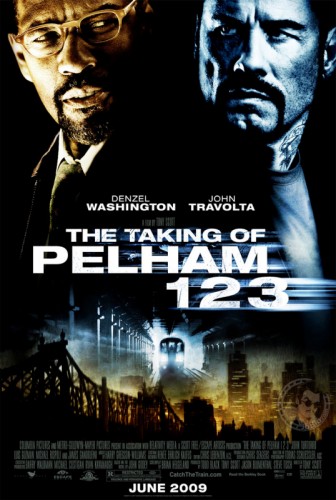
Tony Scott's corybantic, incendiary approbation of rampant nimiety, The Taking of Pelham 123, is at odds with itself and not only because it purports to be, in the words of its TV-ad-cum-action movie conductor, a “re-imagining” of the 1974 Walter Matthau-starring crime drama. Scott's movie is another familiarly skin-deep excursion into human-inspired chaos: a theme-park ride rather than a tense thriller—a feigned supercharged, restless roller coaster, but in actuality one prolonged exercise in cinematic onanism. Tony Scott is in many ways more frustrating than his brother Ridley; the latter lacks an even inchoate panorama of ethnological comprehension, fumbling about in interviews with nonsensical remarks like morally equating the murderous drug kingpin and outstandingly clean policeman who share the stage of American Gangster. Tony—and this is crucial—is by contrast the aspiring painter who lacks the prerequisite patience and poise to fulfill the promise of the canvas. There is, at least, an urgency of vision to Tony's work, and that nearly satisfies, the way an undercooked brownie or refrigerated slice of cheesecake stave off hunger. The nutrients are lacking, and the fear of eating too much of that impels the hand to reach for the fish and vegetables.
There are moments—shots, actually—which taunt the viewer with the periodic flash of fleeting perspicacity. These, alas, are all too little, too insignificant to finally matter. In the hands of the hyper-kinetic, ridiculously fast-cutting Scott, these worthwhile amendments to the portrait are rendered nearly meaningless. Scott's 2004 revenge action thriller Man on Fire occasionally touched upon the spiritual component which should underlay any such saga. As Denzel Washington's violent American almost literally raises hell in Mexico to save a little girl played by Dakota Fanning, Scott sparsely injects shots of Washington's character slowly, irrevocably drowning in an all-consuming pool of water. It is a startling image—and perhaps the only one which remains over five years after seeing that film. The incongruity of the physical is only an infinitesimally-sized component to the image's power: the deeper congruity of Man on Fire's solely resonant theme is what renders the ocular intriguingly impressive. Scott wants to make an occasional comment on his characters—but the shallowness of the enterprise (for which he is chiefly culpable through his mind-numbing visual techniques, though he does tend to work with either uneven or abominable screenplays) undoes him. Almost humorously, Scott pours only more fuel to the fire of his pictures' corroding emptiness, until whatever dramatic purpose was originally afoot has been replaced by Scott's incessant need to call attention to himself. For every sequence which may actually call for whirling, disorienting editing flourishes—such as Brad Pitt's wooing of a complete stranger in mere seconds to allow his boss (Robert Redford) to evaluate him in Spy Game—there are an unknown number which are given the treatment regardless of genuine need.
The Taking of Pelham 123 in Scott's hands features some insightful visual cues, but they are buried under repetitious waves of excessively busy camera movements—often ostensibly manufactured from tying a diminutive camera to the tail of a kitten, human head or hummingbird depending on Scott's whims—as well as needlessly ostentatious lighting, a droning soundtrack and bursts of laughable dialogue. Many routine and static camera pans highlight Denzel Washington's subway command center, which creates the affect of making over half of the film look and feel like a submarine thriller. (J.J. Abrams utilized a similar technique with Star Trek, albeit with greater discipline, and, since that was a naval war film, it worked. That, however, is for a future review.) The entirety of the film almost crushes the few moments of visual wit to be gleaned from the picture, but those few moments are worth detailing.
John Travolta's subway hijacker, “Ryder,” is a demented, loathsome individual who inveighs against the political corruption of America's largest city. Ryder lets Washington's Garber know that he is a Catholic man, and he admonishes Garber for seeing the hostages as innocent—Ryder's Catholicism informs him that no one of this earth is truly innocent. Scott frames Travolta's countenance through the back panel window of the subway, making the small compartment appear like a confessional. This is wholly appropriate considering this is where Ryder gradually, and most reluctantly, begins to confess his sins to the listening Garber. The Taking of Pelham 123 is briefly made into a richly textured ecclesiastical battle between the fallen Catholic and the modern staple of public service, the practical do-gooder. That has almost nothing to do with Brian Helgeland's fundamentally flawed screenplay—which almost always takes natural conversations and quickly makes them yelling matches, in direct, transparent contrast to the icily attenuated battle of wits between Matthau and Robert Shaw from the original film—and almost everything to do with Scott's temporarily arresting motif coupled with the best portion of Travolta's performance, in which he suggests unmitigated self-loathing and black nihilism.
John Travolta's subway hijacker, “Ryder,” is a demented, loathsome individual who inveighs against the political corruption of America's largest city. Ryder lets Washington's Garber know that he is a Catholic man, and he admonishes Garber for seeing the hostages as innocent—Ryder's Catholicism informs him that no one of this earth is truly innocent. Scott frames Travolta's countenance through the back panel window of the subway, making the small compartment appear like a confessional. This is wholly appropriate considering this is where Ryder gradually, and most reluctantly, begins to confess his sins to the listening Garber. The Taking of Pelham 123 is briefly made into a richly textured ecclesiastical battle between the fallen Catholic and the modern staple of public service, the practical do-gooder. That has almost nothing to do with Brian Helgeland's fundamentally flawed screenplay—which almost always takes natural conversations and quickly makes them yelling matches, in direct, transparent contrast to the icily attenuated battle of wits between Matthau and Robert Shaw from the original film—and almost everything to do with Scott's temporarily arresting motif coupled with the best portion of Travolta's performance, in which he suggests unmitigated self-loathing and black nihilism.
Scott, however, cannot wait to get to the scenes of mayhem; an impertinent, compendious system of title cards flashes before the viewer nearly like electronically-constituted destinations at a terminal, informing of just how much more time exists for the city to abide by Ryder's deadline. Whether it is a high-concept action blockbuster or the latest Austrian art-house cine, too many filmmakers place process over the quintessential core of their films. In the case of supposed artsy “hyperlink” films, too many filmmakers strain to make the construct matter in the richness of irony and little else, and that may be due to today's excessive devotion to irony for irony's sake. With The Taking of Pelham 123, Scott misses the forest for the trees. His interpretation is predictably noise, noise, noise, all becoming faint—sound and fury, signifying nothing.
Tobias A. Schliessler's almost literally nauseating lighting schema tells the tale; like a Spike Lee film, Scott's picture accentuates the horridness of urban life in New York City. Yet while Lee's pictures personally transfer the worst and best elemental matters of the complicated social organism he dissects, Scott's take is muted by sheer exploitation. This is the filmmaker who, in Man on Fire, made Mexico City look like the eighth circle of hell, only to attach one last title card to thank the city, calling it a “special place.” The milieu may differ but New York City is given a shockingly similar faux-medicinal regimen in The Taking of Pelham 123. Throughout the messy narrative, the city is besmirched and ridiculed, only to be held up by the final moments as a kind of insuperable but benign beacon of clout and culture. The pairing of a taxi cab ad and the mayor played by James Gandolfini (the deliciousness of Tony Soprano moving next door to New York City and becoming mayor all too obvious) sticking up for public servant Garber in the final reel leaves a bitter aftertaste of cheap manipulation to ensure that no unsafe dramatic destination is remotely touched.
And how do the performers fare? The perfection of Matthau as the lanky, plain and unlikely hero has been replaced by utter artifice. The connective tissue bridging the fictive and actual worlds in 1974 brightened Joseph Sargent's solid thriller. In the wake of Vietnam and Watergate, Matthau's public servant was a bold stand-in for the paradoxes which animated American life. When meeting a hotshot police inspector, Matthau's Garber is taken aback because the man is black. Matthau's Garber was imperfect and crude; he scoffs at Japanese men and finds them to be a waste of his time. Matthau's close physical approximation of Richard Nixon subconsciously seals the deal: an evidently inadvertent collision between Sargent's finespun world and that of the pained reality of 1974 creates a lasting and worthy meta-comment. Washington, who seems to have mortgaged a portion of his soul to Scott, by contrast, is a poor reflector; adding a paunch to his midsection with loose-fitting pants always threatening to slide downward is insufficient in its meager conviction. When Washington spills a liquid all over himself, the scene screeches and squeals under the strain imposed by Helgeland's cliched game plan. Washington himself seems in on the joke, as is the entire audience: look, it's Denzel, playing this role. The man is too much of a thespian, crying at just the right moment, frowning with determination at his imperious boss, to be taken seriously here. Travolta dials in another villain: he at least is having fun, but aside from a presumptuousness which is intermittently endearing in that twisted way that makes everyone wish they were so crazed, he brings little to the picture that piquantly stings. Robert Shaw's creation surpassed such pedantic movie thuggery.
Scott's Pelham 123 arrives in the aftermath of more national trauma, war and debilitation of the figure of public service, just as Sargent's did. The differences, however, are noteworthy. Sargent's film sought to deeply examine societal stratas, class and racial tensions—without resorting to absurdly over-the-top maneuvering such as having the villain confirm that an Irishman is Irish and an Italian is Italian as in Scott's picture—through the prism of overqualified criminals against public servants working inside a corrupt system. Scott and Helgeland's public servant is himself corrupt, so Pelham, 2009's message seems to be, what goes around is money, what comes around is payback. That, and something that everyone should follow right about now: invest in gold.
Wednesday, June 17, 2009
Drag Me to Hell (2009)

How much better is Sam Raimi's Drag Me to Hell for having Alison Lohman as its lead actress rather than the early choice, Ellen Page? Lohman—who lent the impersonal Ridley Scott a lovely pathos in the otherwise mediocre Matchstick Men (2003)—was born in 1979 but she looks not a day over twenty-five and imports a vibrant youthfulness and little-girl giddiness and magnetism of a high school student. Page, by contrast, was born in 1987, yet she pollinates her work with an ever so slightly brash cynicism and despondency. Lohman radiates a welcoming patina to the men who share the screen with her; Page's subtle attitudinal negativism would suit a young woman with a worldview tinged by misandry. Page would probably have succeeded in the role of ascendant loan officer Christine Brown but she would have had an uphill climb—for Lohman, however, the role is ostensibly like playing a variation of herself.
Raimi's long absence from the unadulterated horror of his Evil Dead pictures has made the wait for Drag Me to Hell nearly unbearable. The payoff, however, is so grandiose that there is no fear of disappointment or letdown. Drag Me to Hell—as the title itself vociferously declares—is no halfbreed excursion into the mundane passing for direly rampaging terror: it is the real deal. Like Raimi's grin-inducing cult films, Drag Me to Hell is wacky and warped. Reprieves from the assaulting horror—most conspicuously whipped about on the big screen and in the cinema by the exuberantly impressive and Academy Award-worthy sound-editing and -mixing—are short and exist not to banally contrast with the thrills and chills as in all too many films belonging to the loosely-defined genre, but to inform it. Raimi's newest picture is a smashing, exhausting triumph because he and his screenwriting collaborator brother Ivan so consummately embed the everyday quotidian world of Christine's with the oncoming gypsy curse which threatens her at every turn.
Lohman's performance never drives the film, because Christine as a construct is intended to make pivotal choices and continually react. Some critics have perhaps docked Raimi points for this—they may raise their thumb in approval but quibble with some of the particulars. They have it backwards. As a horror film, Drag Me to Hell, while featuring a dazzling facade, is not truly unique. As a complete film, however, it is an enticingly intimate composition. Raimi's art, even when anchored and occasionally buried by cheesiness (The Quick and the Dead) or apathetic bloat (Spider-Man 3), beams through. It is academic to suggest that all of drama comes down to choices made by characters, but Raimi's particular—sometimes feverish—interest in the consequences of choices endows his films with an unusual heft for such a populist-minded filmmaker. Raimi's multifarious interpretations of morality and choice is an articulate, somewhat astral stand against rampant positivism. Raimi's characters are burdened by the inestimable accountability out of which their metaphorical bed is made.
Whether it be Peyton Westlake/Darkman or Peter Parker/Spider-Man, or the poor Mitchells of the melodramatically charged, deathly ashen A Simple Plan, Raimi's characters are in command of their own destinies, subjects to their own administration. They are infused with the culpability and original sin with which Catholics ceaselessly wrestle. Some critics may chide Raimi's “moralistic” approach—they are mistaken. As in the under-appreciated The Gift and the amiable but quite uneven For Love of the Game, Drag Me to Hell echoes beyond its running time because of the repercussions against which Christine, like Raimi protagonists before her, so tirelessly chafes. As rudimentary as Spider-Man's outstanding line of dialogue may in truth be (“With great power comes great responsibility...”) it remains potent—and in a vein deeper than materialistic or paternal noblesse oblige, which were the oversimplified readings of that film's tonal substance—in no small measure because Raimi is not a pedestrian journeyman ensuring the line readings were recorded; he believes the words.
Now opting for more visceral representations of that implication, Raimi allows the conveyed statement to reverberate with action. Christine's position at her bank is uncertain: she is desirous of a promotion but she must overcome the daunting obstacles of a weasely rival and the all too easily discerned air of sexism and buddy-buddy networking which plagues her professional life. On numerous planes, Christine is a symptomatic creature of modern American society. Gradually pushed to the brink of myriad possibilities such as taking shortcuts, fulfilling vengeance-laden gratification and aiming to please her fickle boss, Christine's journey is an enriching etching of feminine vim and dynamism set against the backdrop of a largely insensitive and hard-featured world. Lohman's sweetly angelic and innocent features italicize the Raimi brothers' point: the darkness of the world is always seeking out the beautiful for retribution, whether deserving of its presence or not.
The meshing of the most base elements of the corporeal and the unthinkable devastation of the otherworldly has rarely been this rivetingly staged. In Drag Me to Hell, bodily fluids, insects and varied repulsive creatures and pests ground the presence of inconceivable evil like the “pea soup” of The Exorcist. While the visages of the picture sometimes play out like grotesque freak show acts strung along together, they cumulatively inspire a level of fright that surpasses mere sensorial reaction. Raimi's manipulative tricks taken by themselves are not breathtaking; the final, haunting tableau they engender is. This is a major accomplishment for Raimi, who proves that his prolonged stint with elephantine budgets has not irreversibly diminished his keen cinematic senses.
Everything aforementioned handsomely buttresses Drag Me to Hell's delirious banquet of Raimi's self-proclaimed “spook-a-blast”; and at his best Raimi communicates to the viewer with wordless irony. Many scenes begin with a scare and conclude with a laugh, but there is a sensation of knowing attached to that laugh, which hurts. Pretty girls having nosebleeds has become a periodical staple of horror and science-fiction (any fan of The X-Files will attest to that) but Raimi pushes the accelerator all the way down to the floor (and in doing so proves that PG-13 need not be synonymous with toothless)—partly for the gasps and chuckles the more robustly animated mise-en-scene inspire but also because it is through the excellently explored absurd that reality finds itself most nakedly revealed. In this instance, a nosebleed becomes a Biblical flood, and a sight gag segues into primal, human fear. “Did any get in my mouth?” Christine's boss frantically asks. The fear itself is futile, as Raimi continually evidences: evil is already lodged within us, perpetually fighting to get out.
Monday, June 15, 2009
Terminator: Salvation (2009), aka Contextualizing "The Terminator" Franchise

When James Cameron made The Terminator (1984), he successfully coupled low-budget gravel with high-concept gravy. Within literally seconds, he established an alternate universe in which an entire (admittedly downbeat) mythology would play itself out. This was slightly unlike any other science-fiction film insofar as it succinctly detailed the players—both present and future—as well as the stakes of its epical tale by transplanting all of the combatants to the contemporary universe the audience readily recognized. Cameron may not be widely considered a high cinematic artist but this was the baptismal instance in which his interests in storytelling, with the aid of prudently utilized practical special effects, proved too excellent and refreshing a commixture to ignore.
The religious undertones to Cameron's first labor of love (Piranha 2 is frequently dismissed as “director-for-hire” work) helped to establish the gravitas of his nascent mythology. The connection between “John Connor” and “Jesus Christ” is obvious (is there a relation of some sort between “James Cameron” and “John Connor” as well?). Then there is Sarah Connor, named after the Biblical Sarah, foremother of the Israelites. The previously barren Sarah was gifted through a divine miracle to conceive and give birth to the providential, foretold son named Isaac. Linda Hamilton's Sarah Connor is impregnated through time travel: the man sent by a burnt-out veteran warrior, hero and resistance fighter John Connor proves to be Connor's father. (The less time spent debating the scientific merits of time travel, the better. Also: one may view the conclusion of Terminator 2: Judgment Day as the inversion of the story of Abraham and Issac, as the father figure—future California Governator Ahnuld—lays down his... life?... for the chosen son.)
For the first three Terminator pictures, this mythology was largely held intact in its basic configuration. For three straight films, poor John Connor—first, to be terminated before conception, then as a rebellious adolescent listening to Guns 'N' Roses (a trait he still possesses in the 2009 release) and finally as a nearly nihilistic, disillusioned twenty-something—was the target. With Terminator: Salvation, Connor is propped up as a man of action, finally resembling in the most perspicuous manner the “freedom fighter” the audience has been repeatedly told he will one day become. What Terminator: Salvation promises with its trailer (vastly superior to the film) is to finally delve deeply into the war between the humans and the machines first alluded to in the opening seconds of Cameron's 1984 modern classic. What all of the studio executives seem to have forgotten, however, is that not a single viewer of the original picture considered the idea of seeing the future apocalyptic war as necessary, or entertaining or even a good idea in the least. Cameron allows Kyle Reese and his combat trauma-induced flashbacks to be the portal through which the viewer sees the hellish carnage and destruction of the future: it's not particularly appetizing or pretty, and there is just enough of it to drive the point home.
This is not to even broach the subject of this series' thematic schizophrenia. The Terminator posited that human beings could fight for their ideals, for their humanity, as it were, against seemingly insurmountable odds, in the face of known horror. The film's release in the 1980s suggests latent Cold War paranoia of nuclear annihilation coupled with uncomfortable acceptance, which makes the picture surprisingly relevant and subversive in the post-9/11 era, too. Terminator 2 was far more upbeat—the future may be grim but “Judgment Day” can be averted with the coupling of humanity and machine as one force for good. “No fate but what we make,” was the 1991 picture's enormously appropriate declaration, seeing as the Cold War was melting away like so many ice cubes on a June porch and people of varied nationalities, ethnicities and histories were, in essence, rising up against a long-feared oppressor.
Unfortunately, the allure of money was too potent for the aforementioned studio executives to resist: Terminator 3, released less than two years after 9/11, seemed to consign humanity to the dustbin for good: there is no stopping “Judgment Day”; as the politically ambitious star remarked with mechanic chilliness, “You only postponed [the future nuclear holocaust]. Judgment Day is inevitable.” And with that, studio avarice blatantly rejected the entire pulsing message of the first two films as crafted by Cameron. Terminator 3's tagline should have read, “No fate but what we make—What a joke.” And thus, with the end of the world, and end of that picture, Nick Stahl self-importantly intoned that the future still lay ahead. In other words, prepare to sacrifice more money to see a franchise go in an entirely unnecessary direction and nullify the purpose and meaning of the first two films, which so many today still love and quote as nineteenth century American politicians recited Biblical verses in their speeches.
The basic skeleton of the first three Terminator films remained the same, despite the thematic muddling and inconsistency. Each film presented a dystopian future dictated by merciless machines. Cameron's vision entailed faith in humanity against the encroaching supremacy of a mechanized future. It is no coincidence that the greatest objective of all three earlier films was to leave Los Angeles as soon as possible. In each case, at least one Connor was tormented by an ostensibly unstoppable and unyielding force. The formula was enticing in the relaxed, almost innate way that recalls simple fairytales or traditional professional wrestling “booking”: the villain is seemingly invincible, but the hero is equally determined to triumph and save the day. As the series progressed, the assassin terminators had to be increasingly deadly, until, with the third film, a Scandinavian supermodel Terminatrix could just about literally do anything it set its electronic mind on accomplishing. A viewer may have asked, as JC did with T2, “Why doesn't it just become a bomb or something and get me?” Terminator 3, however, was a film consciously bathed in self-parody—and, in a way, how could it not be, considering how pervasive the first two films became in the realm of popular culture? At least the film was brisk, if not memorable, and its longest car chase was excitingly mounted in a way all too few action sequences are today.
Which takes this look at the Terminator franchise to the newest release. It is difficult to remember a film so wantonly self-destructive and wasteful. The most fertile substance from T3 was the emotional chemistry between Stahl and Claire Danes as Catherine Brewster, John Connor's future wife and mother of his children. So the terminally confused Terminator: Salvation elects to spend approximately three minutes of its running time on the relationship between man and wife, savior and maiden. Christian Bale and Bryce Dallas Howard make the 2003 pairing of Stahl and Danes look like Bogey and Bacall in comparison. Bale is wholly lost in his role, grunting and fuming, screaming and yelling, behaving more like an impotent teenager confronted by his parents than the bravely insubordinate trooper defying catastrophic orders the film apparently wishes to present. Howard is an empty vessel. The only performer who escapes unscathed from the film is Sam Worthington, whose most accomplished episodes almost convince that there is an entirely functioning brain behind this enterprise. As this film's Frankenstein's monster, he literally howls at the moon, his naked body covered in mud evidently symbolizing man's evolutionary emergence from the muck and mire of the earth, with the wet soil representing a mother's amniotic fluid.
Terminator: Salvation is reminiscent of the 1970s and 1980s James Bond movies of the frequently lamented “Roger Moore era,” as an old, aging and tired franchise begins to steal from newer, flashier populist cinema entries. The Matrix, Steven Spielberg's 2005 War of the Worlds and Michael Bay's Transformers, to name but three, are liberally borrowed from for action spectacles; Apocalypse Now, first poked in the ribs by Watchmen, is once again trotted out by director McG for yet another parading exercise in film geek pandering. Whereas The Terminator was a concisely paced, tersely eloquent exploration of dread, Terminator 2: Judgment Day a glossy action-packed marathon of mythological peregrination and a work of a man wanting to satisfyingly wrap up every loose end presented by his first opus, Terminator 3 an agile if nearly completely mindless compilation of action genre outbursts and obeisance to the superficialities of the two earlier pictures and simultaneously an utter rejection of their respective theses, Terminator: Salvation is a film adrift, with a character built up for three straight films who proves to be nothing less than boring in the flesh. Cameron had it right; the viewer did not need to see the much-ballyhooed war between the humans and the machines. Subtlety is not even the issue—T3 featured Danes' Brewster squeal, “I hate machines!” as one of her first lines. What Terminator: Salvation needs is the very hope of salvation once embraced, and later discarded, like so many long-forgotten cynical campaign promises.
China Moon (1994)

The 1991 (finally released theatrically by Orion Pictures in 1994) romantic neo-noir thriller China Moon establishes early its central character's most palpable traits and attributes, which deceptively foretell his eventual unraveling and undoing. Ed Harris plays cagey, intuitive (fictional) Brayton, Florida (filmed in Lakeland, Florida and the surrounding area) detective Kyle Bodine, whose observant attention to detail allows him to read murder scenes like road signs, knowing within minutes who the perpetrator is. Because he is good at his job, he rarely considers why he is doing it; when questioned by his somewhat green, and in Bodine's words, “okay,” partner, Lamar Dickey (Benicio Del Toro) why he is a cop, Bodine replies that he knew there was a reason. He will think about it sometime.
Bodine's intelligence and awareness prove to be indirect vulnerabilities when placed alongside his ostensible lack of greater motivation. When he discovers a beautiful, mysterious woman named Rachel Munro—played with almost vampiric luminescence by Madeleine Stowe—he falls head over heels for her. Unfortunately she happens to be married to an equally powerful and abusive local banking kingpin, Rupert Munro (a one-note Charles Dance). Gradually, the film's tone shifts from the fairly sumptuous tale of passion between Bodine and Rachel to a serpentine murder mystery.
China Moon is longtime cinematographer John Bailey's (whose credits include American Gigolo, The Pope of Greenwich Village and Mishima: A Life in Four Chapters) directorial debut. The lighting the seasoned director of photography utilizes allows for some mesmerizing visualizations which enhance what is fundamentally a routine potboiler. The screenplay, by Roy Carlson, is sufficiently serviceable when it must be, providing just enough in the way of narrative glue for the picture's subtly dyspeptic yarn to give impetus to the ocular pleasures China Moon offers to the viewer. Bailey and Belgian cinematographer Willy Kurant ably conspire to create a visually rich canvas of coolly colored nighttime vistas and interiors. One particularly memorable setting is the lushly romantic setting of a lake. The reflection of the “china moon”—Bodine tells Rachel that his mother used the term for a full moon, under which people would “do strange things,” he states—is captured against the smooth, seemingly tranquil surface of the body of water in delicately composed shots.
When finding himself in the unenviable position of covering up a murder, Bodine's mercurial gifts are turned against him, and as the cliché goes, the hunter becomes the hunted. Bailey and Kurant's occasionally delicious visages figuratively brighten and literally dim the picture as Harris' detective becomes not only wholly entangled in the mystery but the most suspected figure in the film by his fellow officers, including his partner. Following the time-honored noir template, the protagonist's apparent strengths prove to be strangely debilitating, as Bodine's certainty and sharpness leave hints of hubris. Those seeds are indeed immediately sown in the film's prologue, during which Bodine surveys the scene of a homicide with all of the clinical precision of a genuine expert. “Sooner or later,” he says derisively of murderers, “they all fuck up.” Little does he know his tumultuous future when he makes this comment to his colleagues.
China Moon's most sound component of all, however, is the lead performance by Ed Harris. Harris is dynamic and subtle, forceful and equable all at once. He gives a compelling, convincing performance that keeps the film humming even when too many coincidences and plot holes needlessly distract from the vastly more important emotional through-line with which Harris endows the humble film. Harris' eyes are especially captivating in a film peopled with indelible pools of light as eyes, most notably his costar, Stowe's, which accurately belie her truer nature. Harris makes every little movement of his eyes matter, and it fits wonderfully with his character's chief gift of observation. There is a doom in his eyes, and it is matched, if not with straightforward and engrossing presence, then with a complementary sense of intrigue by Stowe, working off of the guilelessness and fierceness Harris supplies.
Where Stowe comes up short is in the range of her performance; the screenplay and Bailey's uneven handling of his actors contrive to limit her. Whereas many noirs allow for the female presence to display greater shades of character, China Moon is actually the opposite. Stowe's Rachel is if anything too nebulous and murky a figure, and the fact that the very ending hinges on her true motivations leaves a peculiar aftertaste as there has been minimal buttressing of her emotional state beyond common, hoary and hackneyed abused-wife syndrome scenes. As with other conventional neo-noirs that follow similar storylines, the husband, here played by Dance, is completely one-dimensional and totally unsympathetic; if and when such a character meets a violent end, the ramifications of his demise are almost always only of interest insomuch as they relate to the other characters' fates.
Nevertheless, Harris' carefully calibrated turn excellently draws the viewer in with great, meticulous thoughtfulness. When Bodine finally reaches his breaking point and lashes out, the viewer is caught up with him; it's not an entirely different sensation than relishing the confused, furious righteousness of James Stewart's John “Scottie” Ferguson confronting the inscrutable Kim Novak in the closing moments of Vertigo when Harris' Bodine points the finger of indignation at the untrustworthy Rachel. The sophistication that is missing in other parts of the film is evident whenever Harris makes his presence profoundly felt. In a landscape of noir, marked by countless dupes, sometimes what matters is simply trying to get the last word in. Bodine tries his best, and this flawed film is better for it.
Friday, April 3, 2009
Murmur of the Heart (1971)

There is an almost inescapable infectiousness beaming from and residing in Louis Malle's best films. His vibrancy and effervescence, when judiciously meshed with a compelling, mythic anecdote—both of which he himself crafted with singular delicacy—is simply irresistible. It has doubtless often been said that Murmur of the Heart, like other Malle pictures, is a filmic essaying of innocence lost, but that is itself a faux pas. Malle's work, not irregularly maligned by critics who soured on Malle's admittedly tartly acidulous aromatic palette, is best consumed with a suspicion—not of his intentions but of his art, which seems to serve as a rejoinder to the oft-repeated phrase, trust the art, not the artist (which naturally remains true in Malle's case as well). Malle's films are about innocence, period, even when it is politically, sociologically or culturally skewed, benighted and spiritually subjugated to the banalities of polity, as in the mesmeric tarry through callow fascism that is Lacombe, Lucien. Malle's cinema—imbued with an innate plausibility, but purified by a tinting of phantasmagoria—is arrestingly deceptive without resorting to duplicity.
Murmur of the Heart stars Lea Massari and Benoit Ferreux (in his first film) as Clara Chevalier and her adolescent son, Laurent, in 1954 France. As in other Malle pictures, the main pubescent-to-young adult character's insouciance is juxtaposed with the geopolitical tumult that either directly or circuitously informs his peregrination into variegated definitions of manhood, most commonly finding sexual awakening, arousal and action as the definitive fulcrum against which all else pivots. The aforementioned Lacombe, Lucien made Malle's most trenchant points concerning wartime collaboration as seen through ambling indifference—ascetically apolitical in its painterly construction but highly, almost obdurately uncompromising in its most sweeping aspects of efficaciously rendered prevarication (Lacombe's chief imperious/sexual conquest and annexation is of the pulchritudinous girl named France Horn)—but with the earlier Murmur of the Heart, Malle's edifice remained with the entanglements of the familial. As reports stream into the consciousness of Frenchmen from the losing contest in Indochina, Laurent—who, in the film's prologue is found with a friend soliciting random people for aid for wounded veterans of the colonial strife—blossoms in both expected and unexpected ways. This is a most particularly oedipal telling of the nuanced love between a son and mother.
Like Francois Truffaut's The 400 Blows, the son, here Laurent, catches his mother engaging in extramarital love affairs. The love that once deeply marked the Italian-born mother's marriage to her gynecologist French husband, for whom she produced three sons—Laurent being the youngest—has been replaced by gentle but occasionally uncomfortable silences and arguments recurrently about Laurent's nature, with the nearly overprotective mother protesting that the misbehaving child is sensitive as her husband merely throws up his hands and refers to him as a pain in the neck. “He used to be so jealous,” Clara Chevalier tells her son late in the picture. At this time, however, Clara finds herself searching for excitement and warmth of feeling from other men. Laurent's sexual confusion and deep, abiding affection for his mother collide as he catches glimpses of her running off with other men. Clara will tease him late in the film: “You're my little, jealous French husband!” The relationship between Clara and her son doubtless inspires interest from receptive Freudians.
What partly separates Malle's pictures from many others is their curious, salient repetition of movement and form. Like the heartbroken, lonely solitary figure walking seemingly aimlessly about the arid night in Elevator to the Gallows, Murmur of the Heart's cohesion—seen from Laurent's point-of-view, but legitimately adjoined to his equally cogent and misaligned multi-peopled portraitures orbiting his mother—is made up of confident visual enactments that prop up Malle's thematic touchstones. In Murmur of the Heart, these are repeatedly quite funny. One especially rewarding sequence follows Laurent's delirious older brothers playing “spinach tennis” with one another, flinging globs of spinach to one another's plate from across the dinner table. Much later in the film, the actual sport of tennis will become a metaphorical simile for the battle of the sexes, and how the entire war is a stupendously childish game of a different sort, one of Malle's most propitiously important revisited themes.
What ultimately enriches Murmur of the Heart, however, is its densely literate subtexts. In one subtle scene, a brother of Laurent's hands him reading material: “Proust to entertain you and Tintin to instruct you.” As Laurent chastises a shallow suitor for Clara's affections at a health spa, he points to the intelligence of Proust. “But you don't read Jewish writers,” Laurent notes of the apparently nationalistic, colonialist-leaning young man. “A country is nothing without colonies. Look at the English,” Clara's suitor remarks. The allusions to Proust are important to examine, as they hint at Malle's narrative structure. Murmur of the Heart is fundamentally a retelling of Proust's “Within a Budding Grove, Volume 2” from “In Search of Lost Time.” The connective tissue is myriad in its configurations. Malle's health spa—which Laurent, like the story's narrator, is a sick child, attends for the sake of his heart which suffers from murmurs—appears to be a stand-in for Proust's Balbec; the pretty blonde girl Helene seems to be inspired by Proust's Albertine, who in both the story and Malle's film is suspected to be a lesbian; like the narrator, Laurent seeks to sexualize his relationship with Helene/Albertine—Proust's delineation followed the narrator's quest to kiss Albertine whereas the sexually fixated Laurent attempts to bed Helen; and like the narrator, Laurent professes a consummate love for his mother (which again, in Malle's tale, is more acutely sexualized).
As in Lacombe, Lucien and other Malle films, from the mutedly despairing, futuristic parable of the war between the sexes, Black Moon to another rendering of maladjusted childhood fantasia and tragic malignity, Au revoir les enfants, male dream-manufacturing, like spools from which airy cotton candy are proliferated, finds both reward and dejection, elation and despondence, in the ecstatic reverie of dazed abstraction. Where Murmur of the Heart differentiates itself from both Malle's earlier and later work is that its playfulness is more earnest—and therefore brighter and truer all at once—because the child is truly enraptured with not only a conception but a real-world visage of nearly ineffable familiarity and closeness. Oedipal or not, the relationship—superbly brought to life by the effortlessly charming child actor Ferreux and the window of the mortal divine that the impossibly endearing Massari most palpably represents—somehow resides beyond all of his other explications of humans in all of their confounding complexities. Profundity of a peculiarly alien, ethereal kind presents itself in Malle's exquisite denouement. After everything, all the Chevalier brood can do is laugh together, giggling and chuckling, chortling and cackling, in a fit of sustained cachinnation, surveying not so much the world—which for all of national and intimate changes, in immeasurable and decipherable ways alike, coupling the political with the sexual, has not been irreparably altered after all—but themselves. As with almost anyone with any hint of modesty, self-awareness and humility, they have burst together, as in the most reasonable reaction to a sustained episode of looking into a mirror.
Thursday, April 2, 2009
Hunger (2008)

Steve McQueen's feature film debut, Hunger, is an uneven but viscerally forceful picture. Where it fails in comprehensiveness and even filmic movement—McQueen's vignettes almost all stand apart, disparately creating momentary displeasure and disgust, never quite gelling into a substantive narrative, or at least only belatedly finding one to pursue—it succeeds in sensational conviction befitting its subject matter. Not unlike Mel Gibson's The Passion of the Christ, McQueen's film is fervent and nearly maniacal in its unblinking stare; unlike Gibson's film, McQueen's attempt to chronicle the sixty-six day hunger strike spearheaded by Irish Republican Army leader Bobby Sands (Michael Fassbender) is secular in its devotionally obsessive focus. Drawing a parallel between both the cruelty visited upon the defiant and disruptive prisoners of the Northern Ireland Maze Prison by the guards and Sands' self-inflicted choice to starve himself to Christ's passion on several occasions, McQueen and collaborator (and playwright) Enda Walsh seem to nevertheless yearn to unfurl their drama with a level of detachment.
That detachment, however, is occasionally made questionable, and McQueen's actual beliefs are ostensibly betrayed by his insistence of layering stylistic flourishes atop the occurrences his film essays. One repetitive touchstone is the usage of British Prime Minister Margaret Thatcher verbally condemning the Irish Republican Army members as violent terrorists unworthy of the political prisoner status for which they protested. McQueen creates significant sympathy for the Irish prisoners, demonstrating with an unalloyed minimalism, as they communicate through tiny wads of paper passed along through their mouths to one another during mass. However, McQueen and Walsh exhibit empathy for the guards as well; indeed, the film opens with an extended sequence during which the camera follows along a guard who is washing and soothing his scarred-over knuckles in water. In one scene of vicious brutality, one guard appears almost traumatized, weeping as he recognizes the levels of de-humanization to which he and his peers have descended.
While examining Hunger it is advantageous to consider the chiefest qualities of cinema; its immediate fluency, and proficiency when optimally used to convey information. For example, in many of the better unironic, under-appreciated “genre” films, it is almost always the acuity of the filmmaking that enhances the narratively prosaic. It is in these films where the visual craftsmanship and aesthetic stylishness benefits the films' unalloyed machinations. When appropriately meshed, visualization supersedes what is commonly called “plot.” From Taken to Point Break, and many other examples, it is the artful accession of élan that endows the familiar.
So it is with a slightly confounded mien that it is realized that McQueen's Hunger is almost arriving at the opposite spectrum of cinema—the “story” is at the service of his craftsmanship. McQueen is trained as a fine artist, and his debut film is delineated by ostentatiousness and precociousness. The entire ninety-six minute film plays out like an exercise in quaffing precious artfulness. With the proverbial tips of the hat to Robert Bresson (the meticulously detailed manner in which the prisoners communicate with one another cannot not remind of A Man Escaped) and Stanley Kubrick (the entire film accounts de-humanization—of prisoner and guard alike—and a sequence in which a group of jackbooted thugs stand in a long hallway cannot not bring images of Full Metal Jacket to most filmgoers who will actually watch Hunger), McQueen's confidence, at least bordering on arrogance, is doubtless.
Not that there is anything wrong with a stubborn, uncompromising artistic initiative—with Hunger, it is the imagery that stays, long after the final credits have unspooled, after all, but for its second and most impressive act. Nonetheless, McQueen's picture plays like numerous sketches aligned together for the purpose of making a film. Coherence is not an issue—Hunger is rigorously minimalistic and quite slowly paced, which contributes to the pervasive feeling of crushing, listless boredom that is as poisonous to the souls of the prisoners (and guards) as the ordeals to which they are subjected as a price of their disobedience. Ocular recording of the tellurian plays heavily into the visceral potency that is Hunger's most certain attribute. As a guard sedates himself with a quiet sojourn to the yard, smoking a cigarette in the wintry weather, snowflakes fall upon him. McQueen and director of photography Sean Bobbitt capture the subsequent moment on film with fine delicacy. The guard who had earlier soothed his beaten, battered and bloodied knuckles in water finds little snowflakes weep from the sky and landing on his scars and marks of self-inflection against the heads of many prisoners. McQueen's fine artist eye catches many more undisguised flourishes. Prisoners smear their own excrement upon the walls of their cells, and McQueen's camera seems particularly attuned to the spiral patterns one prisoner creates with feces-wall painting.
The best portion of the film, however, is a bravura, unbroken sequence in which McQueen's camera remains still and there are no interruptions of cutting. For over fifteen minutes, two men, Sands, and Father Moran (an extremely stirring and profound Liam Cunningham: his performance alone makes Hunger worth the investment) speak to one another in ostensible “real time,” volleying points to one another. The steadied duration of this puissant portion creates uneasy astriction and tautness, deftly providing an atmospheric contextual support for the final act of the film that details Sands' self-imposed bodily disintegration, wherein the film finally does become soporose in its hazily blurred perspective. When the camera finally does break the hypnotic spell, it is to emphasize Sands' words as he tells an allegorical story from his childhood about doing what was right and accepting the consequences with the peace, dignity and knowledge that he had the courage to do what was right. The conversation between Sands and Father Moran is utterly bewitching and fascinating, and an instance of actors correctly taking over a film and the director allowing them the freedom, space and time with which to tell a story.
It is, then, almost humorously appropriate to consider the inherent artifice of the entire riveting conversation. By all accounts, Sands and Father Moran never spoke to one another, whereas it is clear that such events as IRA members being beaten, refusing to wear certain prison uniforms and going on hunger strikes are part of recorded history. In Hunger's major and outstanding concession to filmic progress and peregrination, it actually extols the virtues of the cinematically schematic derived by storytelling strategies and considerations of scenario. Unlike The Class, which was made intentionally visually unappealing by its director, Hunger is a film with several toes dipped in the waters of vérité filmmaking and mise-en-scene construction but with other toes hanging on to almost wheezing exhalations of exhilaratingly intense abstract artistry. That the most dazzling set-piece of Hunger almost perversely proves the efficacy of what may be loosely defined as “make-believe” is deeply paradoxical.
In the film's foggy, more asomatously focused, denouement, Sands allows his body to waste away. McQueen follows the process with a serviceable melange of the dispassionate and the assertive, engendering a cumulative tableau of a man gradually drifting away. Misty flashbacks to his childhood, the personal history from which he told the emotional story to Father Moran, abut the film's apparent moroseness in its consideration of a young man's life concluding long before it should have. The correlation to Jesus Christ becomes less distancing than it was earlier in the film—a manufactured line of dialogue from Sands in which he says that Christ's disciples were merely jumping on a bandwagon after Christ laid it all on the line himself diminishes their own respectively harsh fates and credentials for martyrdom—as McQueen visualizes Sands' earthly demise. Long, uninterrupted takes with sepia-toned dissolves overlapping atop them punctuates Sands' sixty-six days of deprivation. A flock of birds flying off represents Sands' soul taking flight in a sequence that at least borders on the clichéd, but, like so much of the film, makes itself at least stand apart through sheer force of will.
Wednesday, April 1, 2009
The Night They Raided Minsky's (1968)

The Night They Raided Minsky's is an appropriate film to look over on April Fools' Day, as its narrative hinges on one large “trick” to be played on certain characters. William Friedkin's second feature film is an uneven but sweet and charming ode to the 1920s theaters of burlesque. As the film today exists in current form, it routinely cuts away from his own narrative and splices in many apparent pieces of footage from the time period itself, thick with grain and washed-out images. The screenplay, based on a book by Rowland Barber and written by Arnold Schulman, Sidney Michaels and Norman Lear, supplies a dangerously thin storyline, but the film is at its most fun when the mechanics of the picture are almost invisible, and mere gags and burlesque performances take the center stage.
Jason Robards, who plays central figure Raymond Paine, received mixed notices for The Night They Raided Minsky's, but today his performance seems stronger than it may have at the time of the film's release. Robards was never too much of a “leading man movie star” to diminish his own self-effacing and auto-critiquing tendencies; even in the testosterone-laden westerns in which he appeared, he often played characters either physically or psychologically wounded, such as the contemporaneous Once Upon a Time in the West, Hour of the Gun or The Ballad of Cable Hogue. With Minsky's, Robards allows his most winning attributes to mesh with his nearly continual semblance of debilitation—ever so slightly suave, his persona is crushed when confronted with hostility or projected dubiousness by others. It helps that Robards is given many of the film's best lines. When his longtime partner and friend, Chick Williams (an energetic Norman Wisdom), falls for the pulchritudinous Amish ingénue, Rachel Elizabeth Schpitendavel (a wide-eyed Britt Ekland), Robards' roguish huckster comedian undermines Chick's propriety. )(Which ties into their joined rendition of “Perfect Gentleman,” in which Robards' character sings along with Wisdom's about just how much of a gentleman he is. “You suffer from the three D's,” Raymond tells Chick, “you're decent, devoted and dependable. Good qualities in a dog—disastrous in a man.” He goes on: “Women love bastards. I am a BFC: Bastard First Class.” Robards likewise shines in a long scene in which he approaches a woman at the local deli—where a significant portion of the film's events take place—only to be surprised when her husband returns from the restroom. So Raymond smooth-talks the husband and is as smooth as the skin of a newborn. The humor is obvious but Robards is too excellent when at his best in this film to dismiss, balancing his motor-mouthed shtick with the fearfulness behind it.
Ekland is fine as the young runaway Amish woman who is blinded by the dazzling marquee. As Raymond and Chick contest one another over her affections, Ekland's debatable one-note performance never feels particularly calculated, which is key in making it fit with the long line of young ingénues who were transfixed on the idea of becoming a star of show-business. Considered unqualified for burlesque, Ekland's Rachel is manipulated by the scheming Raymond; his bright idea is to have her perform one night after being billed as “Mademoiselle Fifi,” the French starlet and heroine of pornographic literature, who is, it is constantly noted in her billing, “The Girl Who Drove a Thousand Frenchmen Wild.” Raymond figures Rachel will do what she has done in her Pennsylvania Amish community—perform a Biblical dance rather than a bawdy number. Thus, Secretary for the Suppression of Vice Vance Fowler (Denholm Elliott), determined to raid Minsky's in the event of Mademoiselle Fifi's appearance, will have no reason to shut the establishment down and Raymond's job will be safe.
Two other welcome performers are Joseph Wiseman and Elliot Gould as the father and son (Louis and Billy Minsky), who repeatedly enliven the picture. Wiseman and Gould play their parts as Jewish businessmen with significant emphasis on their ethnicity. The Night They Raided Minsky's pokes some fun at religion in general, as Rachel's stern and unforgiving Amish father, Jacob Schpitendavel (Harry Andrews), hunt her down and finally finds himself confronted with Wiseman's Louis Minsky. Louis educating two other religious men about the identities of each finger's meaning in religious terminology evokes laughter. The picture may satirize stoically religious individuals, but at this late point in the film, it does so with a genial warmth.
The Night They Raided Minsky's was released just as Hollywood films had largely been let loose; censorship in American cinema was coming to an end. So it is particularly amusing to view Minsky's as the film examines a different kind of show-biz thriving under the threatening thumb of censorship. As Elliott's Fowler chastises the men who run Minsky's, he is asked what he finds so objectionable. “Well, the women... They jiggle,” he remarks. The film is hilariously accurate in its depiction of the censoring force having to attend every show and write down in explicit detail what is to be considered lewd and improper.
Reportedly, Friedkin's cut of The Night They Raided Minsky's was a considerably different film from the eventually released 1968 picture—Friedkin's first cut was, it was almost universally agreed, a complete disaster. Editor Ralph Rosenblum worked on the film in postproduction for over a year, finding a coherent film through his assiduousness. Some may assume the concept of cutting to old footage was Friedkin's idea—perhaps an homage to Jean-Luc Godard's stylistics—but it was indeed Rosenblum who came up with the idea himself. Rosenblum, in effect, re-directed the film himself and made an alternative version of Minsky's which is today the one actually seen.
Some of the film's finest moments are simply of Robards and Wisdom engaging in song and dance with one another. The soundtrack is stuffed with modern classics as well as some songs by Lee Adams (the score was provided by Charles Strouse). The agreeable combination Robards' wise-guy next to Wisdom's naïve optimist makes The Night They Raided Minsky's seem so effortlessly mounted, though it actually was one of Hollywood's most painful births; likewise, Robards' history as a great stage actor and Wisdom's history as a great British comedian and music-hall star must have paid dividends as they excel at projecting an immediacy that draws in a live audience. Minsky's isn't a grand time at the movies, but it is fast, fun and frank—a valentine to all things just vaguely fulsome.
Subscribe to:
Posts (Atom)


