Wednesday, March 25, 2009

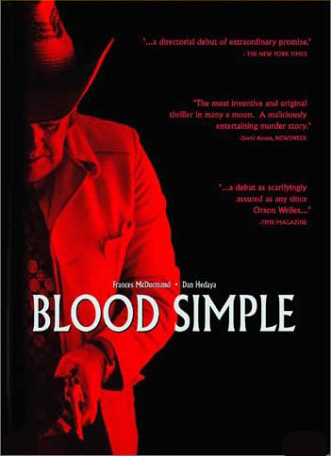
Blood Simple (1984)


“The world is full of complainers. An' the fact is, nothin' comes with a guarantee. Now I don't care if you're the Pope of Rome, the President of the United States or Man of the Year, something can all go wrong. Now go on ahead, ya know, complain, tell your problems to your neighbor, ask for help, 'n watch 'im fly. Now, in Russia, they got it all mapped out so that everybody pulls for everybody else... that's the theory, anyway. But what I know about is Texas, an' down here... you're on your own.”

The film begins with melancholic, almost rueful, narration, visually matched with shots of a long, barren and desolate Texas road. Later, characters will dwell underneath ominous ceiling fans, which seem to hauntingly view down upon the hapless. The camera, fluid but controlled, focuses on doors, particularly at nighttime, heightening the palpable fear of who or what is lurking behind them. A blade of light slicing through the darkness underneath a door is snuffed out. An emphasis on the patulous Texas outdoors pervades the film, contrasted and juxtaposed with the stifling, closed interiors in which people struggle. Shots of cowboy boots populate much of the picture. Blood is found on the ground with great regularity. Otherwise decent people make highly unfortunate decisions. An otherworldly creature mercilessly stalks his prey. This, however, is not No Country for Old Men but rather Blood Simple, the 1984 film debut for Joel and Ethan Coen.

Blood Simple is a subtly mind-bending neo-noir crime thriller in which communication is hampered by circumstance and refuge is denied by the apparent intervention of fate. The picture, photographed with blue-tinted deliriousness by Barry Sonnenfeld, is laced with an oneiric imperishability of location and personage, which meticulously creates a moony pattern that courses through the picture—and the Coen oeuvre entire. Characters move through the film like stationary objects pushed, as they are compelled to vacate their respective natural habitats. As will be proven true with their later efforts, Blood Simple demonstrably essays the Coens' obsessions and idiosyncrasies, their fixations and concerns. As a debut, the film is as pure and distilled an introductory declaratory statement as any before or since.

After the film's dry, almost supernatural opening narration, Blood Simple brings its perspective, literally, with Ray and Abby (John Getz and Frances McDormand) driving at night. The road is visible again, and “The Road” will remain a recurring Coen motif. Abby's first line informs where the picture's plot is headed: her possessive husband gave her a .38 handgun as a gift, but she fears she would use it on him if she did not leave him. The camera remains behind Ray and Abby, he behind the steering wheel of his car, she in the passenger seat. The windshield is spattered with rain, which is furiously flung off by the windshield wipers. With each passing car's briefly blinding headlights moving past them, the main cast members have their names flash against the black of night in cool blue.

The Coens' penchant for quirky, offbeat humor—here typically slathered atop the film's laconic dialogue—makes Blood Simple less familiar than its superficially derivative story would suggest. Rooted in the work of James M. Cain, Jim Thompson and other authors of stories about lust and murder, Blood Simple takes on a twisted viewpoint characterized by mordant humor and razor-sharp wit. As Abby's husband, owner of the bar at which Ray works, Julian Marty (Dan Hedaya), confronts Ray in the back of the bar, the Coens use a bug-zapper to simultaneously underline and subvert Marty's dramatic lines. “You think I'm funny, I'm an asshole? No, no, no... what's funny is her... what's funny is, I had you two followed because if it's not you she's sleeping with, it's somebody else... what's funny is when she gives you that look and says, 'I don't know what you're talkin' 'bout, Ray. I ain't done nothin' funny.' But the funniest thing to me is... you think she came back here for you... That's what's fucking funny!” The “bug-zapper” humorously emits its incongruously appropriate and inappropriate noise just as Marty concludes his angry, jealous speech, poking fun at the character, campy films with thunder and lightning emphasizing characters' dramatic lines and the film itself, with its budgetary limitations and ostensible lack of scope.

After having a finger broken by his wife in an ugly front-yard confrontation—masterfully captured with a racing, fevered camera—Marty seeks out the man he hired to follow Ray and Abby, sleazy private investigator Loren Visser (played with villainously cretinous relish by a superb M. Emmett Walsh). Visser is the Coens' first outsider—less so in terms of his geographical and cultural identity and more so in his complete lack of moral boundaries (the theme would become increasingly literalized in the Coen canon, culminating with the angel from hell, or at least some foreign country, Anton Chigurh, in No Country for Old Men). Visser is fat and sweaty with a devilish cackle and scaly, clammy features. Flies buzz around and about his face. Several of the best scenes in the entire Coen filmography are of Marty and Visser conversing, each holding the other in contempt as they go about their unseemly business. A terse, funny exchange buttresses the Coens' sensibility and interest. Marty: “I got a job for you.” Visser: “Well, if it's legal, and the pay's right, I'll do it.” Marty: “It's not strictly legal.” Visser: “Well, if it pays right, I'll do it.”

In its noirish iconography and air of morbidity, Blood Simple foreshadows the Coens' future efforts. Small-town Americana is the frequent home to Coen narratives, with its seemingly limpid innocence and relative tranquility being brutally invaded by outside forces, always unleashed by their bosses who egomaniacally call the shots behind their big desks—a Coen motif, from Nathan Arizona played by Trey Wilson unwittingly unleashing Leonard Smalls in Raising Arizona to Jerry Lundegaard played by William H. Macy hiring Carl and Gaear to kidnap his own wife in Fargo to the crooked businessman in No Country for Old Men embodied by Stephen Root letting out the demon. In each case, and others, the man behind the big desk believes he can control his fate, and in every instance, the weapon they let loose proves to be uncontrollable. Often, they are even killed by the very demon they let out of the box. The crushing absence of empathy for others informs the Coens' fiendish rogues gallery. Like those who would follow him in the Coens' art, Visser is a serpentine phantasm, putting about in his Volkswagen Beetle. The exchange between Marty and Visser encapsulates what would be re-imagined in Police Chief Marge Gunderson's famed tabulation in Fargo: counting the victims, she concludes, “And for what? For a little bit of money. There's more to life than money, ya know. Don'tcha know that?”

For Visser, like Peter Stormare's coldblooded sociopath, however, the temptation of money is too great to resist. Which is what, in part, separates the voracious, beastly outsiders from the people who are victimized by their own bad luck and poor choices. Ray and Abby are unable to enjoy one another's company, as Marty successfully plants the seed of distrust in Ray's mind. Everything flows from that; and as Ray finds himself covering up a crime he believes Abby has committed, he becomes the most plaintive character of Coen sagas. Like H.I. McDunnough in Raising Arizona, and Tom Reagan in Miller's Crossing, and Llewellyn Moss in No Country for Old Men, each character loses a piece of their soul in sacrificing for those they love, in one way or another. In this picture, Ray and Abby misconstrue one another's motivations and hearts. Finally, when pressed by Ray, Abby states, “I don't know what you're talking about, Ray. I ain't done anything funny,” just as Marty predicted.

Symbolism and representation is to be found in Blood Simple's thematically rich visual subtext. Acknowledging the influence of Roman Polanski and specifically his The Tenant in crafting the horror of the nearly abandoned hotel in Barton Fink, Blood Simple's use of four rotting fish may be an homage to the Polanski picture Repulsion, in which a decaying rabbit mirrors the psychological state of the protagonist. The fish in Blood Simple fester and spoil with greater alacrity just as the film's storyline spirals out of control for all of the characters. In two perfectly corresponding shots, a flock of birds at a roadside lift off to the air, and, in the next shot, their cumulative shadow splashes against the road's morning daylight. Ceiling fans—one of which hypnotizes Marty, who appears to be dead in his chair as he stares at it—accentuate the film's sense of insularity and loneliness, as the devices connote futility and fatalism in the overpowering face of the oppressive Texas heat. The Coens use windows to communicate the naivete and contrasting innocence of Ray and Abby, whose windows are never curtained or covered as Visser watches them couple and sleep together. The windows of an apartment purchased by Abby appear like two gigantic, watchful eyes. Ray realizes only too late how feckless the two have been (“No curtains on the windows,”) as he stares out into the night through Abby's enormous windows.

Carter Burwell's simple, eerily repetitious score starkly conveys the picture's insidious tension and sense of overarching doom. The Coens' gripping aesthetic control—which was yet another sign of things to come—finds itself expressed in the glide of the camera, such as when it flies through a bar, and hovers upward to avoid a motionless drunk. In the film's most widely noted scene, a man crawls on the unforgiving hard pavement of a road, illuminated by passing headlights. Once again “The Road” becomes paramount as the wounded man continues to struggle, his body convulsing as he spews blood. Isolation, most recently revisited in No Country for Old Men, seems to close off the participants of the tale, so that the whole world in all of its moral and recondite complexity is reduced to a single series of events, which, as always in the Coen universe, seem equally predetermined and manipulated. As in their later work, Blood Simple offers the explanation that seems the most logical: choice results in what is frequently labeled “destiny”; chance and fate are acolytes of cognizant decisions. This makes the Coens more interesting than the behaviorist scientists they are often described as being (which is, as far as it goes, accurate). Ray may believe the worst about Abby but he chose to let Marty into his head; he chose to dispose of Marty on behalf of Abby; he chose to not alter his personality so much as to clearly explain what transpired during one of the film's most eventful evenings. People are who they are, the Coens freely admit—but their choices determine what they are. Javier Bardem's psychotic killer in No Country for Old Men chooses fate to be his idol, his golden calf, so by the end of the story it has chosen him.

Like the somewhat pitiable but whimsically fanciful H.I. in Raising Arizona describing the background of his relationship with Ed, or the corporate mountebank in The Hudsucker Proxy, or Sam Eliot's rambling, forgetful “The Stranger” in The Big Lebowski, or Ed Crane in The Man Who Wasn't There—whose titular distinction makes his narration questionable at the outset—or Sheriff Ed Tom Bell in No Country for Old Men, who confesses to Carla Jean Moss that his mind wanders, Blood Simple's narrator, the reptilian Visser is not to be trusted. In each case, their recollection of events or perspective of the same is severely limited. Indeed, each character seems to romanticize and nearly fetishize certain aspects of the events, or people, or places, about which they are speaking. Which, the Coens seem to gently remind the viewer, is only natural.

This narration, however, is predominantly limited in its usage, and is intrinsically a doorway through which the Coens seamlessly articulate the diverging portraitures of the world known, in which evil is inexplicable in almost all ways but its avarice (money is, after all, at the heart of the Coens' stories, the motivating force for the unscrupulous), and the world of the mind. The Coens' characters are endlessly fixated on better places, happier times and idyllic havens. Voiced by Johnny Caspar (Jon Polito) in Miller's Crossing, the Coens are, not esoterically, but defiantly, almost contumaciously, fascinated by the “morality and ethics” into which they repeatedly delve. The Coens' comprehensive interest in these themes, however, does not reduce matters to mere abstract philosophical concepts. Finding a more Aristotelian vein in which to survey these considerations and quandaries, the Coens are not interested in presumptuously crafting an artistic equivalent to Descartes' call for a rationalist revolution or Locke's insistence on creating a “moral algebra,” by which all problems of morality would be reduced to calculations of abstract formulas. There is a consistency to the Coens' compilation, but both the consequences and evaluations (judgments, though not incorrect, is probably too loaded a term) are not predestined. Successive good characters either perish or are wretchedly tormented in the Coens' embroidery, and many evil ones seem almost invincible, but for unforeseeable circumstance, or seeming mischance, or possibly plain bad luck. Yet which is which, and who is to say what shapes events on earth? Abby believes it is Marty, or an avenging ghost of Marty, stalking her in the film's final sequence, completely unaware of the truth. H.I. manages to pull a grenade pin, perhaps by accident, as Smalls punches him away. Marge follows through on a hunch because of an old friend's lies, and then stumbles on one of the perpetrators disposing of his accomplice. In The Ladykillers, G.H. Dorr and his colleagues are flicked away as though they are ants annoying God. Chigurh had his eyes off the road at the worst possible time. In each case, the killers and criminals have largely already triumphed or failed in their objective (usually succeeding insofar as their original scheme goes, only to encounter greater asperity and trouble).

In Blood Simple's taut denouement—the final movement between McDormand's Abby and Walsh's Visser—the Coen predisposition becomes evident, and speaks volumes about their cinema. Like the scene in which Smalls kills little, harmless creatures (“He was especially cruel to little things,” H.I. tells the viewer, as he seems to have manufactured Smalls out of a nightmare), and especially the horrifying scene in which Carl and Gaear nonchalantly break into the unsuspecting Mrs. Lundegaard's home, and Anton Chigurh confabulating with Carla Jean in her own home, the chimerical meets the quotidian, the poisonous shadows the obedient and kindhearted. Blood Simple is charged, eccentrically meticulous filmmaking—precise and loose, focused and in disarray all at once. The Coens' affinity for marrying the most apparently antithetical properties to one another—tragedy and quirkiness, fear and amusement, the anagogic and the everyday—may very well stem from the very texture of their cinematic dissertations on the conflicting characters they observe. Like the all-powerful dirty money in No Country for Old Men, which seems to corrupt all who cross its path, the efficacy of the Coens' more mature filmic disquisitions is arrestingly potent, luring the viewer like Marty's little illicit offering to Mr. Visser.


Thursday, March 19, 2009

Waltz With Bashir (2008)


“To robbery, butchery, and rapine, they give the lying name of 'government'; they create desolation and call it peace.”

—Tacitus

There is a single, indelible moment—among many others—in Ari Folman's Waltz With Bashir that has lingered ever since the screen finally faded out. An Israeli soldier has run away from Palestinians who have shot down his fellow Israeli soldiers as they ran off toward the Mediterranean Sea from an ambush. This one Israeli soldier has hidden from the group of Palestinians—who successfully scared off an Israeli tank, which retreated from the scene—for hours on the Lebanese beach. Finally, as night descends on the Middle East, the Israeli begins to crawl like an animal to the water. Slipping into the soothingly lush Mediterranean water, the Israeli drifts far out, then turns leftward (southward), hoping to swim back to friendly territory. For what seems like an eternity, the soldier is a lone, solitary figure literally amidst a sea—not of turmoil as in most films (live-action and animated alike), but of refuge, of salvation, of escape. As the now-older man explains the remarkable story of his experience in the 1982 Israeli war in Lebanon, speaking of the sea and how he used it to rescue himself, Folman's animated sea, with the geographically correct shoreline landmass appearing in the distance like a disquietingly ominous sleeping beast, simply overwhelms the screen. It is unlike anything recently seen in a cinema—including the using of Hurricane Katrina for the sake of The Curious Case of Benjamin Button's final elegiac shot—and is some of the most tremendously effective suspense in quite some time.

It became apparent, as the scene unfolded, that Folman was, on a comparatively microcosmic level, doing here what he was endeavoring to for the film entire: he was inverting all expectations, all biases, all conventions, all predispositions. This includes the most innately inherent—mere, nebulous beliefs considered in purely ocular compositions. The sea has been and continues to be frequently utilized in literature, poetry, painting, drawing, sculpture and cinema to connote tumult and danger. The open water has been made to look like a horrible place to be, including in works that exploit common fear of the unknown like Jaws. Like many a tantalizing visage, the sea seems to forever obscure its more mysterious and frightening traits, including the many living things which call it home. In Waltz With Bashir, however, after (literally) bringing to the surface a huge, naked and voluptuously beautiful woman who comes to the aid of another Israeli soldier from the depths of the sea, Folman revisits the sea and extrapolates the sea's connection to people, and vice versa. Essaying migration, war and exodus, Folman mercurially pivots his film's myriad themes through the ever-present proximity of the sea to the bloodying of the Middle Eastern soil.

Indeed, the film's protagonist, Ari Folman himself (his 1982 self animated), slowly ascends with two fellow naked Israeli soldiers from the Mediterranean, like three separate forms of life moving to survive, lifting themselves out of the primordial liquid, and finally walking upright to the treacherous land before them. The animation is stark and gorgeous, with an orange-tinged yellow penumbra from the sky lighting the entire imposing (and recurring) scene. This is supremely confident, spare animated filmmaking and almost perceptively obtuse in its singular objective. Many a film has stated as vociferously as possible—“war is awful”—but Folman takes an incisively richer perspective (his own) and allows it to remain, writ small.

In another inversion of cliché, it is Folman himself who cannot remember the specter that must have been so unspeakably horrible he has suppressed it. This is a tortured soldier, yes, but his dreams are not of the actual atrocities and barbarities of “war”; the aforementioned ascension out of the peaceful, serene and tranquil into the most ungodly inferno is what he remembers, all he has allowed himself to retain. As he interviews one Israeli army friend after another, and pieces begin to slowly stick to one another and congeal, the film meticulously bridges the gaps between individuals' respective memories into one massive, oneiric painting. The accounts are all delivered through the voices of the disparate former soldiers, and though music is repeatedly used to great effect, the Hebrew language, with its guttural piquancy and ancient, embedded wisdom, supplies an accomplished auditory soundtrack all by itself.

The visuals are pulsating and powerfully pieced together. The animation is never less than wholly expert in its gradations of color—from the aquamarine blues and greens of the nighttime sojourns to the sea, to the dirty, dusty browns of so many buildings and devastated roads. Buildings and people are in scale, but frequently placed together in surreal panels that accentuate the individual over the setting but never at the expense of the film's haunting verisimilitude. The characters' faces are haunting—often jaundiced and visibly tormented. One character who has an affinity for petuly oil (used by him so that his men could always know where he was) looks like a bald, nearly emotionless gargoyle.

Waltz With Bashir has doubtless been compared to Rashomon and rightly so—the picture's competing memorial visions abundantly endow the proceedings with an intoxicating legerdemain of narrative and documentary filmmaking itself (which Folman has pursued before in Israel). Pregnant pauses in dialogue are unusually discomfiting; former soldiers, who have largely succeeded in moving past the deplorable experience, occasionally struggle to continue their stories, or have selectively edited out certain events too psychologically punishing. (Folman, fascinatingly, has done this more than anyone else.) One soldier's nightmare of twenty-six dogs demanding vengeance for having been killed by an Israeli soldier inaugurates the filmic action. Folman's inquiry into the self, into the mind, and into those with whom he shares an ineffable bond, is one of a consummately Judaic moral imperative. Just as the fear that each particle of memory may be inassimilable and useless to the whole pervades the film's most fiercely unnerved core, Folman manages to continue onward.

What finally bubbles to the surface of that alluring, seductively glistening sea is not an animated figure but a voice birthed from conscience. Not since Steven Spielberg's Munich has the Biblical pursual of Jewish ends at the expense of Jewish ideals been so cinematically palpable. The loss of righteousness for the Jewish State in permitting the 1982 genocide to take place was a heinously personal loss of righteousness for those who were charged with carrying it out. In vanquishing the ambiguously defined “enemy,” the victors in this case—firing flares and controlling the perimeters of the refugee camps for the proxy fighting force of Christian Phalangists—were in many ways the spiritual losers. The massacre of Sabra and Shatila, Folman finally reveals in a denouement of shockingly pained sorrow, may have butchered innocent Palestinians, but it left an eternal wound on the nation of Israel and himself.

Wednesday, March 18, 2009

Gomorrah (2008)

Why is it that some films feel like absolute cheats, whether they are intentionally so or not? And why is it—regularly—true that those which aspire to simply record life in all of its unpleasantness and foulness seem the most insincere? Not that what they are depicting is untrue. Well, at the risk of quoting a certain masked avenger, sometimes the truth isn't good enough. Sometimes people deserve more.

The birthplace of the Renaissance, Italy has bestowed upon the world art and philosophy of voluminous invaluableness. The Renaissance era humanists were extolling the humanism (which it would not be called for several centuries) of the middle ages (or the studia humanitatis), the field of which covered nearly everything beyond theology and the natural sciences. Specifically linking the acclaimed Italian neo-realism of the mid-twentieth century to Renaissance art, it is crucial to keep in mind the Catholic bridging of the mortal and the divine. This is extensively evidenced in Renaissance art by Da Vinci, Michelangelo, Bramante, Titian and Raphael to name but a few titans.

So it cannot come as any great surprise that Italian cinema is intrinsically a deeply humanistic one. Routinely heralded as the precursor to neo-realism, Alessandro Blasetti's 1860 (1934) depicted Garibaldi's conquest of Sicily from the perspective of two peasants played by nonprofessional actors. Neo-realism, however, though manifestly dwelling in the realm of the corporeal, is stanchioned by the transcendence of a culturally pervasive ecumenical fealty. Ladri di biciclette or The Bicycle Thieves for but one example targets the minutia of postwar Italian poverty through the story of a man and his child, yet also reaches an indubitable spiritual elucidation. Marrying an earthly compassion and natural law to the Catholic culture of the world's host for Vatican City through art is perhaps Italy's most singular graceful and (fittingly) thorough characteristic through all of its art, emanating from the Catholic cogitation itself.

Consequently, the recent Italian blockbuster Gomorrah is an even greater disappointment considering its national origin than it would be otherwise. Drab, dull and dire, Gomorrah is another one of those ugly films that look like they were shot on 16 MM (as Darren Aronofsky's The Wrestler actually was), but without any kind of counterbalancing incentive to watch the entirety of the picture aside from being fair to it. Italy, like most of Europe's nations (the most outstanding exception being Muslim Albania), is post-religious in its prevalent culture today, and most Italian films have become less and less anagogic as a result. Gomorrah, though ironically taking its title from the damned Biblical city, has no otherworldly pulse or even a hint of such. That may be writer-camera operator-director Matteo Garrone's scheme—to make a film entirely devoid of any hope, both bodily and beyond—but the effect is one of great, uninvolving tedium.

Some critics have evidently championed Gomorrah because this chronicle of the Camorra crime organization of Naples is the anti-Godfather, a bleak and starkly unromantic telling of the true Mafia in all of its depraved manifestations. However, the picture is only moderately worthwhile in one regard, which is its snapshot-like pictograph of a beleaguered city and the criminals who feast on it like scavengers assaulting a carcass. The film strives to make some scathing points about gangster films entire, particularly in its transparent juxtaposition of the fantasy that enthralls two idiotic Tony Montana-worshipers and Camorra gang recruits with the blighted, impoverished and crime-infested hellishness that Garrone's unblinking camera records. The entire affair reeks of gratuitous violence, such as an unnecessary, completely unconnected opening teaser passage in which a bunch of thugs murder a bunch of other thugs in a tanning salon.

Garrone's quasi-vérité stylistic is, theoretically, intended to bring the viewer up close to the events the film languorously tracks, but there is both too much and too little consistency of visualization to make anything look either as interesting or as pedestrian as they are probably meant to look. When a boy walks toward a camera as murder occurs in the background, Garrone finally creates a memorable image. Yet everything possibly interesting is stifled by too many plots (five in all, but they feel like ten) and one senses that Garrone and his large team of fellow screenwriters (Maurizio Braucci, Ugo Chiti, Gianni Di Gregorio, Massimo Gaudioso and Roberto Saviano, the latter providing the book from which the entire enterprise emerged) feel so obligated to cram in as much information as possible that the film cannot support all of its ambitions. This is proven by nothing less than the picture's conclusion, which meekly flashes a series of facts and statistics—presumably straight out of Saviano's book—as though the film's educational arsenal required one last textual barrage atop all of the scenes of insidious corruption, violent mayhem and licentiousness. Indeed, perhaps Garrone recognizes what is sadly evident—his film is at best a dissatisfying compilation of truisms that ultimately lead to nowhere but frustration. Myth is rightly viewed through a skeptical prism here, and Hollywood films which have glorified the gangster lifestyle from the 1930s to the 2000s should not be the only perspective when exploring this subject matter. However, when pain, pointlessness and plight are unwed to anything interesting or merely colorful, the unappealing flatness of simply watching the world continue to destroy itself is far less than arresting.

Friday, March 13, 2009

My Blueberry Nights (2008)


The art of Wong Kar-Wai, both luminous and numinous, is dauntlessly irrepressible in its romanticism. Like a body of water with a deceptively smooth surface against which a brilliant sheen of light playfully dances—under which a hidden bubbling tumult secretly resides—Wong's pictures are spectacles of bleating, bellowing amour. It is within these excursions into the matters of the heart that Wong's characters caress one another. Wong's characters are all in essence serving prison terms, and the prison constructed for them is one of neon lights reflecting in damp night streets. Time itself, and memory—that most quintessential human tool, gift and burden, which haunts, spoils and entices—are elastically bent until the characters no longer seem capable of steering their own ship. The bedazzling visualizations Wong employs are incisive punctuation marks, such as the skip-frame slow-motion and fast-motion or freeze-frame, with which he chronicles the perturbation and despondency, passion and depression. The tools at Wong's disposal do more than communicate—which is naturally their chiefest raison d'etre—they implement wordless poeticism, both amplifying and moderating moments either too nimble or serene or agonizing to ever be forgotten no matter how his characters, imprisoned by love, try. His most favored tool may be the folding dissolves, which he lays atop one another like a stack of steaming pancakes. It may be said that Wong's most repeated punctuation mark is a visual realization of an ellipses. It is that ellipses that most distinguishes and beckons, and perhaps even frustrates those unacquainted or impatient with the director's marked, seemingly innate form of ever-burgeoning nascence of being. To label it an indulgence is a poor misreading; Wong's cinema glistens like that body of water, in which the characters both struggle and thrive. Mastery of the waves, the ebb and flow, may be temporary (perhaps truly temporal), but the thrill guarantees that the characters slowly unlearn their own histories, and resume their swimming.

My Blueberry Nights, the director's first feature film made in English, shot in America, has been assailed by Wong aficionados and novices, admirers and critics, alike. For a significant portion of the critical establishment, the film was a gangrenous revelation—a fat, easily slain cow of a film, which provided them with sufficient armaments to assault Wong's entire filmography. The lack of subtitles, it was said, pulled the veneer of artfulness away; Wong was the artistic emperor with no clothes, a visual fetishist, perhaps, whose pictures were repetitive, exhaustingly lonely affairs (how simultaneously apropos and lethally invalid a reception, considering that repetition, loneliness and affairs in no small part constitute much of Wong's cinema). To hear the words in English reduced their import, and all connotations and ramifications tied to them were consequently harmed. What the move to English may have demonstrated, however, was that dialogue—scripted by Wong, and in this instance co-written by Lawrence Block—is at best secondary to the optical carnival of sensuous visages that radiate and pulsate with so much electricity. Unfortunately, that My Blueberry Nights is a more minor work than all that which has come before in Wong's oeuvre only seemed to ensure the film's lackluster critical fate.

The uncomplicated story is different for Wong—it's as much an ode to Americana as, say, The Chungking Express celebrates Hong Kong—and probably compelled critics to suspect him of pandering to the American audience. After all, surely Wong must be a cynical exploiter of emotion. Merely glancing through his entire canon, however, Wong is in actuality the world's most vital romantic filmmaker. That the circumstances of My Blueberry Nights seem almost archaically symmetrical—the advertising and most apparently acclaimed and cherished shot of the film (above) speaks to the film's aesthetic and narrative symmetry, which could be mistakenly interpreted as being “too neat,” “too tidy.” Wong's films are riddled with melancholy and anguish, but the swimmers do fleetingly defeat the force of nature, for however long. As the tagline to The Chungking Express noted, “If my memory of her has an expiration date, let it be 10,000 years,” connecting pineapple cans with their dates of expiration to resilient love. That line could be appropriate for all Wong films (sans, perhaps, Happy Together, about a pair of homosexual Chinese living in South America). Like the hidden glass in As Tears Go By, Wong forms his romances around everyday objects. In My Blueberry Nights, he extrapolates deeper meaning out of food, and most directly blueberry pie. Like Cop 663 in The Chungking Express, the viewer is deprived of the scenes of heartbreak that have devastated Elizabeth (Norah Jones) as My Blueberry Nights launches its tale. (As in a number of Wong's memory-induced stories, Cop 223's story is told in part through dreamy flashback.) Elizabeth walks into a vacant diner late at night, and like other love-stricken men whose tales have been told by Wong, Jeremy (Jude Law) becomes quite fond of her almost immediately. Jeremy informs Elizabeth that whereas cheesecake and other desserts have been wholly consumed by closing time, there is always leftover blueberry pie. It is over this blueberry pie that Jeremy and Elizabeth meet-cute, she still stinging from her excruciating break-up, and he recognizing that without missing a proverbial beat.

My Blueberry Nights fittingly opens with languid, oneiric close-ups of delicious blueberry pie being topped with melting ice cream. The music and atmospheric winsomeness make the allusion to semen flowing through a woman's inner cavity while making the pictorial less obvious in its meaning than it logically should be. The viewer is looking at blueberry pie, with melting vanilla ice cream undulating through and about it, but it may just as well be the voluminous ultramarine body of water that opens Happy Together. The shots of the film are lightly embroidered together through the dissolves and faux slow-motion step-printing Wong utilizes in postproduction, taking the process to its limits with The Chungking Express. Limning the film's episodic structure—Elizabeth wanders about the United States from New York City to Memphis and finally to Las Vegas, encountering one triad or pairing or lone figure whose sad stories of regrettable loss does not so much teach as they do asomatously provide her with glimpses of an ache. That mutual heartache finds solace in alcohol (David Strathairn's crushed, nightly-drunken Memphis police officer Arnie Copeland), petty revenge (Rachel Weisz in a dramaturgical interpretation of Arnie's fed-up, unforgiving wife Sue Lynn) and the posturing of ensured command in the form of a daredevil card sharp named Leslie (Natalie Portman) seeking an escape from a place and person she is compelled to revisit. These disparate strangers-cum-doppelgangers are always found in a diner or smoke-filled bar at which Jones' Elizabeth works. The cumulative experience is a mildly emotionally distressing but finally soothingly salving road trip odyssey, after which Elizabeth has wholly convalesced from the hurt of her destroyed relationship.

Cinematographer Darius Khondji, whose affinity for long lenses with which he codifies and composes a vaporous, blurred aesthetic look under which the characters—and especially Jones' Elizabeth, who is featured in plentiful scrupulous facial close-ups—traverse, supplies Wong's film with an obscuring patina as though the viewer is watching the proceedings through a fogged-up window. It is truly as though My Blueberry Nights wishes to forget itself, or look away from its own reflection either out of embarrassment or emotional and psychological paroxysms that arise from confrontations with the unpleasant. (Think of the impetus behind the tracking shot hurtling away from Robert De Niro's Travis Bickle on the telephone in Scorsese's Taxi Driver, here made subtler, more continuous and dreamily celestial rather than nightmarish.) As with Wong's previous pictures, the value of and spasming from memory, through which images, random sights and people are glorified and ripped apart, glossed over and meticulously mentally reconstructed, is at My Blueberry Nights' spirited heart. Elizabeth is like Tony Leung's Chow in In the Mood for Love and 2046 in that she is largely a central unifying beam that connects the disparate, circling characters in her orbit, and unlike Chow in that she is more naïve, more femininely doting and perspicuously alluring in that she transmits a blankness, openness and infectiously spunky fearlessness that seems to be more of a verite capturing of Jones' very qualities than extensive acting. Leung's Chow was doomed to almost precisely know what he was doing and to whom he was doing it; Jones' Elizabeth is unburdened and almost solely receptive, presenting a fulcrum of a precociously innocent wisdom that occasionally comes with youth, distinguished by an emphasis on listening and short, well-meaning bursts of advice.

As per usual with Wong, the film's soundtrack is teeming with tristful, rueful songs such as Cat Power's “Living Proof,” Otis Redding's “Try a Little Tenderness” and the Cassandra Williams cover of Neil Young's “Harvest Moon.” The songs in Wong's films seem to never merely begin or conclude, but rather pick up in almost veritable midstream as music so often does in one's memory. Composer Ry Cooder lays and folds his score and songs atop the soundtrack to which Jones herself contributed with “The Story” in a manner that is seamless—and musically quite similar to Wong's translucent pile of overlapping dissolves. Wong's musical choices are always magnificently accomplished, evoking in the viewer and listener a universalism of sentiment that risks a less challenging mawkishness. That bravery is both a particular quality of Wong's from his earliest Hong Kong days to My Blueberry Nights, and it routinely masks a deeper sociopolitical context, whether it be the anticipated move for Hong Kong to China from Great Britain in The Chungking Express (as Cop 663 fishes for coins to feed the jukebox, remaining perfectly still listening to the music as the rest of the world appears to fly all about him) or Sino-Japanese relations distilled into one ill-fated romance in 2046. My Blueberry Nights is Wong's attempt to explore America, and in so doing he forms compelling links between western and eastern values, customs, mores and personalities. It is not surprising that perhaps the least successful characterization and performance is Weisz's, which at its most histrionic would comfortably remain within Wong's Hong Kong films as played by a beautiful Chinese actress like Maggie Cheung. The most lasting connection between Wong's previous pictures and My Blueberry Nights, however, is in its lushly empyreal keynote image, so fantastically mesmeric, which attains a kind of unmistakable transcendence that Wong brings to his art. Like the passionate kissing between Andy Lau and Maggie Cheung in As Tears Go By set against “Take My Breath Away” and the brilliant blinding white fadeout that transports the two to an entirely different plane—making their stay in Wong's stylized prison of love worth it all—Wong's final shot in My Blueberry Nights unlocks that prison cell, leaving it up to the receiver of the sights and sounds to wonder just how free these two lovelorn people truly are.

Thursday, March 12, 2009

Two Lovers (2008)

Like Martin Scorsese with Mean Streets or Victor Nunez with Ulee's Gold, James Gray makes films about the area he knows. That area is Brighton, which has served as Gray's dramatic stage for Little Odessa, The Yards and We Own the Night. Gray's cinema is influenced by the pulverant pictures of the 1970s, and his first three works seemed to gestate within the womb of genre filmmaking. Within that framework, however, Gray strove to leave an indelible artistic impression on the content. Little Odessa is so equally impressive and precocious, that despite its limitations--Gray's determination to wring the most recondite ramifications from his Bergmanesque familial dichotomy is insatiable to the point of near-suffocation--it leaves an admirable afterglow that cannot be denied. The Yards is a scabrous generational portrait, and it plays like Gray's version of The Godfather (even to the point of James Caan graduating from Sonny Corleone to the Don Vito role). That the film does not quite reach in thematic importance what it maintains in textural and aesthetic consistency and agility--each tragic occurrence marked by an ominous glow into fading out darkness--again buttresses the picture's most visceral peaks such as a brutally realistic fight between Mark Wahlberg and Joaquin Phoenix. We Own the Night yearns to offer another telling of the Biblical contest of brothers, but Gray's contrasting properties of authorial filmmaking--graced by an objectivism not wholly dissimilar from Otto Preminger or Stanley Kubrick but with a dynamic cylinder of mythical filmic interpretation rooted in bonds of blood like a young Francis Ford Coppola or perhaps Spike Lee--is finally too great a melange at the picture's center for it to wholly succeed.

Two Lovers marks Gray's clean departure from crime dramas. Some have noted the picture as Gray's abandonment of genre filmmaking. However, Two Lovers may be best received as another genre exercise, but Gray has endeavored to craft an incisive romantic drama. Displaying great deference to the American films of the 1970s yet again, Two Lovers is an intensely discomfiting cine that feels like the American arthouse films that were, ironically, influenced by the French New Wave masterpieces that were themselves inspired by Hollywood classics in that exceedingly important decade for American cinema. In truth, Two Lovers is separate from Gray's three excursions into neo-noir neither in atmospherics nor tone--Gray's four pictures put aside one another could play like one long, chilly and autumnal autobiographical fever dream of life in Brighton--but simply in its story, grafted by Gray and Ric Menello's somber screenplay. As a result, the film features all of the disparate components that make Gray's work intriguing, though now with his latest film he may be compared to Hal Ashby, creator of some memorably prickly, vexing and emotionally complicated romances.

Two Lovers stars Joaquin Phoenix, whose performance is his third for Gray and probably his best. Phoenix plays what would appear to be another artistic silhouette belonging to Gray, an unstable, deeply troubled young man named Leonard Kraditor who is living with his parents and working for his father's dry-cleaning shop. Like Gray's previous filmic incarnations, Phoenix's Leonard and his family are Russian-Jewish inhabitants of Brighton, and Gray once again essays the particulars of this ethnic clan and the commodious personalities who populate it. Two Lovers details Leonard's tribal obligations to the patriarchal and matriarchal forces of his Jewish family, who both urge him to establish a serious relationship with Sandra Cohen (Vinessa Shaw), the daughter of a family friend with whom the Kraditors wish to merge their respective dry-cleaning operations. Meanwhile, he is quickly becoming hopelessly infatuated with the mysterious Michelle Rausch (Gwyneth Paltrow). Two Lovers as a title refers not only to the two respective women in Leonard's life but the duality of Leonard himself, who behaves like two different lovers with them. Basing his story in part on Dostoevsky's "White Nights" and "Notes on the Underground," Gray revisits the idea of the inevitable. That journey, however, is made considerably less archetypal than Gray's more testosterone-fueled underworld sagas.

Viewing the mating process through the delicate personal, ethnic and financial considerations, Gray delineates a painful and powerful film about a man so devastated by past romantic tragedy he has become suicidal. Phoenix, though perhaps on paper too old for the part, is more than up to the challenge posed by his director, displaying a vulnerability and enervation of being that is nothing less than mesmerizing. Shaw's part is small but she enhances her appearances with a sincerity that is deceptively moving. Paltrow has the larger and more opulently emotive part and she works with the screenplay to embody a flaky mirage of an idea as a person from Leonard's love-sick perspective.

As with Gray's previous work, a sense of seeping and creeping foreboding, signposted with stark, caliginous photography by Joaquin Baca-Asay, haunts the film. The environs are shadowy, the climate cold and hibernal. Paltrow is repeatedly shot from disorienting angles, as though to accentuate the off-kilter, enormously affected point-of-view of Leonard's whenever she is around. The actress's flowing blonde hair often shrouds her countenance, and she appears eerie. The visual communication that makes Gray's work peculiarly vivid in its offbeat, low-key gradations of light and dark, is refined in Two Lovers, entrusting the viewer to take note when the director utilizes his protagonist as the portal through which the film's images play, simultaneously experienced by Leonard and the viewer.

With his latest film, nominated for a Cesar for Best Foreign Language Picture in France, Gray has indeed continued to comment on his own singular obsessions and experiences. Two Lovers is a melancholic, unironic and simply-unfurled drama that contuses with scenes of potent, unadorned honesty like Leonard slyly following Michelle at a train terminal so she can finally notice him. This is a film in which the relationships all feel painfully authentic, and the misunderstandings and moments of isolation, bitterness and anger are earned responses to situations that seem beyond rational control. Gray's film is a maturely and finely crafted, composed and detailed account of a man in rebellion against his own existence, and all that existence entails. Such decidedly heartfelt, unmannered art is an increasingly rare delight.

Saturday, February 28, 2009

Frozen River (2008)


Frozen River is a squeakily schematic motion picture. The film has its central character and that central character changes, is purified or at least moderately reshaped by the aching bitterness to which she succumbs, in the way that more pedestrian independent pictures strictly enforce. The most positively intriguing element of Frozen River is probably the central character's name. Melissa Leo gives a raw performance as the masculine-sounding Ray Eddy, which fits because Ray's husband has abandoned her and their two children, leaving her to serve as both mother and father. It is this starring turn that has ostensibly sanctioned considerable acclaim for Frozen River, but it seems to have been an excuse—most critics tend to bow before the ugliness a certain segment of independent cinema peddles, over and over, perhaps because they believe anything ugly is important and worth respecting. Beautiful films, like attractive people, cannot be trusted, after all: they are either dumb or duplicitous. Perhaps many are, but when the dividends of scabrousness for the sake scabrousness are as meager as they are in the case of Frozen River, a night with Cary Grant as crafted by Alfred Hitchcock or a little farcical frolicking with Max Ophuls is the medication for the disease that is overwrought, vague and vacuous grasps at profundity.

Leo is a source of onscreen strength—and, for the viewer, along with the underrated Misty Upham as Mohawk Indian Lila Littlewolf, an incentive to hang on. Leo's countenance is a finely informative canvas for writer-director Courtney Hunt—wearily weathered, desperate but clinging to a lingering sense of dignity and conveying a history of tragic personal paroxysms to her being. Hunt makes the most out of it, in all of its melancholic hurt and, indeed, desire, wringing from Leo moments of sincerity that temporarily salve the film's more grievous errors. (Ray sees as her and her children's panacea a new home, and the film is at its most convincing when it allows Leo to inform the viewer of the import of this goal through pregnant silences.) Hunt's film, for all of its flaws and foibles, is an adequate stage on which Leo and Upham stir and smolder.

Hunt's picture is a defiantly “tough” woman's film, and for that it deserves a measured respect. What ultimately unites and even ties Ray and Lila together is their shared roles as mothers (single mothers at that). Poverty is in some ways the prime mover of Frozen River, but maternity proves to be the enduring guarantor of bonding. Hunt's film may be assailed, then, for being almost anti-feminist—the hoary bromide against male interpretations of motherhood usually insisting that the significance most men see in women bearing children is somehow sexist or at least reduces women. Yet such concerns are more unrealistic than anything Hunt has created.

Frozen River, however, is a sluggishly paced, visually dull film. The slightly surreal setting—a sizable portion of the picture does indeed play out on a frozen river—may enliven cameraman Reed Morano's compositions but the film's tinny sights and sounds tend to undermine the sense of sinking, irrevocable doom in which Hunt is so abundantly interested. More unforgivable, Hunt's widely lauded screenplay (having been in the spotlight after receiving Indie Spirit and Oscar nominations) is as disheveled as Leo's Ray, and more desultory. When Ray and Lila smuggle illegal immigrants into the United States across the from Canada through the Mohawk reservation, and a duffle bag is tossed out of a car by Ray because the two immigrants they are driving across the titular frozen river are “Pakis” (Pakistanis), it is only more manipulative than it is predictable when Ray learns what was in the bag. Her older son's affinity for the family blowtorch (“I told you to not use that when I'm not here!” Ray scolds her son) leaves no question whatsoever as to how a certain event will turn out when he attempts to use it.

Charlie McDermott is less successful in the role of Ray's older son, T.J. His line readings are too affected for a film which is so desperately striving to be an extended verite trip into despondency and despair. McDermott is never distracting, but he contributes little to the proceedings. Hunt continually places T.J. in the role of Ray's oft-inquisitor but the actor is not up to the task—though he fortunately never resorts to a grating pout or embarrassing fits of screaming.

Sifting through the film, it is uncertain what, if any, political perspective Hunt is bringing to her story about a frantic pair of women viewing the deed of smuggling people into the United States as their last hope of scrounging a life for themselves. The depiction of widespread corruption is believable, but Hunt seems unsure whether she wants to delve more deeply into the greater community's fabric—teasing the idea on several occasions, such as a few scenes in which Ray briefly deals with characters for the benefit of the story and little else. The schematic trait never dissipates; it arguably only worsens as the film approaches the final descent—signposted with the two famous last words of any crime story, “...one last...” Everything—including the ending and Ray's final decision—are easily foreseeable and though Leo and Upham mount a reasonably compelling pair of entwined performances, making their characters wholly “authentic,” the film lets them down. Close-up shots of Ray's repulsively rusty shower head and bathtub seem like cynical, pretentiously arty endeavoring to exploit lower-class angst, anxiety and opprobrium. Many of Hunt's cliches are papered over by Leo and Upham's more precise moments of self-recognition and empathetic humanity, but as fine as these performances are, they can only camouflage so much. Onerous lines of dialogue pile up and Hunt's grasps at profundity begin to completely lose all appeal and meaning, until the film quietly but surely finds itself devoid of the very life it so wantonly determined to depict drains out of it like so much seepage from a melting frozen body of water.

Thursday, February 26, 2009

Shotgun Stories (2008)

And it came to pass, when they were in the field, that Cain rose up against his brother Abel and slew him.

—Genesis, 4:8

In honor of Dionysus, the ancient Greeks performed annual plays of tragedy—or tragōidiā—in an effort to satisfy their god with dances, chants and songs. Phrynichus is often considered the originator of recognizable Greek tragedy, and the most famous tragedians, Sophocles, Euripides and Aeschylus have left an indelible legacy throughout the centuries. The Roman and finally Christian appreciation of the Hellenistic art form finds itself expressed in myriad ways—with a greater emphasis on “closet drama,” writings to be read rather than performed. Elizabethean England and the French Renaissance held host to revivals of tragedian writings, including William Shakespeare, Christopher Marlowe, Alexandre Hardy and Jean Mairet.

The notion of tragedy in American independent cinema today often conjures imagery of drably downbeat movies about the hopelessness of violence or drug addiction. Shotgun Stories, however, is a cinematic tragedy that feels as deep, palpable, authentic and ineluctable as nearly any essaying of bloodlines, kin, familial bonds and masculine heartache. The picture is a compendium piece of sorts, a work of measured, almost calcified, excavation of misdirected anger and frustration. Many films traffic in roughly similar veins—violence is self-perpetuating, and people must outgrow their basest instincts if they are to completely mature—but Shotgun Stories makes its case with on a sui generis frequency, with an indelible acuity. Writer-director Jeff Nichols gifts his first feature with an emotional honesty, forged with painstaking patience and dexterous delicacy, that is finally nothing less than walloping in its hushed reticence. Nichols crafts a simple story with an attention to detail that leaves the sorrowful events depicted both cautiously internalized and lividly apparent. The final result is like witnessing a silent explosion.

The Arkansas Delta-set Shotgun Stories stars Michael Shannon (recently stealing some of the conventional thunder in Revolutionary Road) as Son Hayes, whose entire subdued presence seems to mutedly suggest rationality and an almost preternatural wisdom born from past pain. Son, as the tale's central character, is rightly the film's most profoundly tragic figure—that refutation of the hold that reason should have on thinking individuals but all too often loses out to the tumultuous emotions that restlessly animate. Son and his two half-brothers, Boy Hayes (Douglas Ligon) and Kid Hayes (Barlow Jacobs), find themselves invited to their biological father's funeral. Their father abandoned them as children and sired another set of brothers. Nichols makes the funeral—where Son cannot keep himself silent, and his words, like Cordelia in King Lear, precipitate the grave troubles to follow—the one fateful occurrence that creates the conditions for the entire drama to unravel. A mere contretemps invites feuding mayhem. That gradual process—equal parts accretion and attrition—is never less than wholly consuming. It is with an unsettling maturity that Nichols mounts his small town tragedy.

In one steady long shot, Nichols surveys the three brothers, Son, Kid and Boy, sitting on a barren street corner of their empty, dead ghost town. In one of the most accomplished moments of the picture, a brother comments on the town, saying that it is indeed a dead down. Not missing a beat, one of the brothers remarks that this deserted town seems to belong to them. Another points out that if he owned this town he would sell it. The parallels to tragedies involving royalty arise—the Hayes are, in one dynamic visage, the forgotten and the summation all at once. Their town is depicted as a wasteland but within their own world they are something approximating kings. Son in particular has the Machiavellian strain about him that seems to guard against those he suspects of chronic wrongdoing—a willingness to preserve his family as he sees it at almost any cost. This is only one of the attributes that makes Shotgun Stories so different from the independent features vaguely similar in their minimalism—Nichols' picture embraces a mythicism that couples the fact with the fictive, so the final result is one of a heightened, hypnotizing verisimilitude. This is Ballast by way of opera; the quotidian is sanctified, by Lucero Pyramid's haunting original score and Adam Stone's aesthetically ethereal cinematography.

So Nichols' endowment and augmentation of all of the small moments matters. The emotional and psychological heft Nichols lends the suppositiously “small moments” is remarkable—from grabbing and throwing away a deck of playing cards to dismantling a tent, and finally a long silence of disorientation marked by pregnant pauses as Son decides to seek vengeance for a wrong committed because he cannot bear to allow the horrible loss to go unanswered. The early friction between the the purely palpable and mesmerically lyrical is slowly conformed into a strictly complementary relationship as Nichols' tightening of cinematic language waxes with each ascending sequence, each contemplative scene. It is as though Nichols is finding illumination through the process of creating his own art—as exciting an experience to be found.

As in classic Greek and Shakespearean tragedy, a character exists to relate information to the principals, often just enough to ensure their fates of despair. Shotgun Stories has Shampoo (G. Alan Wilkins), who functions as unwitting provocateur in his detailed tales. It is through this character that events spiral out of control. Nichols allows the character ample humanity, but the part is an excellent distillation of how woeful catastrophes organically sprout.

Shotgun Stories also differs from many a violence-laden picture in its depiction of violence. All too often loosely defined revenge yarns and action tales, and even nominally anti-violence films seem to relish any and all opportunity to display violence—as a kind of self-medicating bout with unfortunately wrongly-prescribed antidotes—and most cinematic violence is italicized and underlined, which all too often serves to provide catharsis. While not wholly illegitimate—cinema is a cathartic, sublimating art form—violence as act is usually highlighted, which underplays the consequences and aftermath of violence. Nichols inverts this, and the rewards are manifold: unconventional and dissatisfying, the blood-for-blood violence never takes on a pleasing characteristic, much less dimensional plane. Just as it appears as though a character is about to suffer a traumatic injury, Nichols deprives the viewer of the actual image, the certain act. In one climactic moment, just as the viewer has been offered enough visual information to ascertain precisely what is about to occur, Nichols sagely cuts to black. Francois Truffaut contended that no film which featured war could ever be considered truly antiwar; cinema has a way of making everything about life exhilaratingly delirious, including bloody, ontic violence. For Nichols, he forces the viewer's attention on the frequently forgotten aftermath. This filmmaker is not interested in providing mere catharsis, and certainly seems to be repulsed by the concept of violence being cinematically fetishized. When he finally lingers on the toll, it is with a heavy, disconsolate heart.

Nichols' interpretative reading of his characters and their setting is morose and slightly incensed—at the horrible waste and senselessness which in such unforgiving ways has doomed the Hayes progeny before they had a chance. The stifling humidity accompanies the declaiming disappointment Son has for his father, but more so for the abstraction that his father was. The bloodlines unite and divide in Shotgun Stories, and the ineluctable seething rage that spills forth is as deadly as cascading molten lava. The internecine struggle that plays itself out is allegorical, finding in its sociological context a scathing reading of behavior. Fortunately, Nichols plays with the possibilities, and exquisitely extrapolates a much more meaningful postulation. One which has everything to do with choices, and the existing, sometimes ostensibly buried, choice to escape the futility of an abysmal pathway to self-immolation and death. It is in dramatizing the choices with which his characters are confronted that Nichols finds the most disarming substance of all between these young men. That they have choices, too—and perhaps they can choose to avert the misery tragedies are supposed to have in store for their participants.

Monday, February 23, 2009

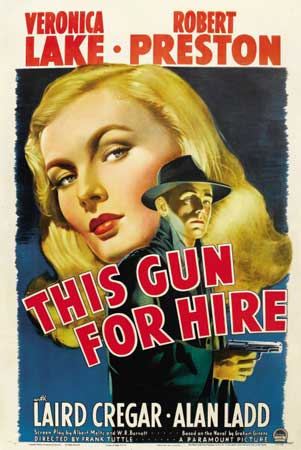
This Gun for Hire (1942)


(In the first weekend of 2009 I was kindly asked by Steve Eifert over at http://www.noiroftheweek.com/ to write a review of the film noir This Gun for Hire. This review is available to be read there. Noir of the Week is a fine website managed quite well by Mr. Eifert, featuring many detailed reviews of classic film noirs. Not to be missed.

Briefly, I would like to inform my readers that the ten-day absence of posts was a time of dealing with many other matters. I love writing for this blog and want to diligently maintain it but at the same time blogging should not be allowed to become one's life. I plan to finish February out strong with several upcoming reviews, starting with at least one or two films from 2008 to be examined as well as much more. Thank you for your patience...)

Frank Tuttle's early film noir, This Gun for Hire, made Alan Ladd a star in the role of Philip Raven, a mentally deranged and psychologically disturbed contract killer. As Raven, Ladd would employ the particular assets that he would continue to bring to his best roles: a laconic mysteriousness and nuanced, cerebral lethality of presence that distinguished him as a rara avis among the quotidian ordinary. Having soujourned for a decade in colorlessly inconsequential parts in approximately forty films, Ladd was finally given an opportunity to demonstrate his captivating talent. Ladd's commanding ubiety in This Gun for Hire is established by Tuttle in the star's first scene, which likewise begins to etch the dour artistry of lighting by Tuttle and cinematographer John Seitz. In a scene to be mimicked by Jean-Pierre Melville for his Le Samourai (1967), the insularly framed lone gunman stays in a slightly unsettlingly empty room. In This Gun For Hire, Ladd's Raven is loving toward only one kind of creature: cats, and when Tuttle's camera captures him smiling, in two of the three cases the predominantly uncharacteristic grin is aroused by the sight of a feline. In Le Samourai, Delon's killer showed love for a pet canary. (Delon would later love cats playing a ruthless spy in the Michael Winner thriller Scorpio.) Le Samourai starred Alain Delon in the role from which Ladd's Raven serves as a template, whose similar first name draws an unintended comparison as well.

Tuttle's mise-en-scene is often rather precise, and is repeatedly marked by dazzlingly expressionist chiaroscuro lighting. As Raven holds his tool of the trade, his handgun, the low-angle camera angle accentuates the man's isolation and power all at once. The shadowy lines that span the wall behind him, and framing square and triangular shapes in the wall and ceiling, connote a subtle gradation of entrapment and doom. As piano playing gently seeps into the room, the killer behaves like a man apart, and when a pushy maid attempts to shoo the kitten away from the room's windowsill, he snaps, spinning the woman around and slapping her. As the film continues, Raven's affinity for cats juxtaposed with his moderately bemused, glassy-eyed distrust of and dislike for people will serve as an important implement of narrative and character indicia. In this instance the episode serves to highlight the character's respectful admiration for the feline as solitary animal fighting for its own survival. Later, as he strokes a cat, he will remark that a cat brings luck—which is one of the only universal things he believes in as a force of aid.

When asked by the effeminate and rotund man who has last hired him to eliminate a chemist how he feels when working, he callously replies, “I feel fine.” Ladd's delivery is flawlessly deadpan, portraying Raven's coldblooded demeanor as a sort of deeply ingrained psychical state rather than mere remoteness of attitude and feeling. Ladd's physical conciseness and verbal succinctness endows the character's most consistent attributes with a naturalness that seamlessly matches the vision of screenwriters Albert Maltz and R.W. Burnett in their fascinating adaptation of Graham Greene's novel, “A Gun for Sale.” Greene's novel was set in Great Britain, but while the Los Angeles setting significantly changes some of the atmospheric qualities of the film from Greene's book, Tuttle conjures a similar percolating quality to the narrative developments. Tuttle does this by utilizing the visual language of cinema that helped to signify the oncoming flurry of aesthetically attractive and visually communicative 1940s Hollywood film noirs.

That man with whom Raven converses after rubbing out the chemist is Willard Gates, played with an effective amalgamation of smarmy unctuousness and bubbly jocoseness by Laird Cregar. Gates is a manager at the Nitro Chemical Corps. who moonlights as manager of the Neptune nightclub, where he finds himself enchanted by an auditioning gorgeous blonde magician Ellen Graham, sensuously brought to life by Veronica Lake. Graham is clandestinely working for United States Senator Burnett (Roger Imhof), who believes the Nitro Chemical Corps. is guilty of selling secrets to America's wartime enemies. Aboard a train from San Francisco to Los Angeles, Raven and Graham find themselves linked to one another when they sit next to one another. The noirish emphasis on luckless circumstance and seemingly random misfortune is palpably rendered. When, at the twenty-nine minute mark, Graham attempts to make contact with Raven, he fittingly asks her the future question of Travis Bickle's from Taxi Driver: “You talkin' to me?”

Tuttle's mise-en-scene is especially sharp in the early and late stretches of the film. A midway excursion into an estate with a thunder-and-lightning storm appears like a horror film. When Raven and Graham are on the run together, Tuttle's camera examines them as an impossible pairing—he is a stoic killer for hire, she is the girlfriend of a police detective named Michael Crane (a feckless Robert Preston) trying to solve a robbery from which Gates has paid Raven with marked bills. The compilation of multiple threads tying into one knot is one of the more satisfying, but possibly distracting aspects of This Gun for Hire's narrative. As Raven and Graham are physically adjoined to one another, with Raven on the run from the police as he attempts to exact revenge for Gates' double-crossing, This Gun for Hire slows down and the screenplay endeavors to explain the chief source of Raven's psychological trauma. Visually and thematically dark, the scene is lit with expressionistic intensity. As Raven and Graham look out through the gaps between wooden planks in a filthy warehouse window, the light skips down diagonally on the two. As Raven describes a recurring dream in which a tyrannical woman continually beat him as a child.

“I dreamed about a woman. She used to beat me—to get the bad blood out of me, she said. My old man was hanged. My mother died right after that and I went to live with that woman. My aunt. She beat me from the time I was three to when I was fourteen. One day she caught me reaching for a piece of chocolate... she was saving it for a cake... a crummy piece of chocolate. She hit me—with a red-hot flat-iron! Smashed my wrist with it. I grabbed a knife—I let her have it! In the throat! They stuck a label on me: killer. Shoved me into a reform school and they beat me there, too. But I'm glad I killed her. What's the use? [There is] nothing I can do.”

This legitimate effort to create melodrama out of the hitman's origins of spiritual, mental and physical (the permanent scarring on his left wrist is used by the police to identify him) disrepair and wounds is successful in creating an empathetic attachment to the character when he continues to run away from the police. As the police struggle to locate the elusive Raven, the film takes a pessimistic but almost lightheartedly comic shot at the cops as bungling and ineffective. Raven rather easily escapes the clutches of the cops who know he is aboard when he exits the train. Over the course of the film, policemen make tragicomic mistakes when attempting to capture Raven. In one such especially personal confrontation, a lone policeman tries to handcuff Raven late in the film, only to fatally underestimate the killer, who shoots him to death for his trouble. Quite late in the film, as Raven tries to satisfy his blood lust, he finds himself looking directly at Detective Crane, who he could have effortlessly eliminated—but he knows he is Graham's man (“You're a copper's girl,” he once dismissively sneers)—and consequently spares him. Graham's gentleness and kindness toward Raven endears her to him and when a villain suggests she ought to be killed, Raven furiously comments that she has been “nice to me,” a most sparse—and perhaps, the film seems to subtly suggest, nonexistent—way in which someone has ever treated him. With a plot that veers perilously close to making This Gun for Hire another propaganda picture—in which even the stone-hearted assassin is finally moved to defend his country from despicable traitors—the screenplay and Tuttle's interpretation of it keep the dilemmas and choices personal and almost disconnected from politics. As with other Greene novels, it is the personal that informs the politics of the story, and This Gun for Hire is finally, gratifyingly, no different.

This Gun for Hire's climax would also be borrowed by Jean-Pierre Melville for his Le Samourai as the hunted killer is chased on an ominous rail bridge. As Ladd's Raven once again outmaneuvers the police, Tuttle captures the entire chase sequence in a bravura depiction of action. The memorable long shot of Raven jumping off the rail bridge onto a moving train is exciting, and the interest and care the audience has for Raven makes it genuinely meaningful. This Gun for Hire is an early film noir and its limitations and imperfections—some of the supporting players give uninspired performances and Tuttle's direction is somewhat lax in the film's midsection, as is the screenplay—while not to be overlooked, should be considered with fairness when assessing it. As such, this is a most thoughtful, interesting and important film.

Friday, February 13, 2009

Eternal Sunshine of the Spotless Mind (2004)


Today [Valentine's Day] is a holiday created by greeting card companies to make people feel like crap.

So thinks Joel (Jim Carrey) in Eternal Sunshine of the Spotless Mind. If every holiday deserves its own film, and every generation deserves its own cinematic explication of each holiday, then surely the 2004 Charlie Kaufman-penned, Michel Gondry-helmed hip, mind-bending comedy-drama romance, Eternal Sunshine of the Spotless Mind, is this epoch's most articulate annotation on that mid-February fixture of romance, Valentine's Day. As Joel awakens on this ostensibly ordinarily dismal winter day, he laments his doleful station in life. He stands, shivering, on a train platform, and—out of nowhere—decides to run off, and ditch the dismal daily peregrination to his job. For no reason in particular he runs to another train—headed to Montauk. He is not sure why; he is not, as he assures the audience through voice-over, an impulsive person. When he finally arrives in Montauk he waltzes about the beach, glaring into the bracing wintry air. It is freezing, he notes to himself. Brilliant, Joel. Montauk in February.

Where Eternal Sunshine of the Spotless Mind goes from there is as exciting as it is touching, with an exactitude of detail that is especially rewarding of repeated viewings—though Gondry's dexterous direction makes the details appear like a baseball in the eyes of an accomplished hitter seeing his ideal pitch: enormous. Why Joel takes his little trip to Montauk will be explained, quite late, and very movingly, but the gap between action and motive, deed and desire, is where the picture most robustly asserts itself. And that is most charmingly fitting; Eternal Sunshine is fundamentally about gaps, in time, and in space, and doubtless chiefly in the mind. Memory for a character is itself is to be assaulted, as it has so many ugly ornaments of nostalgia for the sweet times, loathing and regret for the bitter episodes. Joel does not know it, but he has slipped through the gauntlet of a passionate relationship wrecked on the reef of apparently irreconcilable differences. No longer embittered, he is merely empty; like a model airplane with only some parts adjoined, he is incomplete.

Lost love, largely of the acrimoniously-severed variety, engenders a spitefulness that exceeds vindictiveness. Resigned to their fate, most men simply scorn their fallen idol; once where the woman incomparably stood on a ponderously tall pedestal, she is viewed through the prism of unyielding revision. Unforgiving, the wake of an untethered bond leaves a sourness mainly mundane in its projection, deep in its currents. Cognitively dwelling on every last irritating shortcoming, annoying habit and asymmetrical peculiarity, the person whose flaws once seemed invisible now is ensconced not in blind adoration or even respect but seething, boiling hate. Popular music consecrates the impulse to turn what was, at a different time, deliriously fawned over into the bete noire. Listening to “Time is on My Side” and “Like A Rolling Stone,” the anonymous women are given identities by the audial recipient; countenances that were so long ago angelic, seen now as warped by the ravages of time and circumstance, flash by in a melancholic mental collage of heartbreaking ids. It is perhaps the most self-deluding, and hollowest of redemptions—to envision the pitiable parallel existence the anterior loves are suffering through, all in a reveling of self-importance as figure of sustenance. Inherently egotistic and jealous, the process supplies an embarrassing counterpoise to the wounded.

Kaufman's screenplay is animated in its substance by the nectarous short cut of erasing all sensitively distressed memories. The concept is an immediate hook—and demands an accomplished level of filmic execution worthy of its incorporation into a narrative. Joel discovers that his beloved girlfriend, Clementine (a sublime Kate Winslet), has, in one of her most impulsive moments, had him completely erased from her memory. Having supplied her with this accommodation is Lacuna, Inc., which has ingeniously taken its innocuous-sounding name from the Latin term for a hollow, cavity or dip—lacunae typically referring to a body of water such as a lake or pond—the aforementioned hollow or dip would be in the lake. In the context of the science-fiction project, however, Lacuna takes on the meaning of the lacunae infarct, referring to a brain-damaging stroke that discriminatingly assaults a specific part of the skull-encased muscle, resulting in the debilitation of specific functions or expunging of particular memories. When Carrey's Joel sensibly voices concern about brain damage being a side effect of the process, Tom Wilkinson's Dr. Howard Mierzwiak replies, “Well, technically, the procedure is brain damage.” Possibly also carrying with it the papryological meaning, Lacuna, Inc. may likewise refer to the lacuna as an aberrant gap in a text (here representative of Joel's brain).

Where Kaufman and Gondry succeed most brilliantly is in the implementation of their fable. Eschewing the comfortable familiarity of species—both comic and romantic—for a skittishly-paced exhuming of a contemporary love story. With the questionable Lacuna, Inc.'s vaunted procedure consuming the great amplitude of the film's narrative, Kaufman and Gondry tell a backwards boy-meets-girl tale. If Joel is crushed by Clementine's hegira from him to unknown pastures, then Eternal Sunshine's greatest conceit is to move past the amaroidal angst of an eroding relationship, back to happier times, culminating with their very first meet-cute—over some chicken at an otherwise forgettable beach party—which plays out romantically as the fearless Clementine tests the limits of the introverted and timid Joel. As he is asked by his married friends about the “pretty girl” he was spending time with at the party, he can only reply that she was “just a girl.”

At a time when most cinematic American love stories are prepackaged, preheated and pedestrian in their creeping confluence of cynicism and naivete—made into suppositiously mass-appealing pats on the back from filmmakers who confuse wholly legitimate sentiment with simplistic gratification—Eternal Sunshine of the Spotless Mind stands out all the more. Joel and Clementine are as a couple, beyond convincing; in Kaufmanesque shorthand, Joel is another approximation of Kaufman's ineffectualness as a lover, and here the seemingly always weary Joel tirelessly scribbles down notes to himself but is withdrawn and unable to openly communicate, even with his lover. Clementine's recklessness of being could not be more antithetical to Joel's laconic shyness; as he ineptly struggles to say much of anything, she is brash and lacking in self-censorship. Suffering from an alcoholism that is only partly funny because it is so unfortunately true (authentic and believable), Clementine is Joel's counter and it is this apparent attitudinal and psychological gulf that both disturbs each member of the partnership and, bizarrely, makes their relationship work. The very problem is in its least troublesome vein a complementary personable dichotomy; where Clementine lacks introspection—which she chooses to stave off with alcohol—Joel is acutely self-aware to the point of self-destructively tethering himself to all of his idiosyncratic ways of questioning himself. In a plausible contemporary reversal of the action-minded man and the fence-straddling woman, Clementine's impulsive passion finds in Joel a stability that is both warm and in its quotidian application, smothering.

It is in the self-effacing, whirling pool of details, that Gondry and Kaufman wrap the seriocomic sentiment that leaves bruises of its own. In most romantic-comedies or variations of the template, the filmmakers are inclined to have their cake and eat it, too. Flaws of the characters are presented to make them nebulously human, all the while being played strictly for braying laughter. Eternal Sunshine does not expurgate the moments and traits that are all too familiar, yet usually skimmed over or entirely absent in most vaguely like-minded relationship films. Joel and Clementine's personal flaws are made humorous in the way that the flaws of a friend slowly become a source of amusement. Yet there is a deflating sadness to this pair that is uncommon; Joel is such an emotional weakling that sensitive men will find in him shared pangs—of regret, frequently stemming from absurd cowardice, of over-analysis of the self. Clementine is, to an indefinite degree, the young woman Joel at his angriest declares her to be—tempting in her penumbra of multi-colored-hair mysteriousness and affected, flirtatious unattainability, but stunted in her own development. Though the film, respectively written and directed by two men, makes Joel the hero, whose past is the film's focal point, Clementine's childhood and personal history would make for a potentially remarkable film. The fleeting visibility of a long-ago, nearly mortal wound is carried with her throughout, and is occasionally only held down from complete eruption by her dipsomania.

As if the Joel-Clementine heartache and humorously adorned pathos were not enough, Gondry and Kaufman pack in an entire subplot of hopes and hurts. With such an ostensible godsend as memory erasure, abuse is to follow like night after day. Lacuna, Inc. is itself a warped, closed-off tragicomic melodrama with a clandestine love triangle—two of whose members remain blithely unaware of its existence, though there is a knowingness to each beneath their rock 'n' roll, pot-induced haze of underwear bed dancing and sex. Elsewhere, an unethical young man has fallen for Clementine during her memory-pruning procedure and has stolen an unmentionable from her. Not stopping there he has taken all of Joel's items that he has given over to Lacuna, Inc.—items that would remind him of Clementine—for himself, with which he hopes to seduce the unsuspecting Clementine. When an indescribable sense of déjà vu intervenes for Clementine, she runs away from the cynical manipulator—who may serve as a potential stand-in for Hollywood persons who churn out the strikingly overly-familiar pills like briefly soothing narcotics working from prosaically similar frameworks.

One of the attributes of Eternal Sunshine of the Spotless Mind that cannot go unexamined is its pulsating, prevailing romanticism. Beneath all of the foreknowledge and soothsaying an obviously intelligent man like Kaufman brings with him, he allows himself, and Gondry allows the film, to be an avatar for unmitigated optimism. Despite having had their minds erased, Kirsten Dunst's Mary, Joel and Clementine all stumble, through an indefatigable sense of ceaseless yearning, for their (emotionally and cerebrally) lost loves. At a time when it is nauseatingly trendy to peer into complex matters that affect humans and their symbiotic relationships to one another in variegated contexts, Eternal Sunshine—not entirely unlike Being John Malkovich and Adaptation before it, and Synecdoche, New York after it—is serenely self-confident, enabling it to securely land on a jubilant restoration. It is in that reclamation, of memory, of love, of life—what would people be, by which means would they be informed without all of their memories?—that Eternal Sunshine terrifically realizes itself, all the while plaintively recognizing the inevitable potholes in the road along the way.

For the trajectory of hate and abyssal disappointment to be reached, love must have been an occupant for an extended period of time. It is through literally viewing Joel's own memories that he comes to terms with the exorbitant riches Clementine gifted him. It is not mere cliché to achieve, through storytelling, a character “becoming a better person”; comedy, as the flip side of the Grecian coin of tragedy, historically requires characters to learn—it is one of the most unquestioned features of tragedy that characters are doomed to not learn—and Eternal Sunshine allows Joel to learn an invaluable lesson. Alexander Pope's poem referenced is itself a contradictory extolling of the more modernist embrace of ignorance as bliss. In Eternal Sunshine, it is Clementine who, like Eve, first eats from the tree (this tree literally of ignorance), but Joel and Clementine each find themselves by the end and literally say, “Okay,” to their destiny, each other and themselves. If relationships are fundamentally mirrors into which one member sees the best—including the nonexistent best—of themselves in the other, Joel and Clementine at last allow the mirror reflection to not hurt them, and to be resigned to the imperfections they each possess. As his own mental collage of Clementine unspools backwards, Joel is left, like a beggar, pleading to “...keep just this one [memory]...” Down the rabbit hole it goes, and Joel is abandoned in his own mind until Clementine rescues him, and leads him, as she had before, to better times.

A Woman Is a Woman (1961)

Jean-Luc Godard today conjures inaccessible difficulty, Marxian didactics and Nouevelle Vague enshrinement. Yet he was, at his most playful, a reverential mimic of his favorite Hollywood pictures, a cinematic romantic, a lover of the movies he had absorbed, cherished and in which he had seen greater, more philosophically rich textures than they had perhaps even intended. A Woman Is a Woman, or Une femme est une femme, is as sweet as Godard could become. Before relating the poisoned marriage of Contempt, Godard told a more glisteningly romantic story. His first color picture, A Woman Is a Woman is remarkably airy and ostensibly liberated; gone are the jump-cuts of Breathless as well as that picture's seeping sense of inevitable tragedy, which would resurface in Contempt and the riveting Le Petit Soldat but A Woman Is a Woman is an aching film on its own terms.

Starring Godard's muse, the irrepressible Anna Karina as Angela, a charming, lovely striptease artist who wants to have a baby and settle down. Captured in an ebullient light show that is in its mise-en-scene and construction a piece of commentary on the various emotional states of Karina's Angela, she is as teasing and tempting as she will be for her disagreeable boyfriend Émile Récamier (Jean-Claude Brialy), who does not wish to settle down and have a child with her. The striptease act is made into a comment on cinema itself, with the artist wooing the viewer with a promise. Godard delivers that promise by making his ode to Hollywood musicals succeed, wildly, not in spite of but almost rather because of its unconventional use of music. Viewing cinema as an ideally musical art form, through simple alterations in mise-en-scene Godard makes the arguments between Angela and Émile blossom into vociferous duets.

Godard's conception of the Zodiac club at which Angela works is hilariously tame and refined. The winking awareness of Hollywood distillation of the uncomfortable into more endearing contexts enlivens A Woman Is a Woman in its presentation. As Angela speaks directly into the camera, with an impossibly sweet, smartly sly demeanor, and an intoxicating smile, Godard's camera takes the viewpoint of the men in the audience, doubtless enamored with the young lady. Accentuating the effervescent mise-en-scene of Godard's is the stopping-and-starting scoring of music by Michel Legrand, which functions quite brilliantly as a uniform treatise on the place of music in cinema.

The third acting component is Jean-Paul Belmondo, curiously and humorously named Alfred Lubitsch. Belmondo represents a possible way out for Angela, but when they converse, and listen to a sad song about an unforgiving man surveying the ignominy of a woman, in a particularly long scene, she must confront that she still has deep feelings for Émile. This love triangle is mounted not as a contest, particularly as Émile incredulously subtracts himself from the proceedings, flustered as he is by Angela's uncontrollable willfulness and determination. Godard makes the pair of suitors pleasingly pathetic, but only in that the woman is so remarkably at ease manipulating them... even when she is doing so with such nonchalance that her desires seem shrouded.

As fine as the two men are, the acting star is Karina, while Godard is the star of the picture's ingenuity, vitality and commitment. Rarely has such an intentionally inconsequential souffle been so aesthetically wondrous and overflowing in its cinematic charity. Godard makes hallways and foyers into arenas of romantic battle, not unlike Douglas Sirk wringing melodramatic quintessence from everyday settings. Godard's assured dynamism makes each scene smoke and sizzle, layering a sumptuous patina of light by cinematographer Raoul Coutard, whose work here is awesomely, divinely inspired.

With a narrative functioning as mere coat hanger for the precocious playfulness on display, Godard makes his filmic excavation of Hollywood cinema densely configurated as a meta contextualization of romantic musicals. Echoing Vincente Minnelli in New Wave trappings, Godard whittles the process down, so that, as in his best work, the proper story is truly Godard's incisive critical (as he had been a critic with fellow New Wave founder Francois Truffaut) commentary on cinema itself. When Karina finally addresses the audience at the film's very end, Godard shoots her in such a way as to emphasize the spotlight-like, key-light-like artificiality of movie love filmmaking. Like the funny breaching of the fourth wall in Breathless, A Woman Is a Woman's nimble reworking of standard conventions is lubricated with flourishes that amazingly enhance the entire virginal color palette, visually complementing the illumination Godard lends to the characters' relationships with one another.

Endowed with a delightfully sardonic wit, Godard comments on the titular flirtation with sexism (a woman is a woman, after all, and Angela believes the only thing that can salvage her relationship with her boyfriend is a baby). Angela's glittery ambivalence, however fetching, also speaks to the picture's upending of stereotypes and tropes, all the while essaying them through involved observation. Deciding that her current relationship is hampered by the lack of a child, her approaching of Alfred to accommodate her wish is an effort to ignite jealousy in Émile. Émile is a difficult nut to crack, however, and her test of him eventually becomes his test of her. The gender dynamics and halfhearted suggestion of a triad-structured symbiosis are an avenue on which Godard travels, making comments that would turn more mythical and realistically embittered all at once in Contempt, again playful in his most deliriously fun film, again starring Karina, Bande à part, and the more aggressively sociopolitical cine essay, Masculin féminin.

A Woman Is a Woman, however, still stands out as a harmoniously derived pastiche that is as loving a film as Godard could create. Processing Hollywood's genius for finding the physical and numinous pulchritude in the implausible, Godard's picture is a work of sincere gratitude to a way of making movies that may sadly be extinct. Lars von Trier's more recent attempt with Dancer in the Dark, while intriguing, was never as successful in its complicated melange as Godard's more gracefully crafted 1961 concoction. Godard would turn to more, superficially or not, important subject matter, complete with humorless characters and controversial, politically charged narratives, and as he remained vibrant, so did they, too. Sometimes, however, the irresistably frothy mixtures are more satisfying than the larger, more laborious meals. There is nothing inherently wrong with exploring the insuperable dilemmas of life, but as A Woman Is a Woman demonstrates, sometimes those insuperable dilemmas are everyday matters, challenging artists to make them appetizing.

Wednesday, February 11, 2009

Ali: Fear Eats the Soul (1974)

Rainer Werner Fassbinder's cinema is uncommonly sensitive and sumptuous. Nuanced and thoughtful, it is also earnestly emotional and compassionate. Normally Fassbinder's work is concerned with those who fall outside the “norms” of society, and in his case, this society is the West Germany of the very late 1960s to the very early 1980s. As a bisexual, Fassbinder saw himself as existing just outside the framing typicality of his own society. Viewed through this sociologically bountiful prism, Ali: Fear Eats the Soul is possibly his most purely beautiful work, concerned as it is with the relationship between a strongly virile foreign Arab worker named Ali (El Hedi ben Salem, who was Fassbinder's partner at the time of the film's production) and an older German cleaning lady named Emmi Kurowski (Brigitte Mira).

The quite loosely-followed basis for Ali: Fear Eats the Soul is the Douglas Sirk melodrama All That Heaven Allows, and it is worth noting how much Sirk's cinema influenced Fassbinder. While Sirkian aesthetics were not the most crucial component for Fassbinder, theoretical command of mise-en-scene and the adroitness with which Sirk weaved powerful social commentary through his exquisite precision. Fassbinder wanted to emulate the ocular symmetry of Sirk's films, and was especially moved by the intelligence that buttressed Sirk's stingingly palpable love stories. Fassbinder's filmic treatises on social ostracism and rejection were often searingly muscular, but with The Merchant of Four Seasons, made in 1971, Fassbinder's admiration of Sirk became visible. The Merchant of Four Seasons was the first film Fassbinder made after meeting Sirk at the Munich Film Museum, and he would continue to extrapolate Sirkian touches in his work. Ali: Fear Eats the Soul was the culmination of this strain when it was made.

Decades before Fatih Akin would make films examining German-Arab and German-Turkish relations through narrative, Fassbinder crafted a plausible romance between Emmi and Ali. The film begins with Emmi, as played by the amazing Mira, a slightly stereotypically stout German woman, walking into a bar to escape the rain. Emmi wears clothes with loud colors, and the clothing makes her, as a physical figure, more arresting and interesting, as well as remarking on the unconventional and unorthodox openness of the character that most meticulously comes forth through the narrative. When Emmi walks in, the bar seems strangely motionless; when the plain older lady tells the blonde barmaid that she will have a Coke, a group of customers turn and glare at her. Remarkably, it is Emmi who is perceived as the outsider, and justly so, as her actions create the seemingly irreconcilable firth that becomes a gulf between the central characters and the people who exist in their orbit. As the blonde returns to the bar, she taunts Ali into dancing with the older woman. “Ali dance with old woman?” Ali asks. Yet he decides to move to her table and ask her to dance. As the two dance, the camera focuses with the two in the foreground and the other characters in the background; as Ali and Emmi dance, the rest of the people inhabiting the bar are staring at them.

Ali accompanies Emmi home. As they converse, the dialogue renders the relationship in rigorous terms, while expanding on the characters themselves. Emmi talks about her first husband, who was Polish, as her name suggests. Emmi talks about the importance of wearing colors that make one feel happy. She kindly admonishes Ali about his dark-colored clothes. She says that he should wear bright, colorful clothes. Later he will. The scene is heartwarming, and is mostly shot in a drab apartment complex hallway. The isolation and absence of other characters enhances the separation from all others that most who fall in love experience—while on another plane elucidating the harsher reality of Ali and Emmi's marriage, which carries with it the caveat of (in an expressionistic manner) divorcing the rest of the world.

Ali is limited in his German, and the statements he makes—which always sound and read like maxims—such as “Always work, always drunk,” when describing his days and nights or “German master, Arab dog,” when conveying just how alike he and Emmi are in their social stations (she tells him that many people look down on her when they find out she is a cleaning lady), inform the title itself. The original German title, Angst essen Seele auf, translates as Fear Eat Soul. And Ali indeed tells Emmi that “fear eat soul”; it is, Fassbinder instructs, fear that has pushed Ali and Emmi outside the comfortable ordinariness. Separated by race and age, Ali and Emmi are viewed with contempt; a group of women who live in Emmi's apartment building become incensed that she is living with an Arab. These women are primarily linked together by their shared occupation as cleaning ladies, and so Fassbinder comments on the socio-economic experience that creates bitterness out of despair. One woman says she would rather die than live with a “dog.” Another remarks that “they... only want women” for “one thing.” Most damaging is the fear and loathing Emmi is confronted with from her own immediate family. One son violently kicks in a television set (echoing All That Heaven Allows) upon learning of his mother's lover's identity.

Fassbinder sagaciously utilizes simple devices and creations such as those hallways, windows and doorways, the spaces around tables, and other objects with which to frame Emmi and Ali—and their attendant romantic desperation—which transmit the characters' valiantly heedless acceptance of one another, finally as man and wife, pitted against a large, imposing group of ethnocentric societal guardians of “purity,” a veritable haut monde for the purposes of Fassbinder. In one humorous scene, Emmi is confused by a man to choose between a “rare” and a “medium-rare” dish; she believes rare to mean unusually excellent. In a scene far more disconsolate and tragic scene, Emmi and Ali, sitting at an outdoor table at which they hope to dine, are placed apart from nothing less than all of humanity by a metaphorical forest of empty yellow chairs. As the German and Moroccan quietly converse, she finally succumbing to the shattering realization that she and he are apparently doomed to stand out as the others through their marital bond, director of photography Jurgen Jurges aids Fassbinder in creating a bravura sequence of sight, color and sound in suspended animation.

For Fassbinder, the development of his characters takes on an unrestricted intimacy that is bracing. The act of ablution is made into an experience of cleansing that transcends bodily limitations. Ali is framed, naked, washing himself, and Fassbinder, capturing his naked lover, lends the character and actor portraying him a nearly embarrassing genuine love that surpasses the utilitarian concepts of filmmaking that are as surely used as a man's legs in a brusque gait. Shot in fifteen days on a small budget, between two much larger productions, Ali: Fear Eats the Soul is a redoubtable case of a writer-director squeezing more distilled pathos and integrity out of a “small” film than many “big” ones. The long, almost intermittent stretches of silence, in which life itself seems paused for Ali Emmi, makes the racial tensions both more invisible and present all at once. Defined by his appearance, Ali is gradually accepted by the very women who had earlier feigned repulsion at the mere thought of him. In an extension of the showering scenes, Fassbinder comments on the fetishism of the exotic, as a small circle of German women beam, each happily caressing and gripping the muscular biceps and triceps he possesses. This fetishism of the other is made purposefully whole, as Emmi herself routinely describes her husband as featuring a “foreign mentality”—which is certainly not untrue.

From approximately 1955 to 1973, Arab workers were immigrating to Germany to fill the vacuum of manual labor in the great postwar German economic recovery and boom. Invited in to work, these foreigners often found themselves marginalized by a society whose leadership had requested their presence. Creating social commentary out of the already ripe tale of volition and romance Sirk had etched less than twenty years earlier, Fassbinder's film remains abundantly relevant. Yet in some ways more importantly, this motion picture remains most incendiary in its discomfited self-contained vicinity—its wonderful insistence to tell a complete, human story about two people with all of their unsentimental flaws. Ali strays from Emmi and resorts to rendezvous with the blonde barmaid who dared him to connect with the older woman. The blonde provides Ali with two things his wife cannot, his favorite dish couscous and sex. Coworkers of Ali's are cruel toward Emmi when she visits him at work, asking Ali, “Is that your grandmother?” Nevertheless, through everything Ali and Emmi sustain their great love. Fassbinder's patient, watchful camera captures every last delicate moment, and takes the frighteningly personal viewpoint, which is always more perilous. It is from here he paints with the colors of those framing objects that create gorgeous portals through which to view Ali and Emmi through their many experiences with one another. Again and again, primary colors are utilized, always, it would seem, to italicize the primary urges, desires and needs these two characters so trenchantly carry with them.

Tuesday, February 10, 2009

Scandal Sheet (1952)


(Scandal Sheet was screened at the San Francisco Castro Theatre on Friday, January 23 along with Deadline USA as part of Noir City 7.)

Scandal Sheet is directed with a particularly pungent, uncensored acumen by Phil Karlson, whose fidelity to the screenplay by Ted Sherdeman, Eugene Ling and James Poe, based on the novel “The Dark Page” by Samuel Fuller, enriches the film for its entire eighty-two minute runtime. (The film's title in the United Kingdom was The Dark Page.) Karlson, aided by cinematographer Burnett Guffey—whose lens seems to inescapably capture every last sealed crevice on the gritty sidewalks or clammy characters' faces—creates a verisimilitude out of mise-en-scene that perfectly imparts the scabrousness of the picture's very story. Surveying the relationships in a scandal rag “newsroom” controlled by a bulldog of a man who behaves almost like a centurion guard, managing editor Mark Chapman (a relentless Broderick Crawford), Karlson makes the camera an impartial observer, making casual note of the rampant, anfractuous headline-grabbing (and -making) that is made into a virtue by the avaricious Chapman. Chapman's running of the newspaper, once a respectable publication, The Comet, creating a “scandal rag,” has dramatically increased the circulation of the paper, and he reminds the partnered owners of the institution of that unalterable fact.

Fuller's novel, “The Dark Page,” came about when he decided to write a book about some of the more outstanding experiences of his career as a newspaperman. Fuller had to serve in World War II (with the “Big Red One”) and was notified by his mother while he was away that a publisher was quite interested in purchasing the rights to his first draft. Only a couple of years later, Fuller learned that none other than Howard Hawks was quite interested in adapting the book into a film, and bought the rights for $15,000. Fuller's mother was ecstatic and sent her son $1,000 while he and his unit were fighting in Europe. Sadly, Hawks never made the film, and sold the rights for several times what he paid for them. The buyer was Columbia Pictures, and Karlson would direct it.

The atmospheric component Karlson brings to the picture makes it somehow more compulsively watchable than most films with similar “set-ups.” Crawford's Chapman, like almost all of the best noir protagonists, is a man who has skillfully managed to escape his past, but, as in so much of noir, it is the past that he cannot truly evade. And, as in most noir, the chilling hand of irony finds itself practically slapping Chapman's face—it is through a very idea originated from his greedy mind that his past catches up with him. The newspaper actually hosts a “lonely-hearts ball,” where many companionless people are brought to one venue. Chapman's cynicism is unrestricted, and he guarantees a prize to a couple who marry on the very evening they meet one another: a bed, with a built-in television set.

It is at this “lonely-hearts club” event that Chapman's past runs into him and he is eventually placed in an unenviable position. Suffice it to say he makes a mess out of an already unfortunate situation, and is compelled to cover up a crime he has committed. In pursuing that crime, however, his ace reporter, the young, handsome Steve McCleary (an exceedingly effective motor-mouthing John Derek), digs up just enough dirt to make it into a story—and one so sensationalistic that Chapman is practically forced to run his reporter's story in the newspaper, despite it being highly dangerous to himself. The delicious paradoxical scenario—the potential undoing of Chapman's person due to his own recalcitrant desire to see the most controversial subject matter splash across his front page to ensure wider and wider circulation—is quite the cinematic meal to be engorged.

Fuller is widely attributed the line that the very beginning of a film should give the viewer a “hard-on,” which crudely approximates what his directorial outings would later achieve. (Including the fine newspaper noirish melodrama Park Row from the very same year.) Scandal Sheet almost achieves that standard of criteria—Derek's McCleary behaves like a policeman gleaning gruesome details of a murder, only to be thrown out of the crime scene by a disgusted cop—but unlike Fuller's dyspeptically fast-paced book, it is has less alacrity to its rhythm. Whereas Chapman's irredeemable act occurs right at the beginning of Fuller's novel, Karlson's film is slower to uncover it. Fortunately, Scandal Sheet gains momentum in its aftermath. One highly memorable scene involves a group of woebegone drunkards being questioned by McCleary and his partner Biddle (a well-realized and queasily comical Harry Morgan), as the newspapermen attempt to get to the bottom of the crime at the film's center. Donna Reed as morally upright Julie Allison sometimes veers into didactic, lifeless platitudes, but her relationship with the borderline courting McCleary is well-rendered and believable.

In many ways, however, Scandal Sheet is a film that would not be nearly so sibilating without Crawford's ardent performance. Known for barking like a bulldog, Crawford utilizes his (at this point in his career, especially after winning the Oscar for All the King's Men) on-screen identity, and creates an indelible noir protagonist driven to sheer desperation. As he finds himself committing yet another unspeakable crime against a sympathetic character simply to hide his earlier ones, the audience may find in him, not quite empathy, but responsive connection. It may help that Crawford's Chapman is softened and curiously mollified; in Fuller's novel he is far more incorrigibly awful a person. In Karlson's film noir, however, that aforementioned callous hand of fate entraps Chapman, and makes an already ugly person only far uglier. The very ending of Scandal Sheet may be interpreted as a sight gag of sorts, but it reinforces the smoke-filled verbal lacerations that have come before. (For an example of only one brutal comment to be found throughout the film, McCleary once refers to a dead woman as a wonderment to Reed's Allison—a dame “with her mouth shut.”) The last shot of Scandal Sheet in actuality surpasses its apparent comicality, and comments on the paradoxes that haunt Chapman, driving a man to destroy himself through his own megalomania.