Rainer Werner Fassbinder's cinema is uncommonly sensitive and sumptuous. Nuanced and thoughtful, it is also earnestly emotional and compassionate. Normally Fassbinder's work is concerned with those who fall outside the “norms” of society, and in his case, this society is the West Germany of the very late 1960s to the very early 1980s. As a bisexual, Fassbinder saw himself as existing just outside the framing typicality of his own society. Viewed through this sociologically bountiful prism, Ali: Fear Eats the Soul is possibly his most purely beautiful work, concerned as it is with the relationship between a strongly virile foreign Arab worker named Ali (El Hedi ben Salem, who was Fassbinder's partner at the time of the film's production) and an older German cleaning lady named Emmi Kurowski (Brigitte Mira).
The quite loosely-followed basis for Ali: Fear Eats the Soul is the Douglas Sirk melodrama All That Heaven Allows, and it is worth noting how much Sirk's cinema influenced Fassbinder. While Sirkian aesthetics were not the most crucial component for Fassbinder, theoretical command of mise-en-scene and the adroitness with which Sirk weaved powerful social commentary through his exquisite precision. Fassbinder wanted to emulate the ocular symmetry of Sirk's films, and was especially moved by the intelligence that buttressed Sirk's stingingly palpable love stories. Fassbinder's filmic treatises on social ostracism and rejection were often searingly muscular, but with The Merchant of Four Seasons, made in 1971, Fassbinder's admiration of Sirk became visible. The Merchant of Four Seasons was the first film Fassbinder made after meeting Sirk at the Munich Film Museum, and he would continue to extrapolate Sirkian touches in his work. Ali: Fear Eats the Soul was the culmination of this strain when it was made.
Decades before Fatih Akin would make films examining German-Arab and German-Turkish relations through narrative, Fassbinder crafted a plausible romance between Emmi and Ali. The film begins with Emmi, as played by the amazing Mira, a slightly stereotypically stout German woman, walking into a bar to escape the rain. Emmi wears clothes with loud colors, and the clothing makes her, as a physical figure, more arresting and interesting, as well as remarking on the unconventional and unorthodox openness of the character that most meticulously comes forth through the narrative. When Emmi walks in, the bar seems strangely motionless; when the plain older lady tells the blonde barmaid that she will have a Coke, a group of customers turn and glare at her. Remarkably, it is Emmi who is perceived as the outsider, and justly so, as her actions create the seemingly irreconcilable firth that becomes a gulf between the central characters and the people who exist in their orbit. As the blonde returns to the bar, she taunts Ali into dancing with the older woman. “Ali dance with old woman?” Ali asks. Yet he decides to move to her table and ask her to dance. As the two dance, the camera focuses with the two in the foreground and the other characters in the background; as Ali and Emmi dance, the rest of the people inhabiting the bar are staring at them.
Ali accompanies Emmi home. As they converse, the dialogue renders the relationship in rigorous terms, while expanding on the characters themselves. Emmi talks about her first husband, who was Polish, as her name suggests. Emmi talks about the importance of wearing colors that make one feel happy. She kindly admonishes Ali about his dark-colored clothes. She says that he should wear bright, colorful clothes. Later he will. The scene is heartwarming, and is mostly shot in a drab apartment complex hallway. The isolation and absence of other characters enhances the separation from all others that most who fall in love experience—while on another plane elucidating the harsher reality of Ali and Emmi's marriage, which carries with it the caveat of (in an expressionistic manner) divorcing the rest of the world.
Ali is limited in his German, and the statements he makes—which always sound and read like maxims—such as “Always work, always drunk,” when describing his days and nights or “German master, Arab dog,” when conveying just how alike he and Emmi are in their social stations (she tells him that many people look down on her when they find out she is a cleaning lady), inform the title itself. The original German title, Angst essen Seele auf, translates as Fear Eat Soul. And Ali indeed tells Emmi that “fear eat soul”; it is, Fassbinder instructs, fear that has pushed Ali and Emmi outside the comfortable ordinariness. Separated by race and age, Ali and Emmi are viewed with contempt; a group of women who live in Emmi's apartment building become incensed that she is living with an Arab. These women are primarily linked together by their shared occupation as cleaning ladies, and so Fassbinder comments on the socio-economic experience that creates bitterness out of despair. One woman says she would rather die than live with a “dog.” Another remarks that “they... only want women” for “one thing.” Most damaging is the fear and loathing Emmi is confronted with from her own immediate family. One son violently kicks in a television set (echoing All That Heaven Allows) upon learning of his mother's lover's identity.
Fassbinder sagaciously utilizes simple devices and creations such as those hallways, windows and doorways, the spaces around tables, and other objects with which to frame Emmi and Ali—and their attendant romantic desperation—which transmit the characters' valiantly heedless acceptance of one another, finally as man and wife, pitted against a large, imposing group of ethnocentric societal guardians of “purity,” a veritable haut monde for the purposes of Fassbinder. In one humorous scene, Emmi is confused by a man to choose between a “rare” and a “medium-rare” dish; she believes rare to mean unusually excellent. In a scene far more disconsolate and tragic scene, Emmi and Ali, sitting at an outdoor table at which they hope to dine, are placed apart from nothing less than all of humanity by a metaphorical forest of empty yellow chairs. As the German and Moroccan quietly converse, she finally succumbing to the shattering realization that she and he are apparently doomed to stand out as the others through their marital bond, director of photography Jurgen Jurges aids Fassbinder in creating a bravura sequence of sight, color and sound in suspended animation.
For Fassbinder, the development of his characters takes on an unrestricted intimacy that is bracing. The act of ablution is made into an experience of cleansing that transcends bodily limitations. Ali is framed, naked, washing himself, and Fassbinder, capturing his naked lover, lends the character and actor portraying him a nearly embarrassing genuine love that surpasses the utilitarian concepts of filmmaking that are as surely used as a man's legs in a brusque gait. Shot in fifteen days on a small budget, between two much larger productions, Ali: Fear Eats the Soul is a redoubtable case of a writer-director squeezing more distilled pathos and integrity out of a “small” film than many “big” ones. The long, almost intermittent stretches of silence, in which life itself seems paused for Ali Emmi, makes the racial tensions both more invisible and present all at once. Defined by his appearance, Ali is gradually accepted by the very women who had earlier feigned repulsion at the mere thought of him. In an extension of the showering scenes, Fassbinder comments on the fetishism of the exotic, as a small circle of German women beam, each happily caressing and gripping the muscular biceps and triceps he possesses. This fetishism of the other is made purposefully whole, as Emmi herself routinely describes her husband as featuring a “foreign mentality”—which is certainly not untrue.
From approximately 1955 to 1973, Arab workers were immigrating to Germany to fill the vacuum of manual labor in the great postwar German economic recovery and boom. Invited in to work, these foreigners often found themselves marginalized by a society whose leadership had requested their presence. Creating social commentary out of the already ripe tale of volition and romance Sirk had etched less than twenty years earlier, Fassbinder's film remains abundantly relevant. Yet in some ways more importantly, this motion picture remains most incendiary in its discomfited self-contained vicinity—its wonderful insistence to tell a complete, human story about two people with all of their unsentimental flaws. Ali strays from Emmi and resorts to rendezvous with the blonde barmaid who dared him to connect with the older woman. The blonde provides Ali with two things his wife cannot, his favorite dish couscous and sex. Coworkers of Ali's are cruel toward Emmi when she visits him at work, asking Ali, “Is that your grandmother?” Nevertheless, through everything Ali and Emmi sustain their great love. Fassbinder's patient, watchful camera captures every last delicate moment, and takes the frighteningly personal viewpoint, which is always more perilous. It is from here he paints with the colors of those framing objects that create gorgeous portals through which to view Ali and Emmi through their many experiences with one another. Again and again, primary colors are utilized, always, it would seem, to italicize the primary urges, desires and needs these two characters so trenchantly carry with them.
Wednesday, February 11, 2009

Tuesday, February 10, 2009
Scandal Sheet (1952)

(Scandal Sheet was screened at the San Francisco Castro Theatre on Friday, January 23 along with Deadline USA as part of Noir City 7.)
Scandal Sheet is directed with a particularly pungent, uncensored acumen by Phil Karlson, whose fidelity to the screenplay by Ted Sherdeman, Eugene Ling and James Poe, based on the novel “The Dark Page” by Samuel Fuller, enriches the film for its entire eighty-two minute runtime. (The film's title in the United Kingdom was The Dark Page.) Karlson, aided by cinematographer Burnett Guffey—whose lens seems to inescapably capture every last sealed crevice on the gritty sidewalks or clammy characters' faces—creates a verisimilitude out of mise-en-scene that perfectly imparts the scabrousness of the picture's very story. Surveying the relationships in a scandal rag “newsroom” controlled by a bulldog of a man who behaves almost like a centurion guard, managing editor Mark Chapman (a relentless Broderick Crawford), Karlson makes the camera an impartial observer, making casual note of the rampant, anfractuous headline-grabbing (and -making) that is made into a virtue by the avaricious Chapman. Chapman's running of the newspaper, once a respectable publication, The Comet, creating a “scandal rag,” has dramatically increased the circulation of the paper, and he reminds the partnered owners of the institution of that unalterable fact.
Fuller's novel, “The Dark Page,” came about when he decided to write a book about some of the more outstanding experiences of his career as a newspaperman. Fuller had to serve in World War II (with the “Big Red One”) and was notified by his mother while he was away that a publisher was quite interested in purchasing the rights to his first draft. Only a couple of years later, Fuller learned that none other than Howard Hawks was quite interested in adapting the book into a film, and bought the rights for $15,000. Fuller's mother was ecstatic and sent her son $1,000 while he and his unit were fighting in Europe. Sadly, Hawks never made the film, and sold the rights for several times what he paid for them. The buyer was Columbia Pictures, and Karlson would direct it.
The atmospheric component Karlson brings to the picture makes it somehow more compulsively watchable than most films with similar “set-ups.” Crawford's Chapman, like almost all of the best noir protagonists, is a man who has skillfully managed to escape his past, but, as in so much of noir, it is the past that he cannot truly evade. And, as in most noir, the chilling hand of irony finds itself practically slapping Chapman's face—it is through a very idea originated from his greedy mind that his past catches up with him. The newspaper actually hosts a “lonely-hearts ball,” where many companionless people are brought to one venue. Chapman's cynicism is unrestricted, and he guarantees a prize to a couple who marry on the very evening they meet one another: a bed, with a built-in television set.
It is at this “lonely-hearts club” event that Chapman's past runs into him and he is eventually placed in an unenviable position. Suffice it to say he makes a mess out of an already unfortunate situation, and is compelled to cover up a crime he has committed. In pursuing that crime, however, his ace reporter, the young, handsome Steve McCleary (an exceedingly effective motor-mouthing John Derek), digs up just enough dirt to make it into a story—and one so sensationalistic that Chapman is practically forced to run his reporter's story in the newspaper, despite it being highly dangerous to himself. The delicious paradoxical scenario—the potential undoing of Chapman's person due to his own recalcitrant desire to see the most controversial subject matter splash across his front page to ensure wider and wider circulation—is quite the cinematic meal to be engorged.
Fuller is widely attributed the line that the very beginning of a film should give the viewer a “hard-on,” which crudely approximates what his directorial outings would later achieve. (Including the fine newspaper noirish melodrama Park Row from the very same year.) Scandal Sheet almost achieves that standard of criteria—Derek's McCleary behaves like a policeman gleaning gruesome details of a murder, only to be thrown out of the crime scene by a disgusted cop—but unlike Fuller's dyspeptically fast-paced book, it is has less alacrity to its rhythm. Whereas Chapman's irredeemable act occurs right at the beginning of Fuller's novel, Karlson's film is slower to uncover it. Fortunately, Scandal Sheet gains momentum in its aftermath. One highly memorable scene involves a group of woebegone drunkards being questioned by McCleary and his partner Biddle (a well-realized and queasily comical Harry Morgan), as the newspapermen attempt to get to the bottom of the crime at the film's center. Donna Reed as morally upright Julie Allison sometimes veers into didactic, lifeless platitudes, but her relationship with the borderline courting McCleary is well-rendered and believable.
In many ways, however, Scandal Sheet is a film that would not be nearly so sibilating without Crawford's ardent performance. Known for barking like a bulldog, Crawford utilizes his (at this point in his career, especially after winning the Oscar for All the King's Men) on-screen identity, and creates an indelible noir protagonist driven to sheer desperation. As he finds himself committing yet another unspeakable crime against a sympathetic character simply to hide his earlier ones, the audience may find in him, not quite empathy, but responsive connection. It may help that Crawford's Chapman is softened and curiously mollified; in Fuller's novel he is far more incorrigibly awful a person. In Karlson's film noir, however, that aforementioned callous hand of fate entraps Chapman, and makes an already ugly person only far uglier. The very ending of Scandal Sheet may be interpreted as a sight gag of sorts, but it reinforces the smoke-filled verbal lacerations that have come before. (For an example of only one brutal comment to be found throughout the film, McCleary once refers to a dead woman as a wonderment to Reed's Allison—a dame “with her mouth shut.”) The last shot of Scandal Sheet in actuality surpasses its apparent comicality, and comments on the paradoxes that haunt Chapman, driving a man to destroy himself through his own megalomania.
Frost/Nixon (2008)
Richard Nixon was perhaps the most bizarre figure to ever occupy the presidency of the United States, and especially an aberration in the televized era. That he could lose the presidency once primarily due to that oncoming omnipresent fixture of American life, the television set, speaks to the man's knowledge of what had done him in. He knew he was, almost hilariously, the anti-political animal that a John F. Kennedy was. It was not that he was dumb, or particularly more treacherous than most politicians who attain that most noxiously overused phrase mistakenly reserved for highly ambitious rulers of the world, “greatness.” He was simply all wrong for politics. The moment Nixon endeavored to appear and sound respectable and earnest, many people assumed he was lying to them. Words as innocuous as, “Good evening, my fellow Americans,” spilling forth from his glistening-from-perspiration lips, wreathed in his eerily ominous bass voice, made people grimace and groan. Nixon was actually quite bright, especially for an American president of the latter half of the twentieth century—perhaps another, more underappreciated reason he still sticks out today—and constantly made notes to himself to correct this deficit of charisma and manufactured affinity many successful national hucksters respectively employ and engender. In his first term as president, he would tirelessly scribble such embarrassing instructions in self-help as, “Add element of lift to each appearance. Understanding the young... Lift spirit of people—Pithy, memorable phrases.” Nixon knew how the game was played, especially in the era of television—he had once been its chiefest victim, after all—and he desperately wanted to connect with the people through the art of appealing sloganeering and pandering.
With Frost/Nixon, director Ron Howard has created another monument to ahistorical sophistry, much like his A Beautiful Mind and Cinderella Man, which both wildly distorted true history to serve artistically meager ends of making one character wholly “heroic” while, in the latter case, libelously casting one figure as a loathsome villain. Howard's movies are so impersonal, so slick and inconsequential, that his repetitious bludgeoning of the audience with his subjects' importance is not only alienating, but at this juncture downright comical. Frost/Nixon is based on a stage play, originating in concept from a series of interviews three years after Nixon resigned from office, with the Englishman David Frost. The film is not interested in truly excavating the putrid ugliness of paycheck journalism at the pathetic story's heart—Nixon was paid $600,000 for the interviews, with a third of that up front, and contractually guaranteed twenty percent of all profits derived from the show's exhibition, the latter point being completely lost by Morgan's condescending screenplay.
That is the strategy Morgan and Howard pursue, from the beginning to the conclusion: obfuscation, dishonest revisionism and mischaracterization. How ironic that they doubtless would see in Nixon the very malfeasance of which they are historically and artistically guilty. Why shy away from the ignominiously venal networking between Morgan and Howard's faux pairing of David (Frost) and Goliath (Tricky Dick)? It would deprive them of ensuring that the audience is assuredly relating to Frost as a vicarious interrogator on behalf of virtue and justice when he attempts to slay the demon in their extended boxing match. And Howard does portray the Frost/Nixon interviews as contests of boxing, with two massive personalities dueling. While Howard petulantly strives to make his uncomplicated documentation of pugnacious pugilism, Morgan's screenplay affords Frank Langella's Nixon with a feasible melancholia that treads dangerously close to sloppily sentimentalizing the thirty-seventh president. Moments of loneliness and paranoia unsurprisingly occupy much of Nixon's lackluster post-presidential routine, and Morgan and Howard delineate his fallen star's trajectory through speaking engagements and most confidently in a boozy phone conversation that is probably the film's most curiously efficacious moment.
The performances of Frost/Nixon have received great attention, but they are not especially impressive. Langella as Nixon has the juicy, more carefully modulated part with which to work, but many of his acting choices are either pedestrian or merely adequate. Anthony Hopkins's searing interpretation surpassed imitation; like the Oliver Stone film in which it appeared, it made an embellishment out of not solely Nixon but the “Nixon era” itself—erecting an epic Shakespearean and Marlovian tragedy out of a time, place and man that is effulgent and glowing in its resonance. Langella's hangdog weariness juxtaposed with his Nixon's fits of hysteric yelling recalls some kind of fleeting, off-kilter confluence of Robert Mitchum, Walter Matthau and Al Pacino. However, the film's most perspicuous vacuum is in Michael Sheen's thoroughly uninteresting and inauthentic performance as Frost. Sheen plays Frost as a breathlessly boyish lightweight—and the turn is a total failure as a result. Lost is Frost's public persona, doubtless exaggerated and affected for consumption, of the professorially languorous, vaguely captious purveyor of the postulations of the intelligentsia.
It is oddly fitting that so many of the easily researched factoids of the Frost/Nixon interviews are wholly disregarded, as the entire conformation of the film, and probably the stage play, are in essence a half-truth. Howard is determined to depict these confrontations as the culmination of the entire time period in large part defined by the former president. They were, however, while slightly interesting, little more than one opportunistic figure cashing in on the opportunism of another. Probably unwittingly, Morgan and Howard have essayed the cynical handling of national disgrace as a form of entertainment.
Unfortunately, the screenwriter and director seem incapable of not twisting the facts of the interviews to service their lusterless agenda. In one pivotal moment of the film, Nixon describes himself as “the last casualty of Vietnam”—which would be an intolerable example of hyperbole and self-aggrandizement if it were true. The actual transcript reads, “Frost: ...[P]erhaps you were the last American casualty of the Vietnam War.” To which Nixon seemingly unthinkingly mumbled, “A case could be made for that, yes.” It may seem like a fairly small detail, but it is microcosmic of the artless efforts of legerdemain that characterizes Frost/Nixon, from the dishonest visual conception of the interviews, with the camera inching closer to the two subjects' countenances, to the trite exploration of the rather unexceptional link between them, which may be best understood as an interdependence.
With Frost/Nixon, director Ron Howard has created another monument to ahistorical sophistry, much like his A Beautiful Mind and Cinderella Man, which both wildly distorted true history to serve artistically meager ends of making one character wholly “heroic” while, in the latter case, libelously casting one figure as a loathsome villain. Howard's movies are so impersonal, so slick and inconsequential, that his repetitious bludgeoning of the audience with his subjects' importance is not only alienating, but at this juncture downright comical. Frost/Nixon is based on a stage play, originating in concept from a series of interviews three years after Nixon resigned from office, with the Englishman David Frost. The film is not interested in truly excavating the putrid ugliness of paycheck journalism at the pathetic story's heart—Nixon was paid $600,000 for the interviews, with a third of that up front, and contractually guaranteed twenty percent of all profits derived from the show's exhibition, the latter point being completely lost by Morgan's condescending screenplay.
That is the strategy Morgan and Howard pursue, from the beginning to the conclusion: obfuscation, dishonest revisionism and mischaracterization. How ironic that they doubtless would see in Nixon the very malfeasance of which they are historically and artistically guilty. Why shy away from the ignominiously venal networking between Morgan and Howard's faux pairing of David (Frost) and Goliath (Tricky Dick)? It would deprive them of ensuring that the audience is assuredly relating to Frost as a vicarious interrogator on behalf of virtue and justice when he attempts to slay the demon in their extended boxing match. And Howard does portray the Frost/Nixon interviews as contests of boxing, with two massive personalities dueling. While Howard petulantly strives to make his uncomplicated documentation of pugnacious pugilism, Morgan's screenplay affords Frank Langella's Nixon with a feasible melancholia that treads dangerously close to sloppily sentimentalizing the thirty-seventh president. Moments of loneliness and paranoia unsurprisingly occupy much of Nixon's lackluster post-presidential routine, and Morgan and Howard delineate his fallen star's trajectory through speaking engagements and most confidently in a boozy phone conversation that is probably the film's most curiously efficacious moment.
The performances of Frost/Nixon have received great attention, but they are not especially impressive. Langella as Nixon has the juicy, more carefully modulated part with which to work, but many of his acting choices are either pedestrian or merely adequate. Anthony Hopkins's searing interpretation surpassed imitation; like the Oliver Stone film in which it appeared, it made an embellishment out of not solely Nixon but the “Nixon era” itself—erecting an epic Shakespearean and Marlovian tragedy out of a time, place and man that is effulgent and glowing in its resonance. Langella's hangdog weariness juxtaposed with his Nixon's fits of hysteric yelling recalls some kind of fleeting, off-kilter confluence of Robert Mitchum, Walter Matthau and Al Pacino. However, the film's most perspicuous vacuum is in Michael Sheen's thoroughly uninteresting and inauthentic performance as Frost. Sheen plays Frost as a breathlessly boyish lightweight—and the turn is a total failure as a result. Lost is Frost's public persona, doubtless exaggerated and affected for consumption, of the professorially languorous, vaguely captious purveyor of the postulations of the intelligentsia.
It is oddly fitting that so many of the easily researched factoids of the Frost/Nixon interviews are wholly disregarded, as the entire conformation of the film, and probably the stage play, are in essence a half-truth. Howard is determined to depict these confrontations as the culmination of the entire time period in large part defined by the former president. They were, however, while slightly interesting, little more than one opportunistic figure cashing in on the opportunism of another. Probably unwittingly, Morgan and Howard have essayed the cynical handling of national disgrace as a form of entertainment.
Unfortunately, the screenwriter and director seem incapable of not twisting the facts of the interviews to service their lusterless agenda. In one pivotal moment of the film, Nixon describes himself as “the last casualty of Vietnam”—which would be an intolerable example of hyperbole and self-aggrandizement if it were true. The actual transcript reads, “Frost: ...[P]erhaps you were the last American casualty of the Vietnam War.” To which Nixon seemingly unthinkingly mumbled, “A case could be made for that, yes.” It may seem like a fairly small detail, but it is microcosmic of the artless efforts of legerdemain that characterizes Frost/Nixon, from the dishonest visual conception of the interviews, with the camera inching closer to the two subjects' countenances, to the trite exploration of the rather unexceptional link between them, which may be best understood as an interdependence.
Saturday, February 7, 2009
The Harder They Fall (1956)

(The Harder They Fall was screened along with Johnny Stool Pidgeon on Tuesday, January 27 at the San Francisco Castro Theatre as part of the film noir festival, Noir City 7.)
The Harder They Fall was Humphrey Bogart's final film, which has forever endowed it with an historic import transcending the content of the film. Bogart had played so many haggard, world-weary characters that perhaps his rather obviously tired comportment and demeanor in The Harder They Fall seemed completely natural to many moviegoers. The movie star would die shortly after completing the film, leaving behind one last wholly solid performance. The Harder They Fall would probably not work as well with anyone else in the part, if for no other reason than Bogart's placement as the picture's star bestows upon it a stipulation: like so many other Bogart avatars, his down-on-his-luck ex-sportswriter Eddie Willis is another archetypal representation of the figure that would partly serve to define the “Bogart mystique,” that of the apparent cynic busily, dispassionately pursuing his own interests, only to finally melt before the sweltering heat of conscience and indignation.
One of the gravest problems with The Harder They Fall, however, is that Bogart's final redemption comes too late, and its impact is too little. The screenplay by Philip Yordan, based on novelist Budd Schulberg's book, miscalculates in its manipulation of the “Bogart mystique”; Willis is, while empathetically drawn and comprehensively rounded, a fairly dirty character. That the selling of his soul is done with Bogart coolly inviting audience sympathy from time to time—looking on in abject horror and disgust at the rampant wrongdoings (always laced with nauseating self-righteousness) of the mobster Nick Benko (Rod Steiger)—does not diminish the fact that Willis has sold his soul. Benko believes he has found the greatest meal-ticket in the world, a giant Argentinean he can shamelessly market as a heretofore unknown boxing powerhouse in America, to be ridden all the way to a championship title bout in New York City. Willis (only barely reluctantly) agrees to be Benko's front-man for the press, issuing statements that always help Benko in achieving his ends.
Mark Robson directed The Harder They Fall; he had directed the noirish boxing saga Champion (1949) starring Kirk Douglas. That film was fearless in its zeroing in on the machinations of media in making the Douglas character—a brutish, unsympathetic raging bull—into something of a hero. The Harder They Fall is likewise interested in media manipulation and the manner in which the fourth estate can be so readily utilized by the crooked. Robson's direction of Champion, which was predominantly confident and visually arresting, is not matched here. An opening sequence of cars racing to a boxing studio is a bravura set-piece, laying the gauntlet down for the rest of the picture, but Robson cannot sustain that kind of nervous energy. Much of the film takes place in close quarters, with hotel rooms, arena locker rooms and home living rooms making up the majority of the various, vaguely monotonous settings. Robson finds a certain sizzle in the boxing bouts, with arenas full of people viewing the spectacle of the giant Argentinean Toro Moreno (Mike Lane), and Bogart and Steiger are up to their respective tasks but the film's lack of visual prowess from Robson makes The Harder They Fall dependent on Yates' screenplay and the actors.
The Harder They Fall, introduced by the always highly knowledgeable Eddie Muller at Noir City 7, is, as Muller recounts, loosely based on the astonishing career of 1930s heavyweight champion Primo Carnera, a gargantuan-sized lumbering Italian titan. Pushed to the top of the boxing world, and attaining the championship, the unscrupulous promoters behind his meteoric rise allowed him to be devastated in the ring. In his title fight with Max Baer, he was knocked down eleven times, losing the championship to Baer. As Muller noted in his introduction, two powerful gangsters on the east coast attempted to take over the game of boxing. Muller assured the audience that he was not manufacturing their names—Paul John “Frankie” Carbo and Frank “Blinky” Palermo. Carnera was their prized selection, and so Steiger's Benko is informed by these shadowy real-life men by Schulberg's fire-breathing, outraged novel.
Where The Harder They Fall succeeds most vociferously is in its almost documentarian examination of boxing; in an ad-libbed, unscripted scene, a physically and economically broken-down ex-boxer named Joe Greb is interviewed. Bogart's Willis is forced to view the scene in all of its pathetic unsightliness. Yates' adaptation of Schulberg's fiery indignation still stings. Bogart makes the shame that periodically swells and rises up in him like indigestion palpable, though the foreordained resolution of his character—based on sportswriter and promoter Harold Conrad—neither diminishes nor validates Willis' unseemly involvement in many of the film's most repugnant moments. One painful episode details a gracious veteran brain-scrambled boxer's efforts to leave the boxing game with one final, losing fight against Toro, only to be served as a veritable lamb led to slaughter. Willis' anger and hurt at this makes him a compelling figure, but the unvarnished truth of the aforementioned boxer's condition makes the final redemptive moments only hollower.
“The fight game is like show business. There are no great fighters anymore. Whoever is the best showman becomes the champ.” So declares Benko (with Steiger giving the dialogue everything he has) to Willis. The scathing cynicism is unleashed by Bogart's Willis, to Toro: “What do you care if a bunch of bloodthirsty, screaming people think of you? Did you ever get a look at their faces? They pay a few bucks hoping to see a man get killed. To hell with them! Think of yourself. Get your money and get out of this rotten business.” When a certain boxer is being wheeled out of an arena, a venomous woman screams at him for losing his match. While Robson's mise-en-scene is awkward and stilted at times, Yates' screenplay knows exactly what its target is, and that surpasses only Benko and his henchmen. This makes for a somewhat schizophrenic film, which simultaneously has designs on being a movie with a message and a story about some crooks cashing in on boxing. As Toro is finally mercilessly beaten to a pulp in the picture's final contest, with onlookers booing and hissing him in his moment of agony, it is prudent to remember Muller's first comment in his introduction to the film at the San Francisco Castro: boxing is noir.
Friday, February 6, 2009
Taken (2008)

Taken is being widely interpreted as an action film, which is true in its effect but not nearly as much in its implications. Likewise, it has been battered by some acutely politically correct film critics as a reactionary, George W. Bush-era fantasia of fetishistic vengeful torture and bloodletting, inflicted by an American on Albanian and French villains. That misses the point; the ethnic particulars of the characters, while successfully engendering plausible paradigmatic dynamics—immigrant Albanian gangsters are a source of criminality in France, and human trafficking is a major global industry in which such notorious organizations partake—are not crucial to understanding and processing Taken's efficacy. The producer and co-screenwriter (with Robert Mark Kamen) is Luc Besson, whose penchant for action-infused narratives is occasionally matched by a happily received interest in human relationships. This distinguishes Leon—easily Besson's greatest film—which possessed a sentiently delicate growing affinity as its pulsating bloodstream, not the frantic, sensorially overpowering action sequences that complemented it. Taken functions not as mere pyrotechnic showmanship, but as a curiously restrained exercise in genre-renewal, so to speak; Besson and director Pierre Morel strive to enhance an admittedly weary vessel, that of the revenge action thriller. Eagle Eye was an action movie with a stimulative concept, though the film's more formulaic rendering was less than completely noteworthy. Taken is, at times, spiritually not unlike The Limey or the film that inspired the 1999 picture, Point Blank. There is a gradual, simmering intellect operating beneath the incendiary Taken: if it does not merit unconditional accolades, it should at least not go unmentioned.
Taken is an intriguingly paced picture. At ninety-three minutes long, it allows the first act of the narrative to be dedicated to constructing the consanguinity that serves as the cylinder for the film's intangible pilgrimage. That odyssey serves as a microcosmic statement about fathers and daughters—and, like The Limey, illustrates the undying love an absentee father tirelessly possesses for his little princess. This is (almost wordlessly) demonstrated in the near-opening scene, which is of Liam Neeson's retired American master spy Bryan Mills responding to his own knowledge of his daughter—when he was in her life, he gleaned that she wanted to become a singer. The gift he purchases for her birthday represents that memory. He proudly hands her the gift, which he has poured his heart into, and she fleetingly responds, but when her immensely rich stepfather Stuart (Xander Berkeley) gives her a thoroughbred horse one moment later, she is overcome by the astonishing, living present. Bryan's nonplussed countenance speaks volumes about the socio-economic reality, as well as the fecklessness with which he has attempted to reassert himself in his daughter's life. When his ex-colleagues come by for a barbecue, he explains to them (admittedly in too neat and expository a fashion) why he has left his former life behind. He wants to simply reconnect with his daughter. Taken's economy of style is largely slyly coordinated, but its acceptance of a few short cuts may alienate some. Conveniently, Bryan and his friends have taken a one-night moonlighting job providing security for a pop diva in Los Angeles—opening the stage for Bryan to ask the youthful but famed singer for any advice on behalf of his daughter. Too obvious? Perhaps, but the film, behaving in an almost slumberous manner—befitting the faux superannuated demeanor of Neeson's retiree, belied by his razor-sharp senses and eventually unveiled expertise—spends enough proportional time to make such occurrences fairly believable within the picture's framework.
Once the “plot” of the film begins, however, the patience afforded to establishing everything that matters to Bryan is eschewed in favor of purely cinematic, unpretentiously compact storytelling. The end result is a deliriously fast-paced, hectically unsettling olla podrida portrait of kinetically tumid hostilities. Taken's color schema is a washed out, almost bilious canvas. Cinematographer Michel Abramowicz captures leading man Neeson in a recurring haze of gas, smoke, steam, fog and both natural and artificial light. Contributing a deft numinousness to the proceedings, the visually stimulating mise-en-scene seems to continually enshrine Bryan's actions as the consequences of casuist love for one's own blood. Recalling the casuist St. Alphonsus Maria de Liguori and his monumental book, Theologia Moralis, when Neeson's Bryan stumbles on one camp of beleaguered, drug-addled sex slaves after another, the film intelligently posits his reactions as legitimate. By systematically penetrating the Albanian traffickers' network, he is cast in a virtuous light; that his motive is limited to finding and rescuing his own daughter is wisely viewed as understandable. Tuning the very foundation of comprehending the nature of ethics is highly difficult, in its myriad contradictions when applied to the various incarnations of humanity, but Taken's casuistry is refreshing. Bryan is not a man of absorbed abstractions and ideologies, but a breathing source of specific correction.
In an undeniable way, however, Taken is a parable and model for absentee fathers. The Limey examined the gash in the lives of its father and daughter's connective emotional fluency, while Taken allows itself to imbibe the cathartic trappings more typically attendant to films broadly defined by their interpretations of vengefulness. Unlike most films of this kind, however, Taken is far more serene and troubled, inclusive and off-putting all at once. Bryan's emotive, unconditional love for his daughter—so commendably conveyed by Neeson (the scene in which he is doomed to listen to his daughter's kidnapping finds resonance in the actor's magnificently indefatigable and transmitting face)—provides an investment of audience emotion lacking in the Bourne franchise, for instance, which, in all of its hyperactive dramatics and pyrotechnics, was fundamentally about a man running to express anger at his employers.
Taken's visual patterns and intelligently mounted singularities make Morel's film more nutritious than the great bulk of films often defined by their instances of gun-play. From the very beginning, Taken gently surprises the viewer. The first surprise is the presentation of the title itself. As Neeson's Bryan walks past a picture of his daughter, the film's title appears—large, and in white text, against a dark background. Yet the filmmakers keep the title planted on the screen as the background changes with the next scene—the uncharacteristically bright glare of daylight, with Neeson's Bryan parking his car. This slight jolt created by the mere retaining of the title on the screen accurately describes the subdued yet effective manner in which Taken nudges one peppered surprise after another throughout the narrative. When Bryan's best friend refers to him as “Rambo,” the film later takes this statement to a meta conclusion, as the film comments on the action film: Bryan actually refers to himself over the phone to his inevitable adversary as his “nightmare.” In one scene of derring-do, the trendily loud sounds of machine gun fire are brilliantly subverted by the filmmakers, as the sound actually drops as the gunfire occurs. This creates an intrinsically more surreal recording of the action sequence unfolding. Happily, there is only one major explosion throughout the entire film, and it is perfectly calibrated as the punctuation of a series of gasoline barrels being knocked down like bowling pins in a rhythmic dance. This is linked to the film's one major car chase sequence, which is largely captured through low shots that make the battling jeeps look like giant carnivorous animals in the mud. The chase scene is capped off by a beauteous shot of large globs of mud spilling downward like melting icicles from a wintry roof, splattering about a villain's windshield at just the musically perfect moment.
Certain ubiquitous moments of the “action” genre remain, and it is always worth wondering why villainous infrastructure is never quite trustworthy. However, Morel simultaneously emphasizes and modifies the tale's most pointedly resonant properties. An exchange between sinister snake and heroic avenging angel like, “It wasn't personal. It was just business,”/“It was all personal to me,” may have initially read as prosaic and formulaic but are gifted by an aesthetic propulsion of sight and sound. As Bryan pitilessly shoots a man to death in an elevator, a cloud of smoke wafts and mushrooms in the small environ. That smoke—representing the hell the slain has to look forward to, and the anagogic endorsement of Bryan's conduct—speaks volumes and bolsters the dialogue as simply the words people have for one another juxtaposed with the commentary of visages afforded by the filmmakers. Taken allows itself to be viewed as a wish fulfillment exercise for missing-in-action fathers—Bryan's daughter's abduction provides him with the condition to prove his heroism and love to her, leaving the horse-giving, rich stepfather in the proverbial dust—as well as the blessing of good mercilessly vanquishing evil, and an ethically casuistic tale of the love a father has for his child.
Saturday, January 31, 2009
Shakedown (1950)
(Shakedown was screened Wednesday evening at the San Francisco Castro Theatre along with While the City Sleeps as part of the film noir festival, Noir City 7.)
Howard Duff plays a homme fatale in Shakedown, a sordidly gritty “B” film noir about an unconscionable newspaper photographer who climbs his way to the top of his profession through shooting the most eventful happenings in San Francisco—with his camera. Creepily insouciant with a glassy, pitiless pair of eyes, Duff, as directed by Joseph Pevney, makes his Jack Early a cipher. This ethical black hole of a man is the film's repellent central character, and Shakedown's narrative incrementalism—Early becomes more pronouncedly brackish and more irrevocably insatiable and insufferable as a person as the film continues—makes the picture more engrossing. Following Duff's Early in his pursuits of photographing major, newsworthy moments in the city, the film takes a methodically masticating viewpoint, developing a sort of partially indifferent stance with regards to Early's actions. This intriguing approach makes the film more meta than it may initially appear to be. Pevney sagaciously mimics his protagonist's all-seeing amorality—the film follows him wherever he goes, just as he follows budding stories and dramatic episodes that seem to be cajoled into existence by the very existence of the urban jungle from which they sprout. This, naturally, befits the environment of film noir, and makes what could have been a merely melodramatic jeremiad into something more nutritious and rewarding.
Working from a story by Nat Dallinger, Martin Goldsmith's screenplay periodically stumbles from bouts of excessive literalism and prosaic formula. Yet there are some solid little touches that buttress the greater vein the narrative delineates. Early's homme fatale status is hinted at early when one pretty woman after another cannot avert their enamored gaze as he confidently marches into what he hopes will be the arena in which he will succeed at all costs, the city newspaper. When Early—quite literally—moves in on the cajoling girlfriend of his employer and intrepid newspaperwoman Ellen Bennett (Peggy Dow), the picture of the employer and timid beau of Ellen's, David Glover (Bruce Bennett) is pushed off of a desk, and falls down, to the ground and off camera range.
As the film gracefully concatenates Early in all of his lurid photography, from snapping sensationalist (and manipulated) shots of drowning men and defenestrating women, the atmospherically pitch-black cynosure of Shakedown becomes more perilously foreboding. Gangsters are introduced, such as Nick Palmer (Brian Donlevy) and Harry Colton (Lawrence Tierney). Ann Vernon plays Palmer's French wife, Nita—who quickly attracts the attention of Early. One of the more ambivalently delectable components of Shakedown is the efficacy with which the picture compels the audience to sympathize with the gangsters routinely exploited, coaxed and finessed by Early. The conflicted emotions provide greater detachment from the characters, a sanctuary from which the viewer can remain neutrally engaged for the entirety of the picture while remaining appalled by Early's outrageous antics.
Duff's performance zeros in on his character's gifts—an effortlessly natural charisma and prepossession that seem like necessities for any solid homme fatale—which manage to disguise his more ravenously ugly personality. Like any plausible seducer, Duff's Early is in no small way a feat of muted chicanery and profound deviousness. Securely ensconced within the more saporous property of his persona that ably lures sexual and professional foe alike, these gradually blossoming fragments of more perspicuous wrongdoing are given greater aromatic potency. Scenes in which Early, confronted by the prospect of making money, nonchalantly agrees to one crooked deal after another, pile up like so many sins to never quite be confessed.
Many films have portrayed the conflicts, turmoils and philosophical underpinnings of the art-form of both cinematic and still photography. From the Buster Keaton-starring Edward Sedgwick-Keaton film, The Cameraman to Michael Powell's Peeping Tom, to Michelangelo Antonioni's Blow-Up and many other examples, the act of photographing people in one context or another has left an indelible impression on those who partake in these films' cogent inquiries. Perhaps informed by the Platonic visage of concepts represented by the varied objects that populate the lives of people, the photographs made pivotal in the narratives of these pictures may likewise be avatars of effulgence, mayhem or clandestinely captured and unearthed secrecy. These visual representations are endowed by a finely tuned animistic perspective. Pictures, predominantly suspended in idyllic timelessness, are, a fortiori, typically portals into convivial illustrations. It is when this symmetrical concinnity is breached by invasive, world-altering misfortune that the preternaturally established environment finds itself poisoned. As master-manipulator Early massages one tragedy after another to personally gain from it, Shakedown comments on the dual egoisms of the character himself, circuitously, and the art form he exploits.
Photography finally distilled persuasively records Plato's eidos, while remaining neutral in Aristotle's divergent consideration, and rejection, of independently existing forms. Brought to the modernity in which Early's calculatedly emotive photography thrives, Heidegger's teacher, Husserl, finds relevancy in his “eidetic” application of Platonic phenomenology—but, a photograph may in actuality be the most finely sublimated literal snapshot, humorously, of Plato's eikasia, his comprehension and signification of the elusive human imagination, which is invariably focused on temporal imagery and appearance. Powell and Antonioni (and later Francis Coppola, who would adapt Antonioni's sight for sound in The Conversation) exquisitely detailed this. In Shakedown, however, the noirish storyline finds Early feasting on the sociological ailments that plague the urban jungle with his lethal weapon (the poster for the film notes that his camera was more deadly than the gangsters' guns). This media orchestration befits postwar American cynicism in pervasive institutions and even broad societal relationships, such as between the fourth estate and the populace. This bitterness would find scalding expression in Billy Wilder's Ace in the Hole from the next year. Shakedown places the role of media-sensitive conductor of bewildering machinations in a more achingly personal light, which leaves a different, but no less intriguing mark. Kirk Douglas' reporter in Ace in the Hole was ultimately a self-aggrandizing huckster. As wonderful as Douglas was in that film, his character was not psychologically crippled, and he, though reluctantly, could see the harm he had selfishly administered. Duff's Early is a man with emotional parts simply missing. That barrenness makes this film noxiously arresting; the passive act of watching functions as a recoiling sense of despair. Though Shakedown cannot match the aforementioned films in either ambition or execution, it is a searing documentation of irresponsible turpitude.
Howard Duff plays a homme fatale in Shakedown, a sordidly gritty “B” film noir about an unconscionable newspaper photographer who climbs his way to the top of his profession through shooting the most eventful happenings in San Francisco—with his camera. Creepily insouciant with a glassy, pitiless pair of eyes, Duff, as directed by Joseph Pevney, makes his Jack Early a cipher. This ethical black hole of a man is the film's repellent central character, and Shakedown's narrative incrementalism—Early becomes more pronouncedly brackish and more irrevocably insatiable and insufferable as a person as the film continues—makes the picture more engrossing. Following Duff's Early in his pursuits of photographing major, newsworthy moments in the city, the film takes a methodically masticating viewpoint, developing a sort of partially indifferent stance with regards to Early's actions. This intriguing approach makes the film more meta than it may initially appear to be. Pevney sagaciously mimics his protagonist's all-seeing amorality—the film follows him wherever he goes, just as he follows budding stories and dramatic episodes that seem to be cajoled into existence by the very existence of the urban jungle from which they sprout. This, naturally, befits the environment of film noir, and makes what could have been a merely melodramatic jeremiad into something more nutritious and rewarding.
Working from a story by Nat Dallinger, Martin Goldsmith's screenplay periodically stumbles from bouts of excessive literalism and prosaic formula. Yet there are some solid little touches that buttress the greater vein the narrative delineates. Early's homme fatale status is hinted at early when one pretty woman after another cannot avert their enamored gaze as he confidently marches into what he hopes will be the arena in which he will succeed at all costs, the city newspaper. When Early—quite literally—moves in on the cajoling girlfriend of his employer and intrepid newspaperwoman Ellen Bennett (Peggy Dow), the picture of the employer and timid beau of Ellen's, David Glover (Bruce Bennett) is pushed off of a desk, and falls down, to the ground and off camera range.
As the film gracefully concatenates Early in all of his lurid photography, from snapping sensationalist (and manipulated) shots of drowning men and defenestrating women, the atmospherically pitch-black cynosure of Shakedown becomes more perilously foreboding. Gangsters are introduced, such as Nick Palmer (Brian Donlevy) and Harry Colton (Lawrence Tierney). Ann Vernon plays Palmer's French wife, Nita—who quickly attracts the attention of Early. One of the more ambivalently delectable components of Shakedown is the efficacy with which the picture compels the audience to sympathize with the gangsters routinely exploited, coaxed and finessed by Early. The conflicted emotions provide greater detachment from the characters, a sanctuary from which the viewer can remain neutrally engaged for the entirety of the picture while remaining appalled by Early's outrageous antics.
Duff's performance zeros in on his character's gifts—an effortlessly natural charisma and prepossession that seem like necessities for any solid homme fatale—which manage to disguise his more ravenously ugly personality. Like any plausible seducer, Duff's Early is in no small way a feat of muted chicanery and profound deviousness. Securely ensconced within the more saporous property of his persona that ably lures sexual and professional foe alike, these gradually blossoming fragments of more perspicuous wrongdoing are given greater aromatic potency. Scenes in which Early, confronted by the prospect of making money, nonchalantly agrees to one crooked deal after another, pile up like so many sins to never quite be confessed.
Many films have portrayed the conflicts, turmoils and philosophical underpinnings of the art-form of both cinematic and still photography. From the Buster Keaton-starring Edward Sedgwick-Keaton film, The Cameraman to Michael Powell's Peeping Tom, to Michelangelo Antonioni's Blow-Up and many other examples, the act of photographing people in one context or another has left an indelible impression on those who partake in these films' cogent inquiries. Perhaps informed by the Platonic visage of concepts represented by the varied objects that populate the lives of people, the photographs made pivotal in the narratives of these pictures may likewise be avatars of effulgence, mayhem or clandestinely captured and unearthed secrecy. These visual representations are endowed by a finely tuned animistic perspective. Pictures, predominantly suspended in idyllic timelessness, are, a fortiori, typically portals into convivial illustrations. It is when this symmetrical concinnity is breached by invasive, world-altering misfortune that the preternaturally established environment finds itself poisoned. As master-manipulator Early massages one tragedy after another to personally gain from it, Shakedown comments on the dual egoisms of the character himself, circuitously, and the art form he exploits.
Photography finally distilled persuasively records Plato's eidos, while remaining neutral in Aristotle's divergent consideration, and rejection, of independently existing forms. Brought to the modernity in which Early's calculatedly emotive photography thrives, Heidegger's teacher, Husserl, finds relevancy in his “eidetic” application of Platonic phenomenology—but, a photograph may in actuality be the most finely sublimated literal snapshot, humorously, of Plato's eikasia, his comprehension and signification of the elusive human imagination, which is invariably focused on temporal imagery and appearance. Powell and Antonioni (and later Francis Coppola, who would adapt Antonioni's sight for sound in The Conversation) exquisitely detailed this. In Shakedown, however, the noirish storyline finds Early feasting on the sociological ailments that plague the urban jungle with his lethal weapon (the poster for the film notes that his camera was more deadly than the gangsters' guns). This media orchestration befits postwar American cynicism in pervasive institutions and even broad societal relationships, such as between the fourth estate and the populace. This bitterness would find scalding expression in Billy Wilder's Ace in the Hole from the next year. Shakedown places the role of media-sensitive conductor of bewildering machinations in a more achingly personal light, which leaves a different, but no less intriguing mark. Kirk Douglas' reporter in Ace in the Hole was ultimately a self-aggrandizing huckster. As wonderful as Douglas was in that film, his character was not psychologically crippled, and he, though reluctantly, could see the harm he had selfishly administered. Duff's Early is a man with emotional parts simply missing. That barrenness makes this film noxiously arresting; the passive act of watching functions as a recoiling sense of despair. Though Shakedown cannot match the aforementioned films in either ambition or execution, it is a searing documentation of irresponsible turpitude.
Wednesday, January 28, 2009
Night Editor (1946)

(Night Editor was screened along with Alias Nick Beal on Monday evening at the San Francisco Castro Theatre as part of the film noir festival, Noir City 7.)
Night Editor is a stalwart “B” film noir that paddles through an appealingly tawdry narrative with characters who are not among the more virtuous committed to celluloid. Based on the radio program of the same name, the film is shackled to a cumbersomely clunky and illogical framing device—a group of newspapermen conversing about old stories to one another late at night (the device utilized for the radio show)—but this matters little. The actual plot is not outstanding, either, but it does provide the habitat in which its bracing characters move about. William Gargan plays Tony Cochrane, a man who grew up poor and became a cop, becoming a homicide lieutenant. His unfaithfulness to his loving wife and child, and compulsive attraction to a wicked sadomasochistic socialite named Jill Merrill, played to hyperbolic delirium by the shapely blonde beauty Janis Carter, seals his fate as the archetypal dupe. Night Editor's dyspeptic narrative is lively and allows these two characters carte blanche to display all of their unsightly traits. Night Editor is a mammoth-sized, slightly viscid cheeseburger that is only scarcely grilled and all the better for it.
Directed by Henry Levin and adapted from Hal Burdick's radio program and Scott Littleton's story, “Inside Story,” by Hal Smith, the film's most pronounced presence is doubtless Carter's Jill. Carter is Night Editor's fire-breathing, coldblooded embodiment of the exteriorly hot but interiorly icy femme fatale. Carter's interpretation of her character, adorned with an eerily itchy, equally playful and disconcerting leering smirk, is what lingers well after the picture has ended. Wracked by neurosis, Jill is sexually excited by violence, and, when she and her illicit lover enjoy one another's company in a parked car, they witness a ferocious murder-by-tire iron. Tony wants to act, and nearly does—but finally heeds Jill's shrill commentary on the situation, which is that scandal will erupt if he intervenes in catching or killing the murderer. Shamed by his inaction, Tony returns to the car, where the aroused Jill maniacally squirms and writhes in her seat, demanding that he show her the battered body.
This set-piece is the springboard for the rest of the tale, and what abides in the viewer's mind days after watching the film is the pulchritudinous but pernicious Jill. Carter's performance is gloriously histrionic but never deleteriously so. She outshines the rest of the cast, most of whom are men. Like many a femme fatale—crafted at a time supposedly more sociologically askew in its male-dominant perspective—the femme figure is, while definitively peccant, also far more charismatically bedecked than all of her male counterparts combined. Carter's performance—underneath all of the immoral maneuvering and aberrant amorousness—is simply nectarous. Her allure is overwhelming, but she is so mentally imbalanced and perverse that Tony knows she is completely wrong for him. Tony's somewhat humorously mousy wife, Martha (Jeff Donnell), serves as the contrast to Jill—upstanding and good, but bland, and lacking the spicy sizzle that the incorrigible Jill brings with her.
Femme fatales in Hollywood film noirs are formed from varied shades, but they do share commonalities. Their origin is particularly historically and culturally rich. As ancient as the Hebrew mythological figure Lilith, from Sumerian wind and storm demons like Lilitu at approximately 4,000 BC, a Judaic night demon and a screech owl in the King James Bible. Eve herself is depicted as an easily tempted creature of sensuality whose misleading of Adam doomed man. Other figures from the Judaic and Christian history include Delilah and Salome, the latter of whom used her physical endowments and wiles to ensure John the Baptist's beheading. Greek mythological goddesses, historical figures and specters like Aphrodite, the Sphinx, the Siren, Helen of Troy and Agamemnon's murderous wife, Clytemnestra set the Hellenistic foundation for modern depictions of unsavory females. Just as noir's femme fatales are noted for their exotic magnetism, Cleopatra's manipulations of Roman men established her as a permanent fixture of Roman antipathy.
Night Editor is arguably a minor noir, but the depiction of the femme fatale makes the film deserving of greater recognition. Other aspects of the film are chronically conventional to the genre, including Burnett Guffey and Philip Tannura's cinematography, but Hal Smith's scorching screenplay, pied with livid, exceptional pieces and dialogue, and Carter's gusting performance recommend it, and in a way pay great homage to the fatales of history and literature. Indeed, Jill is not unlike John Keats's Matilda, whose tempting of the once-incorruptible hero (Keats's The Monk) through the luridly “transgressive” (pace the literary term) and duplicitous means at her disposal entrap him. Night Editor is not nearly a film wholly worth comparisons to such past representations of such dramatic tales, but Jill's irrepressible constitution stands apart from anything that could be termed generic.
The film hits its stride just when it should—its conclusive passage—as the femme fatale once again disarms and enchants her male victim through her beguiling beauty, only to violate his being in the most personal of ways. The sequence is scary, sad, funny and powerful all at once, a flamboyant feat perhaps only a “B” film could achieve. Gargan and director Levin must have known that he (along with his character) was no match for Carter's Jill, and the actor underplays everything, including this most noteworthy moment of the film. Gargan does not cover much range, yet when the screenplay demands that he be shocked and horrified by events encircling him, he does so well. The apathetic, practically suicidal foreknowledge he has—he is insane, stupid or simply so pathetically overcome by Jill and her sex, to even barely trust her—enriches his actions, making him both more and less pathetic all at once. Levin's mise-en-scene is mostly unremarkable, but he paces the action sufficiently well, and occasionally stages his actors in ways that heighten the tension. The film belongs completely to its leading lady, however, whose feigned, wide-eyed innocence seems to ensnare every male viewer with a pulse, despite their being endowed by the verisimilitude-separating knowledge that they are watching a film, and Carter is playing a character of sheer villainy. Jill is perverse in a way that is rare even among the rottenest femme fatales. That feminine nastiness has rarely been so much fun; when Gargan's Tony refuses to basely satisfy Jill's needs, it would not be difficult to find many a fellow watching the film who would gladly volunteer.
Monday, January 26, 2009
Slightly Scarlet (1956)

Slightly Scarlet is a fascinating, grippingly trimmed, splashily Technicolor film noir starring John Payne, Rhonda Fleming and Arlene Dahl. The film is a consanguineous addition to the broader canon of American film noir but has the lurid intemperance of a 1950s “kitchen sink” melodrama, and has become quite beloved in France in recent years. Payne plays the humorously named Ben Grace, a slithery, unscrupulous mercurial manipulator of the smoke-filled rooms he traverses, which host the likes of thuggish syndicate master Solly Caspar (Ted de Corsia).Fleming and Dahl play redheaded sisters—Fleming as June Lyons, the secretary/girlfriend of fictitious Bay City mayoral candidate Frank Jansen (Ken Taylor), a reform-minded agitator and Dahl as the kleptomaniac and nymphomaniac “bad girl” sister, Dorothy Lyons (often shortened to “Dor”). Directed by Allan Dwan, the film finds its rhythmic surreality by famed cinematographer John Alton, whose work in color enlivens Slightly Scarlet to dimensions that truly, lastingly, distinguish the picture. Alton makes Slightly Scarlet look like a live-action, unspooling 1950s movie poster, with its garish reds, brilliant whites and deliciously, darkly and inky clothes, guns and eyes all converging to create a sumptuous visual experience.
Alton's use of key-lighting is reined in, but he sloshes the frame with opulent oranges, picturesque pinks and gorgeous greens, often sharply contrasting the characters with colors that accentuate whichever complexion and iridescent glow they bring before the camera. Taking an intrinsically black background, befitting noir, Alton shoots in Technicolor with bombastic fervency, creating a palette that is sparkling and alarming in equal measure. The cinematography is an irreplaceable property belonging to Slightly Scarlet—the oneiric chiaroscuro of black-and-white suitably replaced by mid-'50s, bountifully colorful bespattering that is fiery in its luridness.
The performances are all seismically wrought, with Payne playing a character who is never exactly what the audience suspects he is—while occasionally appearing to be far worse. Grace's gangsterism finds itself at the film's epicenter, as he is battered and slapped around by his “boss,” Caspar, only to eventually try to take the mob over himself. Fleming plays her part with a firmness that befits her “straight” character. Her nearly maternal handling of Dahl's “Dor” is at times quite touching without being sentimentalized. Dahl, however, is given the scene- and film-stealing role, and she plays it to the juicy hilt. In the picture's denouement, Dor is depicted as a woman descending into utter madness—perhaps she had been there all along and had been barely able to obscure it from others beforehand—and Dahl makes it believable. Never falling over the precipice of sheer camp, Dahl makes her character firstly a “strong woman,” accursed by a weak mind. Ted de Corsia is brutal and burly as the film's most poisonous malefactor, tossing a dead man out of a building and instructing his underlings, “C'mon, let's see if we can beat him down.”
Dwan and Alton collude to create memorable and sometimes mesmerizing visual spectacles. As Payne's Grace discusses Dor with June, Dahl's Dor is captured by the camera through an open door, laying in the backyard, listening to their conversation. The visualization speaks to the essentially triangular relationship that emerges, with Dor affixing herself between Grace and June whenever she can. As Grace and June continue their dialogue, Dor finally stands upright, and slowly walks through the door, which, it is finally revealed, has been open all along. She introduces herself to Grace by calling herself “Dor”—an “open door,” which carries with it both the sexual innuendo and verbal stroke delineating the space through which she has just listened and finally traveled.Much later, as June and Grace talk, Dor is seen between them once again, descending down stairs, which feature phallic-shaped structures.
The visual components underly the film's deterministic psychopathology, which, rather beautifully, seems to seek to make reason out of varied forms of insanity. This paradoxic dramatic undertaking separates itself in some ways from James M. Cain's novel, Love's Lovely Counterfeiter, from which the film is only nominally based. More daring and breathlessly embroidered than Cain's book, Slightly Scarlet, adapted by screenwriter Robert Blees, is powerfully pulpy. The characters are all motivated by some form of self-interest, even the “good girl,” June, whose efforts to keep her little sister on a leash can be interpreted to be, to one degree or another, driven by her own relationship with the mayoral candidate. Likewise, Grace's romantic pursuing of both June and Dor portrays the desire of a man to have everything the symbiotic siblings have to offer, though when Dor shoots a harpoon near him, he is shaken by the younger woman's instability.
Slightly Scarlet is finally an intriguing melange of noir attributes with more romantic inclinations. The film finally places Grace in the position of the hero, being compelled to save the true love, June, from a fate engineered by his ruthless employer, Solly and the compliantly docile Dor. The climax also brings forth the matter of sacrifice, both literal and figurative, as Grace finally acts in a way that just may make his name rightly descriptive. Alton frames him as he makes his final decision against the blunt, dark background behind him.
Slightly Scarlet's depiction of big-city political corruption is in some ways the picture's “MacGuffin,” which is utilized to propel the bare necessities that drive the narrative early on, leaving the rest of the work of storytelling to be done through the engaging characters. American cinema in the 1950s was becoming increasingly paranoid about the powerful, and took repeated shots at institutions and figures of great clout. Some of this doubtless arose from the Hollywood backlash against McCarthyism, seeing governmental force as a more malevolent force than it had often been interpreted as earlier. Slightly Scarlet is an exemplary case belonging to this vein of 1950s cinema, but, befitting its cotton-candy rainbow bowl of mixed colors, it is a mixture of that, of domestic melodramas and of crime drama noir.
Dispatches from Noir City 7
Friday night at the San Francisco Castro Theatre was a great deal of fun, as it opened up the ten-day schedule of festivities. After entering the building, I conversed with the "czar of noir," Eddie Muller, and pointed out that he commented on my August 24, 2008 review of The Big Heat when it was posted at http://www.moviezeal.com/. (The review can also be found here, for those who wish to brave eye strain.)
Dark City Dame, I promise I'll tell "EM" you said hello sometime tonight or in the very near future; I'll be sure to run into him some more over the course of the next seven evenings.
Moments later, my dad and I found terrific seats--the center of the front row of the balcony--though those balcony seats are not as comfortable as the downstairs seats. The seats in the balcony seem to have remained the same seats for a long time. Eddie Muller came out on-stage and introduced the evening's two films, Deadline--USA and Scandal Sheet, both "newspaper noirs" from 1952. (Though the former is not, strictly speaking, a noir. It is fun, however.) Broderick Crawford is excellent in the latter film, as an amoral managing editor of a newspaper-turned-scandal sheet. The film is based on Samuel Fuller's novel, The Dark Page, and is very well-directed by Phil Karlson, whose visual keenness is quite exciting. (I recently reviewed his 1959 The Scarface Mob, which kicked off television's crime series, The Untouchables.) One I may review in the near future.
Saturday was a marathon day, as the matinee double feature was comprised of Blind Spot (1947), a fairly "light" mystery about a drunken writer (Chester Morris), mulling a plot for a mystery novel, the details of which seem crucial in a real murder investigation--of which he's the prime suspect. The Castro program notes, "Martin (Detour) Goldsmith’s script is particularly amusing for its backhanded take on crime writing." After that, the Alan Ladd-starring 1949 newspaper noir, Chicago Deadline, was up. I'm strongly considering reviewing this whenever I have an opportunity--underneath the surface of the plot, Chicago Deadline has many thematic similarities to Laura (1944).
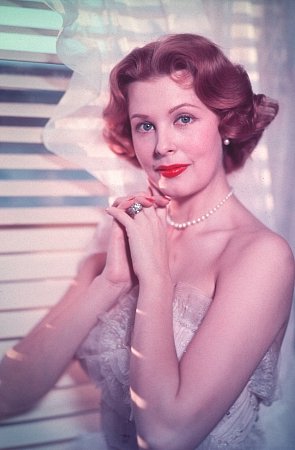
Saturday evening, after having dinner at Orphan Andy's restaurant, my father and I returned to the Castro. I met Arlene Dahl upstairs at the mezzanine. I was in line to sit down with her on a comfortable red couch and have a picture I printed out from the Internet autographed. Just as I handed her the picture, some crazy person lost control of their alcoholic drink and splattered poor Arlene Dahl and yours truly--and my picture--with liquor. Unfazed by the occurrence, Arlene Dahl happily signed the picture--which is the one at the top of this post.
Wicked as They Come (1956), starring Dahl as a social-climbing gold-digger, was screened. Sitting in what I consider the best row of the theatre, I was pleasantly surprised to learn that Ms. Dahl and five others--including her son, Loranzo Lamas, the offspring of her four-year marriage with actor and two-time costar, Fernando Lamas--sitting to my left, taking up the far-left three seats of my row and the one ahead of it. As the Castro program notes, "Arlene Dahl is a sizzling sensation as Kathleen Allen, a woman who learns early that sex is how she’ll get ahead in the world. Her high heels leave puncture wounds in a trail of saps stretching from America to England. British writer-director Ken Hughes adapts Bill Ballinger’s novel Portrait in Smoke, and the result lives up to its re-titling."
After this film was screened, a tribute reel of some of Ms. Dahl's career highlights, and moments of great passion--often violently kissing men or violently throwing objects at them--and Ms. Dahl took the stage with Mr. Muller. The interview was quite good, and moved along at a brisk pace. Ms. Dahl opened up about how she reached Hollywood, and it sounds like something out of a movie. She had joined a theatre's musical production in New York City and on opening night found herself visited backstage by Jack Warner himself, who asked her to come out to Hollywood for a screen testing. Ms. Dahl said that she believed this was all an enormous practical joke, committed by friends she knew who enjoyed pulling off stunts (though this would have been an awfully elaborate practical joke, she rightly figured). After her screen test, which she believed to be "terrible," she was signed to a seven-year contract with Warner Brothers. She recounted her stories, such as replacing Ann Sheridan in My Wild Irish Rose opposite Dennis Morgan, whose compassion and helpfulness were, she believed, indispensable in aiding her before the camera. As she and Mr. Muller downed glasses of champagne, Ms. Dahl discussed seeing Gary Cooper, her relationship with John F. Kennedy and many other interesting stories. She said she had seen Slightly Scarlet screened in France, where it is revered, and Mr. Muller gave the French credit for "getting" film noir.
After the interview, there was another break and I was amused by the terribly long line at the concession stand for popcorn and candy; as a "passport" holder, I moved my way up to the mezzenine again, and found an assortment of goodies to munch on. My favorite was easily the red potato wedges with the sour cream-horseradish sauce for dipping.
Slightly Scarlet (also 1956) followed. To be reviewed soon here at Coleman's Corner.
Sunday it was a return to the matinee, with the obscure "swamp noir," as it was billed, Cry of the Hunted (1953), shown. Formed by a strange screenplay from Jack Leonard, and helmed by Joseph H. Lewis, director of Gun Crazy and The Big Combo, this film, not surprisingly, also features some strong sexual undercurrents. I may return to this film as well, if I ever have an opportunity! It's a wild, fascinating picture, with a memorable dream sequence by the protagonist, played by William Conrad.
After an intermission, Billy Wilder's Ace in the Hole (1951) was screened. Possibly Wilder's most viciously cynical film, starring Kirk Douglas as a manipulative reporter who uses a cave-in to put him back to the top of his profession. As the Castro program boldly states, "On its release, critics called this the most bitter, cynical, mean-spirited movie ever made. It still might hold the honor."
Thus far, it has been a fine festival of film noir. Stay tuned here for more developments, reviews and whatever else strikes my fancy.
Saturday, January 24, 2009
Deadline--USA (1952)

(Deadline—USA was shown Friday night, January 23, at the San Francisco Castro Theatre as part of the film noir series, Noir City 7.)
“A free press is like a free life—it's always in danger.”
That pithy twelve-word, melodiously planate maxim is spoken by Humphrey Bogart's The Day newspaper editor Ed Hutcheson. Hutcheson is a weary and weathered man, played by the increasingly weary and weathered movie star, Bogart, to nearly utter perfection. Deadline—USA is not truly a film noir but rather a newspaper business expose, complete with an ostensibly prescient essaying of the tergiversation by a moneyed elite that desires not the civic responsibly role of the press, but rather to simply sell newspapers off, and kill them. Bogart's editor is a principled traditionalist who recoils at the ridiculous extravaganza of sensationalism that he sees steadily overtaking the role of the “news.” Despondent, and still pungently wounded by the divorce that shattered his marriage two years earlier, he has only the newspaper to live for, and now that is being taken away. New York City's The Day is being sold off by its owner, the offspring of its creator, a mercenary daughter, who, according to Hutcheson, loathed her father and, after his death, can only kick him in his grave by killing the thing for which he lived. Hutcheson sees how the rival newspaper is churning revenue—with equally prurient and puerile emphases.
As Hutcheson says at the newspaper's unofficial “wake” at an Irish pub to his largely sullen journalistic cohorts (busily drowning their pangs and fears with alcohol), “It's not enough any more to give 'em just the news. They want comics, contests, puzzles. They want to know how to bake a cake, win friends, and influence the future. Ergo, horoscopes, tips on the horses, interpretation of dreams so they can win on the numbers lottery. And, if they accidentally stumble on the first page... news!” Bogart delivers the monologue with as much conviction as writer-director Richard Brooks could ask for, and he continues delivering many astringent, lacerating lines of acerbic and ill-tempered hostility and anger. Brooks continually reinforces Hutcheson's bitterness with reasonable idealism, which he fears he may be forced to abrogate. The dialogue is composed of numerous speeches, most of which are delivered by Bogart, but Brooks' gift for making the verbiage realistically compelling and convincing vivifies the proceedings.
Where Brooks typically falls short is in the visual realm of filmmaking and though Deadline—USA is surely always serviceable, one of the reasons it is not truly a noir is its more static, unimaginative optics. Fortunately, strong cinematography is provided by Milton Krasner (All About Eve and a few noirs such as The Set-Up, No Way Out and Vicki), casting Bogart and the supporting players in an ever slightly monochromatic ablution of lightness and darkness.
Primarily, however, the film's greatest strengths are its actors' fine turns. Ed Begley plays Hutcheson's most stalwart ally, Frank Allen, and though the character is more of a concept, he fits in as such. Brooks' screenplay deals with axiological matters, and utilizes the characters as bulwarks. The crime story that impels the narrative's forward motion, which takes place throughout a three-day span, is interesting but functions most sharply as a fulcrum against which the ensemble's numerous characters rotate. Those characters, from Hutcheson, to Allen, to Hutcheson's ex-wife Nora Hutcheson (Kim Hunter), to Martin Gambel's sinister Sicilian gangster whose existence supplies Hutcheson with a possible out from his predicament named Thomas Rienzi to an elderly immigrant lady named Mrs. Schmidt (Kasia Orzazewski) are, springing from Brooks' screenplay, Platonic representatives of variegated philosophical and conceptual panoramas.
Taken as more of a meat-and-potatoes drama, Brooks' film is a solid pressure-cooker single-picture repertory, Deadline—USA is at its most proturberant, a vehicle for Bogart, whose performance—not unlike almost all of his latter turns—is both challengingly different from his past efforts but also comfortingly akin to them. Bogart was especially adept at playing parts intended to be viewed as inspirational figures of one variation or another, as his onscreen persona was a constant contrast to the simpler, more linear trajectories his characters often traversed. Bogart was seemingly an inherently cynical figure, his dour, scuffing and caustically erosive exterior camouflaging the beneficence that lurked beneath his abrasiveness. As the oft-crusading editor, Bogart tremendously softens the role's potential hoariness; the eyes are so casual, so indifferent, that they mask the vociferous portrait of righteousness. It is quite a spectacle to watch Bogart make his case, pleadingly advancing on a character late in the film in what seems like a futile endeavor to save the newspaper. His demeanor suggests apathy while the words he spouts directly from Brooks denote zealous passion.
The issue of martyrdom is presented by Brooks. The gangster Bogart's Hutcheson is investigating tells him in the back of a car, "Show me a martyr and I'll show you a dead man." Brooks repeatedly allows "The Battle Hymn of the Republic" (which in 1855 did not include a verse about John Brown or include the melody of "John Brown's Body," but was later changed to include him as the abolitionist "martyr"). Drawing from this perspective of martyrdom, influenced by the song and its reverential constitution, Brooks draws the comparison between Hutcheson and supposed martyrs like Brown, and suggests that through the press, "His truth keeps marching on!" (Changed again from the original, "His soul's marching on!") Brooks' handling of this is, and various symbolic gestures, are not subtle, but it lends some strong commentary on the film's plot and main character.
Viewing the fate of newspapers entire as an integral element of society and its healthful saliency, Brooks, born Ruben Sax, worked as a newspaperman in his early life for several newspapers. He worked primarily as a sports reporter. Drawing on some of his past experiences, and projecting the love he had for the profession, he crafts a solid screenplay that allows for substantial supporting turns to develop as greater components of the whole. Paul Stewart plays what would appear to be Brooks' onscreen alter-ego, fearless, quick-witted and sardonic sports reporter, who becomes pivotal in Hutcheson's investigation of the powerful, corrupting gangster.
Deadline—USA may not quality as a film noir in a fairly strict sense, and it is not without flaws, but it is agreeable entertainment with sterling performances. Bogart is the film's beating heart, and the role loses nothing from having him essentially reprising his own established archetype while modifying it once again. Brooks' screenplay is peppered with suspense, and made whole by the performers. One of the best attributes of the film is the authenticity that acts as a foundational support for the entire drama. The long, powerful scene in the pub early in the film demonstrably showcases the ensemble as a whole, and convinces the viewer that these characters have worked with one another for many a year. Finally, it is this small, intimate community of journalists that makes the viewer care. Brooks created a perfectly feasible small world of Platonic constructs, enriching abstractions and artfully making them into actively animated humans. Deadline—USA is a film that wins the viewer over with its sincerity, and its shining adoration of its struggling personages.
Friday, January 23, 2009
Kiss of Death (1947)

Henry Hathaway's 1947 film noir, Kiss of Death, is a durable melange of the director's semi-documentarian stylization, employed earlier in his previous crime drama, The House on 92nd Street (and to be used again in the following year's Call Northside 777), as well as his subtly dexterous command of mise-en-scene, the teaming of celebrated screenwriters Ben Hecht and Charles Lederer and two wildly different but similarly persuasive performances by Victore Mature and Richard Widmark. Hathaway's visual prowess has sadly gone unappreciated in many circles, but what he presents—even in his sparest, most astuciously straightforward films—is an organically holistic helming that conveys the emotive undercurrents of his characters and narratives. This vein pulsates through Kiss of Death with greater certitude than the more documentary-like The House on 92nd Street, but it never distracts from Hecht and Lederer's adaptation of Eleazar Lipsky's story. Rather, Hathaway's confident framings and prismatic shots, well-composed by cinematographer Norbert Brodine, gently enhance the other components of the film.
Kiss of Death follows Nick Bianco (Mature), a physically imposing, sloe-eyed, potential gentle giant who, through being brined in a culture of desperate criminality, finds himself being a purloining hood. Bianco's most vivid childhood memory is of his father being fatally shot in the back by a policeman on a street twenty years earlier than the events of the film. This, narrator Nettie (Coleen Gray) informs the viewer, is mirrored by the opening set-piece of a heist attempt by Bianco and a few partners in crime. Nettie, who helped take care of Bianco's two little girls, as he wasted away in prison, is used by the screenplay to afford greater sympathy to Bianco. “Christmas Eve: a happy time for some people. The lucky ones. Last minute shopping, presents for the kids, hurry home to light the tree and fill the stockings... for the lucky ones. Others aren't so lucky.” Bianco is couched in the film's complete sympathy through Nettie's narration.
What makes this tendentious storytelling succeed, however, is Mature's underrated performance. He studiously maintains a likability that does not condescend to demanding the audience's unwavering fondness, but between his charismatic turn and the screenplay's deftness of action, that fondness does develop. Rarely has the archetypal role of the gradually reforming criminal and ex-convict been so persuasive in attracting the viewer's lasting interest. Mature makes his character more innately comprehensible than the rather blunt narration. That his Bianco finds himself entrapped, shot on a street by a policeman as he attempts to escape the heist, not only greatly establishes the picture as a noir, but naturally makes the character all the more amenable as the protagonist. After he has been arrested, he finds himself placed between the proverbial rock and hard place, as an ambitious crime-fighting Assistant District Attorney, Louis D'Angelo (Brian Donlevy), asks him to “sing” about his partners. Though Bianco refuses early on, going to prison, he eventually turns. As he walks into the warden's office, Hathaway uses the arching windows behind him to describe the character's state of mind. As the conversation between prisoner and warden concludes, the latter says the prisoner could use “more exercise... We'll put him on the ball team,” he says to another prison official. He asks, “Do you play ball, Bianco?” “I'm going to,” Bianco replies, delivering the screenplay's double meaning.
Kiss of Death is known best for the feral supporting performance that consumes the very subterranean fabric of the film. As Tommy Udo, a sadistic arrested adolescent of an animalistic criminal, complete with a hyena laugh, Widmark burns the screen. The part is in actuality quite small, spanning no more than approximately fifteen or twenty minutes, but it is not difficult to understand that the actor's very first screen performance was so arresting as to achieve controversial acclaim and an Oscar nomination in the supporting actor category. Hathaway believed Widmark was wrong for the part, seeing only the man's clean-cut and fair projection of self-possession. Producer Darryl Zanuck passionately disagreed, responding to Widmark's borderline boyish iniquity as Udo, a violent, uncontrollable force of nature with an equally beguiling and mystifying high-pitched voice and equipped with an arsenal of callow inflections and unnerving shifts in temperament. Zanuck aided Widmark with a hairpiece that lowered the forehead—intended to make him appear slower, but even more importantly, scarier. Widmark's turn is rightly legendary for a variety of reasons, but one is that he represents a clear, distinguishing break from the very cloth from which Mature's Bianco comes. Criminals had, from the gangster cycle of the very early 1930s, and even earlier, usually been endowed with a background that informed the characters' actions. Sometimes these back-stories were so disarming in their detailed myth-making and romanticization, audiences were nothing less than enraptured by the hoodlums' electricity, played as they were by charismatic actors who excelled in enthralling and tempting the audience all at once. (Even James Cagney in The Public Enemy, who was depicted as a ne'er-do-well from childhood onward, was, even at his most wretched, able to attract audience identification.) Widmark as Udo, by contrast, is a self-preserving kobold, a nearly unthinking sensorially-responsive demon with the countenance of a skull with piercing, glowing eyes.
Kiss of Death's screenplay, shaped by the illustrious Hecht and Lederer, is more ambitious than it may initially appear, as it builds Mature's Bianco up as a man steadily reformed by his love for his two daughters, and the budding romantic relationship between he and Gray's Nettie. Yet what may distinguish Hecht and Lederer's screenplay is what is not shown. Bianco's wife is a major focal point in the plot, but she is never seen. The verbal suggestion of her existence more than suffices. Bianco finally deciding to “squeal,” to “sing,” is what drives the picture's narrative, and yet there is not one shot of the interior of a courtroom. Perhaps Hecht and Lederer wanted to exclusively avoid making their film into anything resembling a courtroom drama, a sub-genre of sorts that many films of the era eventually became, at one point or another, in their narratives. In any event, the film is more greatly streamlined by the lack of these unnecessary scenes and adornments; what matters more than simple story beats, as in great noir, is the prominently displayed psychology of the characters.
What most superbly enlivens Kiss of Death is Hathaway's deft treatment of mise-en-scene. In the opening heist attempt, Hathaway uses the doors of an elevator—including in an excellently composed mirror shot—as a framing device that demonstrates just how entrapped Bianco is. The taut tension of the scene is made patently tangible by Hathaway's assured direction, as Bianco eyes the numerical symbols in the elevator, which glow one at a time in slow intervals. Mature projects the discomfited emotions with his steady, nervous gaze in this sequence. At the eighteen minute mark, Hathaway frames Widmark's Udo and Mature's Bianco, sitting in their jail cell together, Udo rambling about the reason he's locked up (“Big man like me getting picked up just for shoving a guy's ears off his head. Traffic ticket stuff.”), with the gray bars utilized as more framing devices. At the thirty-six minute mark Bianco is reunited with his two daughters, who emerge through the entrancingly framed door at a Catholic children's center. The scene is punctuated by the religious iconography that is found nearby as Bianco embraces his children. At the thirty-nine minute mark, Hathaway and cinematographer Brodine shoot Bianco's conversation with a lawyer with the background of crisscross-patterned shadows created by bars. A moment later, Widmark's Udo is captured through the frame of a door—he has just entered a place that used to be safe, now it is threatened by his very diabolical presence. Minutes later, as Bianco is conversing on a telephone with someone, Nettie looks down at him from above, which Hathaway and Brodine capture in an atypical Dutch angle. The shot describes their relationship, as Nettie looks down upon Bianco, who has so frequently found himself in the mire of illegality; he, meanwhile, looks above, towards her, seeing her as the true panacea and person greater than he. As Bianco finally leaves her to attempt to set something right, Hathaway gorgeously shoots him through the glass pane of the front door. At approximately the seventy-minute mark, as Bianco stews in the toxic juices of his own past life catching up with him, Nettie is caught through the frame of an opened door, ascending upwards, which is a visual contrast with the scene in which, the characters depressed, descended down the stairs together. The final exquisite framing device utilized by Hathaway is aptly reduced to a mere blade of light, a crack that separates two curtains in an Italian restaurant, through which one of Widmark's fiery eyes appears, malice beaming from its mesmerizing intensity.
Kiss of Death is a fine film noir and an exemplary case of a director telling a fairly simple story through the fantastic visualizations at his disposal. Hathaway's impressive visual schema serves as a fine complementary habitat for his actors, from whom he extracts highly engrossing performances. Kiss of Death, known as it is for Widmark's untamed performance, serves as a pointing to the future, both near—Cagney in White Heat—and far—so many psychopathic screen performances since the 1940s. A film with simmering angst and despair at its center, Kiss of Death leaves a lasting impression of downcast sensibility, and rightly pained emotions. What possibly most lingers, however, is the melancholic but affectionate depiction of a noir archetype, the man played by Mature, who, in this instance, must paradoxically attempt to capitalize on his past to try to escape it.
Tuesday, January 20, 2009
Revolutionary Road (2008)

Seemingly no matter which route the viewer takes to find the new film Revolutionary Road, the result is not terribly different: disillusion, disappointment, discomfort. Screenwriter Justin Haythe and director Sam Mendes have built a turgid trip into solipsism while somehow losing almost all of the contextual properties belonging to Richard Yates' novel, which has won regnant acclaim since its publication in 1961. The film bizarrely takes the book's author literally when it should not, and discards his intentions when it should follow them; trusts him completely in his bromidic public statements denouncing the conformity of the 1950s, while strenuously avoiding the engrossingly astute psychology that made the melodramatic pyrotechnics of the decaying, gangrenous marriage whose story it tells somehow more honest than hackneyed. As an adaptation, the film is grievously flawed. Predictably, where the film is at its most convincing, it has simply taken whole pages' worth of acrimonious dialogue practically straight from the novel and made its two stars, Leonardo DiCaprio and Kate Winslet, play scenes from the novel. Where it fails is in supplying the cognitive supporting buttresses that illuminate the innermost inspirations of Frank and April Wheeler (DiCaprio and Winslet).
The triumphs of the film are primarily the superbly convincing production design by Kristi Zea and the fulgurous cinematography by Roger Deakins. The domestic interiors are all blanched to the extreme, with white prevailing. Deakins' ethereally fumid compositions take particular advantage of diffuse lighting, both inside and outside (a shot of a procession of businessmen moving like a herd of cattle is wonderful), and lend Mendes' joke of a visual scheme and palette some credibility. Attempting to evoke the achromatic environs of an insane asylum, Mendes bathes his characters in the background of whiteness. This is surely intended to pictorially describe the “phoniness” and sterile plasticity that became so resented in the 1950s. Perhaps Mendes was also taking his cues from the novel's John Givings (Michael Shannon), a former resident of an asylum, regularly electro-shocked because he dares to be truthful. The character is an embarrassingly hoary construct, so transparent in the almost hilarious pretense—possibly only Mendes would have the gall to keep him in, so perhaps he should be thanked since Shannon's performance is so audaciously redoubtable he manages to breathe some life and amusement into the otherwise almost wholly bleak enterprise. (Shannon is so good, he should have been given an opportunity to play Frank.) Thomas Newman liberally borrows from his own score for Road to Perdition. Winslet, meanwhile, acquits herself well. (If she wins the Oscar this year, however, it should be hoped by all that it is for her exquisite performance in The Reader.) Of DiCaprio, however, perhaps some critics should behave like John Givings and simply state the truth: he is miscast in the part, for a variety of reasons, not the least of which being that he simply lacks the miraculous internalizing depth that only an actor of a particular unshakably nuanced ingenuousness could bring to a role as poorly adapted as Frank is here. Richard Burton in Who's Afraid of Virginia Woolf?, or Albert Finney in Alpha Beta, or Erland Josephson in Scenes From a Marriage—all sensationally sensitive, simultaneously extroverted and introverted men who could afford the complex psychological penumbra to Frank that he needs due to Haythe and Mendes' blundering in missing Yates' more pertinent quality of characterization. Frank is, in a most warped way, perhaps, stuck in the Lacanian Symbolic order, and views his father as the main entrapping force of his life, which he hopes to replace with his own offspring, suffering from a strain of the Sophoclean Oedipus complex. One of the queasiest ironies is that DiCaprio would be far better cast if the film chronicled all the emotional manipulations, and hubristic ploys—put simply, if he were playing the character as fully explored as Yates' Frank Wheeler, DiCaprio would probably succeed wildly in the part. As he is constructed by Haythe's screenplay and Mendes' direction, however, he nearly comes across as simply a self-pitying leaf being blown in the wind—a coward, who should stick to his principles rather than a charlatan and nebulously thuggish possessor viewing his offspring as advantageous fulcrums, beings who conveniently present him with the fait accompli he most desires.
Woody Allen's use of Brechtian narration in his newest film indicated the kind of lack of confidence of an excessively self-questioning painter, who goes ahead and mars his creation by not knowing when enough is enough. The Curious Case of Benjamin Button used voice-over narration as a crutch, informing the audience what the protagonist was supposed to be feeling at any given time. If there is a film from 2008 that could have benefited enormously from good voice-over narration, it would have to be Revolutionary Road. Yates' novel is so internalized, it may be as some suggest, “unfilmable.” Though that has been said about other books, which proved to be most successfully “filmable.” While Yates allowed for the absurdity of his contrivances to remain for what they often were—humorous—Haythe and Mendes have almost no patience nor inclination for anything but lugubriousness, perhaps because in the latter's case he had already tried to blend comedy and melodrama. Here Mendes attempts to create an oozy, glacial ambiance out of the Wheelers' colorless milieu, but the affectation only makes an unpleasant story more perpetually unpleasant.
Yates used symbolism to suggest truth of his characters, studding the narrative with acute imagery, such as—April resting against furniture, against the refrigerator, and against anything else, especially when she is arguing with Frank; exceedingly friendly neighbor Shep Campbell behaving like a lovingly eager dog whenever April is around, devotedly following her; Frank having great difficulty in laying a path across the front garden; April is the woman who wants to be an actress, and cannot, while Frank's pathological guise is indicative of a natural performer; stingingly ironically, Frank is not frank at all, but rather indirect and duplicitous; Helen Givings is a giver of home; John Givings a giver of scathing veracity; and, yes, the Wheelers do spin out of control.
Haythe and Mendes seem unsure of whether or not they should simply have their stars go pre-Method or play around with stylizing the dialogue and acting. If Mendes was attempting to evoke Douglas Sirk, like Todd Haynes with Far From Heaven, he has failed miserably; Sirk's most preposterous melodramas could be relied on to deliver immense juiciness. The actors and actresses in Sirk films were made into emblematic touchstones of larger types, borderline Platonic creations, which made the immoderate climate of their conflicts make complete sense: how can restraint even be an option when greed meets loyalty one-on-one, for but one example? Sirk nevertheless fiercely held on to a sincerity and compassion for his characters, both of which are lacking here. In Revolutionary Road, even Winslet is compromised by stylization, which, for Mendes is doubtless intended to underline the rigidity, conformity and stultification of the era he believes he is depicting. That she remains watchable, whether she is confronting her husband at the beach or playing a Stepford wife one morning, speaks to her status as one of the greats on the planet. DiCaprio is a powerhouse when he's playing to his natural strengths—his suaveness, his cunning emotional trickery—but he has, for one reason or another, chosen to take parts that go directly against his gifts. Which is not to say that he is abysmal in the part, just that he is ill-suited, and, more importantly, unable to make up for the ruinous screenplay's plentiful weaknesses.
Returning to the theme of a misbegotten adaptation, it should be remembered when analyzing Yates' novel the old saw: trust the art, not the artist. Yates has publicly stated that his novel was about the crushing conformity of the 1950s that he saw, but if it could truly be boiled down to its barest essentials, it is about the delusions that cause self-destruction. “The grass is always greener,” and “No matter where you go, there you are,” have both never rung truer than when Yates' Revolutionary Road is consumed by a reader. Haythe and Mendes make their film a boorish condemnation of the 1950s, following Yates' unfortunately simplistic political paradigm rather than the saturating percipiency of personality and psyche that makes his novel a worthwhile read. The book (the first third of which or so is almost entirely gutted by Haythe's inadequate screenplay) follows Frank Wheeler, a young man who believes himself to be specially clever, and who convinces a young woman, named April, of this. Frank and his girlfriend find themselves at a crossroads when she becomes pregnant—and he utilizes this as an opportunity to wrap himself up in the purported misery of “conformity,” of “those people,” whose spiritually wan lives have become sapped of anything meaningful, all the while despising them. Stemming from his own deep-seated fear of becoming just like his father, Frank finds himself slowly coming to the realization that he has, indeed, become his father, which allows him to stew about it, and pose as a potentially remarkably clever and exceptional man, if only he did not have the child to support. Haythe and Mendes miss the argument between Frank and April about their first child, and the impulse of April's, which is to abort it, and the manipulative heartlessness of Frank, who sees in the child little more than an avenue on which to escape not “conformity” but the jolting epiphany—which he doubtless fears April will have—that he is not so clever, special or exceptional at all. April's constitution has been corrupted by her childhood, which influences her at all turns, including her inclination to terminate her children, first once and then finally again with the third child. Frank again uses her third pregnancy as an excuse for himself to stay home and not leave for Paris as they were planning—he halfheartedly dragging his feet, rationalizing his future failure as anything special as he “finds himself” as she supports him—further revealing to April just how utterly duped she was. When she says to him that he is the most beautiful thing in the world—“A man”—it is as much a verbally expressed hope that he will finally become the man he appeared, like a mirage in the desert, to be.
Lost are almost all of the intensely unpleasant personal machinations employed by Frank to remain what he perhaps subconsciously wants to be: a “mediocrity” who could always blame someone—his children will suffice—for his not becoming whatever it is he was supposed to become before they inconveniently entered his world. Yes, John Givings is still used as the device he was intended to be, sounding off on Frank's unctuous wiliness, but as amusing as the scenes in which he appears are thanks to Shannon, they, like the long, venomously argumentative battles between the Wheelers and the chilly denouement are but the mountains of the novel, which lose their greater tenor due to the film's sidestepping of the many crucial crevasses. Even scenes that work fairly well on their own—because they stick so well to Yates' novel—like the Wheelers' early roadside verbal fight, culminating in Frank bashing his Buick with his fist, or Frank attempting to use the revelation of his affair to an attractive secretary with whom he works as a way to demand jealousy and love from his wife, feel like a theatrical tableau removed from a greater, far more gratifying work.
Strange, then, that Haythe and Mendes so heedlessly take April as the central character; if she were shown to be as much the victim as the literary April, this would make more sense, but as portrayed in the film, her neurosis seems almost apart from Frank's, as though he played no significant part in shaping her adult deportment. Most viewers of Revolutionary Road will see April as a crazed woman, a preposterous figuration not distantly related from Bening's harridan. Even when it is clear April is rebelling from Frank, indulging in an affair of her own, it seems more dutifully presented than genuinely probed. Her horrified surprise when she learns that her husband is actually climbing up the ladder at his job, listening to his meek, hypocritical response to his own words about Paris (“People are alive there, not like here...”), “Paris isn't the only place where people can live,” is possibly the film's most honest scene as it relates to Yates' book. A shame, then, that for Mendes the villain is “conformity,” vacuous success and (here it finally is) suburbia.
So, discarding Yates' novel, and delving into Mendes' focus on suburbia, the question arises: has Mendes ironically bought into the same nonsensical solipsism that consumes the despicable Frank, that the true enemy to be vigilantly feared is the supposedly unbearable conformity of the suburbs? Is Mendes' Revolutionary Road as much an act of cowardly obfuscation as Frank's self-installed prison that he secretly wishes to never escape? Possibly. At least Frank is not interpreted as some sort of heroic figure like Kevin Spacey's Lester Burnham—so Mendes drizzles and then finally pours as much of the finite empathy he has for any of his characters on to April, perhaps seeing this as his chance to redeem himself for making Annette Bening an intolerable cartoon of a femme realtor (here an intolerable cartoon of a femme realtor shows up periodically in Kathy Bates' Helen Givings), and allowing for the character to experience a kind of red-colored epiphany not wholly dissimilar from Lester's visions of red roses. Taken at face value, this is a failure because Mendes and Haythe have undermined their own project in making April as completely understandable as she ought to be, no matter what emotions her desires provoked, since the very central construct of the story—Frank and April's relationship—has been so woefully translated from page to screen. The proscenium is rendered imbalanced, as Frank is made out to be simply weak and April, in a way, weaker, creating a gaping vacuum at the film's fitting centripetal emptiness (the latter word is to this picture what “fear” was to Batman Begins) center, siphoning the life out of what should have been a challenging drama.
The 1950s, as an “era,” was a massive panoply of contradictions. It was the decade that has now been unceremoniously dismissed, though it paved the way for the future so many who decry it purport to cherish. The 1950s were populated by Muddy Waters and Chuck Berry, Bo Diddley, James Brown, Elvis Presley and others. Subversive westerns were already commenting on past Hollywood oaters and viewing white/American Indian relations in more complex lights; film noirs, while returning to many of the motifs of German Expressionism, targeted institutionalized corruption with greater, more uncompromising tenacity; it was the decade of Otto Preminger's run-ins with the censors; challenging cinema, whether from the boisterously cynical Billy Wilder in Ace in the Hole and The Seven-Year Itch, or Vincente Minnelli's Some Came Running; the aforementioned melodramas of Sirk, The Marrying Kind, and 1960, the year before Yates' novel's publication, dealt with marital disharmony in the Kirk Douglas-Kim Novak teamer of Strangers When We Meet; mental illnesses were essayed in Home Before Dark and The Three Faces of Eve; the rise of Sidney Poitier; sci-fi was decrying nuclear annihilation through radioactive monster movies; Marlon Brando was a Wild One and James Dean was a Rebel. Jack Kerouac and John Updike (whose Couples is not dissimilar from Yates' work) belonged in this decade; literary movements as outre as “lesbian pulp fiction” blossomed.
Mendes has in a major way taken the viewpoint of Frank, in his writhing under what he seems to view as an indictment first and foremost of American conformity in the 1950s. Readers of Yates' novel should be able to see the grave error in describing the work as an uncomplicated slamming of an abstraction; if anything, the image that emerges from the book is that the obfuscating, manipulative Frank and the pathetic, unfit April are a couple of craven, conceited and saturnine boors who may deserve, at best, pity but not purloined, illegitimate identification. Frank and April are like paranoiacs who believe “those people” are soulless zombies. Gradually their fear becomes consuming, to the point where they not only have become what they believe they hate, but something far worse. American Beauty could at least be laughed off, for the silliness with which it so often waltzed, as though winking at the audience, knowing it was a socio-political platitude, a capricious fun-house mirror aimed at the culture it lampooned. Mendes' Revolutionary Road peddles pain, and damns an entire society for not being as enlightened as it should have been. Deakins' fine cinematography and Zea's cogently palpable production design manage to make a point independent from Mendes' latest assault: if the Wheelers represent any form of enlightenment, then enlightenment leads straight to the madhouse.
Subscribe to:
Posts (Atom)


